
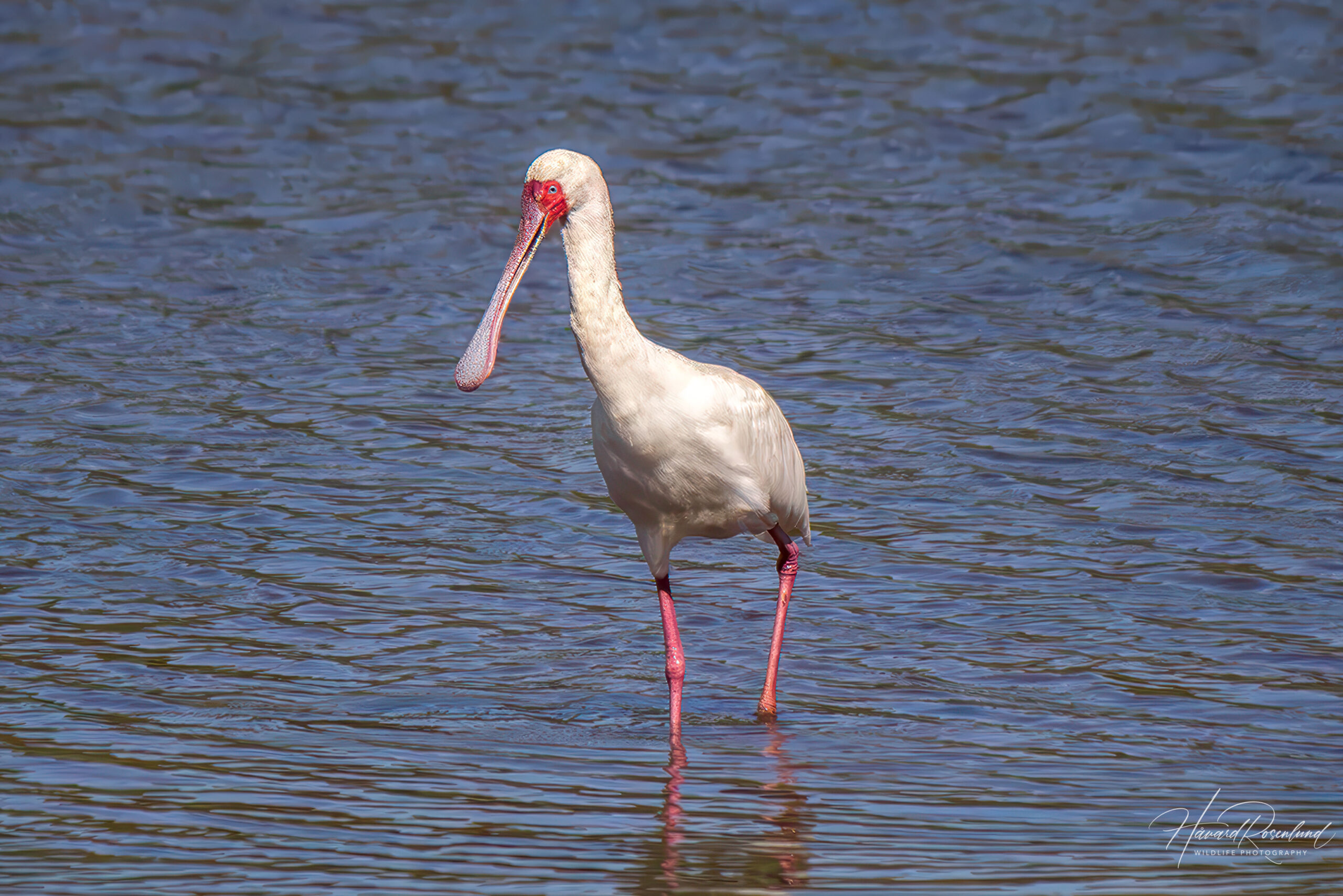
African Spoonbill
Platalea alba
At a glance
Habitat
- Shallow freshwater wetlands, lakes, marshes, pans, floodplains and occasionally coastal lagoons
Diet
- Small fish, amphibians and aquatic invertebrates, especially crustaceans and insects
Activity
- Mostly diurnal
Size
- Length: About 90 cm Weight: About 1.5–1.8 kg
Range
- Widespread across sub-Saharan Africa and Madagascar, but scarce in the driest regions
Description
The African spoonbill (Platalea alba) is a large white wetland bird, about 90 cm tall and weighing roughly 1.5–1.8 kg. Adults have long red legs, extensive bare red facial skin and a long greyish to reddish bill that broadens into a flat spoon-shaped tip. The plumage becomes especially clean white and the bare parts more vivid during breeding. Males and females look similar, although males are generally larger and more robust.
The spoonbills are closely related to the ibises and belong to the family Threskiornithidae. Compared with the Eurasian spoonbill (Platalea leucorodia), adults lack the long rear head crest and show much more extensive red bare skin on the face.
Habitat
African spoonbills use shallow freshwater wetlands such as lakes, marshes, pans, floodplains and seasonally inundated grassland, and they also occur locally in estuaries and coastal lagoons. Shallow margins are especially important because the feeding technique works best where the bird can walk while keeping the bill close to the bottom.
Local numbers can change as water levels rise and fall. Birds readily move between wetlands when feeding conditions change and may appear quickly at newly flooded or shrinking areas where aquatic prey becomes concentrated.
Diet
The diet consists mainly of small aquatic animals, including fish, frogs, crustaceans, molluscs and aquatic insects. The balance varies with locality, water depth and season.
Food brought to the young can differ from what adults commonly take for themselves. A breeding study in South Africa found frogs and aquatic invertebrates to be prominent among prey delivered to chicks, showing how parents use whatever suitably sized food is abundant around the colony.
Foraging
The spoon-shaped bill is a specialised sensory feeding tool rather than simply a scoop. While walking through shallow water, an African spoonbill holds the bill partly open and sweeps it rhythmically from side to side. Sensitive structures near the tip detect contact with hidden prey, allowing effective feeding even in turbid water where vision is limited.
The visual field is also adapted to this technique. The broad bill tip creates a blind area immediately below it, while binocular vision extends around the bill and between the open mandibles. Touch and vision therefore work together as the bird detects, seizes and manipulates prey during rapid sweeping movements.
Breeding
African spoonbills usually breed colonially, often alongside ibises, herons and other waterbirds. Nests may be built in trees, reedbeds or other sites over or close to water. Courtship is elaborate and includes at least 14 described ritualised displays used during pair formation and breeding.
The nest is a platform of sticks, reeds and other plant material. The male commonly brings nesting material while the female arranges much of it. Clutches usually contain two to four eggs; a study in the Free State, South Africa, found a mean of 2.6 eggs. Both parents incubate for about 25–29 days and later feed and guard the young.
The chicks remain dependent on their parents after hatching but become increasingly mobile. They can begin moving around the vicinity of the nest from about three weeks of age and usually leave the colony at around five weeks.
Status
The African spoonbill is classified as least concern on the IUCN Red List and remains widespread across sub-Saharan Africa and Madagascar.
Wetland degradation, altered flooding, declining water quality and disturbance at breeding colonies can reduce local feeding and nesting opportunities, but the species is not currently threatened across its range.
Image gallery
Loading map and observations…
Have you seen this species?
Independent species archive
Did you find this species page useful?
Wildlife Vagabond is independently built and maintained. Voluntary support helps cover hosting, maps, data storage and continued improvements to the species archive.
Support Wildlife VagabondSpecies content will remain freely available.
References
Information about the species’ global distribution and status is based primarily on global Red List data. See the references below for details.
- Avibase. (n.d.). AviList 2025 / Avibase – African Spoonbill (Platalea alba). https://avibase.bsc-eoc.org/species.jsp?avibaseid=F86BB1D3818BDB03
- Biodiversity Explorer. (n.d.). African Spoonbill. Iziko Museums of South Africa. https://www.biodiversityexplorer.info/birds/threskiornithidae/platalea_alba.htm
- BirdLife International. (n.d.). African Spoonbill species factsheet. https://datazone.birdlife.org/species/factsheet/african-spoonbill-platalea-alba
- International Union for Conservation of Nature. (n.d.). African Spoonbill. The IUCN Red List of Threatened Species. https://www.iucnredlist.org/species/22697564/93620935
- Kahl, M. P. (1983). Breeding displays of the African Spoonbill Platalea alba. Ibis, 125(3), 324-338. https://doi.org/10.1111/j.1474-919X.1983.tb03118.x
- Kopij, G. (1997). Breeding ecology of the African Spoonbill Platalea alba in the Free State, South Africa. Ostrich, 68(2-4), 77-79. https://doi.org/10.1080/00306525.1997.9639716
- Martin, G. R., & Portugal, S. J. (2011). Differences in foraging ecology determine variation in visual fields in ibises and spoonbills (Threskiornithidae). Ibis, 153(4), 662-671. https://doi.org/10.1111/j.1474-919X.2011.01151.x