
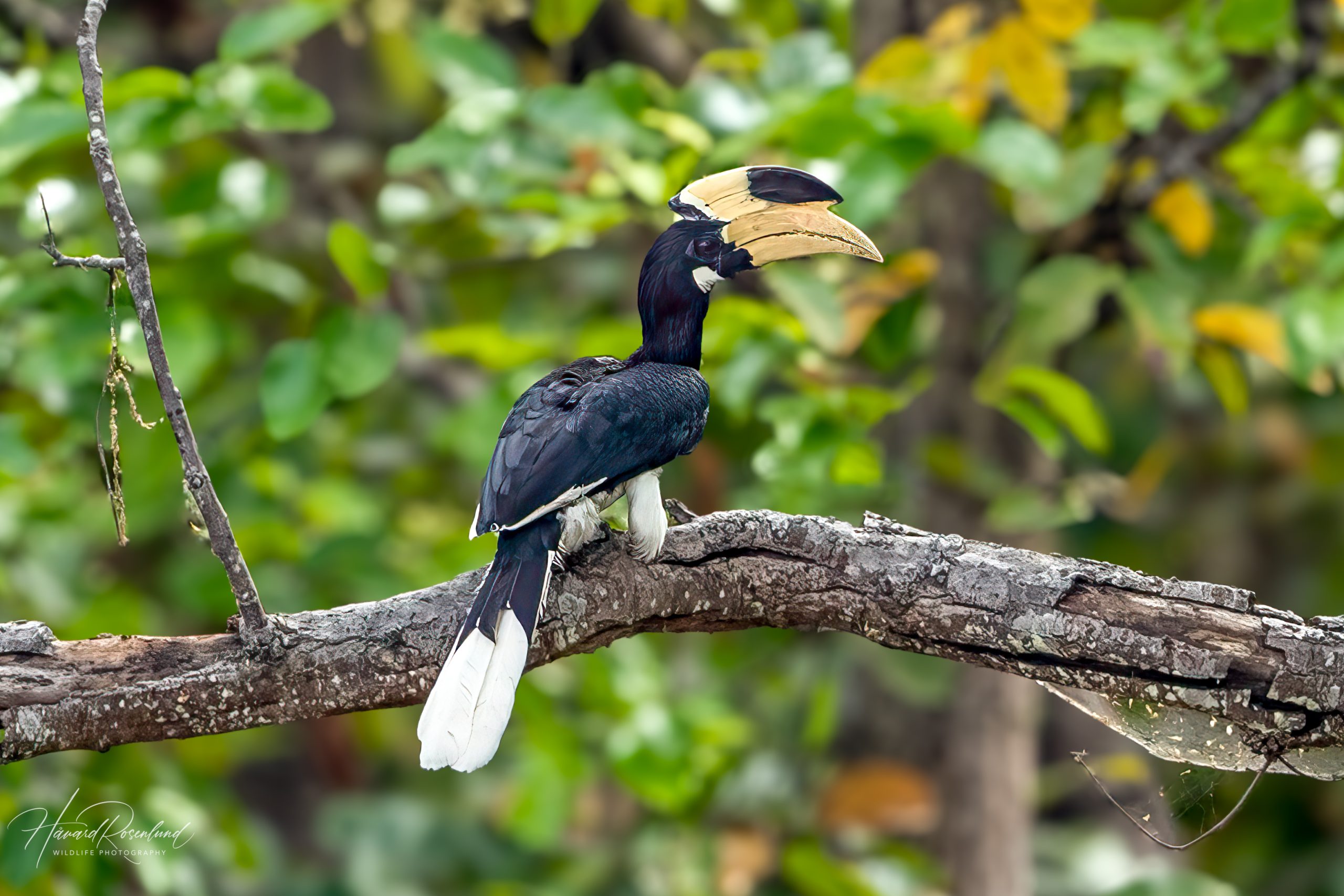
Malabar Pied Hornbill
Anthracoceros coronatus
At a glance
Habitat
- Lowland deciduous and moist forest, riverine woodland and plantations with large fruiting and cavity-bearing trees
Diet
- Mostly fruit, especially figs; also insects, lizards and other small animal prey
Activity
- Diurnal
Size
- Length: females 63–68 cm; males 78–82 cm Weight: females about 861 g; males about 1.02 kg
Range
- India and Sri Lanka, with fragmented populations in the Western and Eastern Ghats and central India
Description
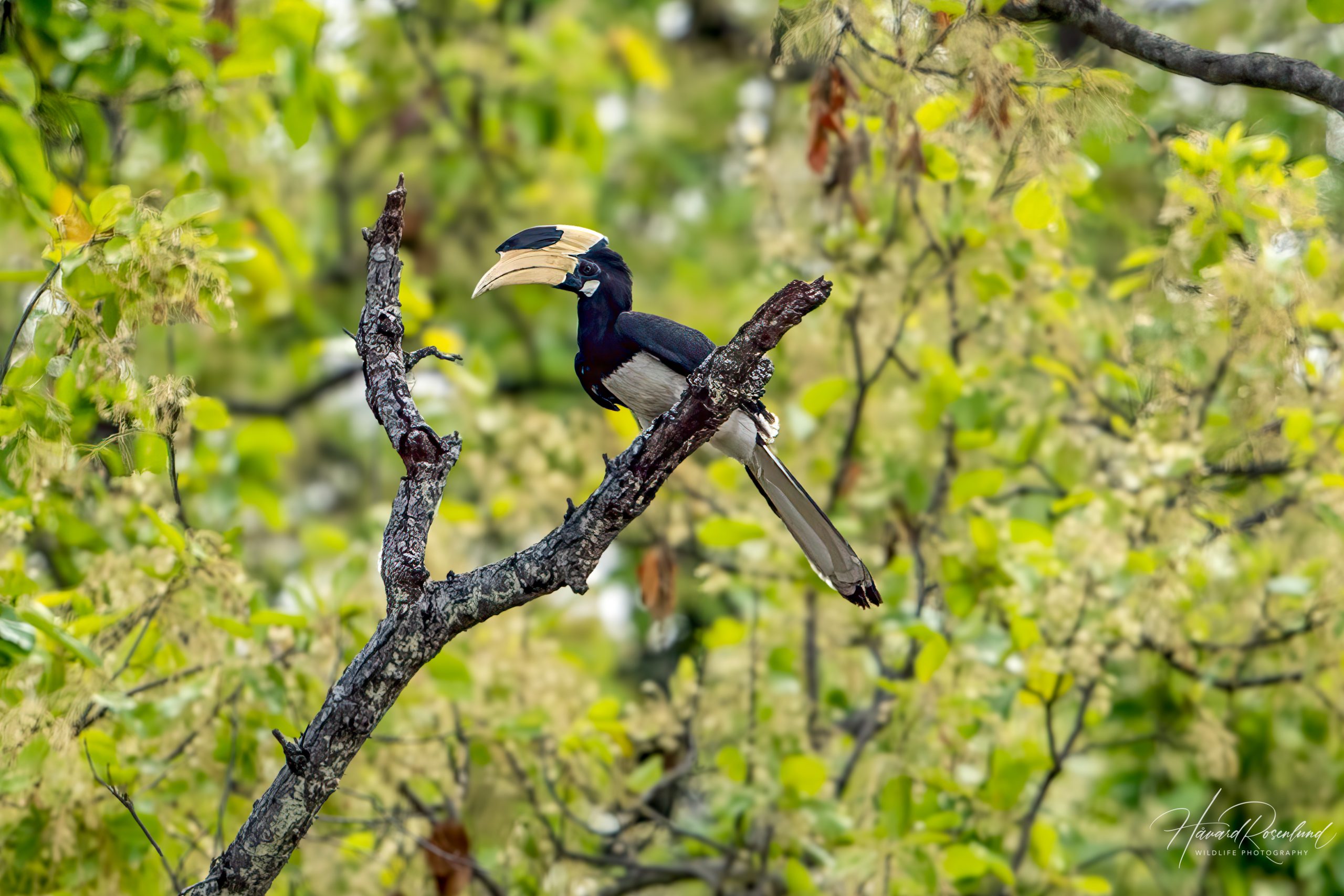
The Malabar pied hornbill (Anthracoceros coronatus) is a large black-and-white hornbill found in India and Sri Lanka. Females are about 63–68 cm long and weigh around 861 g, while males are substantially larger at roughly 78–82 cm and 1.02 kg. The enormous yellow bill carries a prominent casque on top, while the body is mostly black with a white belly and broad white areas in the wings and tail.
Males and females are similar overall, but males usually have a larger bill and casque. The species resembles the Oriental pied hornbill (Anthracoceros albirostris) but is larger and more heavily built, with a larger casque and more extensive dark markings on it. The broad wings produce loud, rhythmic wingbeats that can often be heard before the bird comes into view.
Habitat
Malabar pied hornbills occur in moist and dry deciduous forest, riverine woodland, forest edges and some plantations, especially in lowland landscapes that retain large trees. They can visit isolated fruiting trees outside continuous forest, but still depend on mature trees for feeding, roosting and nesting.
Lowland riverine forest can be especially important because large fig trees and other fruiting species provide food through periods when fewer trees are fruiting. Old trees with large cavities are also necessary for breeding, so habitat can lose much of its value to the species long before the forest canopy itself disappears.
Diet
Fruit dominates the diet, with figs playing an unusually important role. A study published in 2004, based on fieldwork in the Athikadavu Valley of the Western Ghats from December 2000 to December 2001, recorded 13 fruit species in the diet. During the non-breeding period, about 60% of the food eaten was figs, and the three most strongly preferred foods were all fig species.
The dependence became even clearer during breeding. Two nests were monitored for 150 hours, and 98% of food deliveries were fruit; figs made up 75.6% of all deliveries. Figs therefore provide an important food supply both during breeding and during lean periods when fewer other fruits are available.
Hornbills also take insects, lizards and other small animal prey, and may descend from the canopy to pick food from the ground. By swallowing fruit and later passing the seeds elsewhere, they also help disperse the seeds of many forest trees.
Behaviour
Malabar pied hornbills are usually seen in pairs or small family groups. They move between fruiting trees with strong, direct flight and advertise their presence with loud calls. Outside breeding they may gather in larger groups where fruit is abundant or at communal evening roosts; gatherings of several dozen birds have been recorded.
The birds can make local movements as different trees come into fruit. This means that a hornbill may regularly move between forest patches, river valleys and isolated fruit trees rather than remaining inside one small territory throughout the year.
Breeding
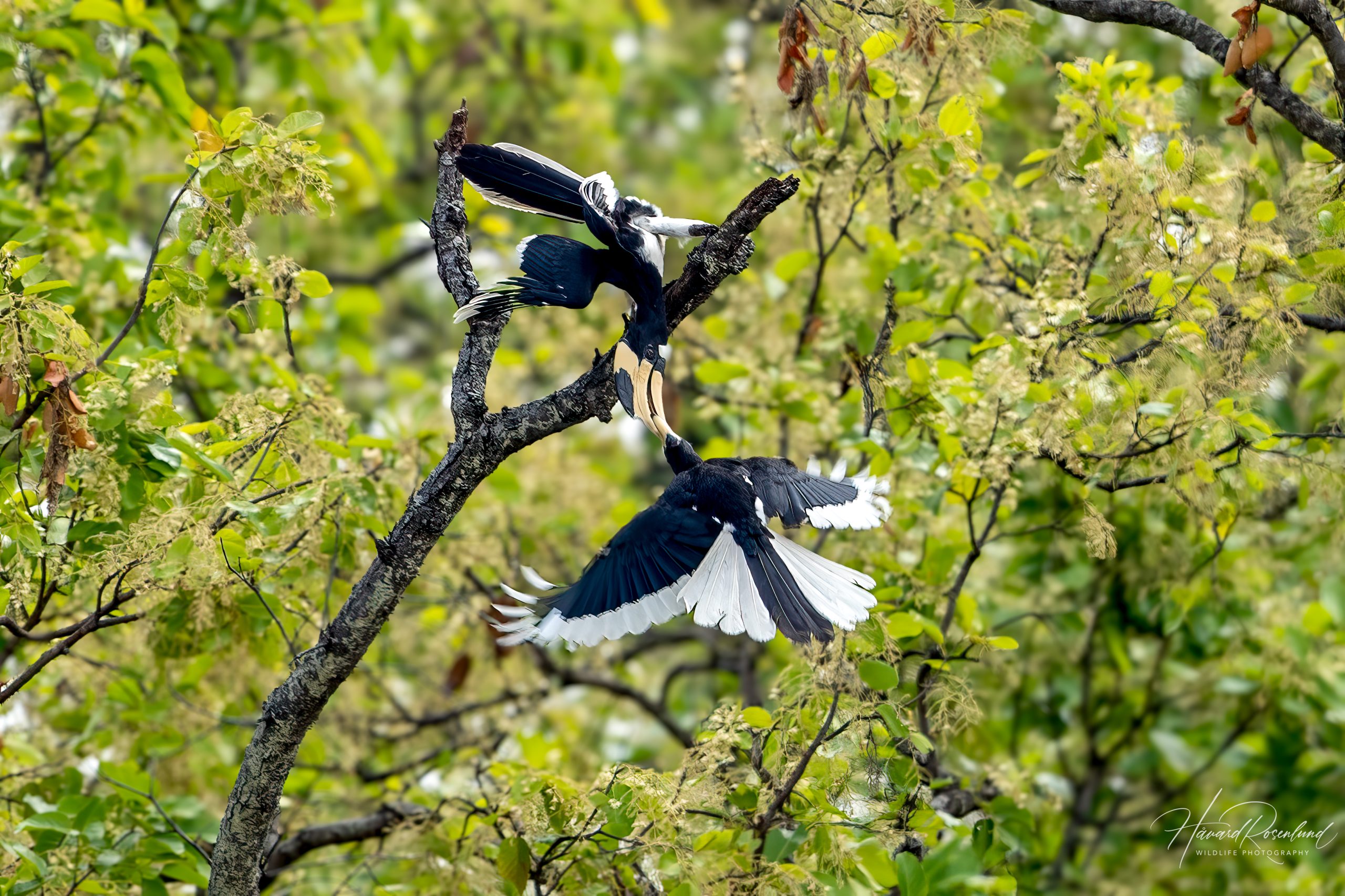
Like other hornbills, the Malabar pied hornbill has an unusual nesting system. The pair uses a natural cavity in a large tree. The female enters the cavity and seals most of the entrance with mud, droppings and fruit remains, leaving only a narrow slit. The male then passes food through this opening while the female incubates and cares for the chicks inside.
A clutch usually contains two to four eggs, and the species normally raises only one brood per breeding season. As the chicks grow, the female breaks out of the cavity. The entrance is sealed again while the chicks remain inside, after which both parents bring food until the young are ready to leave the nest.
Suitable old trees are therefore a critical resource. A study published in 2019, based on fieldwork in Pillur Valley in the Western Ghats in 2017–2018, found nests in five tree species, four of them hardwoods. Madhuca longifolia was used particularly often, and 55% of cavities were on large primary branches. The results show that important nesting habitat can disappear long before all forest cover is lost if large cavity-bearing trees are removed.
Status
The Malabar pied hornbill is classified as near threatened on the IUCN Red List. Its distribution is fragmented, with important populations in the Western Ghats, parts of central and eastern India and Sri Lanka.
Indian monitoring data updated in 2025 do not yet show a clear national population trend, either over the long term or in recent years.
Threats
Loss and degradation of lowland forest are the main long-term threats. Removing large cavity-bearing trees can eliminate nesting sites even where substantial tree cover remains, while the loss of large figs and other fruiting trees reduces food across the year. Fragmentation can also force birds to cross increasingly open landscapes as they move between feeding and nesting areas.
Hunting adds further pressure locally. Because the species reproduces slowly and depends on a limited supply of suitable large nest trees, repeated losses of adults or breeding sites can be difficult for local populations to replace.
Conservation
Malabar pied hornbills move regularly between forest patches and isolated fruiting trees, making connections across the landscape important to local populations. Known nest trees are especially valuable because suitable cavities can be scarce and may be reused over several years. Hunting pressure and the loss of trees between forest areas can therefore affect populations even where the breeding habitat itself remains intact.
Image gallery
Loading map and observations…
Have you seen this species?
Independent species archive
Did you find this species page useful?
Wildlife Vagabond is independently built and maintained. Voluntary support helps cover hosting, maps, data storage and continued improvements to the species archive.
Support Wildlife VagabondSpecies content will remain freely available.
References
Information about the species’ global distribution and status is based primarily on global Red List data. See the references below for details.
- Balasubramanian, P., Saravanan, R., & Maheswaran, B. (2004). Fruit preferences of Malabar Pied Hornbill Anthracoceros coronatus in Western Ghats, India. Bird Conservation International, 14(S1), S69-S79. https://doi.org/10.1017/S0959270905000249
- BirdLife International. (n.d.). Malabar Pied Hornbill species factsheet. https://datazone.birdlife.org/species/factsheet/malabar-pied-hornbill-anthracoceros-coronatus
- Girikaran, P., Samson, A., Ramakrishnan, B., & Ramasubramanian, S. (2019). Nesting tree preference of Malabar Pied Hornbill (Anthracoceros coronatus) in Pillur Valley, Western Ghats, Southern India. Nature Conservation Research, 4(3), 45–53. https://doi.org/10.24189/ncr.2019.040
- International Union for Conservation of Nature. (n.d.). Malabar Pied Hornbill. The IUCN Red List of Threatened Species. https://www.iucnredlist.org/species/22682433/92945240
- IUCN SSC Hornbill Specialist Group. (n.d.). IUCN Hornbill Specialist Group – Malabar Pied Hornbill. https://iucnhornbills.org/malabar-pied-hornbill-2/
- Raman, T. R. S., Mudappa, D., & Boesman, P. F. D. (2025). Malabar Pied-Hornbill (Anthracoceros coronatus). In Birds of the World. Cornell Lab of Ornithology. https://doi.org/10.2173/bow.maphor1.02
- State of India's Birds. (2025). State of India’s Birds 2025 – Malabar Pied Hornbill. https://stateofindiasbirds.in/species/wdl-maphor1/