
Giant Kingfisher
Megaceryle maxima
At a glance
Habitat
- Rivers, streams, lakes, dams, estuaries, lagoons and sheltered coasts with clear water and suitable perches
Diet
- Mainly freshwater crabs and fish; also frogs and other aquatic prey
Activity
- Diurnal; hunts from waterside perches and sometimes by hovering before a plunge-dive
Size
- Length: 42–46 cm Weight: about 255–425 g
Range
- Widespread through much of sub-Saharan Africa, absent from the driest regions
Description
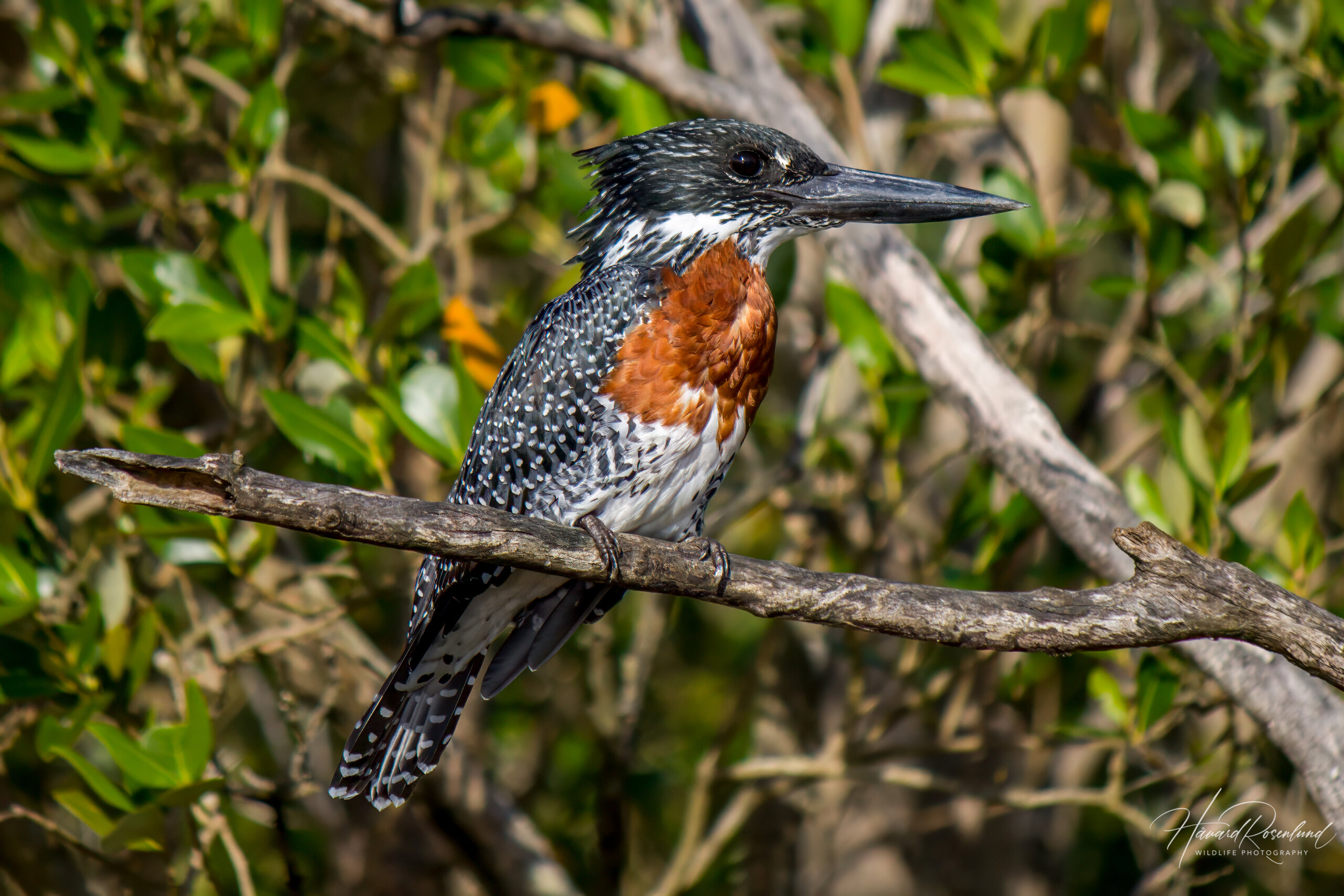
The giant kingfisher (Megaceryle maxima) is Africa’s largest kingfisher, measuring roughly 42–46 cm and weighing about 255–425 g. It has a massive black bill, a shaggy crest and heavily spotted black-and-white plumage. Its size alone makes it difficult to confuse with most other African kingfishers.
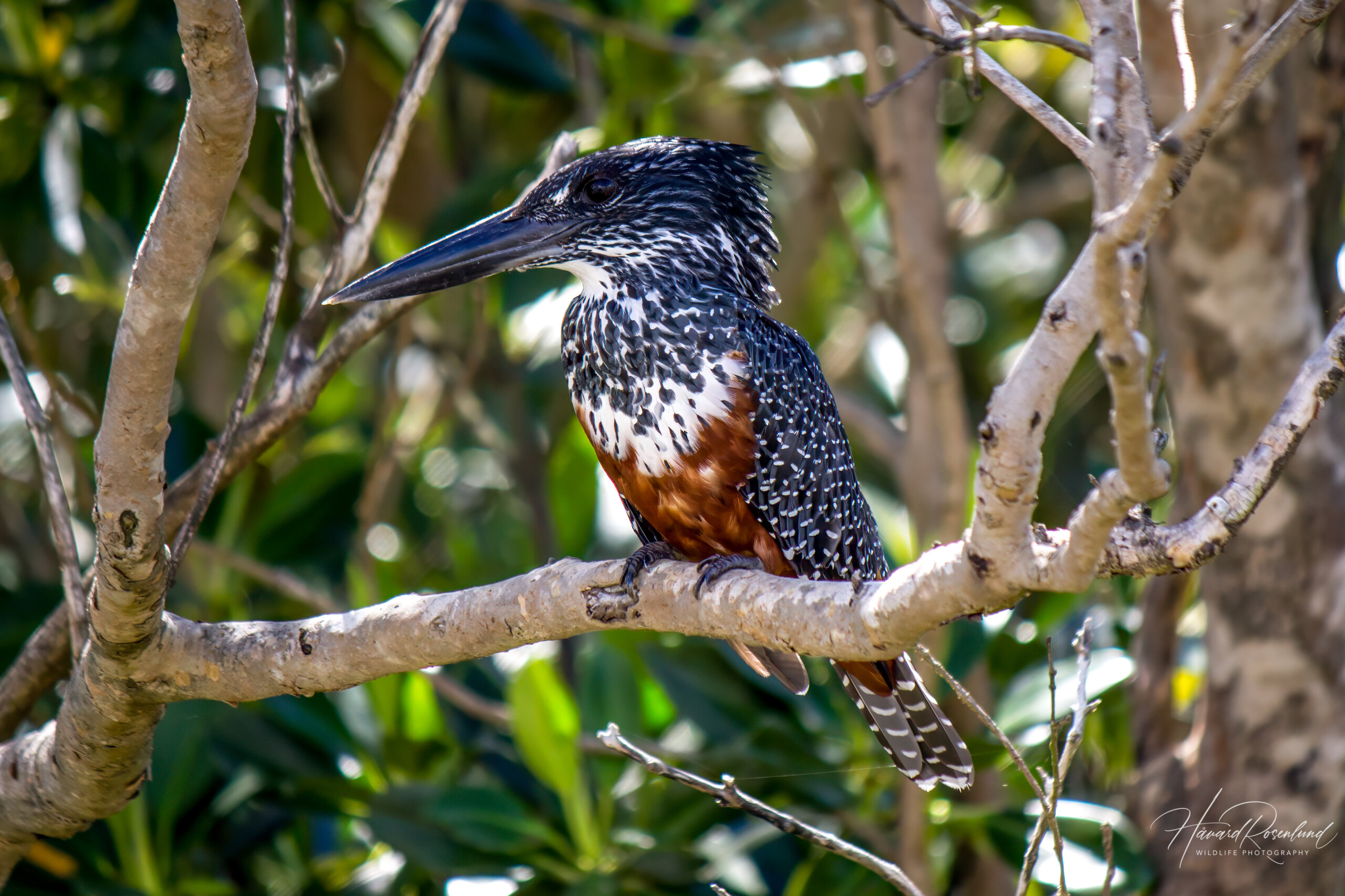
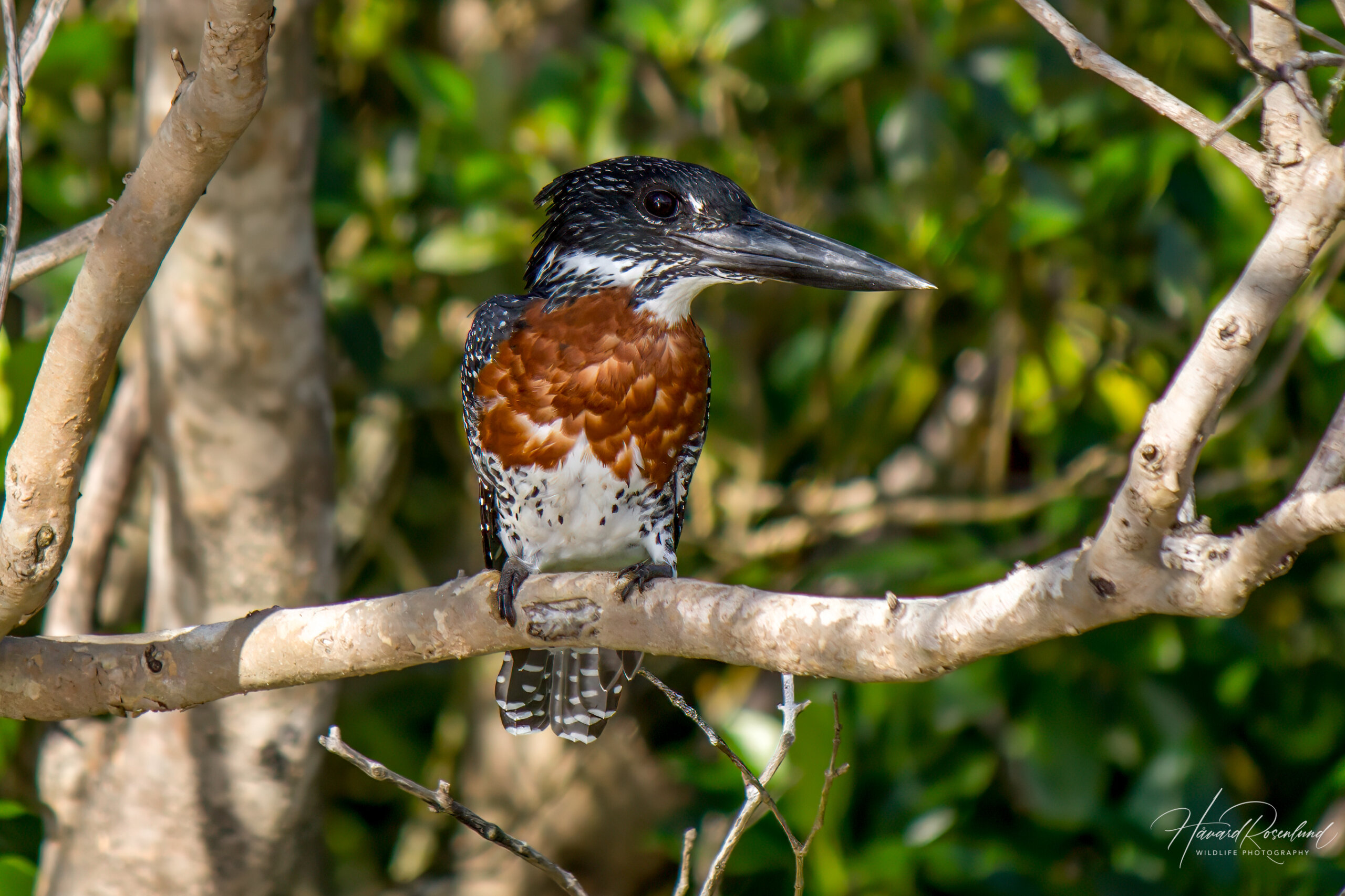
The sexes differ strikingly underneath. Males have a broad chestnut-orange breast above a mostly white, dark-spotted belly, while females have a black-and-white spotted breast and a chestnut-orange belly. A useful mnemonic is that the male wears an orange “shirt”, while the female wears an orange “skirt”.
Two subspecies are recognised. M. m. maxima occurs across much of eastern and southern Africa. The darker M. m. gigantea is found mainly in the rainforest belt of western and central Africa and has less spotting above and heavier dark barring below. One ringed giant kingfisher in southern Africa was found or recaptured just over eight years after ringing.
Habitat
Giant kingfishers occur beside a wide range of waters, from forest streams and large rivers to lakes, reservoirs, estuaries, lagoons and sheltered seashores. Suitable hunting perches and an adequate supply of fish or crustaceans are more important than any single vegetation type, although the birds normally remain close to water.
They can use both natural and artificial water bodies, but breeding additionally requires steep earth or sand banks suitable for excavating nest tunnels.
Diet
Freshwater crabs are especially important prey in much of southern Africa, while fish make up most of the remainder of the diet. Frogs and other aquatic animals are taken less often, and recorded fish can approach 18 cm in length.
Small crabs may be swallowed whole. Larger crabs are battered against a perch and can have the hard carapace and pincers removed before being eaten. Fish are normally manipulated so that they can be swallowed head first.
Hunting
The giant kingfisher usually hunts from an exposed branch or other perch overlooking the water. It watches for prey before plunging steeply into the water and may disappear completely beneath the surface. The bird can also hover briefly before diving when a suitable perch is unavailable or prey is detected away from shore.
Its large size allows it to tackle substantial fish and crabs, which are often carried back to a perch before being swallowed.
Breeding
Pairs are monogamous and territorial and excavate their own nest burrow in a vertical sand or earth bank, usually close to water. Both birds take part in digging, which may take about a week. The tunnel normally extends roughly 0.9 m or more into the bank, but an unusually long tunnel of 8.45 m has been recorded. It ends in a chamber about 20–60 cm wide with no added nesting material.
In southern Africa egg-laying occurs mainly from July to January, with a peak from August to October. Three to five eggs are incubated by both parents for about 25–27 days. The chicks remain underground for roughly 37 days and are fed frequently, with the male often providing much of the food. After leaving the burrow they remain dependent on their parents for at least another three weeks.
Status
The giant kingfisher is globally classified as Least Concern on the IUCN Red List. It remains widespread through much of sub-Saharan Africa, occurs in many protected areas and can use both natural and artificial water bodies.
Local populations can nevertheless be affected by deterioration of water quality, declines in aquatic prey and the loss or repeated disturbance of riverbanks and other suitable nesting sites. These pressures are mainly local.
Image gallery
Loading map and observations…
Have you seen this species?
Independent species archive
Did you find this species page useful?
Wildlife Vagabond is independently built and maintained. Voluntary support helps cover hosting, maps, data storage and continued improvements to the species archive.
Support Wildlife VagabondSpecies content will remain freely available.
References
Information about the species’ global distribution and status is based primarily on global Red List data. See the references below for details.
- AviList. (2026). v2025b. https://www.avilist.org/checklist/v2025b/
- Biodiversity Explorer. (n.d.). Giant Kingfisher. Iziko Museums of South Africa. https://www.biodiversityexplorer.info/birds/cerylidae/ceryle_maxima.htm
- BirdLife International. (n.d.). Giant Kingfisher species factsheet. https://datazone.birdlife.org/species/factsheet/giant-kingfisher-megaceryle-maxima
- International Union for Conservation of Nature. (n.d.). Giant Kingfisher. The IUCN Red List of Threatened Species. https://www.iucnredlist.org/species/22683616/92991520
- Paijmans, Catto & Oschadleus. (2017). Maximum longevities and causes of death in kingfishers from SAFRING data. https://journals.uct.ac.za/index.php/BO/article/view/471
- Woodall, P. F. (2020). Giant Kingfisher (Megaceryle maxima). Birds of the World. https://doi.org/10.2173/bow.giakin3.01