
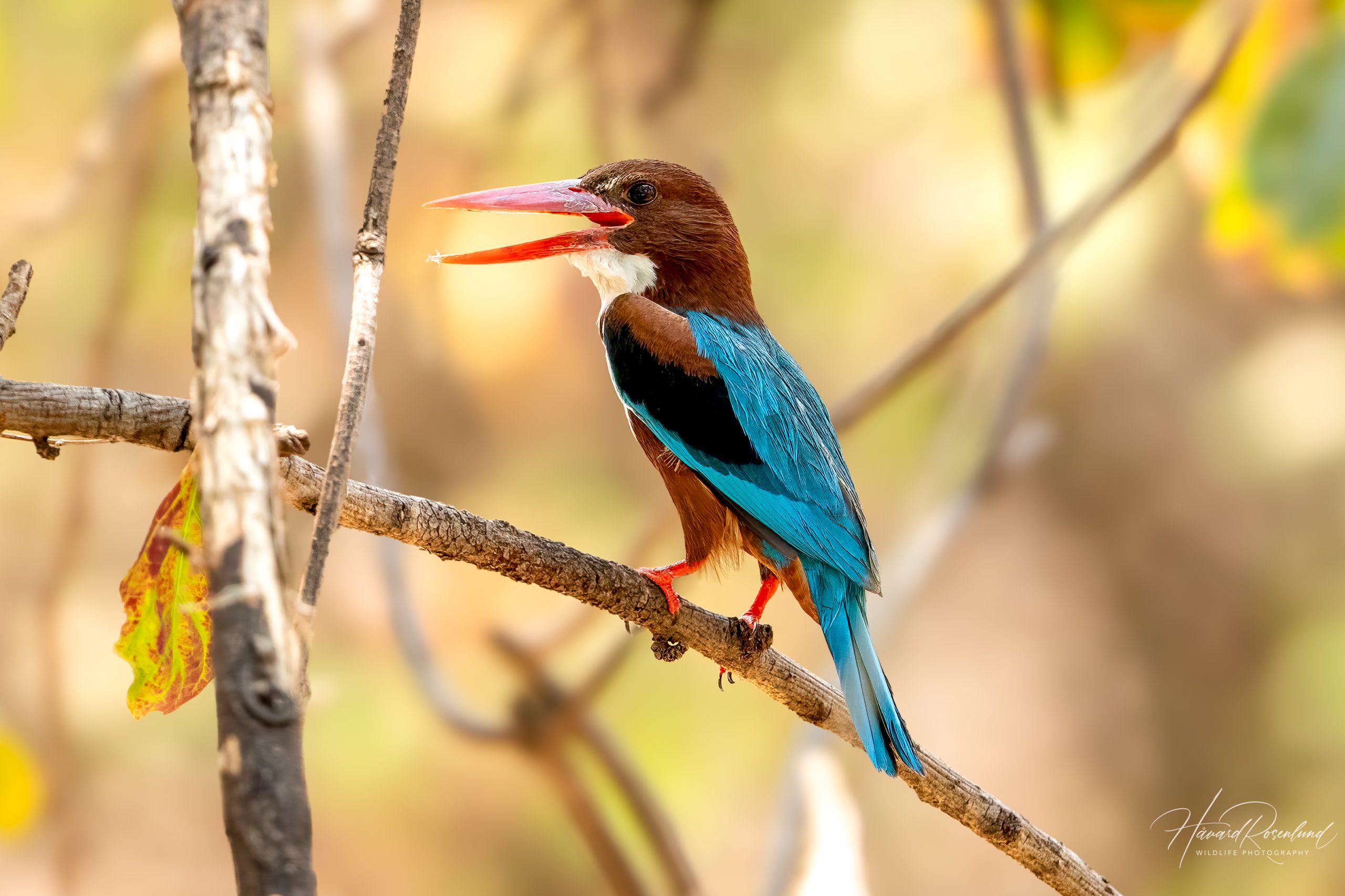
White-throated Kingfisher
Halcyon smyrnensis
At a glance
Habitat
- Wetlands, farmland, grassland, forest edge, scrub, plantations, gardens and urban landscapes
Diet
- Mainly large insects and other arthropods, plus amphibians, reptiles, small mammals, crustaceans and fish
Activity
- Diurnal
Size
- Length: 27–28 cm Weight: 65–90 g
Range
- From the eastern Mediterranean and Middle East through South Asia to parts of Southeast Asia
Description
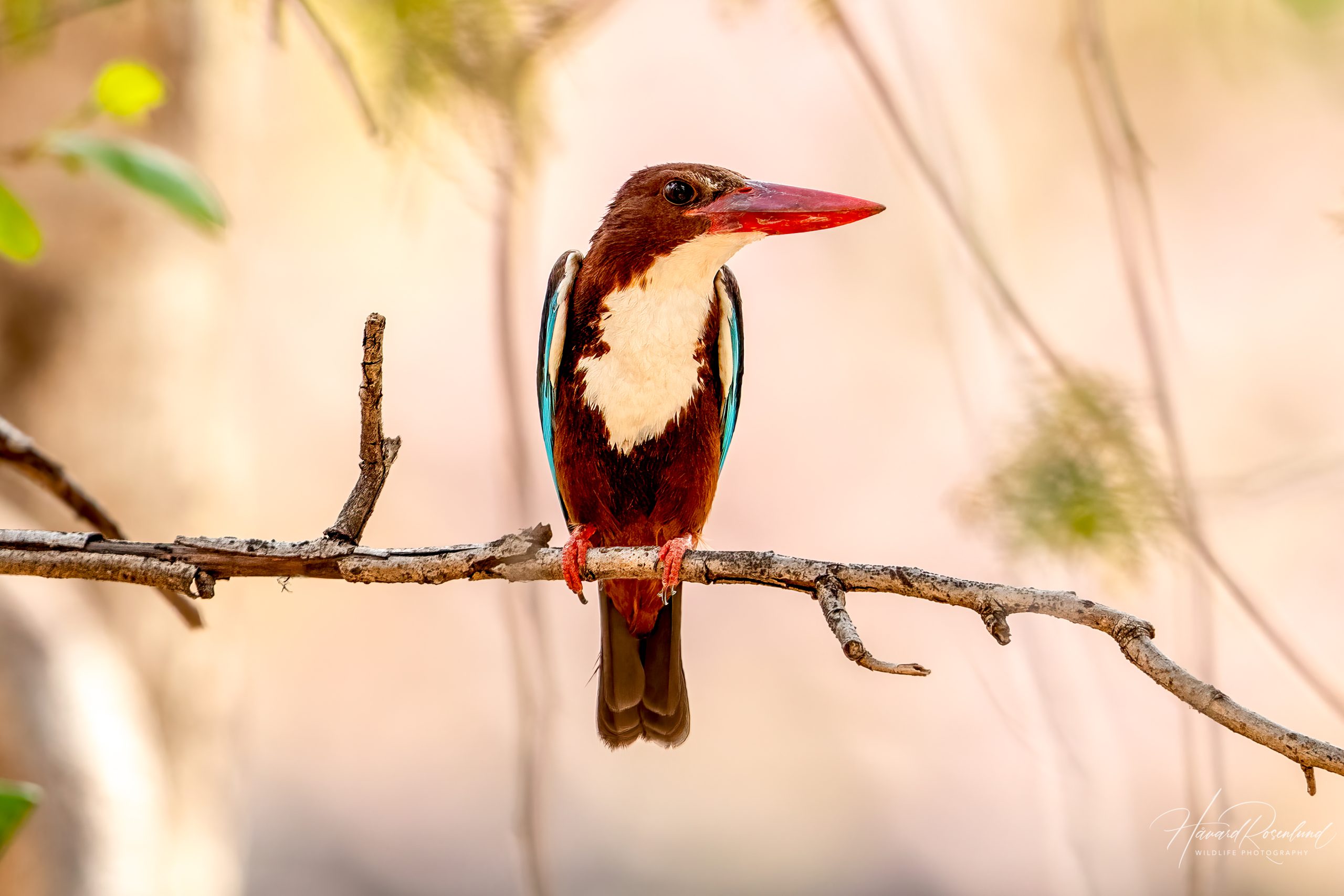
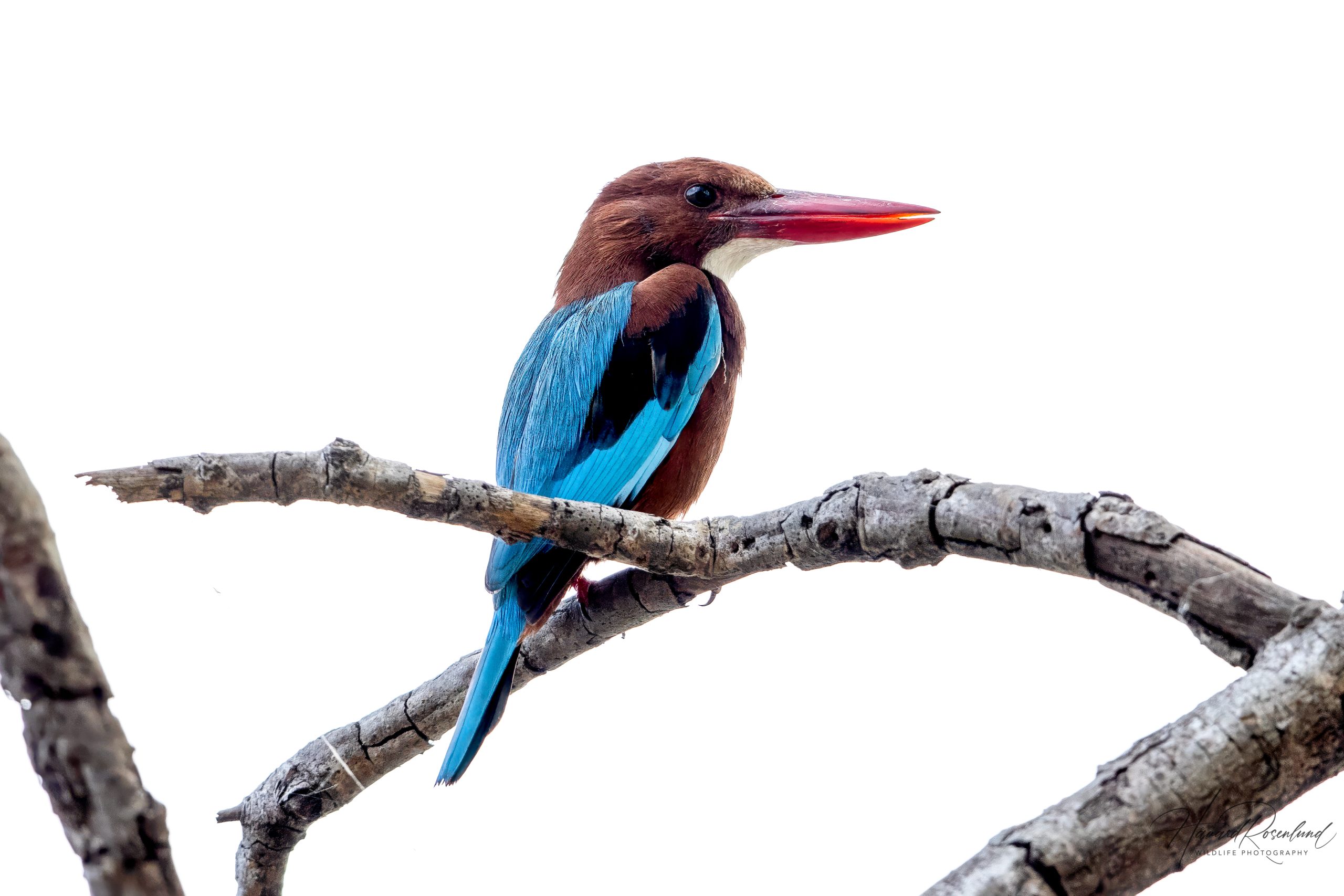
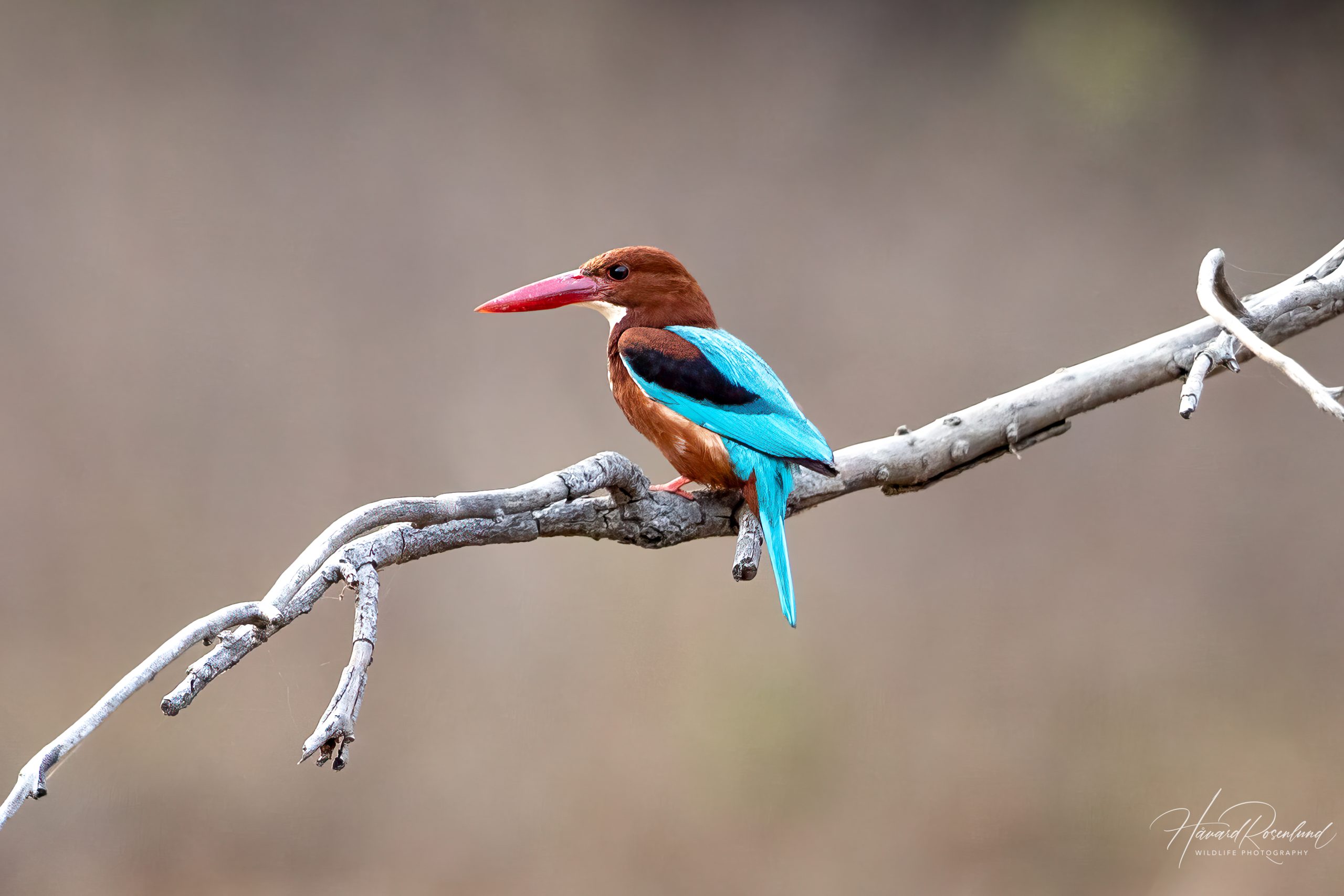
The white-throated kingfisher (Halcyon smyrnensis) is a large and unmistakable tree kingfisher with a broad distribution from the eastern Mediterranean and Middle East through the Indian subcontinent into parts of Southeast Asia. Adults are about 27–28 cm long and combine brilliant turquoise-blue wings, back and tail with a deep chestnut head and underparts, a large white throat and breast patch and a massive red bill.
Unlike the common kingfisher (Alcedo atthis), which is strongly tied to water and catches mainly fish and aquatic prey, the white-throated kingfisher is often encountered far from water. Its heavier bill, powerful body and extremely broad diet allow it to hunt just as effectively from perches over open ground as beside water.
Habitat
White-throated kingfishers are habitat generalists. They occur around rivers, ponds, marshes and irrigation channels, but also in farmland, grassland, open scrub, forest edge, plantations, gardens, villages and cities. Their main requirements are exposed perches, open ground or shallow water in which prey can be detected, and suitable banks or cuttings for nesting.
In India, the species is resident and a habitat generalist. Utility wires, fences, poles and isolated branches can substitute for natural hunting perches, helping the species exploit heavily modified landscapes.
Diet
The species has one of the broadest diets among Asian kingfishers. Large insects, spiders and other arthropods are important, together with frogs, lizards, snakes, small rodents, crustaceans and fish. It also occasionally takes other small vertebrates. The balance changes with habitat, and fish may be a relatively minor component where terrestrial prey is abundant.
A pellet study published in 2009 from Nagapattinam District in Tamil Nadu found that arthropods made up 83.4% of the recorded diet. Beetles, true bugs, wasps, ants and grasshoppers were the dominant insect groups. This strongly terrestrial diet helps explain why white-throated kingfishers can thrive in agricultural and urban landscapes far from permanent water.
Behaviour
White-throated kingfishers hunt mainly from exposed perches. A bird sits upright and scans the ground or water, then launches in a fast direct flight and drops onto prey, often returning to a perch to beat larger prey against a branch before swallowing it. The same basic technique works for insects in grass, lizards on bare ground and fish in shallow water.
Birds are usually seen alone or in pairs and defend feeding areas. The loud, rattling call is conspicuous and is often given from wires, treetops or other high perches. Most populations are resident, although local dispersal and some seasonal movement occur, especially toward the edges of the range.
Breeding
Pairs defend breeding areas. The nest is excavated as a horizontal tunnel into a sandy bank, earth cutting, roadside embankment or similar vertical face, ending in an enlarged chamber. Termite mounds and other suitable earthen structures are also used in parts of the range. Nesting can occur surprisingly close to farmland, roads and settlements when secure banks and hunting perches are available.
A study published in 2010 from the Cauvery Delta in Tamil Nadu examined 46 nests. Tunnels measured 48–152 cm and averaged about 114 cm. Among 26 active nests, clutches contained three to five eggs and averaged 3.7. Incubation lasted 14–17 days, averaging 15.3 days, and 80% of hatched young fledged. The young left the nest toward the end of a roughly four-week nestling period.
A field note published in 2021 documented an unusual nest in Moratuwa, Sri Lanka: a pair bred in an artificial wooden nest box in December 2020. This was the first documented nest-box use for the species anywhere in its range and shows that nest-site choice can be flexible when a secure cavity is available.
Status
The white-throated kingfisher is classified as least concern on the IUCN Red List and remains one of the most widespread and familiar kingfishers across the Indian subcontinent. Indian data updated in 2025 estimate a national range of about 2.61 million km² and also show that the species is resident and not strongly specialised to one habitat type.
The same data estimate a long-term increase of about 65.8% and a recent annual increase of about 1.48%. Although both estimates are positive, the evidence is still too uncertain to establish either the long-term or recent trend confidently. Local loss of nesting banks, hunting perches and productive feeding habitat can still affect birds even though the species adapts well to human landscapes.
Image gallery
Loading map and observations…
Have you seen this species?
Independent species archive
Did you find this species page useful?
Wildlife Vagabond is independently built and maintained. Voluntary support helps cover hosting, maps, data storage and continued improvements to the species archive.
Support Wildlife VagabondSpecies content will remain freely available.
References
Information about the species’ global distribution and status is based primarily on global Red List data. See the references below for details.
- Ali, A. M. S., Asokan, S., & Manikannan, R. (2010). Observations on nesting ecology of White-breasted Kingfisher Halcyon smyrnensis (Aves: Coraciiformes) in Cauvery Delta, Southern India. Journal of Ecology and the Natural Environment, 2(7), 134–139. https://doi.org/10.5897/JENE.9000077
- Asokan, S., Ali, A. M. S., & Manikannan, R. (2009). Diet of three insectivorous birds in Nagapattinam District, Tamil Nadu, India – a preliminary study. Journal of Threatened Taxa, 1(6), 327-330. https://doi.org/10.11609/JoTT.o2145.327-30
- BirdLife International. (n.d.). White-throated Kingfisher species factsheet. https://datazone.birdlife.org/species/factsheet/white-throated-kingfisher-halcyon-smyrnensis
- International Union for Conservation of Nature. (n.d.). White-throated Kingfisher. The IUCN Red List of Threatened Species. https://www.iucnredlist.org/species/22725846/119289544
- Prakash, T., Jayakody, S., Perera, A., Gamage, R., & Kusuminda, T. (2021). Unusual nesting behaviour of white-throated kingfisher (Halcyon smyrnensis). Taprobanica, 10(1), 64-65. https://doi.org/10.47605/tapro.v10i1.251
- State of India's Birds. (n.d.). State of India’s Birds – White-throated Kingfisher. https://stateofindiasbirds.in/species/whtkin2/