

European Roller
Coracias garrulus
At a glance
Habitat
- Open, warm landscapes with scattered trees, woodland edges, farmland and savanna with suitable hunting perches and nest cavities
Diet
- Mainly large insects, especially beetles and grasshoppers; also spiders, scorpions and occasional small vertebrates
Activity
- Diurnal; typically hunts from exposed perches
Size
- Length: 29–32 cm Weight: about 130 g
Range
- Breeds from northwestern Africa and Europe east through western and central Asia; spends the non-breeding season in sub-Saharan Africa
Description
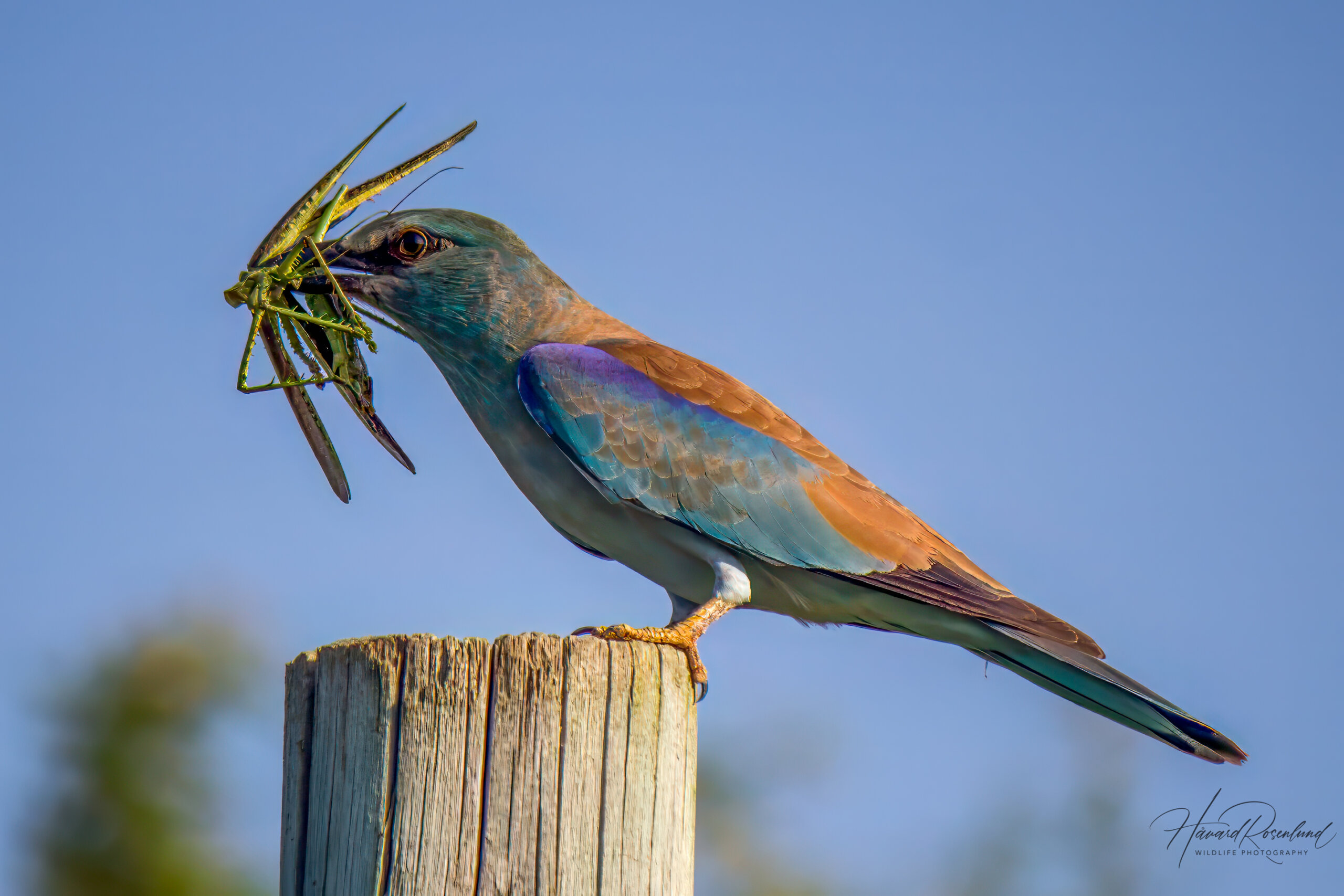
The European roller (Coracias garrulus) is a stocky, brightly coloured roller and the only roller species to breed in Europe. Adults are about 29–32 cm long and weigh around 130 g. The head and underparts are pale blue to turquoise, the back is warm rufous-brown and the wings combine brilliant blue with dark flight feathers. Males and females look alike.
In Africa it can resemble the Abyssinian roller (Coracias abyssinicus), which has much longer outer tail feathers. Two subspecies are recognised: C. g. garrulus across the western part of the breeding range and the generally paler C. g. semenowi farther east into western and central Asia.
Habitat
European rollers favour warm, open landscapes with scattered trees, woodland edges, pasture, low-intensity farmland, orchards and other habitats that combine open hunting ground with elevated perches. Breeding areas also need suitable cavities in mature trees, cliffs, buildings or other structures.
On the African non-breeding grounds the species uses open savanna, grassland and woodland mosaics. Short or patchy vegetation is particularly useful because large ground-dwelling insects are easier to detect and capture from a perch.
Diet
Large terrestrial insects dominate the diet, especially grasshoppers and beetles. Crickets, mantises, spiders, scorpions, centipedes and other invertebrates are also taken, while frogs, lizards, small snakes, mammals and birds form a much smaller part of the diet.
The exact prey mix changes with place and season. Studies on both the breeding grounds and in southern Africa show an opportunistic predator that concentrates on relatively large prey, which provide more food with each successful capture, rather than depending on one particular insect group.
Hunting
European rollers are classic sit-and-wait hunters. A bird typically watches from a branch, fence post, wire or other exposed perch before dropping rapidly to the ground to seize prey, then returning to a perch to swallow or handle it. Some prey is also caught in the air.
Hunting success depends strongly on both vegetation structure and prey abundance. Rollers favour open, short or patchy ground where large insects are visible and accessible, and studies in European farmland have found particularly heavy use of fallows and grazed areas. This dependence on both prey-rich ground and suitable lookout posts helps explain why structurally varied farmland can support the species better than uniform intensive agriculture.
Migration
The European roller is a long-distance Afro-Palearctic migrant. Birds breeding from Europe and northwestern Africa east through western and central Asia leave the breeding grounds and spend the non-breeding season in sub-Saharan Africa, with many reaching southern Africa after journeys of well over 10,000 km.
Tracking studies show that different breeding populations use partly distinct flyways. Western European birds can travel down the Atlantic side of Africa before turning toward Angola and Namibia, while populations farther east use central or eastern routes through the Middle East and the Horn of Africa. These routes converge across broad African savanna regions during the non-breeding season.
Ongoing satellite tracking by BirdLife South Africa is revealing more detail from the southern end of the flyway. Birds tagged in South Africa have demonstrated links extending deep into Asia, including China, showing that rollers sharing the same African non-breeding areas may originate from widely separated breeding regions.
Breeding
Pairs are monogamous and territorial during the breeding season. Courtship includes conspicuous aerial displays with steep climbs, dives and rolling movements. European rollers usually do not excavate their own nest cavities and instead use holes in mature trees, cliffs and buildings, steep earthen or sandy banks, or old excavations made by other birds.
Four to five eggs are typical. The female performs most of the roughly 17–19 day incubation, while both parents feed the chicks. Young usually leave the cavity after about 25–30 days and continue receiving food for several weeks.
Suitable cavities can be a limiting resource, and nest boxes have become an important conservation tool in parts of Europe where old trees and traditional rural structures have disappeared. Breeding success therefore depends on both secure cavities and nearby insect-rich hunting habitat.
Status
The European roller is globally classified as Least Concern on the IUCN Red List. The global assessment estimates roughly 100,000–499,999 mature individuals. Despite the present category, the species suffered major declines and local extinctions across parts of Europe during the twentieth century and the global population is still considered to be declining.
In South Africa, Lesotho and Eswatini, where the species is a non-breeding migrant, BirdLife South Africa’s 2025 regional assessment classifies it as Near Threatened. Models based on regional citizen-science data indicate a range contraction of up to about 20.7% over three generations.
Threats
Pressures act across the entire migratory cycle. On the breeding grounds, agricultural intensification can reduce the large insects and low, heterogeneous vegetation used for hunting, while removal of mature trees and renovation of old rural buildings can eliminate nest cavities. Pesticide use can further reduce prey availability.
Egg collecting, trapping and illegal hunting remain concerns along parts of the range and migration routes. Climate change may also shift where suitable breeding and non-breeding habitat occurs or reduce its extent, making the protection of a species that crosses continents more complicated than conserving any single site.
Conservation
Conservation combines protection of insect-rich open habitats with retention or replacement of nesting cavities. Nest-box programmes have helped populations recover or stabilise in several European areas where natural holes are scarce, while maintaining extensively managed grassland, fallows, scattered trees and other structural diversity preserves hunting habitat.
At the other end of the flyway, BirdLife South Africa has run a dedicated European Roller Monitoring Project since 2021. The programme uses citizen-science surveys, colour rings and satellite trackers to identify migration routes, stopover sites and important non-breeding habitat. The project has expanded across South Africa and is intended to support conservation across the entire flyway rather than treating European breeding and African non-breeding populations separately.
Image gallery
Loading map and observations…
National Red List status
| Country | Status | Assessment | Source |
|---|---|---|---|
| South Africa | NTNear Threatened | Regional Red Data Book of Birds of South Africa, Lesotho and Eswatini 2025 | BirdLife South Africa – Regional Red Data Book 2025 |
Have you seen this species?
Independent species archive
Did you find this species page useful?
Wildlife Vagabond is independently built and maintained. Voluntary support helps cover hosting, maps, data storage and continued improvements to the species archive.
Support Wildlife VagabondSpecies content will remain freely available.
References
Information about the species’ global distribution and status is based primarily on global Red List data. See the references below for details.
- AviList. (2026). v2025b. https://www.avilist.org/checklist/v2025b/
- BirdLife International. (n.d.). European Roller species factsheet. https://datazone.birdlife.org/species/factsheet/european-roller-coracias-garrulus
- BirdLife South Africa. (2025). European Roller, Regional Red Data Book assessment. https://www.birdlife.org.za/red-list/european-roller/
- BirdLife South Africa. (n.d.). European Roller Monitoring Project. https://www.birdlife.org.za/what-we-do/regional-conservation-programme/what-we-do/european-roller/
- Catry, I., Catry, T., Granadeiro, J. P., Franco, A. M. A., & Moreira, F. (2014). Unravelling migration routes and wintering grounds of European rollers using light-level geolocators. Journal of Ornithology, 155(4), 1071-1075. https://doi.org/10.1007/s10336-014-1097-x
- Feare. (1983). Mass spring migration of European Rollers Coracias garrulus in eastern Tanzania. https://www.biodiversitylibrary.org/page/40055891
- Finch, T., Saunders, P., Avilés, J. M., Bermejo, A., Catry, I., de la Puente, J., Emmenegger, T., Mardega, I., Mayet, P., Parejo, D., Račinskis, E., Rodríguez‐Ruiz, J., Sackl, P., Schwartz, T., Tiefenbach, M., Valera, F., Hewson, C., Franco, A., & Butler, S. J. (2015). A pan‐European, multipopulation assessment of migratory connectivity in a near‐threatened migrant bird. Diversity and Distributions, 21(9), 1051-1062. https://doi.org/10.1111/ddi.12345
- International Union for Conservation of Nature. (2019). European Roller. The IUCN Red List of Threatened Species. https://www.iucnredlist.org/species/22682860/154424974
- Meschini, A., Brambilla, O., Cannarella, S., Muscianese, E., Mastronardi, D., Norante, N., Pascucci, M., Pucci, M., Sottile, F., Tagliagambe, S., Gustin, M., & Ferrarini, A. (2024). Space–Time Patterns of Nest Site and Nesting Area Selection by the Italian Population of European Rollers: A 3-Year Study of a Farmland Bird Species. Diversity, 16(7), 359. https://doi.org/10.3390/d16070359
- Nupen, L., Gardner, M., Morin, J., Ndou, T., & Dugmore, E. K. (2023). Web-sourced photographic methods reveal dietary composition and shifts in resident and migrant Coracias rollers in southern Africa. Biodiversity Observations, 13, 61-94. https://doi.org/10.15641/bo.1227