
Red Junglefowl
Gallus gallus
At a glance
Habitat
- Forest, forest edge, secondary growth, bamboo and scrub with dense cover beside open feeding ground
Diet
- Seeds, fruit, shoots and other plant material together with insects and other small invertebrates
Activity
- Diurnal; roosts in trees at night
Size
- Length: Males 65–78 cm including tail Weight: Males 0.67–1.45 kg; females smaller
Range
- Native from the Indian subcontinent and Himalayan foothills east through southern China and Southeast Asia
Description
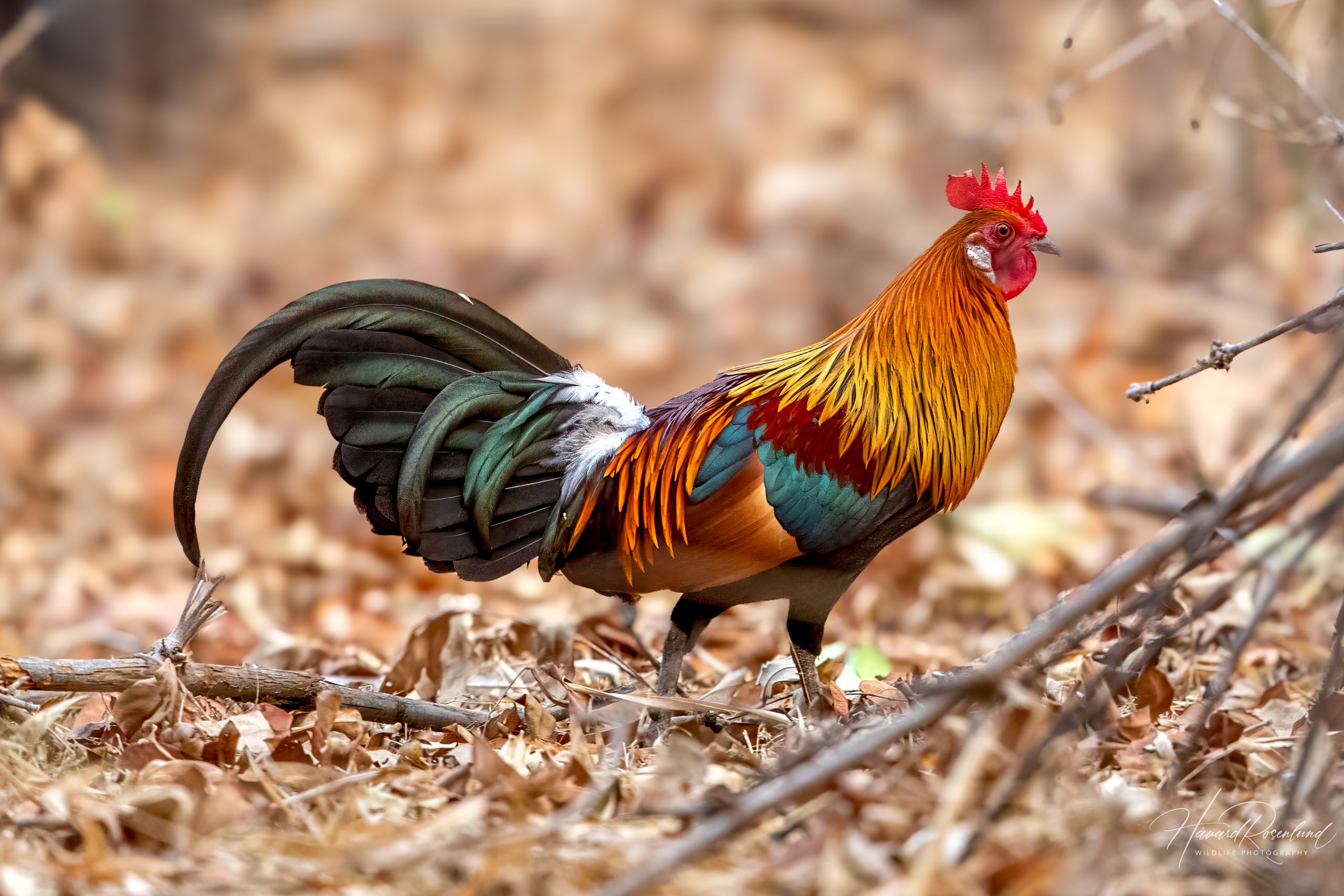
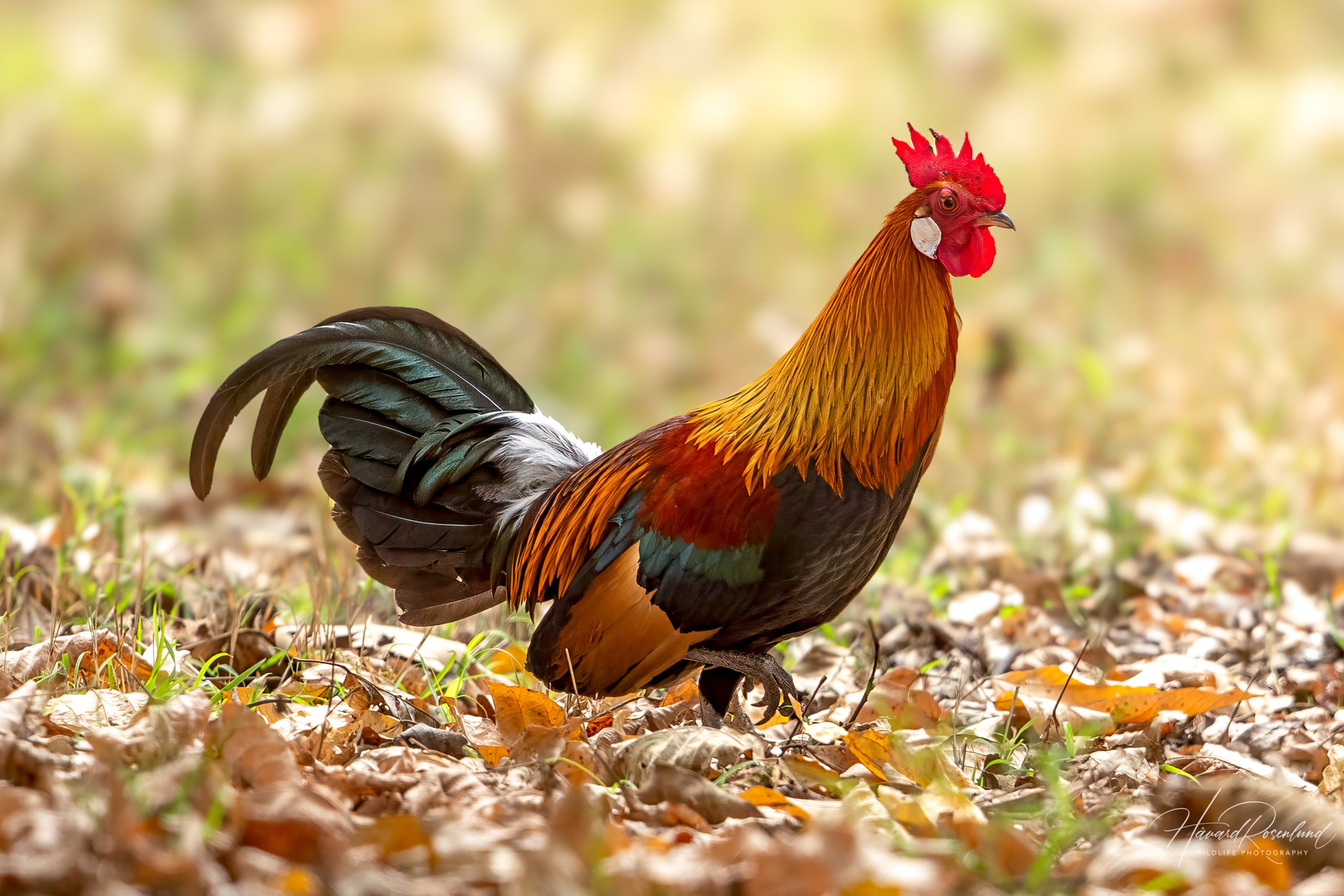
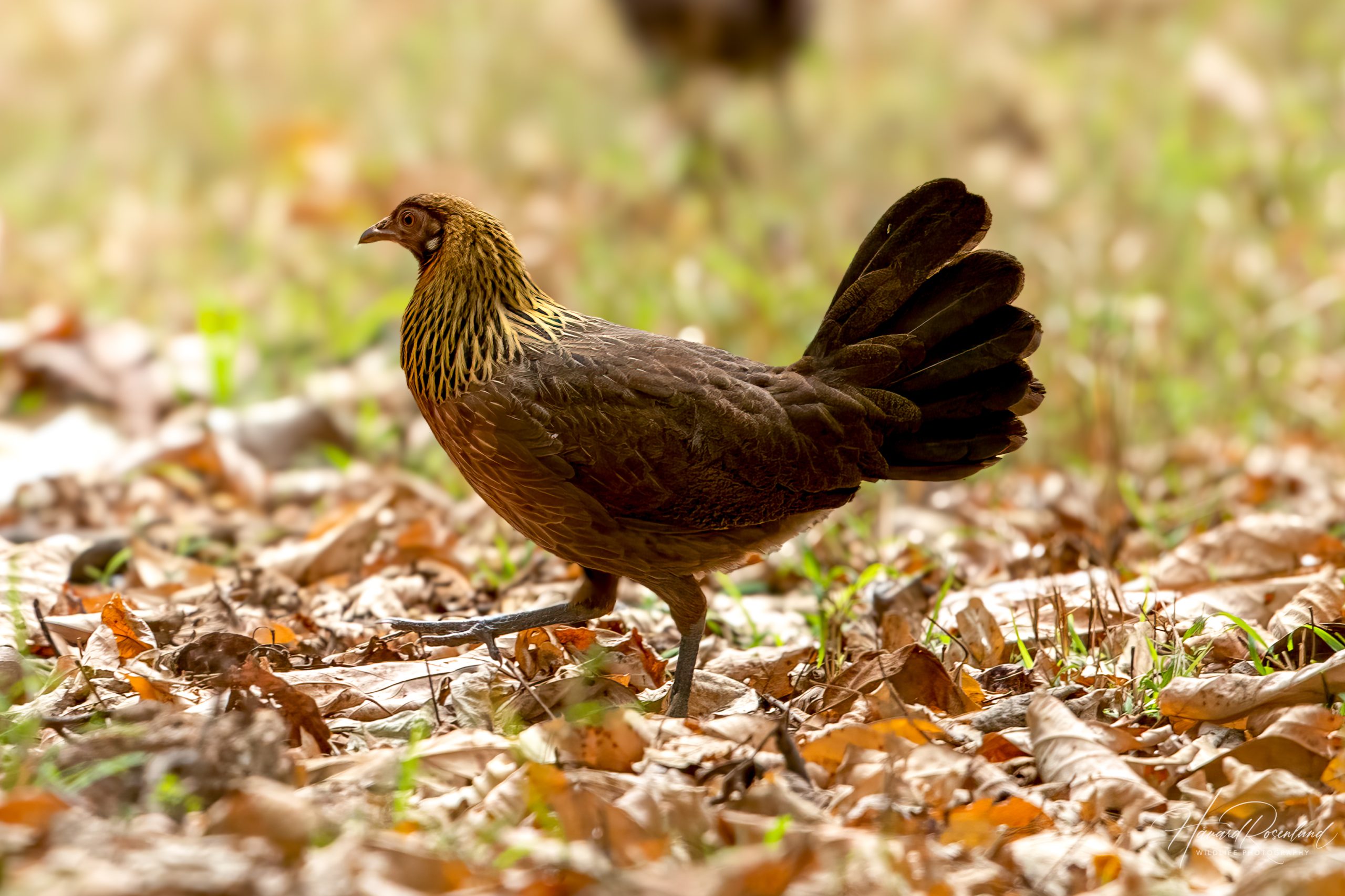
The red junglefowl (Gallus gallus) is the wild species from which domestic chickens primarily descend. It is native from the Indian subcontinent and Himalayan foothills east through southern China and much of Southeast Asia. Wild males are striking birds with a red comb and wattles, golden-orange hackles, dark iridescent body plumage and long curved black-green tail feathers. Females are much smaller and cryptically mottled brown.
Wild males are roughly 65–78 cm long including the tail and typically weigh about 0.67–1.45 kg; females are shorter and lighter. In central and southern India, grey junglefowl (Gallus sonneratii) is an important comparison species. Males of that species have a greyer body and distinctive flattened, spotted hackle feathers rather than the rich red-gold neck plumage of red junglefowl.
Habitat
Red junglefowl use a range of wooded habitats, from mature forest and bamboo to secondary growth, scrub and forest edge. They are especially well suited to landscapes where dense cover for escape and roosting lies close to open or disturbed ground used for feeding.
In India, the species is strongly associated with forest rather than being a broad habitat generalist. Birds may enter cultivated areas near forest, but wild populations still depend on wooded landscapes with secure cover and tree roosts.
Diet
Red junglefowl are omnivorous. Seeds, fallen fruit, shoots, leaves and other plant material are eaten together with insects and other small invertebrates. The balance changes with season as fruiting, seed production and insect abundance vary.
Most feeding takes place on the ground. Birds rake backward through leaf litter and loose soil with their feet, exposing seeds and small animals before picking them up with the bill. Behavioural studies of semi-wild red junglefowl show that this pecking and scratching occupies a large share of their active day.
Behaviour
Red junglefowl are diurnal and move between dense cover and more open patches through the day. Between bouts of feeding they spend time resting, preening and dustbathing. Around dusk the birds fly into trees and settle on elevated roosts for the night, returning to the ground after daybreak.
Social behaviour
Red junglefowl live in flexible social groups with clear dominance relationships. Birds may occur alone or in mixed-sex flocks, and females often form especially close associations with one another. A three-year study published in 1991 of a free-ranging population found female–female associations to be the most cohesive social bonds, while flock cohesion broke down as hens became isolated during chick rearing.
Both sexes form dominance hierarchies, and rank can strongly affect access to mates and reproductive success. An experiment published in 2000 on all-female flocks found that previous social experience and aggressiveness were important in determining rank, whereas age and measured body traits were not. Dominance therefore develops through social history and repeated interactions rather than simply reflecting age or body size.
Breeding
Mating behaviour is strongly shaped by male competition and female choice. Males advertise with crowing, visual displays, the bright comb and ornamental plumage, and competition can escalate into fights involving the leg spurs. Social rank affects access to females. Courtship also includes tidbitting, in which a male repeatedly calls while picking up and dropping a food item in front of a female; females can use such displays when assessing males.
The female makes a shallow ground nest concealed beneath vegetation, roots or fallen leaves and lines it with local plant material. Breeding timing varies across the wide range and often follows seasonal peaks in food availability. Clutches of several eggs are typical, and incubation lasts about three weeks.
The female performs the incubation and leads the precocial chicks after hatching. Chicks leave the nest almost immediately and feed for themselves while remaining close to the hen for warmth, protection and guidance. Their early foraging behaviour closely resembles the scratching and pecking seen in adults.
Relationship with humans
The red junglefowl has had an exceptional influence on human history as the principal wild ancestor of the domestic chicken. A genomic study published in 2020 analysed 863 genomes from domestic chickens and wild junglefowl and identified the red junglefowl subspecies G. g. spadiceus, now centred in southwestern China, northern Thailand and Myanmar, as the main ancestral source of domestic chickens. Genes from other red junglefowl populations and other Gallus species were mixed in later as domestic chickens spread.
The timing of domestication is more complex than older claims of a single very ancient event. A major archaeological reassessment published in 2022 examined material from about 600 sites in 89 countries and placed the earliest unambiguous domestic chicken remains at Ban Non Wat in central Thailand around 1650–1250 BCE. The authors proposed that expanding rice and millet cultivation drew junglefowl into human environments by providing concentrated grain and associated invertebrates, after which domestic chickens spread through Asia and eventually across much of the world.
Status
The red junglefowl is classified as least concern on the IUCN Red List and retains a large distribution in India. The recent annual trend in India is considered stable, while the evidence remains too uncertain to establish the long-term trend confidently.
Domestic introgression is also a conservation issue for wild populations. A genomic study published in 2023 compared whole genomes from 51 domestic chickens with 63 junglefowl from across the natural range, including museum specimens collected about a century earlier. Domestic ancestry varied strongly within and among modern populations and was estimated at roughly 20–50% in sampled modern junglefowl. The species can therefore remain widespread while the genetic distinctiveness of some wild populations is progressively reduced.
Image gallery
Loading map and observations…
Have you seen this species?
Independent species archive
Did you find this species page useful?
Wildlife Vagabond is independently built and maintained. Voluntary support helps cover hosting, maps, data storage and continued improvements to the species archive.
Support Wildlife VagabondSpecies content will remain freely available.
References
Information about the species’ global distribution and status is based primarily on global Red List data. See the references below for details.
- BirdLife International. (n.d.). Red Junglefowl species factsheet. https://datazone.birdlife.org/species/factsheet/red-junglefowl-gallus-gallus
- Collias, N. E., & Collias, E. C. (1996). Social organization of a red junglefowl,Gallus gallus, population related to evolution theory. Animal Behaviour, 51(6), 1337-1354. https://doi.org/10.1006/anbe.1996.0137
- International Union for Conservation of Nature. (n.d.). Red Junglefowl. The IUCN Red List of Threatened Species. https://www.iucnredlist.org/species/22679199/92806965
- Kim, T., & Zuk, M. (2000). The effects of age and previous experience on social rank in female red junglefowl, Gallus gallus spadiceus. Animal Behaviour, 60(2), 239-244. https://doi.org/10.1006/anbe.2000.1469
- Peters, J., Lebrasseur, O., Irving-Pease, E. K., Paxinos, P. D., Best, J., Smallman, R., Callou, C., Gardeisen, A., Trixl, S., Frantz, L., Sykes, N., Fuller, D. Q., & Larson, G. (2022). The biocultural origins and dispersal of domestic chickens. Proceedings of the National Academy of Sciences, 119(24), e2121978119. https://doi.org/10.1073/pnas.2121978119
- Peterson, A. T., & Brisbin, I. L. (1998). Genetic endangerment of wild Red Junglefowl Gallus gallus? Bird Conservation International, 8(4), 387-394. https://doi.org/10.1017/S0959270900002148
- Roth, A. M., Dingemanse, N. J., Nakagawa, S., McDonald, G. C., Løvlie, H., Robledo‐Ruiz, D. A., & Pizzari, T. (2021). Sexual selection and personality: Individual and group‐level effects on mating behaviour in red junglefowl. Journal of Animal Ecology, 90(5), 1288-1306. https://doi.org/10.1111/1365-2656.13454
- State of India's Birds. (n.d.). State of India’s Birds – Red Junglefowl. https://stateofindiasbirds.in/species/redjun/
- Sullivan, M. S. (1991). Flock structure in red junglefowl. Applied Animal Behaviour Science, 30(3-4), 381-386. https://doi.org/10.1016/0168-1591(91)90143-L
- Wang, M.-S., Thakur, M., Peng, M.-S., Jiang, Y., Frantz, L. A. F., Li, M., Zhang, J.-J., Wang, S., Peters, J., Otecko, N. O., Suwannapoom, C., Guo, X., Zheng, Z.-Q., Esmailizadeh, A., Hirimuthugoda, N. Y., Ashari, H., Suladari, S., Zein, M. S. A., Kusza, S., … Zhang, Y.-P. (2020). 863 genomes reveal the origin and domestication of chicken. Cell Research, 30(8), 693-701. https://doi.org/10.1038/s41422-020-0349-y
- Wu, M. Y., Forcina, G., Low, G. W., Sadanandan, K. R., Gwee, C. Y., van Grouw, H., Wu, S., Edwards, S. V., Baldwin, M. W., & Rheindt, F. E. (2023). Historic samples reveal loss of wild genotype through domestic chicken introgression during the Anthropocene. PLOS Genetics, 19(1), e1010551. https://doi.org/10.1371/journal.pgen.1010551
- Wu, M. Y., Low, G. W., Forcina, G., van Grouw, H., Lee, B. P. Y., Oh, R. R. Y., & Rheindt, F. E. (2020). Historic and modern genomes unveil a domestic introgression gradient in a wild red junglefowl population. Evolutionary Applications, 13(9), 2300-2315. https://doi.org/10.1111/eva.13023