
Spotted Eagle-Owl
Bubo africanus
At a glance
Habitat
- Savanna, grassland, shrubland, semi-desert, rocky hills and urban green spaces
Diet
- Rodents, other small mammals, birds, reptiles, amphibians and large invertebrates
Activity
- Nocturnal; often active from dusk
Size
- Length: 43–50 cm Weight: about 487–850 g
Range
- Sub-Saharan Africa
Description
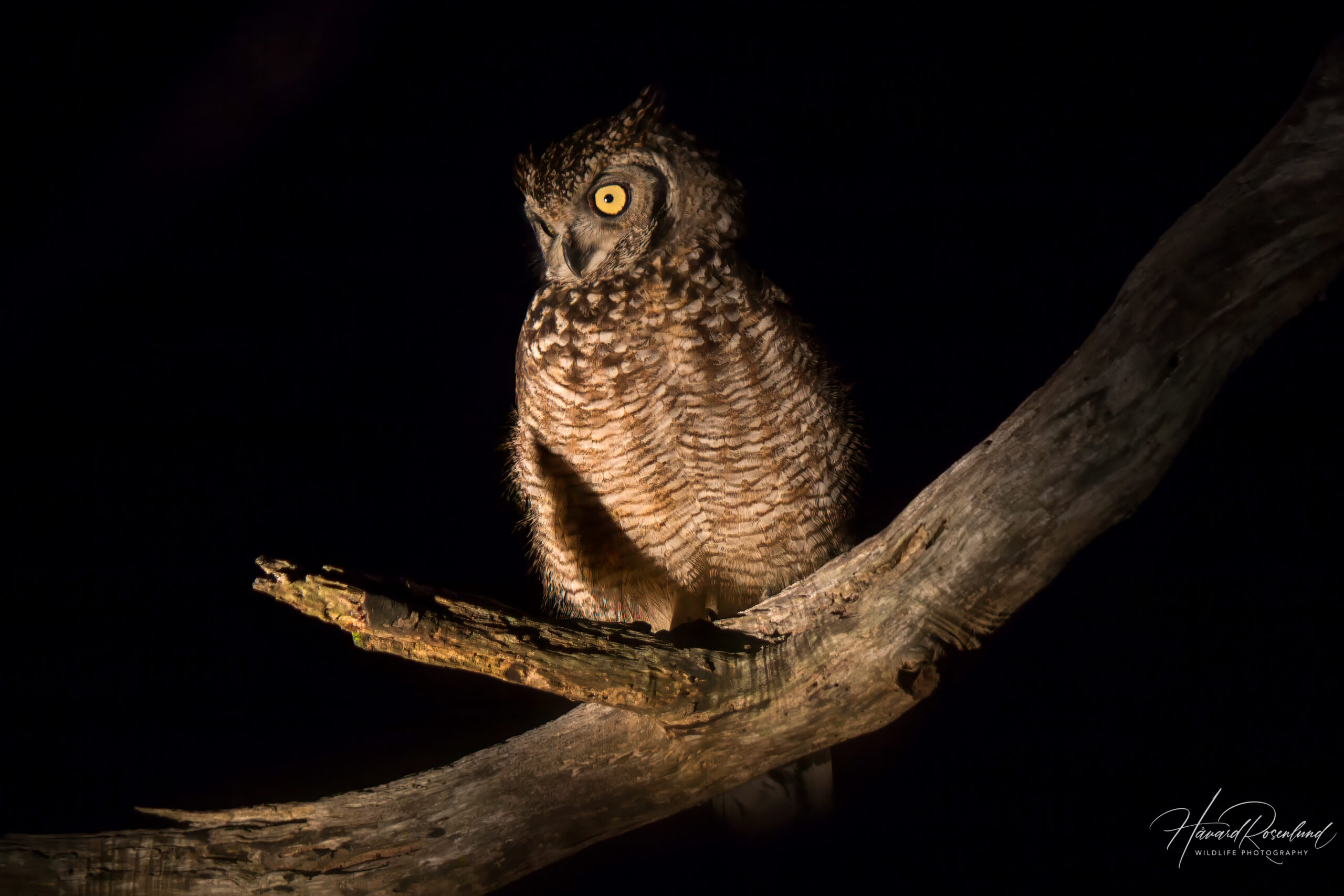
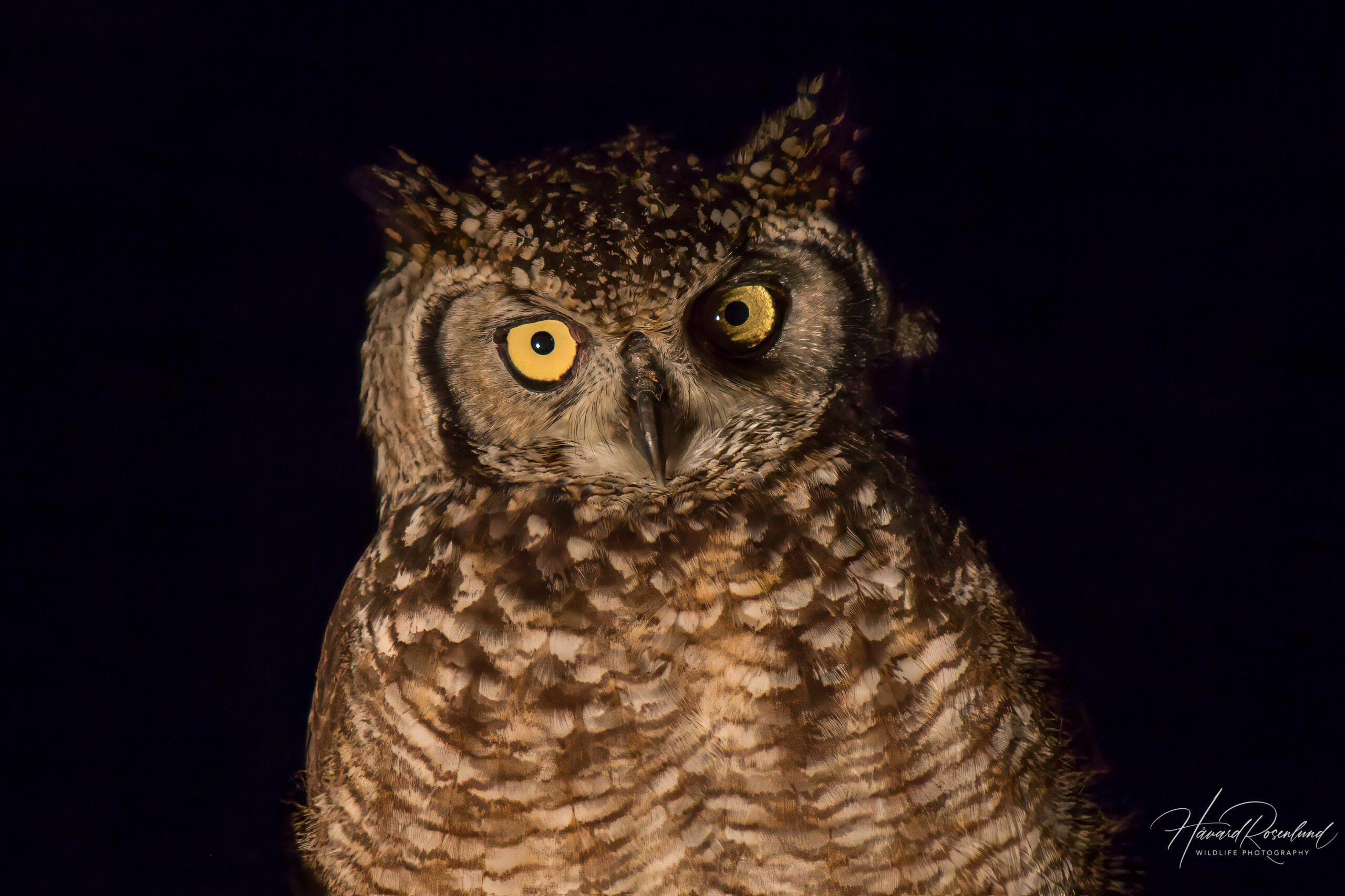
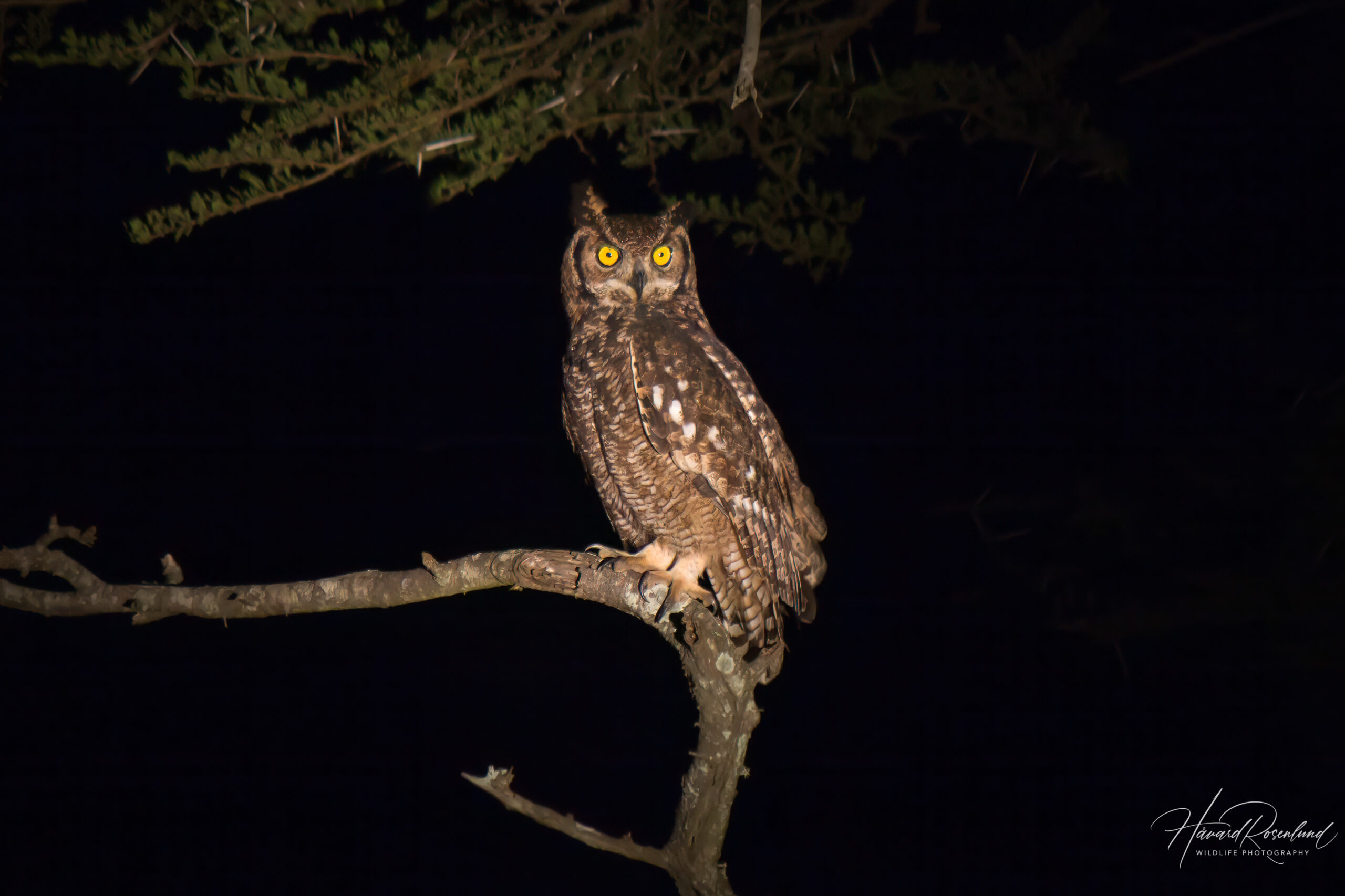
The spotted eagle-owl (Bubo africanus) is a medium-sized eagle-owl, about 43–50 cm long and weighing roughly 487–850 g, with females generally heavier than males. The wingspan is about 1.0–1.4 m. Adults are grey-brown with darker blotches above, fine barring across the pale underparts, conspicuous ear tufts and bright yellow eyes. A broad facial disc helps channel sound toward the ears.
Plumage varies from greyish to warmer brown tones and provides effective camouflage against bark, rocks and dry vegetation. A less common rufous morph also occurs, with browner plumage and orange-yellow eyes. Juveniles resemble the adults but appear softer and fluffier, with less prominent ear tufts.
Habitat
Spotted eagle-owls occupy an unusually broad range of habitats, including savanna, grassland, shrubland, semi-desert, rocky hills and open woodland. They are generally absent only from very dense forest and the most barren landscapes.
The species also adapts readily to towns and cities where gardens, parks, buildings and other structures provide roosting and nesting sites, while lawns, roadsides and artificial lighting can create productive hunting areas.
Diet
The diet is highly opportunistic and includes rodents, shrews and other small mammals, birds, reptiles, amphibians and large invertebrates. The proportions change with habitat and local prey availability rather than following one fixed diet.
A South African study published in 2014 found that urban owls fed mainly on rodents, while birds in rural areas took a broader mixture that included more birds and other small mammals. This flexibility is one reason the species succeeds across such different environments.
Hunting
Spotted eagle-owls hunt mainly after dusk. A common method is to watch from a tree, post, roof or other perch and then glide silently onto prey on the ground. Their broad wings, soft-edged flight feathers and acute hearing allow them to approach prey with little warning.
The hunting repertoire is broader than simple perch-and-pounce predation. Birds can pursue prey on foot, make short aerial chases and catch flying animals in the air. In urban areas they may exploit concentrations of insects and small vertebrates around artificial lights, which can make otherwise modified environments productive hunting grounds.
Behaviour
Spotted eagle-owls are nocturnal and usually spend the day resting quietly in trees, among rocks, on the ground or at other sheltered roosts. They become active around dusk and remain active through much of the night.
Birds are usually encountered alone or as established pairs. Their mellow hooting calls help partners maintain contact and are also used in territorial advertisement, making voice one of the easiest ways to detect an otherwise well-camouflaged owl.
Breeding
Pairs are monogamous and often form lifelong bonds. Nest sites are extremely varied. In natural habitats the eggs are often laid in a shallow scrape among rocks, beneath a shrub, on a cliff ledge or in a sheltered hollow, while urban pairs may use buildings, window ledges and nest boxes. A good nest site may be reused for several years.
The female usually lays two to four eggs and performs the incubation while the male supplies food. Incubation lasts about 30–34 days. In ground nests the young often begin leaving the immediate nest site at around 30–38 days, while they usually remain longer in elevated nests. They are not yet independent, and the parents continue feeding and protecting them for several more weeks; strong flight develops at around seven weeks of age.
Relationship with humans
The spotted eagle-owl is one of the African owls most able to live close to people. Gardens, campuses and suburban neighbourhoods can provide both prey and nesting sites, and purpose-built owl boxes are readily used in some areas. This tolerance often makes the species a familiar urban predator and can help control rodents naturally.
Living close to people also creates hazards. Vehicle collisions, fences and other structures, secondary poisoning from rodenticides and direct persecution can all cause injury or death.
Status
The spotted eagle-owl is globally classified as Least Concern on the IUCN Red List. It remains widespread across sub-Saharan Africa, and the South African population is also considered Least Concern.
Its broad habitat tolerance and ability to persist in modified landscapes make the species relatively resilient, although local populations can still decline where safe nesting sites and prey disappear or human-caused mortality is high.
Image gallery
Loading map and observations…
Have you seen this species?
Independent species archive
Did you find this species page useful?
Wildlife Vagabond is independently built and maintained. Voluntary support helps cover hosting, maps, data storage and continued improvements to the species archive.
Support Wildlife VagabondSpecies content will remain freely available.
References
Information about the species’ global distribution and status is based primarily on global Red List data. See the references below for details.
- BirdLife International. (n.d.). Spotted Eagle-Owl species factsheet. https://datazone.birdlife.org/species/factsheet/spotted-eagle-owl-bubo-africanus
- Holt, D. W., Berkley, R., Deppe, C., Enríquez, P. L., Petersen, J. L., Rangel Salazar, J. L., Segars, K. P., Wood, K. L., Marks, J. S., & Boesman, P. F. D. (2021). Spotted Eagle-Owl (Bubo africanus). Birds of the World. https://doi.org/10.2173/bow.spoeao2.01
- International Union for Conservation of Nature. (n.d.). Spotted Eagle-Owl. The IUCN Red List of Threatened Species. https://www.iucnredlist.org/species/61741628/95178164
- Kopij, G., Symes, C. T., & Bruyns, R. (2014). Dietary Overlap of Co-Occurring Barn OwlTyto albaScopoli and Spotted Eagle OwlBubo africanusTemminck in Urban and Rural Environments. Polish Journal of Ecology, 62(4), 801-805. https://doi.org/10.3161/104.062.0402
- Mbali Mashele, N., Thompson, L. J., & Downs, C. T. (2022). Trends in the admission of raptors to the Moholoholo Wildlife Rehabilitation Centre, Limpopo province, South Africa. African Zoology, 57(1), 56-63. https://doi.org/10.1080/15627020.2021.2016073
- South African National Biodiversity Institute. (n.d.). Spotted Eagle-Owl species profile. https://www.sanbi.org/animal-of-the-week/spotted-eagle-owl/