
Common Myna
Acridotheres tristis
At a glance
Habitat
- Urban areas, farmland, villages, open woodland and other human-modified landscapes
Diet
- Omnivorous; insects, other invertebrates, fruit, seeds and human food
Activity
- Diurnal
Size
- Length: 23–26 cm Weight: 82–143 g
Range
- Native to South and Southeast Asia; widely introduced across Africa, Australasia and oceanic islands
Description
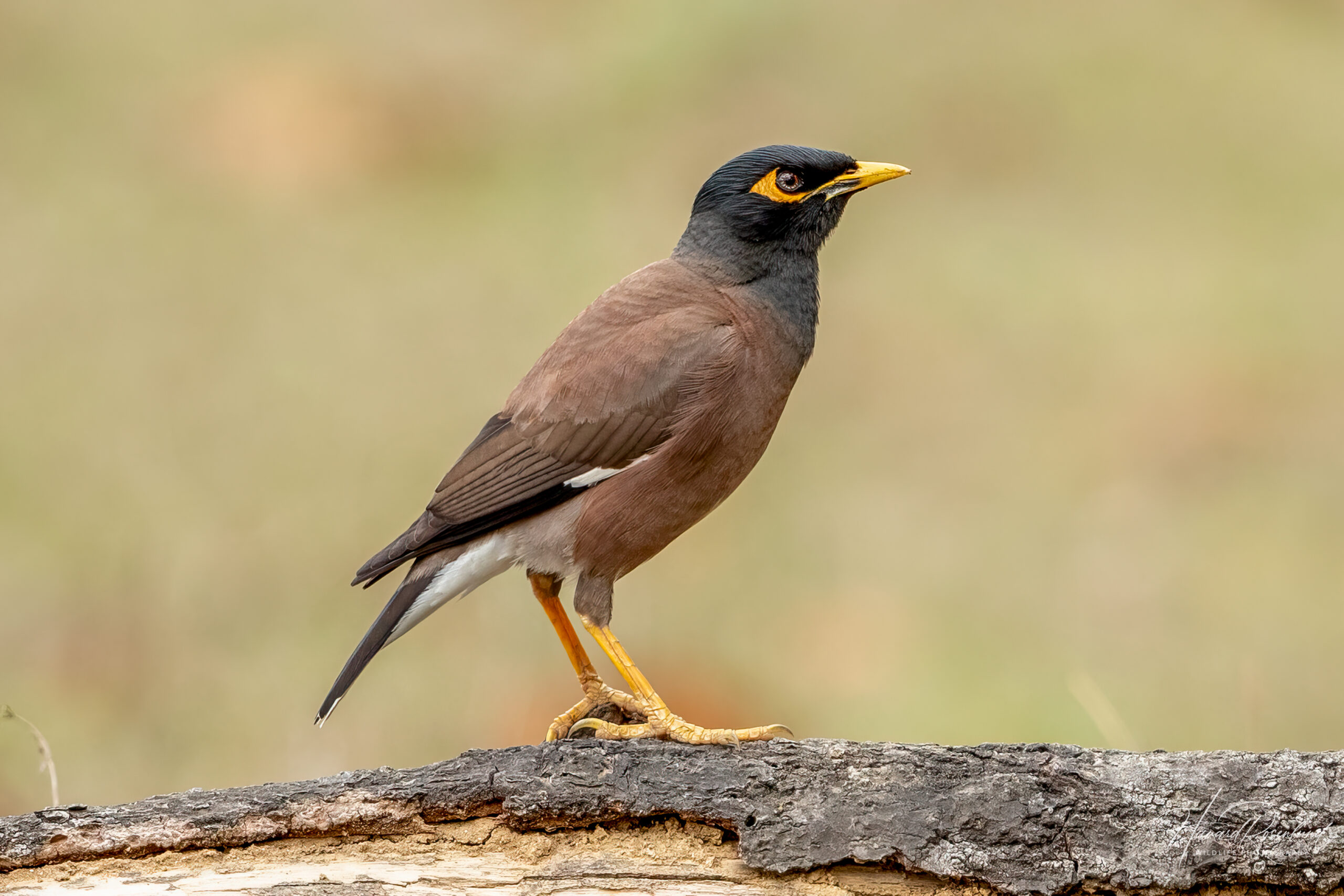
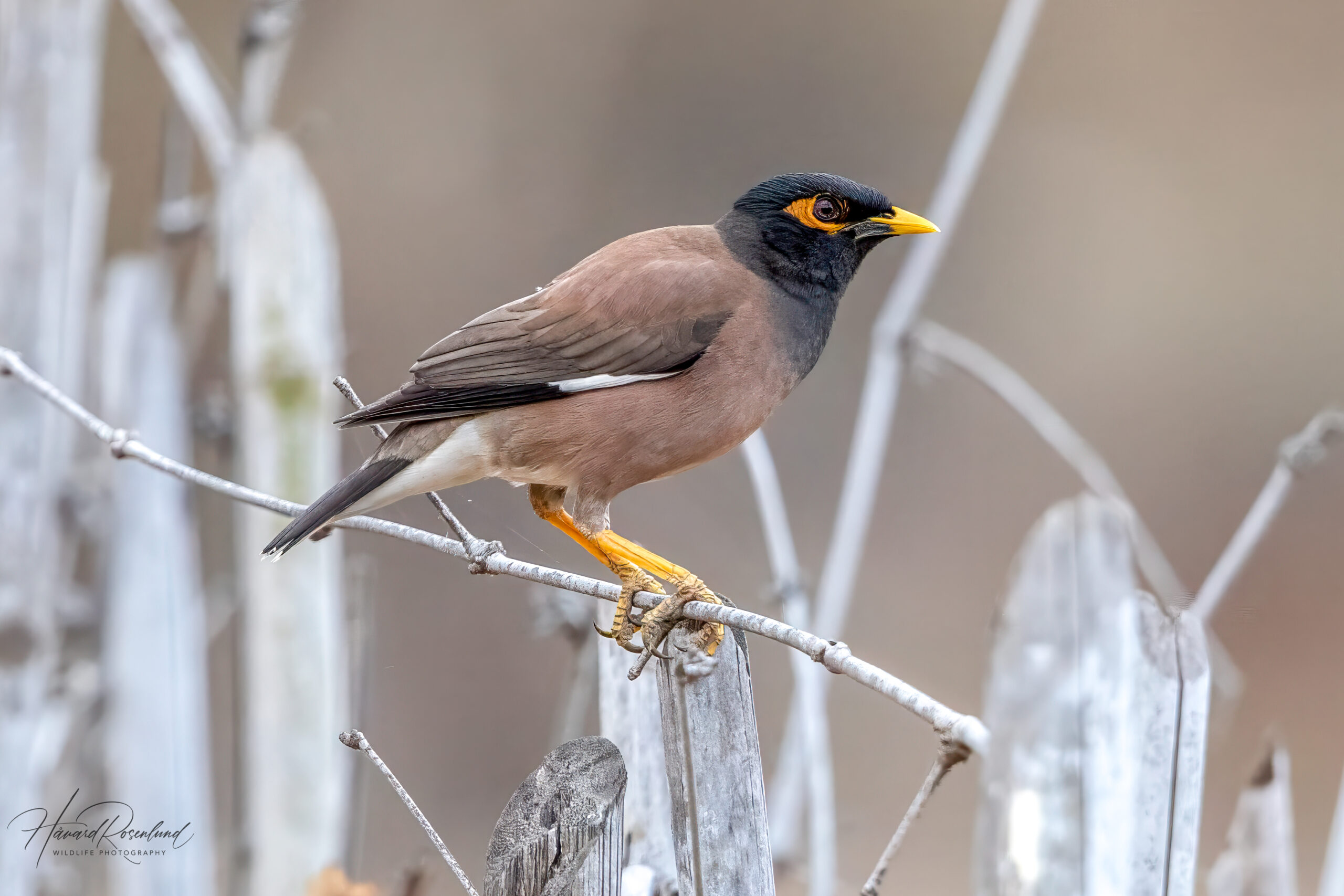
The common myna (Acridotheres tristis) is a medium-sized starling native to South and Southeast Asia. Adults are 23–26 cm long and weigh roughly 82–143 g. The body is rich brown with a glossy black head, bright yellow bill and legs, and a conspicuous patch of bare yellow skin behind the eye. Large white wing patches become especially obvious in flight.
It can be confused with the bank myna (Acridotheres ginginianus) in parts of the native range. Bank mynas are greyer overall and have orange-red bare skin around the eye rather than the bright yellow facial patch of the common myna.
Habitat
Few birds exploit human-modified landscapes as successfully as the common myna. It occurs in villages, cities, farmland, parks, open woodland and around roads, markets and refuse sites, while generally avoiding extensive closed forest. Open ground for feeding, cavities for nesting and predictable food supplies make settlements particularly suitable.
The species also uses more natural open woodland and grassland within its native range, but its abundance often increases sharply where people create lawns, cultivated ground, buildings and concentrated food resources.
Diet
The diet is extremely broad. Common mynas eat insects and other invertebrates, fruit, seeds and other plant material, and readily take discarded human food. Small vertebrates and eggs may also be taken when available.
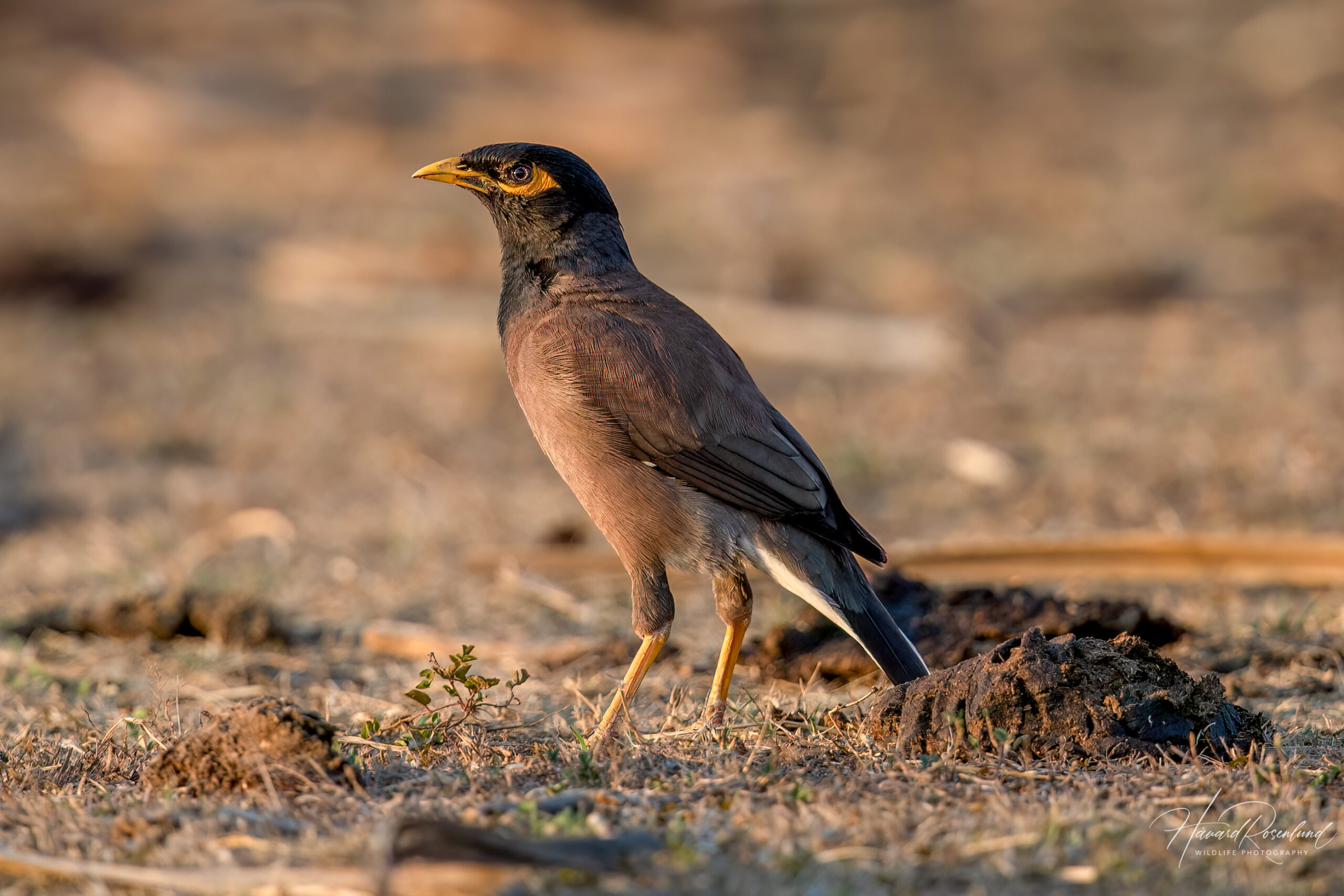
Most feeding takes place on the ground, where the birds walk rather than hop and investigate soil, short vegetation and refuse. They readily exploit temporary food exposed by mowing, cultivation, livestock and human activity and switch easily between natural prey and food associated with people.
Behaviour
Common mynas are highly vocal and use a varied repertoire of whistles, croaks, chattering calls and imitations. These sounds are used throughout the day between pair members, feeding groups and larger gatherings, not only during breeding.
By day the birds are usually encountered in pairs or small groups, but communal roosts can hold dozens to thousands of birds after sunset, especially in towns. A two-year study published in 2014 found little evidence that these roosts simply serve as places where birds discover successful foragers and follow them to food the next morning. The study therefore did not support a simple food-information-centre explanation for communal roosting.
The species is also a flexible learner. A study published in 2017 showed that both urban and rural mynas could abandon a learned choice when it stopped being rewarding and switch to an alternative that now provided the reward. The groups differed in some aspects of the task, but urban birds were not consistently better, so city living does not simply make mynas universally “smarter”.
Breeding
Common mynas form socially monogamous pairs and can remain paired throughout the year. They nest mainly in cavities. Tree holes are used in more natural settings, while buildings, roofs, walls, poles and nest boxes provide abundant alternatives around people. Competition for cavities can be intense, especially where the species has been introduced. Pair interactions include mutual preening and other courtship displays before nesting.
Clutches usually contain 3–6 eggs. Both parents incubate for about 12–14 days and feed the nestlings, which normally remain in the cavity for 22–30 days. Adults continue to feed and protect the young for several weeks after fledging, and in favourable climates a pair may raise more than one brood in a season.
A nest-box study published in 2026 in Pakistan found contrasting patterns between urban and rural sites: rural nestlings grew better, while fledging success was higher at the urban sites studied. Urban and rural conditions therefore did not affect every measure of breeding performance in the same direction.
Introduced populations
People have deliberately or accidentally transported common mynas far beyond their Asian native range. Established introduced populations now occur in Australia, New Zealand, South Africa, many Pacific and Indian Ocean islands and several other regions. Genomic work published in 2023 traced introduced populations to different parts of India rather than to one single source population.
South Africa provides a well-documented example. The population is thought to originate from captive birds that escaped in Durban in 1902 and subsequently spread widely through human-dominated landscapes. Elsewhere, mynas were deliberately introduced for reasons including insect control.
Introduced common mynas can compete with native cavity-nesting birds, prey on eggs or chicks and take over nest sites. A study published in 2025 in Israel documented these effects directly: after common mynas became established, House Sparrow breeding in nest boxes accessible to mynas fell by about 68%, and mynas were also recorded raiding and then occupying Great Tit nests. The magnitude of ecological effects varies between regions, so the species is managed as invasive in several countries even though it remains a normal native bird across South Asia.
Status
The common myna is classified as least concern on the IUCN Red List. It remains widespread and common across much of its native South and Southeast Asian range, and the global population trend appears to be increasing.
Introduced populations may nevertheless be controlled where they compete with native species or cause other ecological problems.
Image gallery
Loading map and observations…
Have you seen this species?
Independent species archive
Did you find this species page useful?
Wildlife Vagabond is independently built and maintained. Voluntary support helps cover hosting, maps, data storage and continued improvements to the species archive.
Support Wildlife VagabondSpecies content will remain freely available.
References
Information about the species’ global distribution and status is based primarily on global Red List data. See the references below for details.
- Atsawawaranunt, K., Ewart, K. M., Major, R. E., Johnson, R. N., Santure, A. W., & Whibley, A. (2023). Tracing the introduction of the invasive common myna using population genomics. Heredity, 131(1), 56-67. https://doi.org/10.1038/s41437-023-00621-w
- BirdLife International. (n.d.). Common Myna species factsheet. https://datazone.birdlife.org/species/factsheet/common-myna-acridotheres-tristis
- Engel, I. F., Izhaki, I., & Charter, M. (2025). Effects of the Invasive Common Myna (Acridotheres tristis) on Nest Site Competition and Predation in Native Birds: A Before-After-Control-Impact Study. Biology, 14(7), 828. https://doi.org/10.3390/biology14070828
- Federspiel, I. G., Garland, A., Guez, D., Bugnyar, T., Healy, S. D., Güntürkün, O., & Griffin, A. S. (2017). Adjusting foraging strategies: a comparison of rural and urban common mynas (Acridotheres tristis). Animal Cognition, 20(1), 65–74. https://doi.org/10.1007/s10071-016-1045-7
- International Union for Conservation of Nature. (n.d.). Common Myna. The IUCN Red List of Threatened Species. https://www.iucnredlist.org/species/22710921/111063735
- Kannan, R., & James, D. A. (2020). Common Myna (Acridotheres tristis). In Birds of the World. Cornell Lab of Ornithology. https://doi.org/10.2173/bow.commyn.01
- Peacock, D. S., van Rensburg, B. J., & Robertson, M. P. (2007). The distribution and spread of the invasive alien common myna, <i>Acridotheres tristis</i> L. (Aves: Sturnidae), in southern Africa. South African Journal of Science, 103(11–12), 465–473. https://www.biodiversitylibrary.org/page/40028609
- Sadam, A., Hu, H., & Liang, W. (2026). Breeding ecology of the common myna Acridotheres tristis : rural nestlings exhibit enhanced growth compared to urban conspecifics. Journal of Avian Biology, 2026(1), e03545. https://doi.org/10.1002/jav.03545
- Sarangi, M., Ganguly, P., Zenia, Arvind, C., Lakshman, A., & Vidya, T. N. C. (2014). Common Myna Roosts Are Not Recruitment Centres. PLoS ONE, 9(8), e103406. https://doi.org/10.1371/journal.pone.0103406