
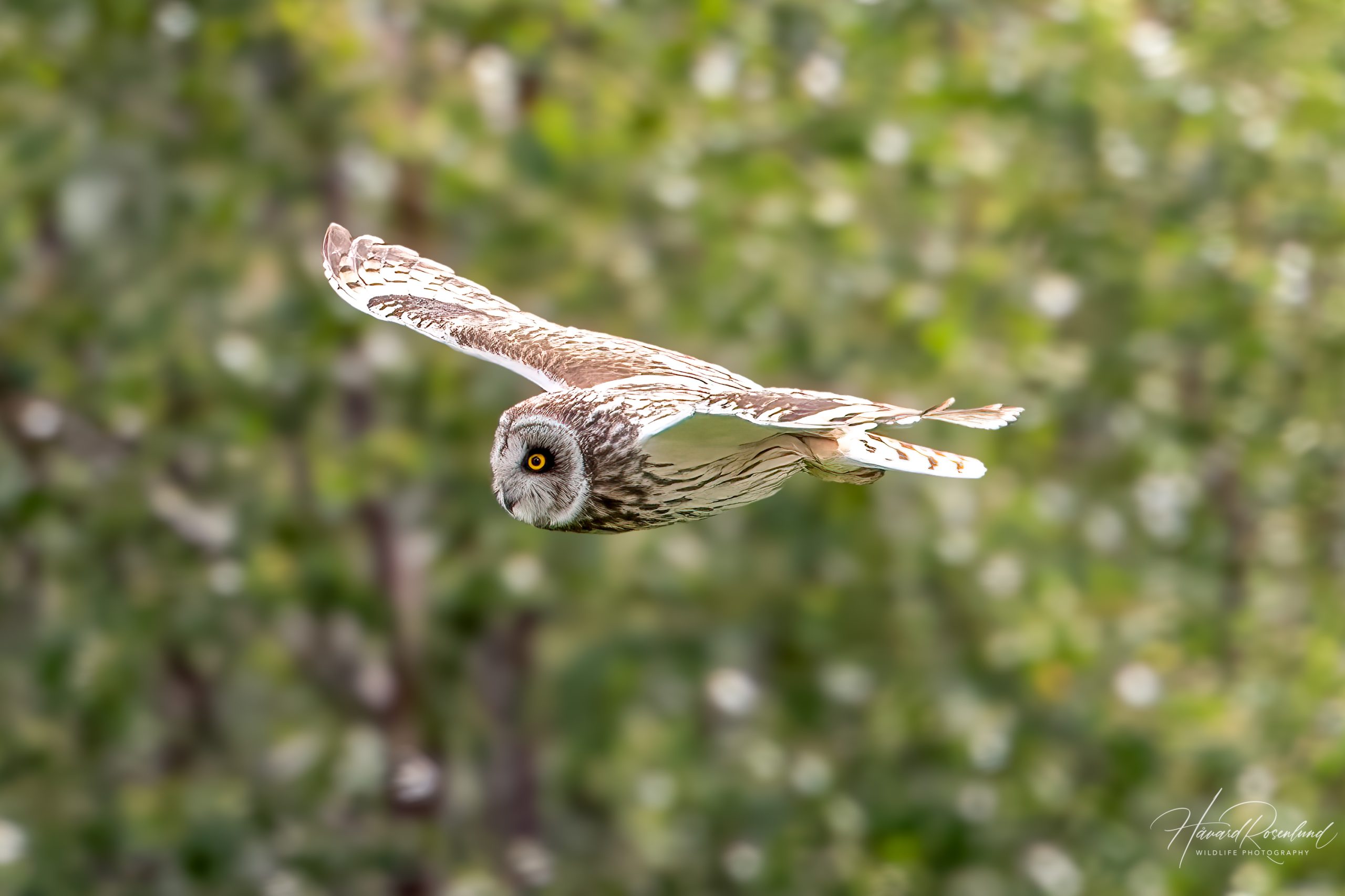
Short-eared Owl
Asio flammeus
At a glance
Habitat
- Open grasslands, marshes, moorland, tundra and farmland with abundant small mammals
Diet
- Mainly voles and other small rodents; also other small mammals and birds
Activity
- Active by day and night; hunting times closely track prey activity
Size
- Length: ~34–43 cm Weight: ~206–475 g
Range
- North and South America, Europe, Asia, parts of North Africa and many oceanic islands; northern populations are migratory or nomadic
Description
The short-eared owl (Asio flammeus) is a medium-sized owl of open landscapes and one of the most widely distributed owls in the world. Adults are roughly 34–43 cm long, have a wingspan of about 86–110 cm and weigh around 206–475 g. Females are generally larger than males. The plumage is mottled brown, buff and cream, and the small ear tufts are often so flattened that they are difficult to see.
The similar long-eared owl (Asio otus) has much more obvious ear tufts and is more strongly associated with woodland and trees. Short-eared owls have a rounder-looking head, striking yellow eyes surrounded by dark patches and longer, paler wings suited to their low hunting flights over open ground.
Habitat
Short-eared owls depend on open landscapes that can support high numbers of small mammals. Breeding habitat includes grassland, marshes, moorland, tundra, coastal wetlands and open farmland. Unlike most owls, they nest directly on the ground, so areas must provide both prey-rich hunting grounds and enough vegetation to conceal the nest.
A GPS-tracking study published in 2024 found that habitat use could differ between regions. In Britain, tracked owls tended to hunt more over grass patches within moorland, while birds using Norway spent more time hunting over dwarf-shrub vegetation. The difference probably reflects where small mammals are most available, showing that the owls can switch hunting habitats according to local conditions rather than relying on one fixed vegetation type.
Diet
Short-eared owls are small-mammal specialists. Voles are particularly important through much of the range, with mice, lemmings and shrews also taken. Small birds and other prey become more important when rodents are scarce. Because vole abundance can rise and crash dramatically, food availability can change over a large region within a short time.
Hunting
Short-eared owls hunt mainly by flying slowly and buoyantly a few metres above open ground, mixing long glides with sudden turns. Acute hearing helps them locate small mammals moving within grass and other vegetation before they drop rapidly onto them; where suitable lookout points exist they can also hunt from a perch.
A field study published in 1999 on Orkney found that hunting activity closely followed peaks in vole activity. This helps explain why the species can be conspicuously diurnal at some seasons but much more nocturnal at others, rather than following one fixed day–night schedule.
Behaviour
Outside the breeding season the species is less territorial, and several birds may gather in the same rich feeding area or use communal roosts.
Migration
Movement in the short-eared owl is better described as partly migratory and strongly nomadic than as a simple seasonal journey between two fixed places. In northern regions many birds move south in winter, but individuals can also cross huge distances between years as they search for areas with abundant vole populations.
A 2024 GPS study followed 47 owls from Iceland, Scotland and Spain. Among birds tracked through more than one breeding season, the distance between successive nesting areas ranged from only 41 km to an extraordinary 4,216 km. Birds showed little loyalty to either breeding or non-breeding areas, showing how mobile the species can be as it follows changing feeding opportunities.
Breeding
During courtship, males perform conspicuous aerial displays that can include steep climbs, dives and rapid wing-clapping beneath the body. The short-eared owl is one of the few owls that regularly nests on the ground. The female makes a shallow nest among grass, heather or other low vegetation and commonly lays four to seven eggs, although larger clutches can occur during exceptional rodent years. Incubation lasts about 26 days, with the male supplying much of the food while the female incubates and cares for small chicks. The young often leave the nest on foot at around two weeks old and hide in nearby vegetation, but usually do not fledge until they are about four weeks old.
The same 2024 tracking study revealed an interesting division of parental care. In most of 18 successful breeding attempts followed in detail, females left the breeding area after the youngest chicks were old enough to cope without constant warming but before they were fully independent. The male then completed much of the remaining care. This may allow females to begin moving towards other feeding or breeding opportunities unusually early.
Status
The short-eared owl is classified as least concern on the IUCN Red List. It has an enormous range, but populations are declining or fluctuating strongly in many regions. Loss of grasslands, marshes and other open habitat, agricultural intensification and changes in land management can reduce both nesting cover and small-mammal prey.
Its nomadic behaviour also makes population trends difficult to measure. A site can hold many breeding owls in one rodent-rich year and almost none in another, even when the habitat has not deteriorated. A single season at one site therefore says little about the long-term population trend.
Image gallery
Loading map and observations…
Have you seen this species?
Independent species archive
Did you find this species page useful?
Wildlife Vagabond is independently built and maintained. Voluntary support helps cover hosting, maps, data storage and continued improvements to the species archive.
Support Wildlife VagabondSpecies content will remain freely available.
References
Information about the species’ global distribution and status is based primarily on global Red List data. See the references below for details.
- Artsdatabanken. (2021). Jordugle, Norsk rødliste 2021. https://lister.artsdatabanken.no/rodlisteforarter/2021/28170
- BirdLife International. (n.d.). Short-eared Owl species factsheet. https://datazone.birdlife.org/species/factsheet/short-eared-owl-asio-flammeus
- Calladine, J., du Feu, C., & du Feu, R. (2012). Changing migration patterns of the Short-eared Owl Asio flammeus in Europe: an analysis of ringing recoveries. Journal of Ornithology, 153(3), 691-698. https://doi.org/10.1007/s10336-011-0786-y
- Calladine, J., Hallgrimsson, G. T., Morrison, N., Southall, C., Gunnarsson, H., Jubete, F., Sergio, F., & Mougeot, F. (2024). Remote tracking unveils intercontinental movements of nomadic Short‐eared Owls (Asio flammeus) with implications for resource tracking by irruptive specialist predators. Ibis, 166(3), 896-908. https://doi.org/10.1111/ibi.13304
- Calladine, J., Southall, C., Wetherhill, A., & Morrison, N. (2024). Use of dwarf shrubland–grassland mosaics by a nomadic predatory bird: the Short-eared Owl Asio flammeus. Journal of Ornithology, 165(4), 1039-1049. https://doi.org/10.1007/s10336-024-02174-z
- Cornell Lab of Ornithology. (n.d.). Short-eared Owl identification and measurements. https://www.allaboutbirds.org/guide/Short-eared_Owl/id
- International Union for Conservation of Nature. (n.d.). Short-eared Owl. The IUCN Red List of Threatened Species. https://www.iucnredlist.org/species/22689531/202226582
- Reynolds, P., & Gorman, M. L. (1999). The timing of hunting in short‐eared owls (Asio flammeus) in relation to the activity patterns of Orkney voles (Microtus arvalis orcadensis). Journal of Zoology, 247(3), 371-379. https://doi.org/10.1111/j.1469-7998.1999.tb01000.x
- Store norske leksikon. (n.d.). jordugle. https://snl.no/jordugle