
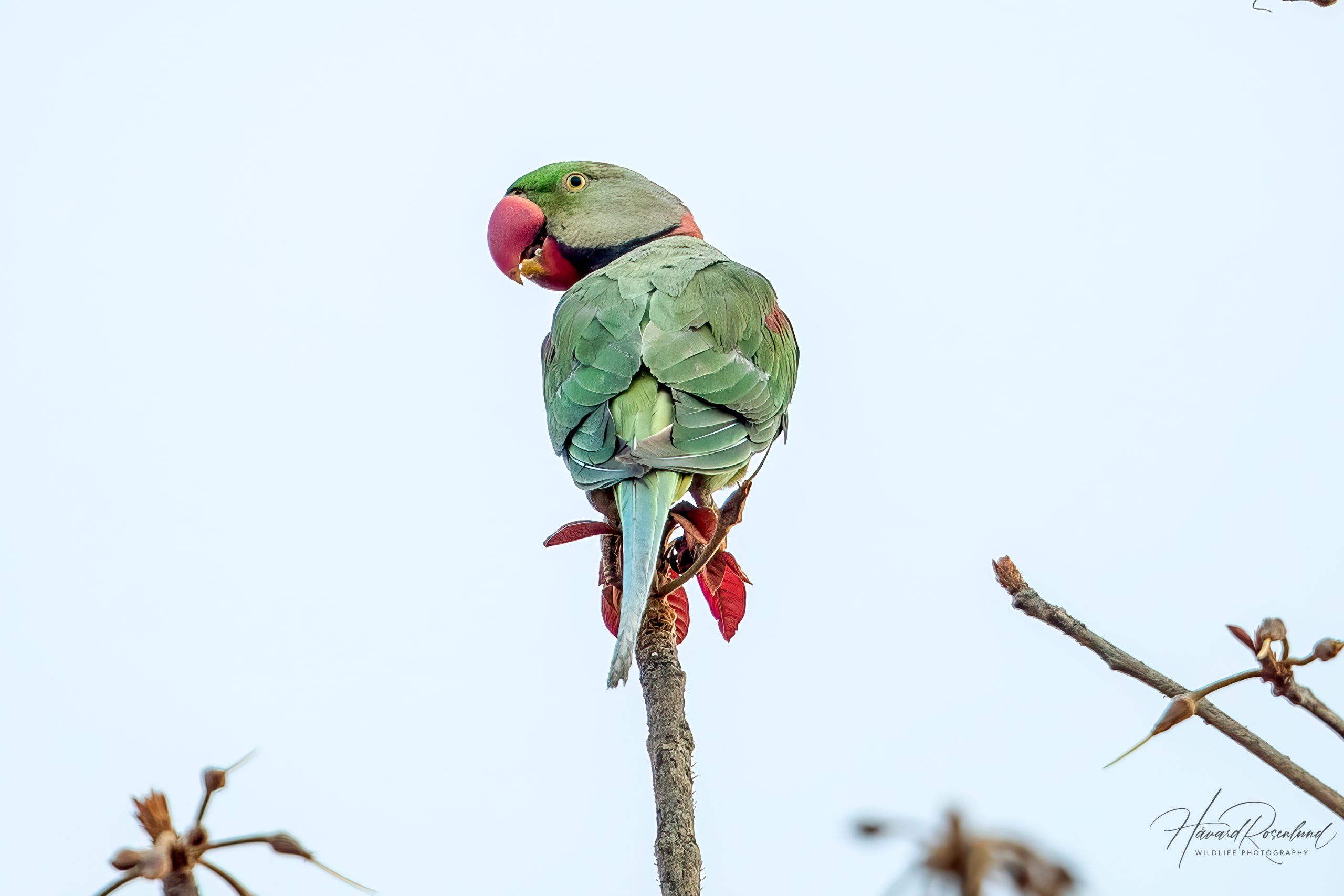
Alexandrine Parakeet
Psittacula eupatria
At a glance
Habitat
- Forest, woodland, wooded farmland, plantations and tree-rich urban landscapes
Diet
- Seeds, fruit, nuts, buds, flowers and cultivated crops
Activity
- Diurnal
Size
- Length: about 56–62 cm Weight: about 200–300 g
Range
- South Asia from Pakistan and India to Sri Lanka, extending east through Myanmar and parts of mainland Southeast Asia
Description
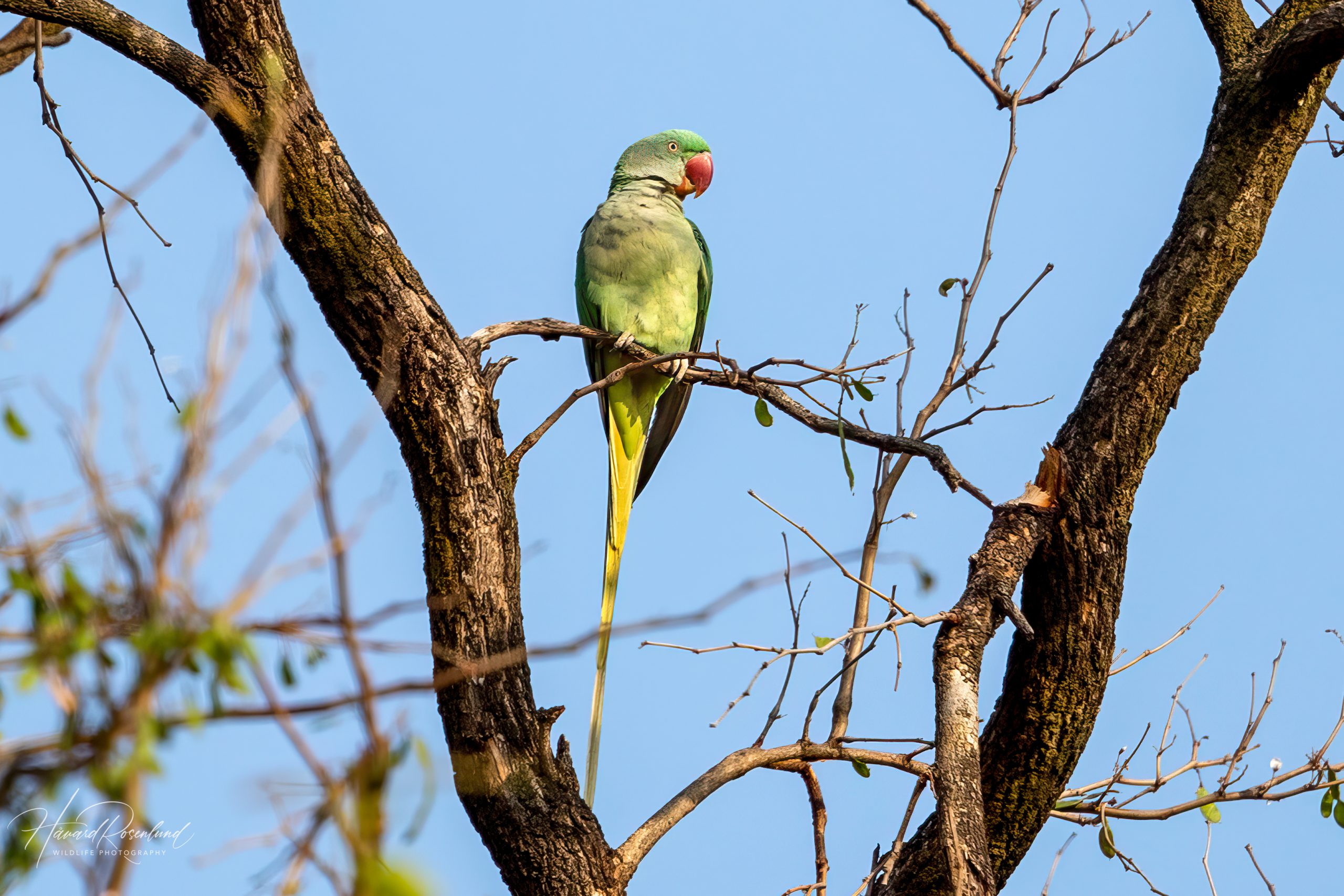
The Alexandrine parakeet (Psittacula eupatria) is one of the largest long-tailed parakeets, measuring about 56–62 cm from bill to tail tip and weighing roughly 200–300 g. The body is predominantly green, with a massive red bill and a distinctive maroon shoulder patch. Adult males develop a black-and-rose neck ring, while females and young birds lack the complete ring.
It can be confused with the smaller rose-ringed parakeet (Psittacula krameri), but Alexandrine parakeets are noticeably larger and heavier-billed and, in all adult plumages, show the diagnostic maroon patch on the wing. Much of the total body length is formed by the long graduated tail.
Habitat
Alexandrine parakeets use a wide range of tree-rich habitats, including dry and moist forest, open woodland, wooded farmland, plantations, parks and urban areas with mature trees. In India the species is resident and occurs in both forest and plantation landscapes.
The presence of old cavity-bearing trees is particularly important because the species nests in holes rather than building an exposed nest. Retaining mature trees can therefore be important even in rural and increasingly developed landscapes where the birds otherwise find ample food.
Diet
The diet is mainly plant-based and includes seeds, fruit, nuts, buds and flowers. The heavy bill can crack large hard seeds and tear open fruit, and birds also feed on grain and other cultivated crops where these are locally abundant.
Foraging often takes place in groups in the canopy or on fruiting and seed-bearing trees. The ability to exploit both native foods and crops helps the species persist in many modified landscapes, although feeding in agricultural areas can also bring it into conflict with people.
Behaviour
Alexandrine parakeets make regular daily movements between feeding areas and resting sites, often travelling some distance across open ground between patches of suitable trees. During breeding, these movements become more centred on the nest area as pairs repeatedly return to suitable cavities.
Social behaviour
Alexandrine parakeets are strongly social and are commonly seen in pairs or flocks. Groups keep contact with loud, carrying calls and often gather at communal roosts, where many birds may converge toward evening before dispersing again after sunrise.
Outside the breeding season, flocking helps birds locate patchy food sources and maintain contact while moving over large areas. During breeding, pairs become more closely tied to nest sites, but remain highly vocal and may nest where several suitable cavities occur relatively close together.
Breeding
Breeding timing varies across the range but falls mainly between November and April in much of South Asia. Pairs use natural cavities in large trees, and suitable nest holes may be reused between years. The female normally lays two to four eggs and carries out most of the incubation, while the male provides food. Both parents feed the chicks after hatching.
A field study published in 2019 followed 18 nests at Shwesettaw Wildlife Area in Myanmar. Breeding there ran from December to April, clutches contained two or three eggs, and the female alone incubated. Published incubation estimates vary; this study reported 23–28 days. Young generally leave the nest at around seven weeks.
Because the species depends on existing tree cavities, the survival of mature cavity-bearing trees can limit breeding opportunities. Removal of old trees can therefore reduce nesting habitat even in landscapes that still provide abundant feeding opportunities.
Relationship with humans
The English name has long been associated with Alexander the Great. Traditional accounts connect Alexander with the arrival of Asian parrots in the Mediterranean world, although the details are not securely documented and are better treated as historical tradition than established fact. Alexandrine parakeets have nevertheless been kept and traded as cagebirds for centuries.
A study published in 2023 analysed media-reported bird seizures in India from 2010 to 2020 and found the Alexandrine parakeet to be the third most frequently recorded native parrot species. The species is protected under Indian wildlife legislation and is listed in CITES Appendix II, which regulates international commercial trade. Illegal capture and domestic trade remain concerns, especially because chicks can be taken directly from nest cavities.
Status
The Alexandrine parakeet is classified as least concern on the IUCN Red List. In 2025, the global category was changed from near threatened to least concern; the earlier category had reflected heavy trapping and declines in parts of the range.
The reassessment reflects particularly strong evidence of population growth in India, which holds a large part of the global population. State of India’s Birds 2025 estimates a long-term national increase of about 137.7% and a recent annual increase of about 6.33%. At the same time, trapping and loss of suitable nesting trees continue to affect populations in parts of South and Southeast Asia.
Image gallery
Loading map and observations…
Have you seen this species?
Independent species archive
Did you find this species page useful?
Wildlife Vagabond is independently built and maintained. Voluntary support helps cover hosting, maps, data storage and continued improvements to the species archive.
Support Wildlife VagabondSpecies content will remain freely available.
References
Information about the species’ global distribution and status is based primarily on global Red List data. See the references below for details.
- AviList. (n.d.). Psittacula eupatria. https://www.avilist.org/
- BirdLife International. (n.d.). Alexandrine Parakeet species factsheet. https://datazone.birdlife.org/species/factsheet/alexandrine-parakeet-palaeornis-eupatria
- Convention on International Trade in Endangered Species of Wild Fauna and Flora. (n.d.). CITES – Appendices. https://cites.org/eng/app/appendices.php
- India Code. (n.d.). Wild Life (Protection) Act, 1972. https://www.indiacode.nic.in/handle/123456789/1726
- International Union for Conservation of Nature. (n.d.). Alexandrine Parakeet. The IUCN Red List of Threatened Species. https://www.iucnredlist.org/species/22685434/241494588
- International Union for Conservation of Nature. (n.d.). Psittacula eupatria. The IUCN Red List of Threatened Species. https://www.iucnredlist.org/species/22685434
- Kalra, S., Davies, A., Martin, R. O., & Poonia, A. (2024). Insights from the media into the bird trade in India: an analysis of reported seizures. Oryx, 58(1), 69-77. https://doi.org/10.1017/S0030605322001594
- Khaing, T. T., & Mar, K. M. (2019). Reproductive performance of Alexandrine Parakeet, <i>Psittacula eupatria</i> (Linnaeus). International Journal of Innovative Science and Research Technology, 4(6), 228–231. https://ijisrt.com/wp-content/uploads/2019/06/IJISRT19JU299.pdf
- State of India's Birds. (2025). State of India’s Birds 2025 – Alexandrine Parakeet. https://stateofindiasbirds.in/species/alepar2/
- World Parrot Trust. (n.d.). Alexandrine Parakeet. https://parrots.org/encyclopedia/alexandrine-parakeet/