
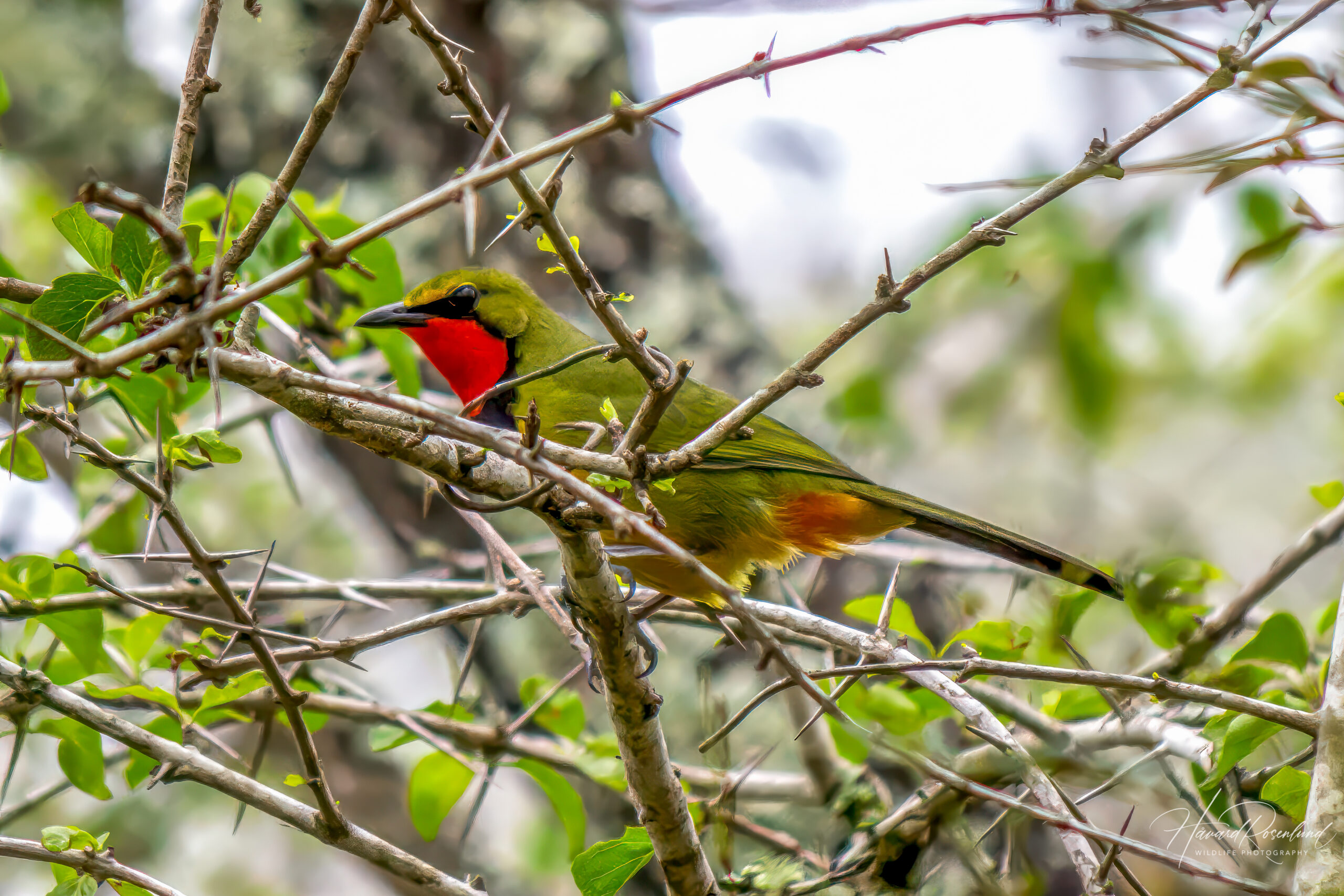
Gorgeous Bushshrike
Telophorus viridis
At a glance
Habitat
- Dense thickets, riverine woodland, forest edges, coastal evergreen forest and wooded drainage lines
Diet
- Mainly insects and other arthropods gleaned from foliage
Activity
- Diurnal; usually remains concealed within dense vegetation
Size
- Length: About 19 cm Weight: About 36–37 g
Range
- Patchily distributed from parts of west-central and eastern Africa south through Mozambique, Zimbabwe, Eswatini and eastern South Africa
Description
The gorgeous bushshrike (Telophorus viridis) is a brilliantly coloured but secretive African bushshrike, about 19 cm long and weighing 36–37 g. Adult males have olive-green upperparts, a yellow forehead and eyebrow, a bright red throat and upper breast and a broad black breast-band above the yellow to orange belly. Females are similar but generally greener and have a narrower black breast-band. In the southern quadricolor form, reddish-orange also appears around the base of the tail and on the undertail coverts.
Despite its striking plumage, the bird is rarely seen in the open for long because it spends much of its time inside dense vegetation.
Taxonomy
The taxonomy and English names have changed over time. Forms formerly known as Perrin’s bushshrike and four-coloured bushshrike have sometimes been treated as separate species, but the current AviList treatment includes them within one species, Telophorus viridis, with four recognised subspecies.
Birds in eastern South Africa and Eswatini belong to T. v. quadricolor, including the individuals photographed on this page.
Habitat
Gorgeous bushshrikes favour dense thickets and woodland with a well-developed shrub layer, including riverine woodland, wooded drainage lines, forest edges and coastal evergreen forest. They are resident and remain closely associated with thick cover.
Diet
The diet consists mainly of insects and other arthropods, including beetles, caterpillars, mantids, wasps and bees. Much of the foraging takes place in the canopy, where birds move methodically through foliage and glean prey from leaves and branches, usually without leaving dense cover for long.
Behaviour
Gorgeous bushshrikes are usually encountered alone or in pairs and can remain almost invisible even when calling only a few metres away. When approached, a bird may freeze and become silent rather than moving into the open.
The loud, carrying whistle is therefore one of the best ways to locate the species. The call is often rendered as kong-koit or kong-kon-koweet and can be repeated for long periods from within cover. It can make the bird seem much more common by ear than by sight. The contrast between its powerful calls and extremely secretive behaviour is one of its most characteristic field traits.
Breeding
Both adults build a shallow cup nest from fine twigs, rootlets, leaf stalks and grass, sometimes binding the material with spider web. The nest is usually placed low in a thorny tree or dense tangle, often about 1–2 m above the ground, where surrounding foliage provides strong concealment.
One to three eggs are laid, and both parents incubate for about 13–14 days. Both adults also care for the chicks after hatching. In one documented nesting, the young left the nest after 12 days, but how long chicks usually remain in the nest is still poorly known. Southern African breeding records peak in spring and early summer, particularly from October to December.
Status
The gorgeous bushshrike is classified as least concern on the IUCN Red List. It has a broad but patchy African distribution and remains locally common in suitable dense woodland and thicket.
The global population has not been quantified precisely. Clearance and fragmentation of dense thicket and riverine woodland can reduce local habitat, but no major range-wide decline is currently known.
Image gallery
Loading map and observations…
Have you seen this species?
Independent species archive
Did you find this species page useful?
Wildlife Vagabond is independently built and maintained. Voluntary support helps cover hosting, maps, data storage and continued improvements to the species archive.
Support Wildlife VagabondSpecies content will remain freely available.
References
Information about the species’ global distribution and status is based primarily on global Red List data. See the references below for details.
- AviList. (2026). The Global Avian Checklist, v2025b. https://www.avilist.org/checklist/v2025b/
- Biodiversity Explorer. (n.d.). Telophorus viridis: habitat, food and breeding in southern Africa. Iziko Museums of South Africa. https://www.biodiversityexplorer.info/birds/malaconotidae/telophorus_viridis.htm
- BirdLife International. (n.d.). Gorgeous Bushshrike Telophorus viridis species factsheet. https://datazone.birdlife.org/species/factsheet/gorgeous-bushshrike-telophorus-viridis
- International Union for Conservation of Nature. (n.d.). Telophorus viridis (Gorgeous Bushshrike). The IUCN Red List of Threatened Species. https://www.iucnredlist.org/species/103707122/94134112