
Grey-headed Bushshrike
Malaconotus blanchoti
At a glance
Habitat
- Wooded savanna, broadleaved woodland, thornveld, riverine forest, thickets, plantations and large gardens
Diet
- Large insects and other invertebrates plus reptiles, birds, bats and other small vertebrates
Activity
- Diurnal; forages slowly through trees and dense woodland
Size
- Length: 23–26 cm Weight: 65–99 g
Range
- Widespread but patchy across much of sub-Saharan Africa
Description
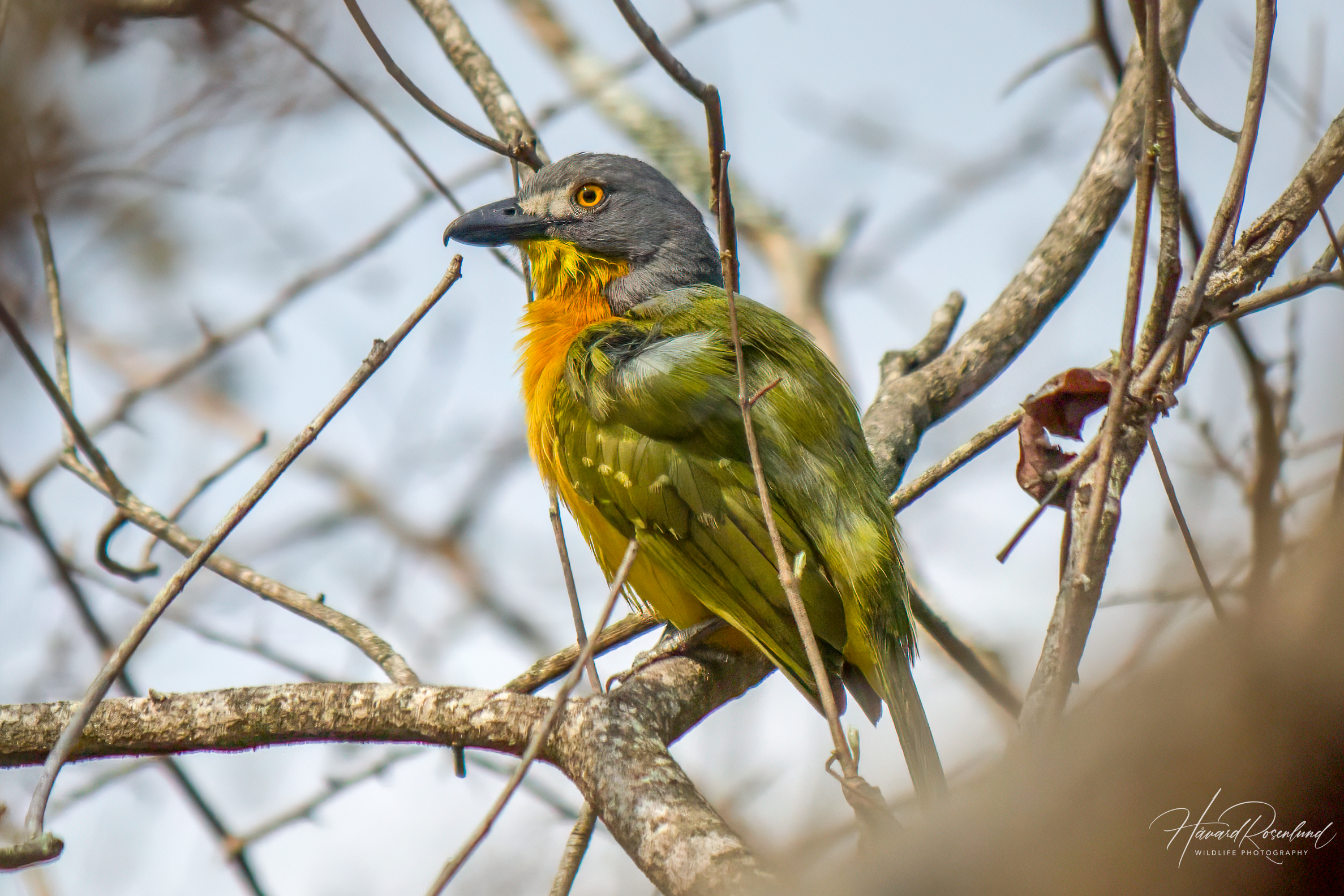
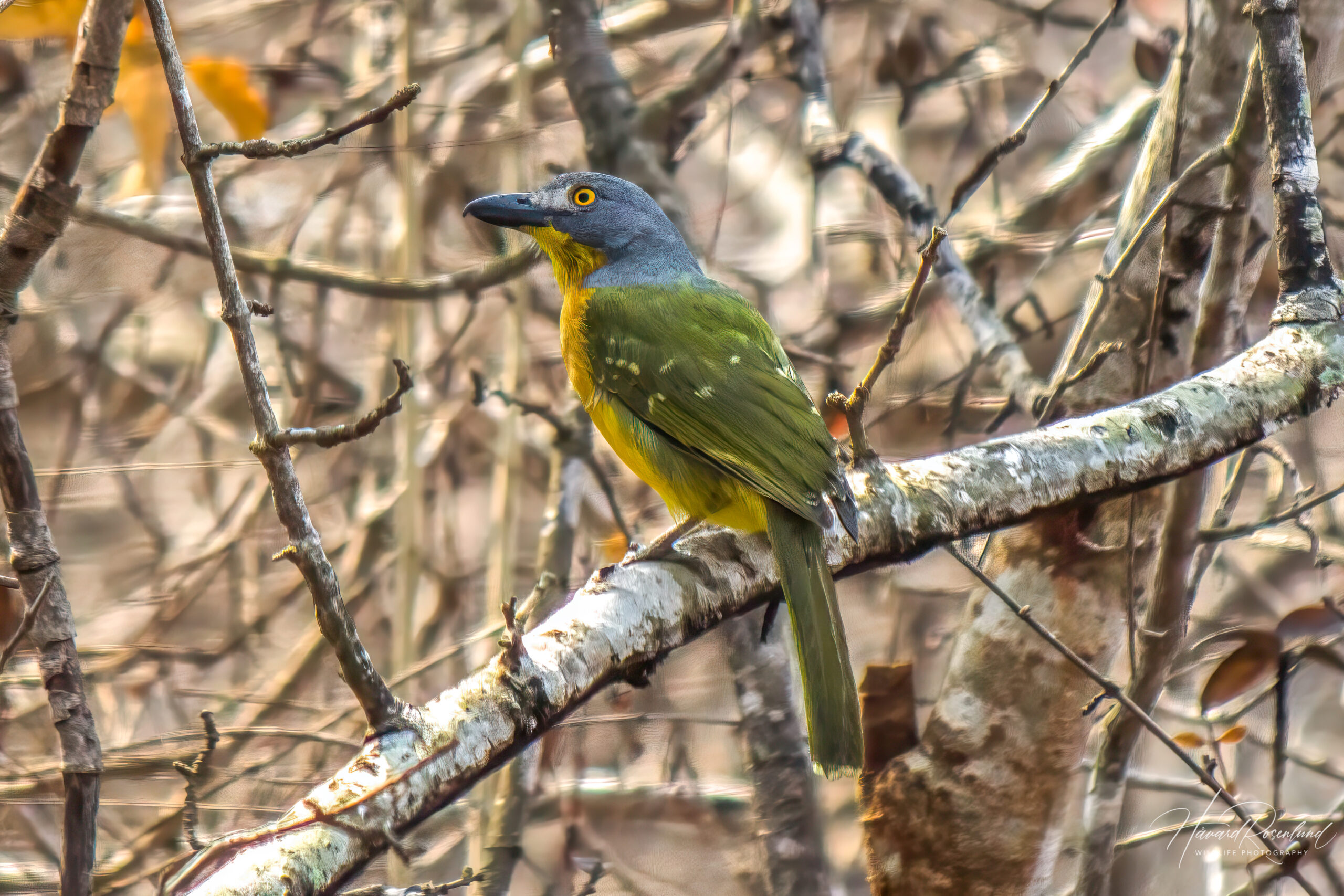
The grey-headed bushshrike (Malaconotus blanchoti) is one of Africa’s largest and most powerfully built bushshrikes. Adults are about 23–26 cm long and weigh 65–99 g. The massive head and strongly hooked black bill give the bird an almost raptor-like profile, while the plumage combines a grey head and neck, olive-green upperparts and yellow to orange-yellow underparts. The eyes are bright yellow.
Several subspecies occur across sub-Saharan Africa and differ in the tone and extent of yellow, orange and olive in the plumage. All are still treated as one widespread species in current major checklists.
Habitat
The species lives in wooded savanna, broadleaved woodland, thornveld, riverine forest and dense thickets and can also occur in plantations and large gardens where enough natural cover remains.
Diet
Large insects and other invertebrates form an important part of the diet, but grey-headed bushshrikes also take lizards, chameleons, geckos, snakes, small birds, bats and other small vertebrates.
Hunting
Grey-headed bushshrikes move slowly and deliberately through woodland, searching leaves, branches and dense foliage for prey. Their powerful hooked bill allows them to subdue unusually large animals for a songbird.
Recorded snake prey can approach one metre in length. Large prey may be torn into smaller pieces before being swallowed, and the birds sometimes impale food on thorns, creating a temporary store that can be returned to later.
Behaviour
Birds are usually encountered alone or in pairs and seldom join mixed feeding flocks. Their secretive movements through dense foliage can make them difficult to see even where they are present.
The low, prolonged whistle is one of the characteristic sounds of African woodland and may be repeated dozens of times in succession. It is often rendered as a long whhooooooo, and its mournful quality explains the Afrikaans name Spookvoël, meaning “ghost bird”. Pairs can exchange calls or sing together, while harsher clicks, rasps and screams are used at closer range.
Breeding
In southern Africa, egg-laying is recorded from about August to January, with a peak from September to November. The male gathers much of the nesting material while the female constructs a shallow, fragile cup of grass, leaves, twigs and finer plant fibres, usually in the fork of a deciduous tree about 3–6 m above the ground. Abandoned nests of doves, turacos and goshawks may occasionally be reused.
Two to four eggs are laid. The female incubates alone while the male supplies food. After hatching, the female usually broods the chicks while the male hunts and brings food; males have occasionally been recorded taking a turn at brooding. The young usually leave the nest after about 20–24 days and may remain within their parents’ territory for up to a year afterwards.
Status
The grey-headed bushshrike is classified as least concern on the IUCN Red List. It has a very large distribution across sub-Saharan Africa and remains locally common in many wooded habitats, even though its secretive habits and relatively low densities can make it seem scarce.
No precise global population estimate is available. Woodland clearance, removal of dense riverine vegetation and other habitat changes can affect local populations, but no major decline across the full range is currently known.
Image gallery
Loading map and observations…
Have you seen this species?
Independent species archive
Did you find this species page useful?
Wildlife Vagabond is independently built and maintained. Voluntary support helps cover hosting, maps, data storage and continued improvements to the species archive.
Support Wildlife VagabondSpecies content will remain freely available.
References
Information about the species’ global distribution and status is based primarily on global Red List data. See the references below for details.
- Biodiversity Explorer. (n.d.). Grey-headed Bushshrike. Iziko Museums of South Africa. https://www.biodiversityexplorer.info/birds/malaconotidae/malaconotus_blanchoti.htm
- BirdLife International. (n.d.). Grey-headed Bushshrike species factsheet. https://datazone.birdlife.org/species/factsheet/grey-headed-bushshrike-malaconotus-blanchoti
- Fry, H. (2020). Gray-headed Bushshrike (Malaconotus blanchoti). Birds of the World. https://doi.org/10.2173/bow.gyhbus1.01
- International Union for Conservation of Nature. (n.d.). Grey-headed Bushshrike. The IUCN Red List of Threatened Species. https://www.iucnredlist.org/species/22707735/94135564
- Oiseaux.net. (n.d.). Grey-headed Bushshrike. https://www.oiseaux.net/en/grey-headed.bushshrike.html