
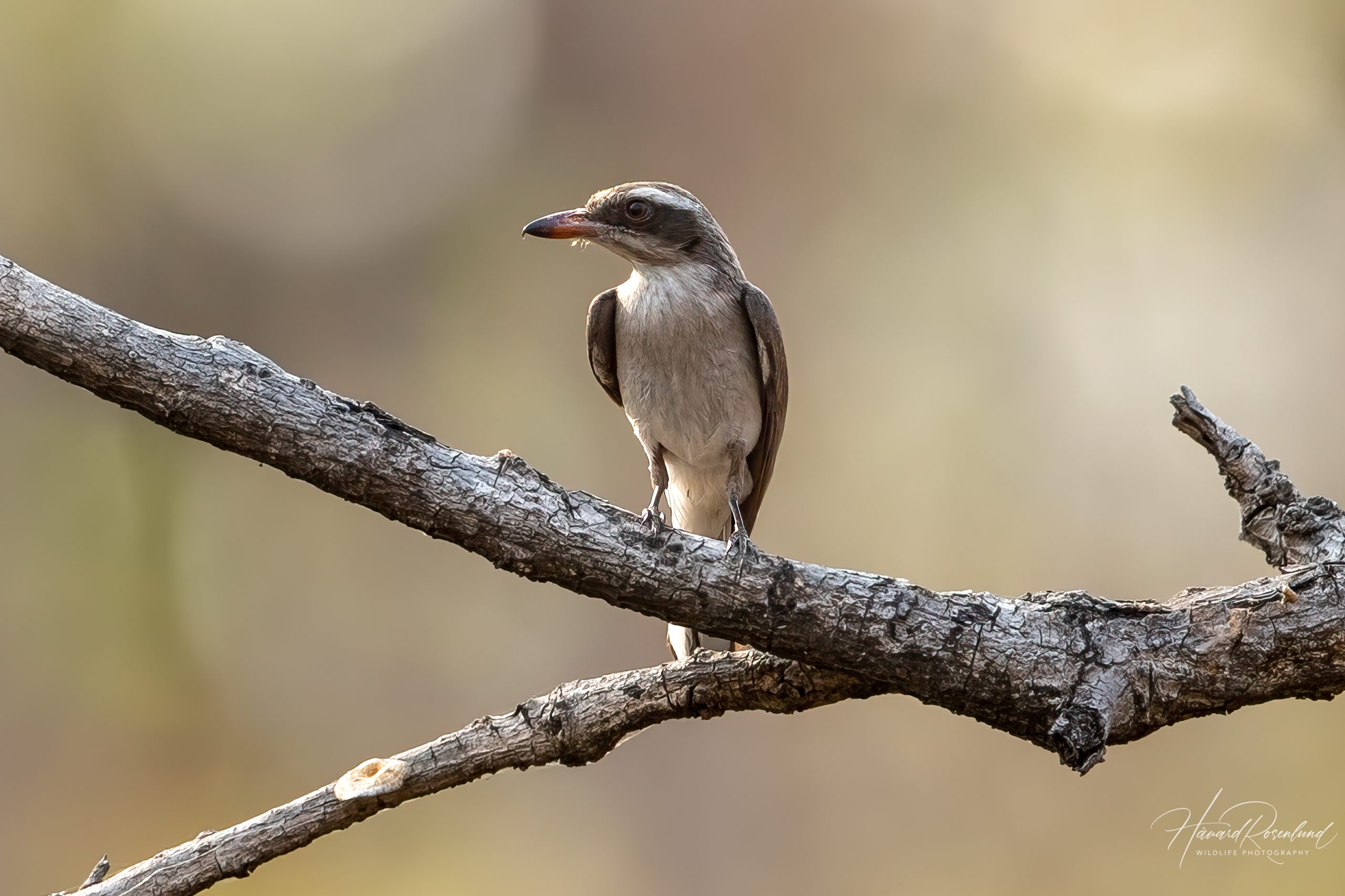
Common Woodshrike
Tephrodornis pondicerianus
At a glance
Habitat
- Dry and open woodland, deciduous forest, scrub, wooded farmland, forest edges and gardens
Diet
- Mainly insects and other small invertebrates; fruit taken occasionally
Activity
- Diurnal
Size
- Length: 13–18 cm Weight: about 20–22 g
Range
- South Asia east to mainland Southeast Asia; Sri Lankan birds are now treated as a separate species
Description
The common woodshrike (Tephrodornis pondicerianus) is a small, robust songbird of South Asia and mainland Southeast Asia. It has a large head, stout slightly hooked bill and mostly ash-grey to grey-brown plumage, with a broad pale eyebrow above a dark mask through the eye. Adults are roughly 13–18 cm long and weigh about 20–22 g.
The Sri Lankan population once included within this species is now recognised as the separate Sri Lanka woodshrike (Tephrodornis affinis) in AviList. The common woodshrike therefore has a more northerly, mainland-centred range than older sources that treated the two together.
Habitat
Common woodshrikes use dry and open woodland, deciduous forest, scrub, wooded farmland, plantations, forest edges and gardens. They tolerate a fair amount of habitat modification as long as trees and shrubs remain available for foraging, nesting and cover.
They are generally birds of open tree cover rather than dense closed forest. This flexibility allows them to persist close to settlements and in agricultural mosaics, although extensive removal of trees and scrub reduces suitable habitat.
Diet
The diet consists mainly of insects and other small invertebrates. Birds search leaves, twigs, branches and bark, make short aerial sallies after flying prey and sometimes descend to the ground. Small fruits and berries are taken occasionally.
Foraging is active and mobile, with birds moving through several vegetation layers rather than remaining at one fixed height. They also frequently forage alongside other insect-eating birds in mixed-species flocks.
Behaviour
Common woodshrikes are usually encountered in pairs or small groups and frequently join mixed-species feeding flocks with other insect-eating birds.
They often flick or raise the wings after landing, a conspicuous movement that can help reveal an otherwise unobtrusively coloured bird. Pairs keep in contact with clear whistles and rapid repeated notes as they move through trees and scrub.
Breeding
In much of India breeding extends from about February to July. The small cup nest is fixed to a branch or fork and built from fine plant fibres, roots and bark, bound with spider web and often camouflaged externally with bark fragments or lichen. Both sexes take part in nest building and incubation.
Clutches contain two to four eggs, with three usual, and incubation lasts about 14–16 days. A note published in 2005 described an unusual division of parental care in which only the female was observed feeding the young, although both sexes incubated; nestlings were given insects and berries. The birds can become strongly territorial around nests. The age at which the young first fly is less well established.
Status
The common woodshrike is classified as least concern on the IUCN Red List and remains widespread across a large range.
State of India's Birds 2025 estimates a long-term national decline of about 45.73%, with an uncertainty interval of −55.3 to −34.3%. The recent annual estimate is +1.08%, but its interval of −0.40 to +2.56% crosses zero, so there is no clear recent national trend. The species still occurs widely in India but depends on landscapes that retain trees, scrub and structurally varied open woodland.
Image gallery
Loading map and observations…
Have you seen this species?
Independent species archive
Did you find this species page useful?
Wildlife Vagabond is independently built and maintained. Voluntary support helps cover hosting, maps, data storage and continued improvements to the species archive.
Support Wildlife VagabondSpecies content will remain freely available.
References
Information about the species’ global distribution and status is based primarily on global Red List data. See the references below for details.
- AviList. (n.d.). Tephrodornis pondicerianus taxonomy. https://explore.avilist.org/
- BirdLife International. (n.d.). Common Woodshrike species factsheet. https://datazone.birdlife.org/species/factsheet/common-woodshrike-tephrodornis-pondicerianus
- eBird. (n.d.). Common Woodshrike. Cornell Lab of Ornithology. https://ebird.org/species/comwoo1
- International Union for Conservation of Nature. (n.d.). Tephrodornis pondicerianus. The IUCN Red List of Threatened Species. https://www.iucnredlist.org/species/103703875/112334632
- Soni, H., Pankaj, J., & Joshua, J. (2005). Nesting behaviour and unusual feeding pattern in Common Woodshrike Tephrodornis pondicerianus. Journal of the Bombay Natural History Society, 102(1), 120. https://biodiversitylibrary.org/page/48378803
- State of India's Birds. (2025). 2025 – Common Woodshrike. https://stateofindiasbirds.in/species/mh-comwoo1/
- Sundararaman, V. (1989). On the parental care of Wood Shrike Tephrodornis pondicerianus. Journal of the Bombay Natural History Society, 86(1), 95. https://biodiversitylibrary.org/page/48710439