
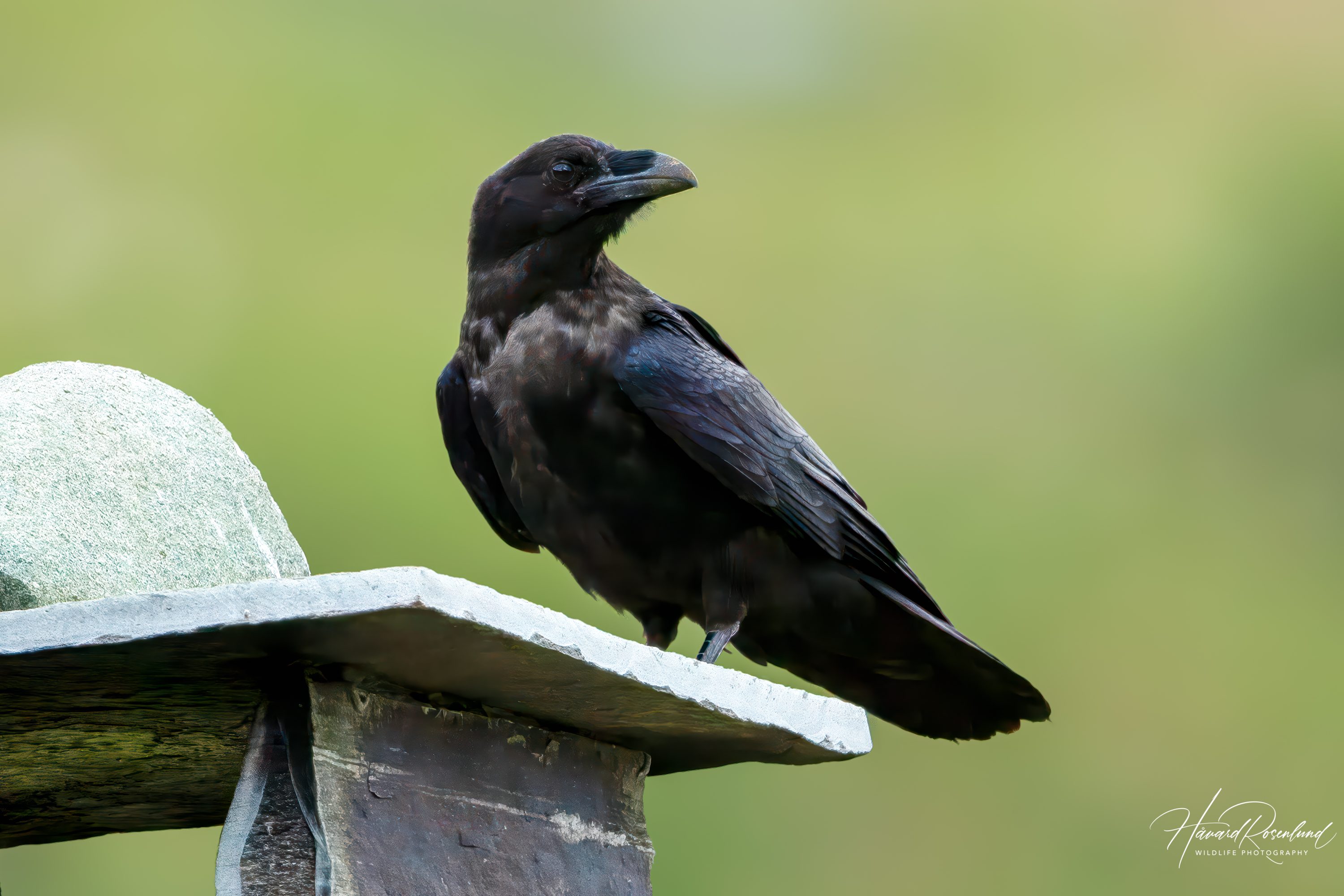
Common Raven
Corvus corax
At a glance
Habitat
- Extremely varied: coasts, cliffs, forests, mountains, tundra, deserts, farmland and settlements
Diet
- Carrion, small vertebrates, eggs, invertebrates, fruit, seeds and human food waste
Activity
- Diurnal
Size
- Length: 54–67 cm; wingspan 115–150 cm Weight: about 0.69–1.63 kg
Range
- Across much of the Northern Hemisphere, including Europe, Asia, North America and parts of North Africa
Description
The common raven (Corvus corax) is the largest living passerine and one of the most widely distributed birds of the Northern Hemisphere. Adults are about 54–67 cm long, span roughly 115–150 cm and weigh around 0.69–1.63 kg. The plumage is entirely black but shows blue, purple and green iridescence in strong light.
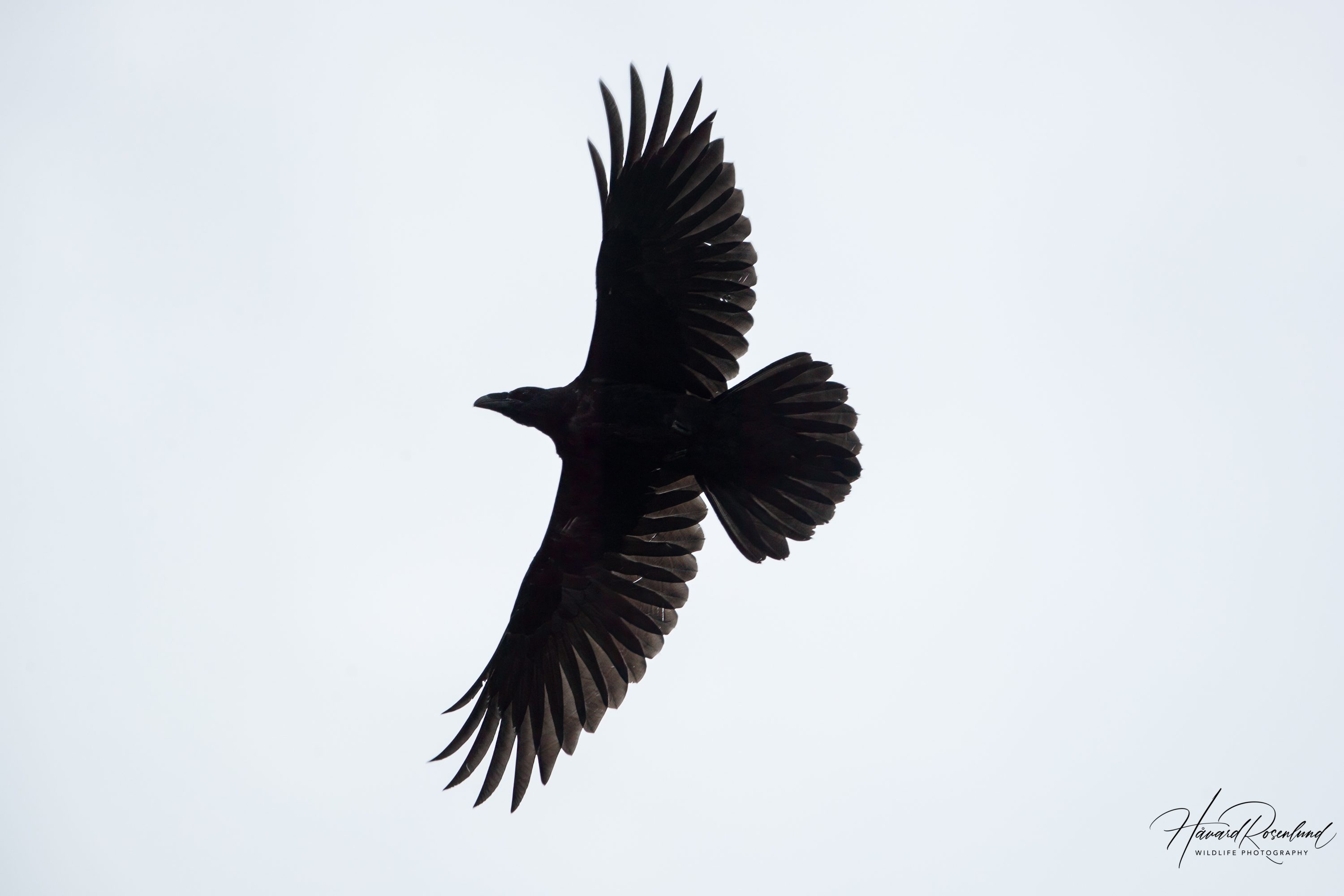
Ravens are heavily built, with a deep bill, shaggy throat feathers and a wedge-shaped tail that is particularly useful in flight identification. They are larger and more powerful than most crows and have deeper, more resonant calls.
Habitat
Few large birds use as wide a range of environments as the common raven. The species occupies rocky coasts, cliffs, forests, mountains, tundra, desert, open farmland and human-modified landscapes from sea level to high elevations.
Two resources are especially important: safe nesting sites and dependable food. Cliffs and large trees are traditional nesting places, while buildings, pylons and other structures are used locally. This flexibility allows ravens to persist in environments ranging from remote wilderness to heavily altered landscapes.
Diet
Ravens are opportunistic omnivores and scavengers. Carrion can be especially important, but they also take small mammals, birds and their eggs, reptiles, amphibians, insects and other invertebrates, as well as berries, fruit, seeds and many human-derived foods.
Foraging
Ravens use a very broad feeding repertoire. They search shorelines and open ground, patrol large areas for carrion, investigate temporary food sources and also hunt live prey when opportunities arise. Carcasses left by large predators or people can become especially rich resources, but the birds shift readily between scavenging, predation and plant foods.
Non-breeding ravens often range widely and can gather quickly at concentrated food sources, while territorial pairs repeatedly use familiar parts of their home range. Strong spatial memory and learning from other ravens and other species help them exploit food that is unpredictable in place and short-lived once discovered.
Behaviour
Ravens play frequently, including aerial games and manipulation of objects. Young birds may travel enormous distances before obtaining a territory, so this dispersal rather than regular seasonal migration accounts for much of the species’ large-scale movement.
Social behaviour
Adult ravens usually form long-term pair bonds and defend territories throughout the year. Non-breeders live very differently: young and unpaired birds can range widely, gather at rich food sources and use communal roosts where social relationships and information about feeding opportunities are important.
The species has a rich vocal repertoire and uses calls, postures and displays in social interactions. The contrast between stable territorial pairs and mobile non-breeding groups gives ravens a flexible social system that changes markedly with age and breeding status.
Intelligence
Common ravens are among the best-studied birds in animal cognition. A study published in 2017 showed planning outside the immediate context of food caching: ravens selected tools or barter objects that would become useful later, with delays of up to 17 hours, and showed self-control while waiting for the better future reward.
A 2020 study tested eight hand-raised ravens with a cognitive battery adapted from tests used with primates. Highly developed physical and social skills were already present at four months of age, and performance across quantitative, causal and several social tasks was broadly similar to that of adult chimpanzees and orangutans tested with comparable methods. Some individual tasks measured precursors of broader cognitive abilities rather than the complete ability itself.
Food caching reveals another side of this intelligence. Ravens change where and when they hide surplus food when competitors are watching and can remember caches made by other birds. A 2026 satellite-tracking study followed 69 ravens, 20 wolves and 11 cougars in Yellowstone. Ravens rarely followed predators over long distances, but repeatedly returned to areas where wolf kills had occurred, sometimes from as far as 155 km away. The pattern suggests that spatial memory helps them locate temporary carrion resources without simply following predators to fresh kills.
Breeding
Pairs often remain together for many years and may reuse the same nesting area repeatedly. The large stick nest is placed on a cliff ledge, in a tall tree or on a suitable human-made structure and lined with softer material such as grass, bark, wool and hair.
Clutches most often contain four to six eggs, with three to seven widely recorded. The female performs most incubation for about 20–25 days while the male supplies food. Both parents feed the young, which normally leave the nest after roughly five to seven weeks and may remain with the adults for weeks or months afterwards.
Cultural significance
The raven has a prominent place in mythology, literature and folklore across the Northern Hemisphere. In Norse mythology, Odin’s ravens Huginn and Muninn fly through the world and return with information. Ravens have also been associated with knowledge, death, transformation and prophecy in many traditions.
Relationship with humans
Ravens readily exploit food created or concentrated by people. Roadkill, livestock remains, refuse, game parks and waste sites can become predictable feeding places, and GPS tracking in the Alps showed that non-breeding ravens repeatedly moved among such anthropogenic food sources. Human food can therefore reshape both daily movement and local concentrations of birds.
Ravens have been persecuted or poisoned in some regions and may come into conflict with people where they gather around farms, settlements or waste. Conversely, abundant human food can support unusually high local numbers. Changes in waste management and carcass availability can therefore alter raven abundance even when the physical habitat itself remains suitable.
Status
The common raven is listed as least concern on the IUCN Red List. It remains widespread and numerous across much of its enormous Northern Hemisphere range.
Regional trends nevertheless vary, and local populations can respond strongly to changes in food supply, persecution and the availability of secure nesting sites.
Image gallery
Loading map and observations…
Have you seen this species?
Independent species archive
Did you find this species page useful?
Wildlife Vagabond is independently built and maintained. Voluntary support helps cover hosting, maps, data storage and continued improvements to the species archive.
Support Wildlife VagabondSpecies content will remain freely available.
References
Information about the species’ global distribution and status is based primarily on global Red List data. See the references below for details.
- BirdLife International. (n.d.). Common Raven (Corvus corax) species factsheet. https://datazone.birdlife.org/species/factsheet/common-raven-corvus-corax
- Cornell Lab of Ornithology. (n.d.). Common Raven life history and identification. https://www.allaboutbirds.org/guide/Common_Raven/lifehistory
- Heinrich, B., & Pepper, J. W. (1998). Influence of competitors on caching behaviour in the common raven,Corvus corax. Animal Behaviour, 56(5), 1083-1090. https://doi.org/10.1006/anbe.1998.0906
- International Union for Conservation of Nature. (n.d.). Corvus corax. The IUCN Red List of Threatened Species. https://www.iucnredlist.org/species/22706068/113271893
- Jain, V., Bugnyar, T., Cunningham, S. J., Gallego-Abenza, M., Loretto, M.-C., & Sumasgutner, P. (2022). The spatial and temporal exploitation of anthropogenic food sources by common ravens (Corvus corax) in the Alps. Movement Ecology, 10(1), 35. https://doi.org/10.1186/s40462-022-00335-4
- Kabadayi, C., & Osvath, M. (2017). Ravens parallel great apes in flexible planning for tool-use and bartering. Science, 357(6347), 202-204. https://doi.org/10.1126/science.aam8138
- Loretto, M.-C., Beck, K. B., Smith, D. W., Stahler, D. R., Walker, L. E., Wikelski, M., Mueller, T., Safi, K., & Marzluff, J. M. (2026). Ravens anticipate wolf kill sites across broad scales. Science, 391(6790), 1151-1154. https://doi.org/10.1126/science.adz9467
- Pika, S., Sima, M. J., Blum, C. R., Herrmann, E., & Mundry, R. (2020). Ravens parallel great apes in physical and social cognitive skills. Scientific Reports, 10(1), 20617. https://doi.org/10.1038/s41598-020-77060-8