
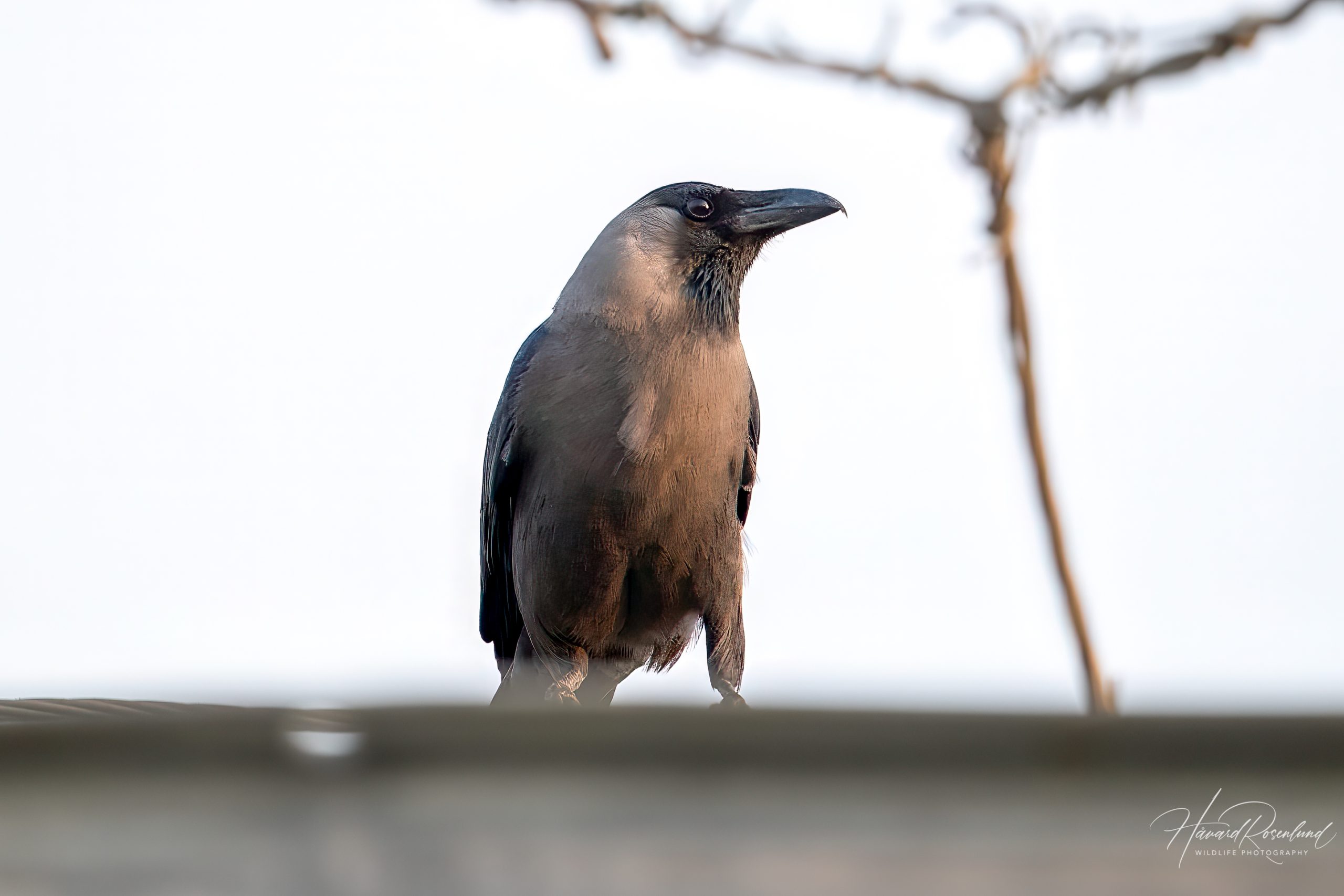
House Crow
Corvus splendens
At a glance
Habitat
- Cities, ports, villages, farms and coastlines; strongly associated with people
Diet
- Omnivorous: refuse, carrion, grain, fruit, invertebrates, eggs and small animals
Activity
- Diurnal
Size
- Length: 40–43 cm Weight: 245–370 g
Range
- Native to the Indian subcontinent and nearby southern Asia; introduced widely around the Indian Ocean and beyond
Description
The house crow (Corvus splendens) is a slim, medium-sized crow about 40–43 cm long and roughly 245–370 g in weight. The forehead, crown, throat, wings and tail are glossy black, while the neck and upper breast form a contrasting grey-brown collar.
It is more lightly built than the large-billed crow (Corvus macrorhynchos), with a narrower bill and relatively long-legged appearance. The sexes look alike, although males average slightly larger. Its close association with people is almost as characteristic as its plumage, and populations living far from human activity are unusual.
Habitat
House crows are among the most strongly human-associated birds in their range. They thrive in cities, ports, villages, markets, farms and coastal settlements where food waste, water, trees and buildings provide reliable resources. They are much less characteristic of extensive wilderness far from people.
A 2026 study in Singapore revisited nest-site selection about two decades after earlier work. Current nests were associated particularly with taller trees, wider branch angles and proximity to buildings, while the proportions of tree species used for nesting had not changed significantly between 2001 and 2022. The results show that the structural and urban features associated with nest placement can change even when preferred tree species remain broadly similar.
Diet
The house crow is an opportunistic omnivore. Refuse, carrion, grain, fruit, insects and other invertebrates are all eaten, together with small vertebrates, eggs and nestlings. Birds forage on streets, at markets, around fishing areas and livestock, and wherever human activity concentrates food.
The broad diet allows the species to exploit both natural prey and human food. House crows readily use temporary food sources in groups and investigate unfamiliar objects when they may lead to food.
Behaviour
House crows are diurnal and make regular daily movements between predictable feeding sites and resting or nesting areas. Their close association with people means that these movements can shift quickly when food availability, disturbance or urban conditions change.
Social behaviour
House crows are highly social and conspicuously vocal. They forage alone or in groups, use a varied repertoire of calls and gather at communal roosts that can contain large numbers of birds. Larger groups readily mob raptors, mammals or people perceived as threats.
Social organisation is flexible rather than fixed. Pairs maintain close bonds around a breeding territory, while non-breeders and feeding birds repeatedly join and leave larger groups as resources change. Individuals can therefore use both social information and temporary concentrations of food without remaining in one permanent flock.
Intelligence
House crows show considerable behavioural flexibility, but experimental evidence for numerical discrimination is mixed. A study published in 2014 tested six house crows choosing between different quantities of mealworms. The birds often chose the larger quantity, but only one of the seven comparisons produced choices above chance level, giving much weaker evidence of numerical discrimination than in the common mynas tested alongside them.
Tool use provides clearer examples of physical problem-solving. In an observation published in 2025 from Singapore Zoo, a house crow used a hooked stick to retrieve otherwise inaccessible food after first watching a Sunda crow solve the task once; the authors considered social learning a likely part of the house crow's success. A 2023 report described five wild house crows around burning oil lamps in India, including birds that lifted flaming cotton wicks, extinguished them and ate the cotton. Together with earlier captive observations, these cases show that the species can use objects flexibly when opportunities arise.
Breeding
Breeding timing varies geographically, but in much of India it is concentrated from spring into the monsoon season. Both adults build a bulky stick nest high in a tree or occasionally on a structure, sometimes incorporating wire and other artificial material.
Clutches usually contain three to six eggs. Incubation lasts around 16–17 days, and the young remain in the nest for about a month before fledging. Both parents feed and defend the young, and pairs may attack much larger birds or mammals near the nest.
In South Asia, house-crow nests are parasitised by Asian koels (Eudynamys scolopaceus). A study from Bangladesh reported parasitism in 10.8% of house-crow nests in its study area; koel eggs can closely resemble the normal spotted eggs of the crow.
Relationship with humans
Few wild birds are as closely integrated into human daily life as the house crow. Markets, refuse dumps, fishing harbours, slaughter areas, livestock facilities and household waste can all provide food, while roadside and ornamental trees supply nesting and roosting sites. This relationship has allowed the species to reach very high densities in some towns.
The same success creates conflict. Large roosts can generate noise and fouling, birds may scatter refuse, raid food and poultry, and heavy predation on nests can affect native birds. Waste management influences house-crow numbers directly because reducing exposed food lowers the amount of food available to support dense local populations.
Introduced populations
The native range centres on the Indian subcontinent and nearby southern Asia, but house crows have repeatedly travelled aboard ships and established populations around the Indian Ocean, Arabian Peninsula, eastern and southern Africa and parts of Southeast Asia. Ports have been especially important gateways, allowing birds to cross barriers that would otherwise separate populations.
Where introduced, house crows can raid nests, compete with native birds, exploit refuse and create noise and sanitation problems around dense roosts. A 2026 scoping review of African research found substantial ecological and socio-economic impacts and concluded that existing control methods remain insufficiently effective.
Status
The house crow is classified as least concern on the IUCN Red List. It is widespread across both its native and introduced range, but trends within the native range are not uniform.
State of India's Birds 2025 estimates a long-term national increase of about 36.7% but a current annual decline of about 2.1%. The species remains classified as Low Priority nationally.
Image gallery
Loading map and observations…
Have you seen this species?
Independent species archive
Did you find this species page useful?
Wildlife Vagabond is independently built and maintained. Voluntary support helps cover hosting, maps, data storage and continued improvements to the species archive.
Support Wildlife VagabondSpecies content will remain freely available.
References
Information about the species’ global distribution and status is based primarily on global Red List data. See the references below for details.
- Athumani, P. C., Safari, I., Mbise, F. P., & Mmbaga, N. E. (2026). Comparison of socio-ecological and economic impact and control techniques of the invasive Indian house crow (Corvus splendens) and the red-billed quelea (Quelea quelea) in Africa: a scoping review. Discover Conservation, 3(1), 12. https://doi.org/10.1007/s44353-026-00083-1
- AviList. (n.d.). Corvus splendens. https://www.avilist.org/
- BirdLife International. (n.d.). House Crow (Corvus splendens) species factsheet. https://datazone.birdlife.org/species/factsheet/house-crow-corvus-splendens
- Giri, T., & Garcia‐Pelegrin, E. (2025). Opportunistic Tool Use by Two Unexpected Corvid Species. Ecology and Evolution, 15(5), e71314. https://doi.org/10.1002/ece3.71314
- Global Invasive Species Database. (n.d.). IUCN Global Invasive Species Database – Corvus splendens. https://www.iucngisd.org/gisd/speciesname/Corvus%2Bsplendens
- International Union for Conservation of Nature. (n.d.). Corvus splendens. The IUCN Red List of Threatened Species. https://www.iucnredlist.org/species/22705938/131944731
- Leong, Y. X., Soh, M. C. K., Chia, S. J. M., Samsuri, A. N., Ng, Y. Z., & Er, K. B. H. (2026). Changes in nesting preferences of the invasive house crow (Corvus splendens) after two decades in Singapore’s evolving urban landscape. Frontiers in Ecology and Evolution, 14, 1784788. https://doi.org/10.3389/fevo.2026.1784788
- Nahid, M. I., Fossøy, F., Stokke, B. G., Begum, S., & Røskaft, E. (2019). Confirmation of House CrowsCorvus splendenslaying immaculate blue eggs. Bird Study, 66(1), 141-144. https://doi.org/10.1080/00063657.2018.1563047
- Rahman, N. A. A., Fadzly, N., Dzakwan, N. M., & Zulkifli, N. H. (2014). The Numerical Competency of Two Bird Species (Corvus splendens and Acridotheres tristis). Tropical life sciences research, 25(1), 95-103. https://pubmed.ncbi.nlm.nih.gov/25210590/
- Sarlin, P. J., Morris, S., Morris, S., Morris, S., Joseph, P., & Sherly, D. (2023). First report of house crow Corvus splendens removing burning cotton wicks from oil lamps, extinguishing and eating. Avian Biology Research, 16(2), 75-80. https://doi.org/10.1177/17581559231176984
- State of India's Birds. (n.d.). House Crow. https://stateofindiasbirds.in/species/houcro1/