
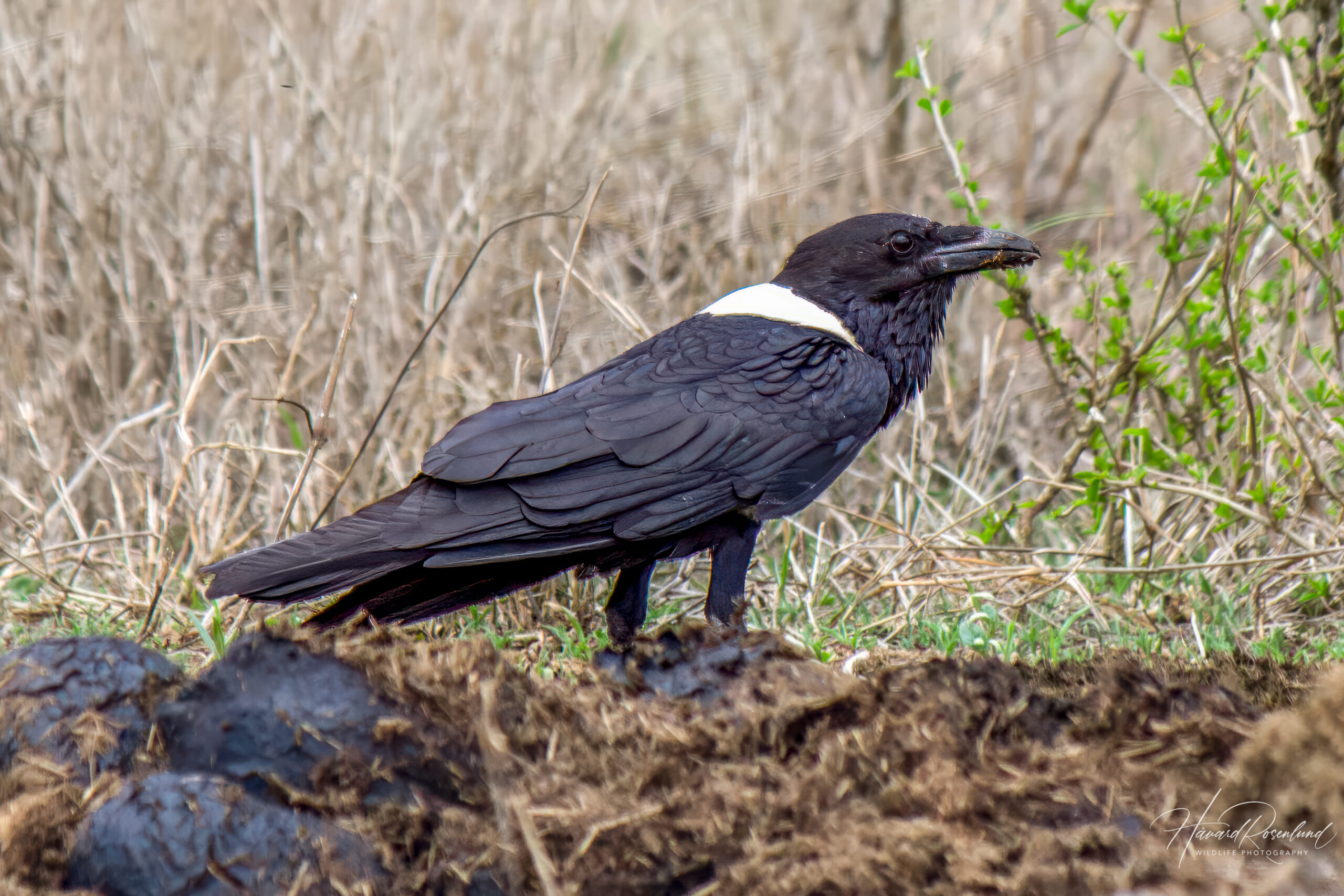
Pied Crow
Corvus albus
At a glance
Habitat
- Savanna, grassland, shrubland, farmland and urban areas
Diet
- Omnivorous; fruit, seeds, invertebrates, small vertebrates, carrion and human food waste
Activity
- Diurnal
Size
- Length: 46–52 cm Weight: About 520 g
Range
- Widespread across most of sub-Saharan Africa
Description
The pied crow (Corvus albus) is one of Africa's most widespread and conspicuous corvids. Adults are about 46–52 cm long and weigh around 520 g. The glossy black head, throat, wings and tail contrast sharply with a broad white collar and white breast and belly.
The species overlaps with the larger white-necked raven (Corvus albicollis) in parts of southern Africa. Pied crows have a much more extensive white breast and a slimmer bill, while white-necked ravens are heavier, deeper-billed birds with white confined mainly to the nape.
Habitat
Pied crows favour open landscapes such as savanna, grassland and shrubland, but are equally at home in farmland, villages, towns and cities. They usually avoid extensive closed forest and the driest true desert.
Human-modified landscapes can be especially attractive where open feeding areas occur together with tall trees, utility structures, buildings or towers that provide lookout, roosting and nesting sites.
Diet
The pied crow is an opportunistic omnivore. Fruit, seeds, insects and other invertebrates, eggs and nestlings, reptiles, small mammals, carrion and human food waste can all form part of the diet.
Foraging
Much feeding takes place on the ground, where pied crows walk through open areas, investigate potential food with the bill and exploit carcasses, recently disturbed soil and concentrated food around farms, roads and refuse sites. They readily investigate new opportunities and switch among food sources as conditions change.
In parts of western South Africa, some breeding pairs have been documented taking substantial numbers of small tortoises. This behaviour is concentrated in particular pairs and places rather than being typical of pied crows throughout their range.
Behaviour
Pied crows are active, alert birds that spend much of the day moving between feeding sites, elevated lookout points and resting areas. Pairs can defend nesting areas, while individuals use a varied repertoire of harsh calls for contact, alarm and territorial interactions.
The species is highly adaptable and readily changes where it feeds, rests and nests as local conditions change.
Social behaviour
Pied crows are often encountered in pairs or small groups, but they can become strongly gregarious where food or safe resting sites are concentrated. Large numbers may gather at refuse dumps, carcasses and other rich feeding sites.
Communal roosts can also contain many birds. These gatherings allow individuals to rest together outside the breeding territory and can become conspicuous features of urban and agricultural landscapes, especially where tall trees or artificial structures provide secure roost sites.
Intelligence
A field experiment in South Africa showed that pied crows can learn quickly from unpleasant feeding experiences. After encountering treated eggs that produced an aversive reaction, the birds became less likely to raid similar artificial nests, and nest predation remained lower even after the treatment ended.
A striking natural example was documented in The Gambia in 2024. Adult pied crows carrying sticky cooked rice to their chicks deliberately collected water in the bill and delivered it with the food, apparently helping to loosen the rice and make it easier for the chicks to swallow. This kind of water provisioning had not previously been described in a wild altricial bird, whose chicks remain in the nest and depend on parental feeding. The behaviour shows how flexibly pied crows can respond to a problem created by an unfamiliar food.
Breeding
Pied crows form breeding pairs and build a large stick nest, usually high in a tree but increasingly also on artificial structures. Both partners contribute to construction, adding a softer lining inside the main platform. Breeding timing varies geographically and often follows local seasonal conditions rather than one common breeding season across Africa.
Clutches can contain one to seven eggs, with four or five common in well-studied populations. The female performs most of the incubation, which lasts about 18–19 days, while both parents feed the chicks. The young usually fledge after roughly 35–43 days.
Telecommunication towers, utility poles and other structures can provide suitable nest sites where natural trees are limited. A South African study documented repeated use of cellular towers for nesting, showing how infrastructure can directly increase the availability of nest sites. The species is also a recorded host of the great spotted cuckoo (Clamator glandarius), a brood parasite that lays its eggs in the nests of other birds.
Relationship with humans
In parts of southern Africa, particularly western South Africa, pied crows have increased in abundance and expanded into areas where they were formerly scarcer. Warming conditions, food associated with people, roadkill and artificial nesting structures such as utility poles, wind pumps and telecommunication towers have all contributed to this expansion.
The species is therefore sometimes described as a “native invader”: it is indigenous, but human changes can allow it to become unusually abundant in areas where it was formerly less common. Where crow numbers rise strongly, predation on eggs, young birds and small reptiles can also increase, although the effect varies greatly among places and individual pairs.
Status
The pied crow is classified as least concern on the IUCN Red List and remains widespread across most of sub-Saharan Africa.
In some human-modified regions, populations are increasing rather than declining as food and nesting opportunities become more abundant.
Image gallery
Loading map and observations…
Have you seen this species?
Independent species archive
Did you find this species page useful?
Wildlife Vagabond is independently built and maintained. Voluntary support helps cover hosting, maps, data storage and continued improvements to the species archive.
Support Wildlife VagabondSpecies content will remain freely available.
References
Information about the species’ global distribution and status is based primarily on global Red List data. See the references below for details.
- Avibase. (n.d.). AviList 2025 / Avibase – Pied Crow (Corvus albus). https://avibase.bsc-eoc.org/species.jsp?avibaseid=17834DA14FA4FC3D&lang=EN
- Biodiversity Explorer. (n.d.). Pied Crow. Iziko Museums of South Africa. https://biodiversityexplorer.info/birds/corvidae/corvus_albus.htm
- BirdLife International. (n.d.). Pied Crow species factsheet. https://datazone.birdlife.org/species/factsheet/pied-crow-corvus-albus
- Durà i Franch. (2017). Understanding predation of tortoises by nesting Pied Crows. https://open.uct.ac.za/items/ffa24d2f-d92a-4325-aee5-9c12db23ba0f
- Ferguson, A. J., Thomson, R. L., Nelson-Flower, M. J., & Flower, T. P. (2021). Conditioned food aversion reduces crow nest predation: An improved framework for CFA trials. Journal for Nature Conservation, 60, 125970. https://doi.org/10.1016/j.jnc.2021.125970
- FitzPatrick Institute of African Ornithology. (n.d.). Understanding the ecological impacts of Pied Crows. University of Cape Town. https://science.uct.ac.za/fitzpatrick/research-maintaining-biodiversity-global-change/understanding-ecological-impacts-pied-crows
- International Union for Conservation of Nature. (n.d.). Pied Crow. The IUCN Red List of Threatened Species. https://www.iucnredlist.org/species/22735894/118783820
- Joseph, G. S., Seymour, C. L., & Foord, S. H. (2017). The effect of infrastructure on the invasion of a generalist predator: Pied crows in southern Africa as a case-study. Biological Conservation, 205, 11-15. https://doi.org/10.1016/j.biocon.2016.11.026
- Lahti, D. C., & Barlow, C. R. (2024). First observations of water provisioning to wild altricial nestlings: pied crow (Corvus albus) parents resolve a sticky situation in The Gambia. Behaviour, 161(13-15), 977-1001. https://doi.org/10.1163/1568539X-bja10291
- Mundy, P. J., & Cook, A. W. (1977). Observations on the breeding of the pied crow and great spotted cuckoo in northern Nigeria. Ostrich, 48(3-4), 72-84. https://doi.org/10.1080/00306525.1977.9634084
- Senoge, N. D., & Downs, C. T. (2023). The use of cellular telecommunication towers as nesting sites by pied crows (Corvus albus) in an urban mosaic landscape. Urban Ecosystems, 26(3), 881-892. https://doi.org/10.1007/s11252-023-01342-y