
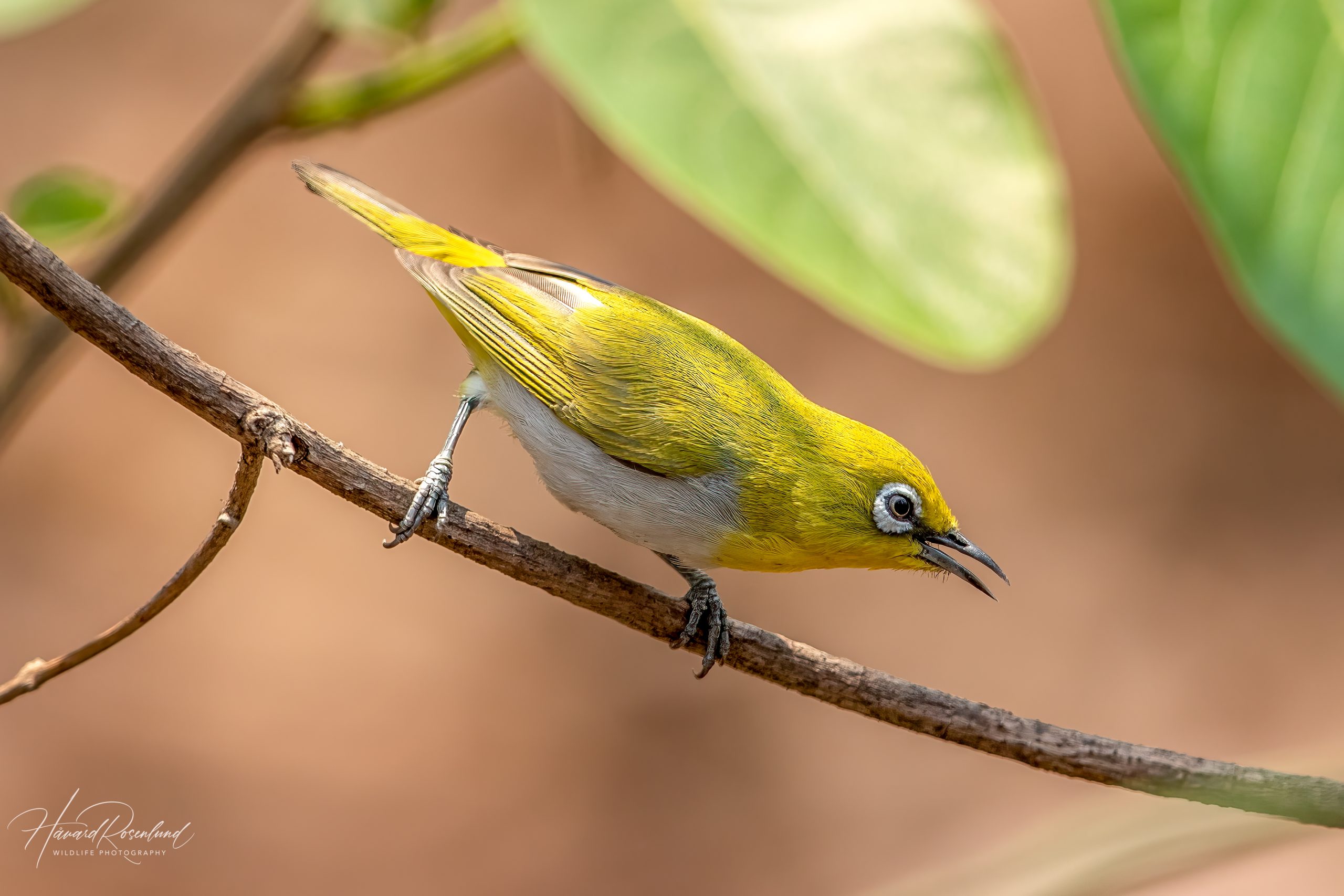
Indian White-eye
Zosterops palpebrosus
At a glance
Habitat
- Open woodland, scrub, forest edge, plantations, orchards, parks and gardens
Diet
- Insects and spiders, nectar, pollen and soft fruit
Activity
- Diurnal
Size
- Length: 8–9 cm Weight: 6–10 g
Range
- South Asia from the Arabian Peninsula and Afghanistan across the Indian subcontinent to southern China and western mainland Southeast Asia
Description
The Indian white-eye (Zosterops palpebrosus) is a tiny, agile songbird, about 8–9 cm long and usually weighing around 6–10 g. It has yellow-green upperparts, a yellow throat and vent, pale greyish underparts and a conspicuous ring of white feathers around the eye. Males and females look alike.
The species is widespread across South Asia, from the Arabian Peninsula and Afghanistan through the Indian subcontinent to parts of southern China and western mainland Southeast Asia. Plumage varies geographically, particularly in the strength and extent of yellow on the underparts, but the broad white eye-ring remains its most obvious field mark.
Taxonomy
The Indian white-eye was formerly known as the Oriental white-eye and once included populations spread much farther across Southeast Asia. Genetic and morphological work showed that this broad treatment combined several distinct lineages, and the complex was subsequently split by major global checklists.
Former members of the broader complex now include Hume's white-eye (Zosterops auriventer), Sangkar white-eye (Z. melanurus), Swinhoe's white-eye (Z. simplex) and ashy-bellied white-eye (Z. citrinella). AviList 2025 retains Zosterops palpebrosus as Indian white-eye for the remaining South Asian species. The taxonomic changes explain why older books give “Oriental white-eye” a much larger range than modern checklists.
Habitat
Indian white-eyes use open woodland, scrub, forest edge, mangroves, plantations, orchards, parks and gardens. They readily move between natural and human-modified habitats wherever flowering trees, fruit and foliage support a steady food supply.
The species is not strongly tied to one forest type. This flexibility helps explain its broad distribution and its success around villages and cities, although extensive loss of trees and shrubs can still remove feeding and nesting habitat locally.
Diet
Indian white-eyes eat insects and spiders as well as nectar, pollen and soft fruit. Small animal prey is picked from leaves and twigs, while the slender, slightly curved bill allows the birds to reach into flowers.
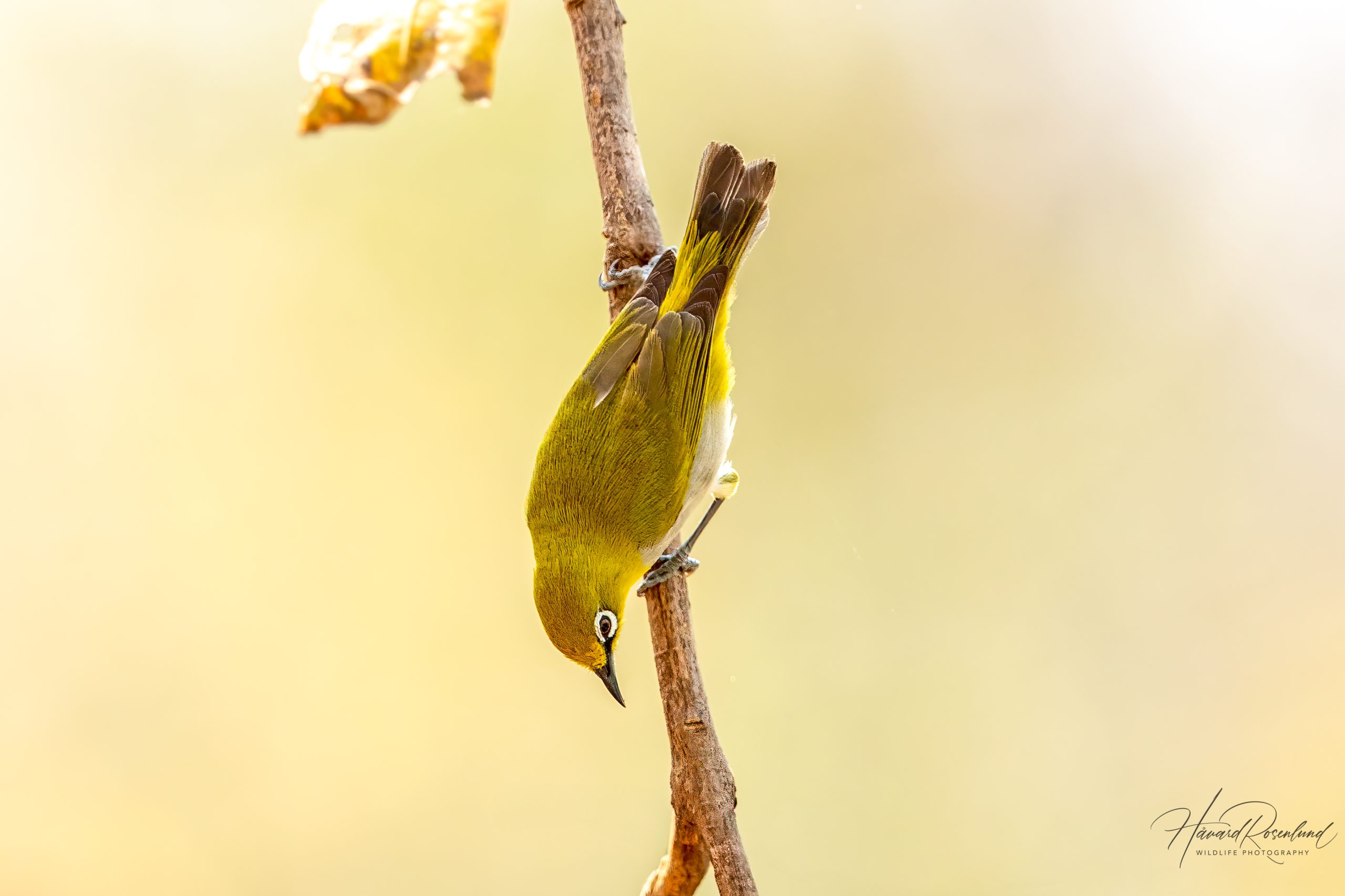
Flower feeding can leave the forehead dusted with pollen, which may then be carried to other flowers. Fruit and nectar provide readily available energy, while insects become especially important when adults are feeding growing chicks. Birds forage acrobatically, frequently hanging upside down or stretching between fine twigs to inspect leaves and flowers.
Behaviour
Indian white-eyes are almost continuously on the move while active, working rapidly through foliage and rarely remaining in one place for long. Their small size and agility allow them to search fine twigs, leaves and flowers throughout the shrub layer and canopy.
Social behaviour
Outside the breeding season, Indian white-eyes are highly social and often travel in lively flocks, keeping contact with soft, high-pitched calls. Flocks frequently join other small insect- and nectar-eating birds, creating mixed-species groups that search the canopy and shrub layer together.
Alarm can trigger coordinated mobbing rather than simple retreat. Indian white-eyes give distinctive mobbing calls, and a 2026 field study in Yunnan showed that playback of these calls elicited responses from a wide range of other small forest birds. Their alarm calls can therefore provide useful information to other species as well as to members of their own flock.
Breeding
Breeding timing varies greatly across the wide range and can extend from late winter into the monsoon period in India. As breeding approaches, pairs separate from the larger flocks and become more territorial around the nest. The female builds a small, delicate cup suspended between fine twigs, using plant fibres, cobweb and other soft material.
Clutches usually contain two to four pale blue eggs. Both parents incubate and later feed the chicks, and the pair may mob birds or mammals that approach the nest. Reported incubation and nestling periods vary among localities, and reliable species-wide timing remains limited.
Status
The Indian white-eye is classified as least concern on the IUCN Red List. It remains widespread and common in many wooded and human-modified habitats.
State of India's Birds 2025 estimates a long-term national increase of about 38% and a current annual increase of around 2.3%. The monitoring therefore shows no broad current decline in India.
Image gallery
Loading map and observations…
Have you seen this species?
Independent species archive
Did you find this species page useful?
Wildlife Vagabond is independently built and maintained. Voluntary support helps cover hosting, maps, data storage and continued improvements to the species archive.
Support Wildlife VagabondSpecies content will remain freely available.
References
Information about the species’ global distribution and status is based primarily on global Red List data. See the references below for details.
- Avibase. (n.d.). AviList 2025 / Avibase – Indian White-eye (Zosterops palpebrosus). https://avibase.bsc-eoc.org/species.jsp?avibaseid=0BD6646B10D030B0
- Birding.in. (n.d.). The Nests and Eggs of Indian Birds – Indian White-eye historical breeding account. https://birding.in/a_hume/nests_and_eggs_of_indian_birds_13c.htm
- BirdLife International. (n.d.). Indian White-eye (Zosterops palpebrosus) species factsheet. https://datazone.birdlife.org/species/factsheet/indian-white-eye-zosterops-palpebrosus
- Cornell Lab of Ornithology. (2019). Updates and corrections: Indian White-eye complex. https://www.birds.cornell.edu/clementschecklist/introduction/updateindex/overview-august-2019/updates-corrections-august-2019/
- International Union for Conservation of Nature. (n.d.). Zosterops palpebrosus. The IUCN Red List of Threatened Species. https://www.iucnredlist.org/species/155155950/155176891
- Lim, B. T. M., Sadanandan, K. R., Dingle, C., Leung, Y. Y., Prawiradilaga, D. M., Irham, M., Ashari, H., Lee, J. G. H., & Rheindt, F. E. (2019). Molecular evidence suggests radical revision of species limits in the great speciator white-eye genus Zosterops. Journal of Ornithology, 160(1), 1–16. https://doi.org/10.1007/s10336-018-1583-7
- Liu, Y., Shen, Z., & Lei, F. (2026). Comparing line transect and Indian White-eye mobbing call playback for detecting forest birds in subtropical Yunnan. Avian Research, 17(2), 100362. https://doi.org/10.1016/j.avrs.2026.100362
- Moyle, R. G., Filardi, C. E., Smith, C. E., & Diamond, J. (2009). Explosive Pleistocene diversification and hemispheric expansion of a “great speciator”. Proceedings of the National Academy of Sciences of the United States of America, 106(6), 1863–1868. https://doi.org/10.1073/pnas.0809861105
- State of India's Birds. (n.d.). Indian White-eye. https://stateofindiasbirds.in/species/indwhe1/