
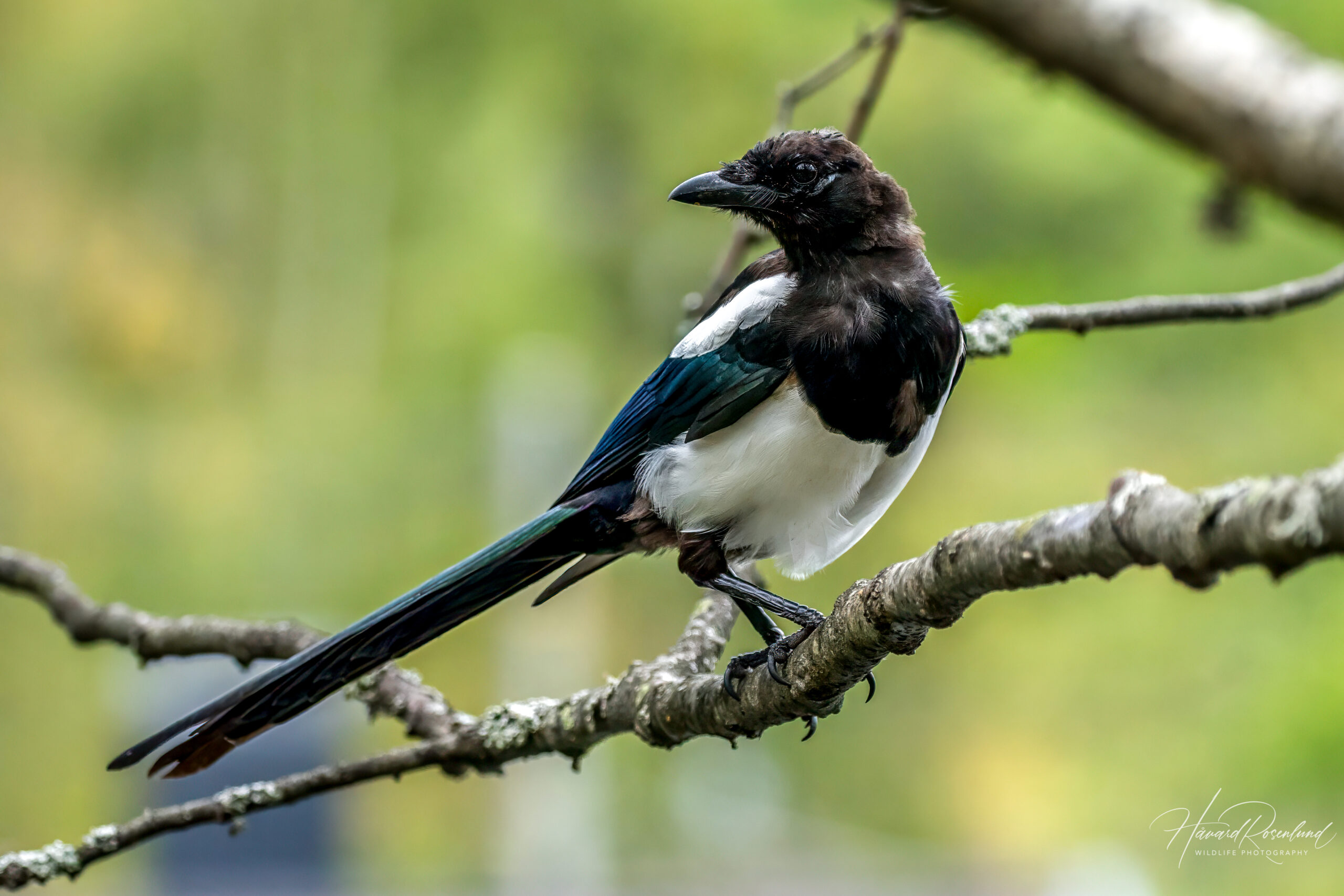
Eurasian Magpie
Pica pica
At a glance
Habitat
- Open woodland, farmland, hedgerows, parks, gardens and urban areas
Diet
- Insects, other invertebrates, seeds, fruit, carrion, eggs and occasional small vertebrates
Activity
- Diurnal
Size
- Length: 44–46 cm Weight: 182–272 g
Range
- Europe and much of temperate Asia
Description
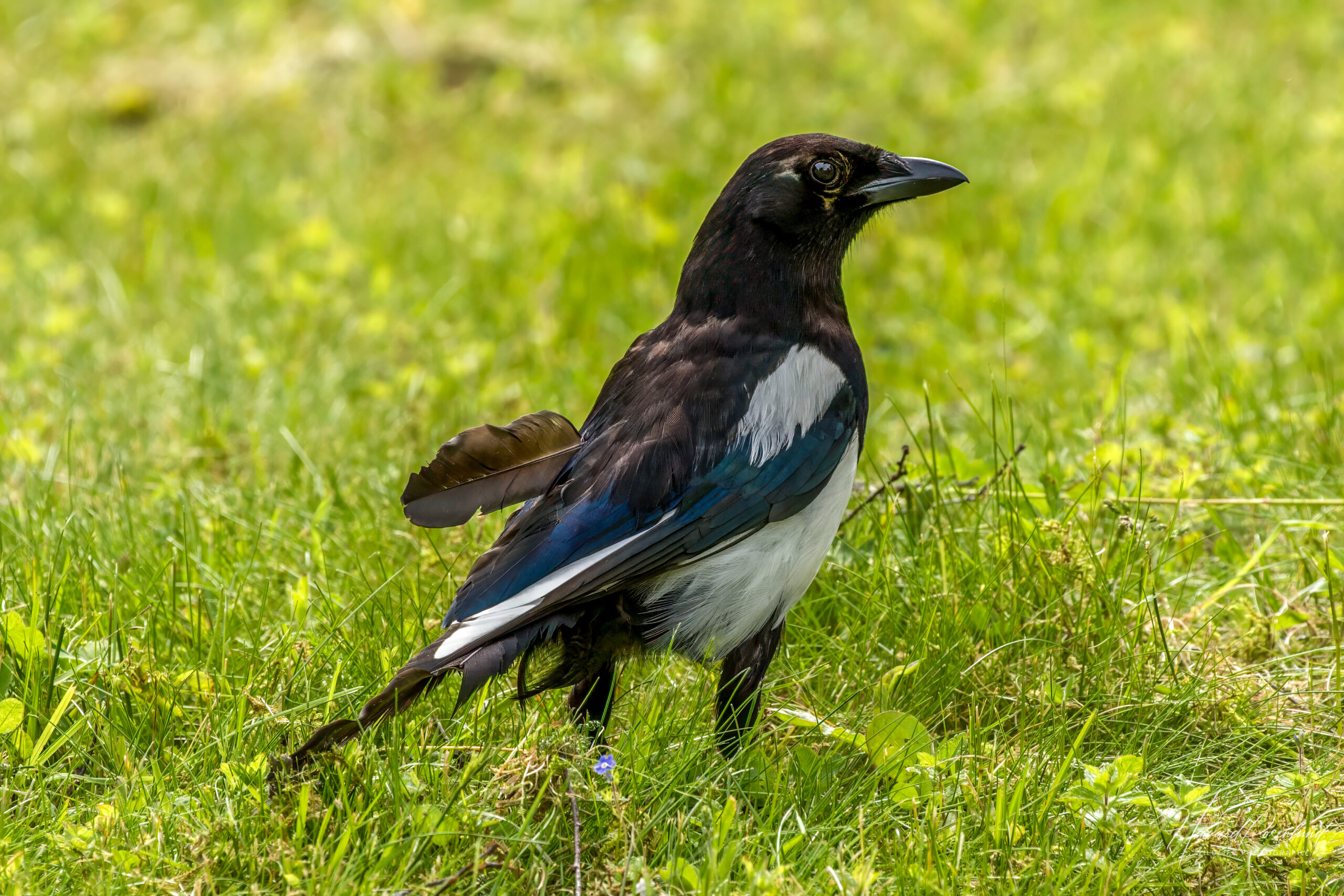
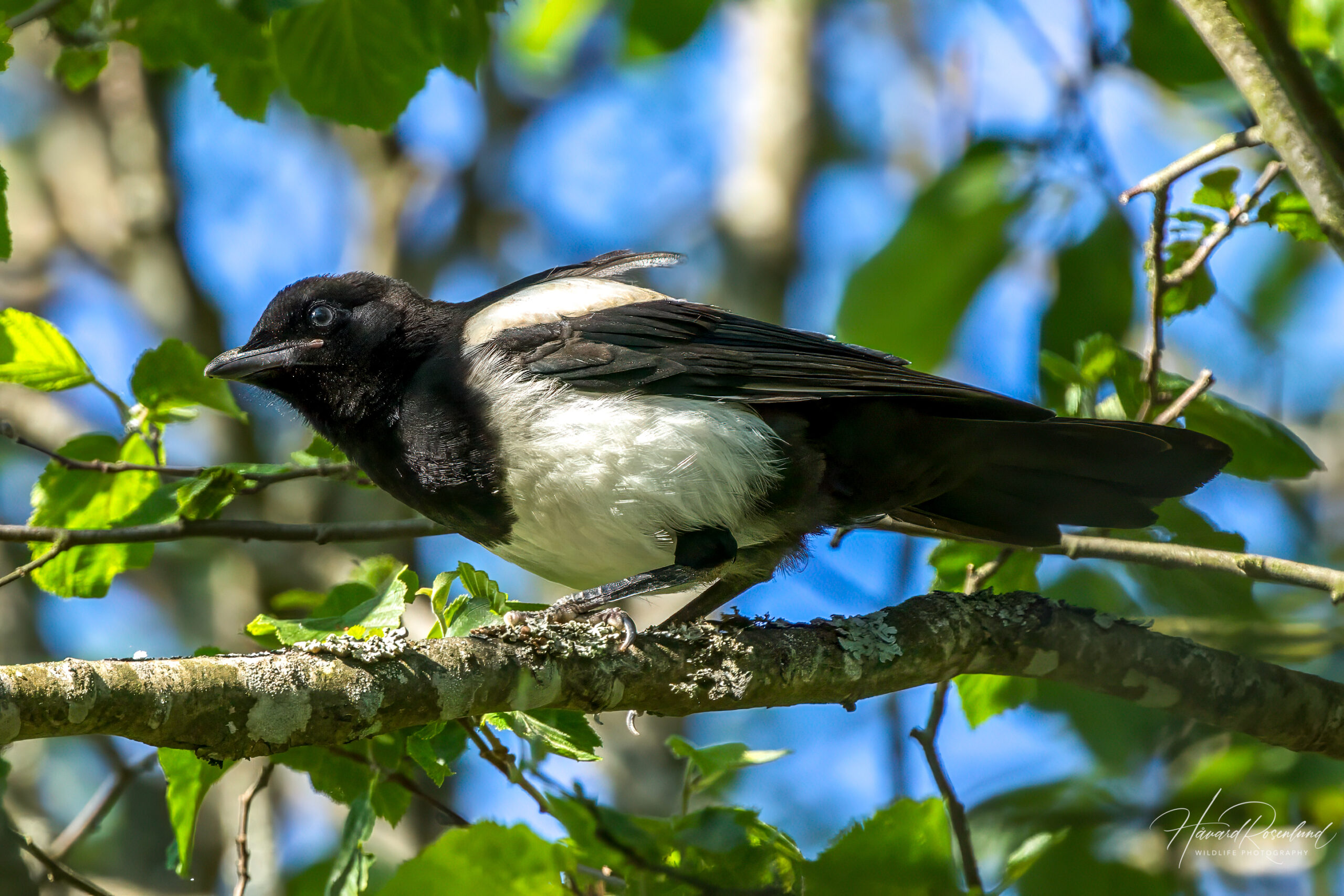
The Eurasian magpie (Pica pica) is a large, long-tailed corvid widespread across Europe and much of temperate Asia. Adults measure about 44–46 cm, with the tail accounting for more than half of the total length. Females usually weigh about 182–214 g and males around 210–272 g.
The plumage appears black and white, but the dark feathers show metallic green, blue, violet and purple iridescence in good light. The shoulders, belly and much of the inner wing are white. Juveniles have shorter tails and duller, less glossy plumage.
Taxonomy
The Eurasian magpie was formerly treated as part of a broader Pica pica complex extending farther across North Africa and East Asia. Modern global checklists recognise several of those geographically distinctive populations as separate species.
In the current AviList treatment, the Oriental Magpie (Pica serica) of East Asia and the Maghreb Magpie (Pica mauritanica) of northwestern Africa are separate from P. pica. Older literature using a broader concept of the Eurasian magpie may therefore include populations that no longer belong to P. pica.
Habitat
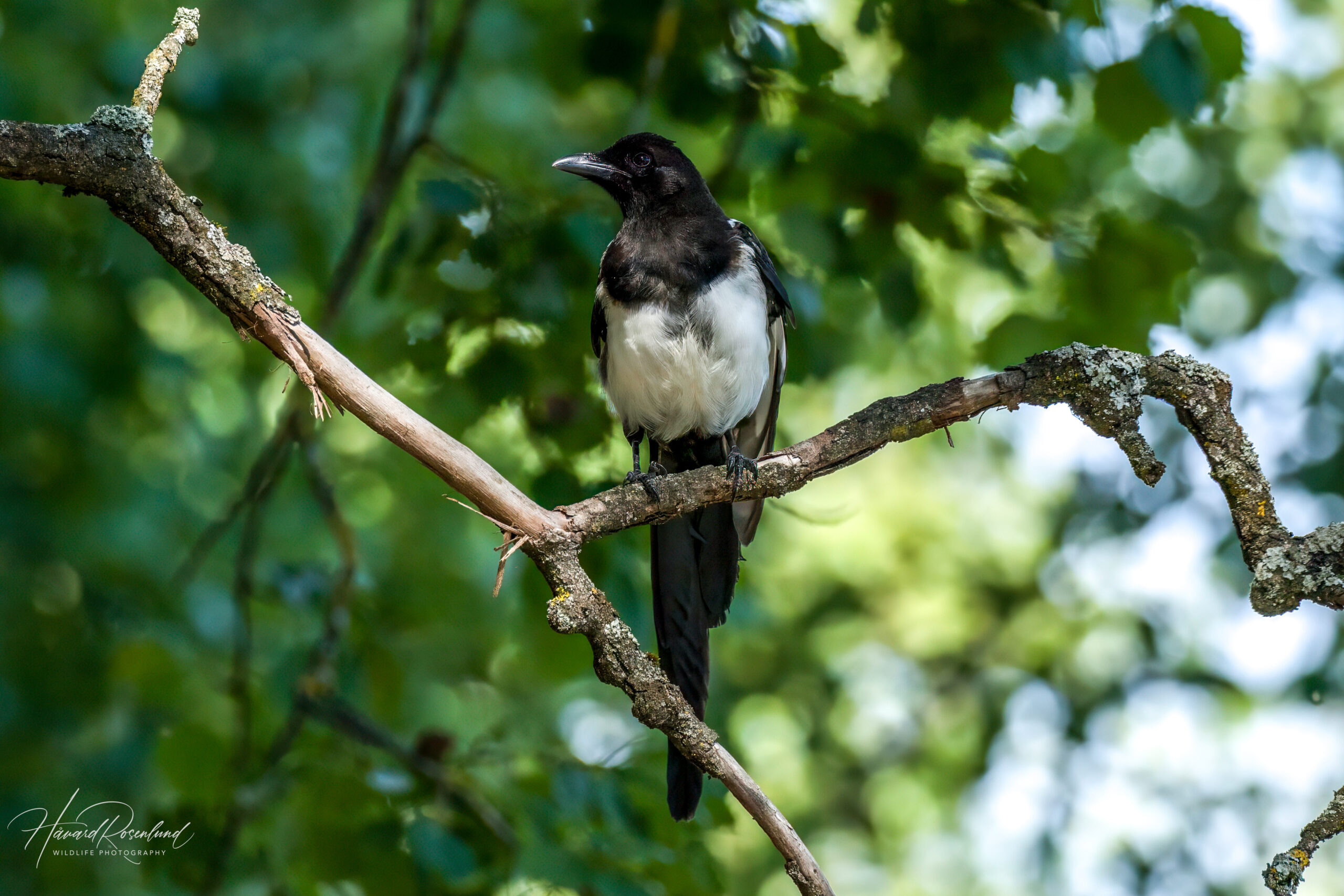
Eurasian magpies favour landscapes that combine open ground with trees, shrubs or structures for nesting and lookout. They are common in farmland, woodland edge, hedgerows, parks, gardens, villages and cities and generally avoid extensive dense forest and completely treeless country.
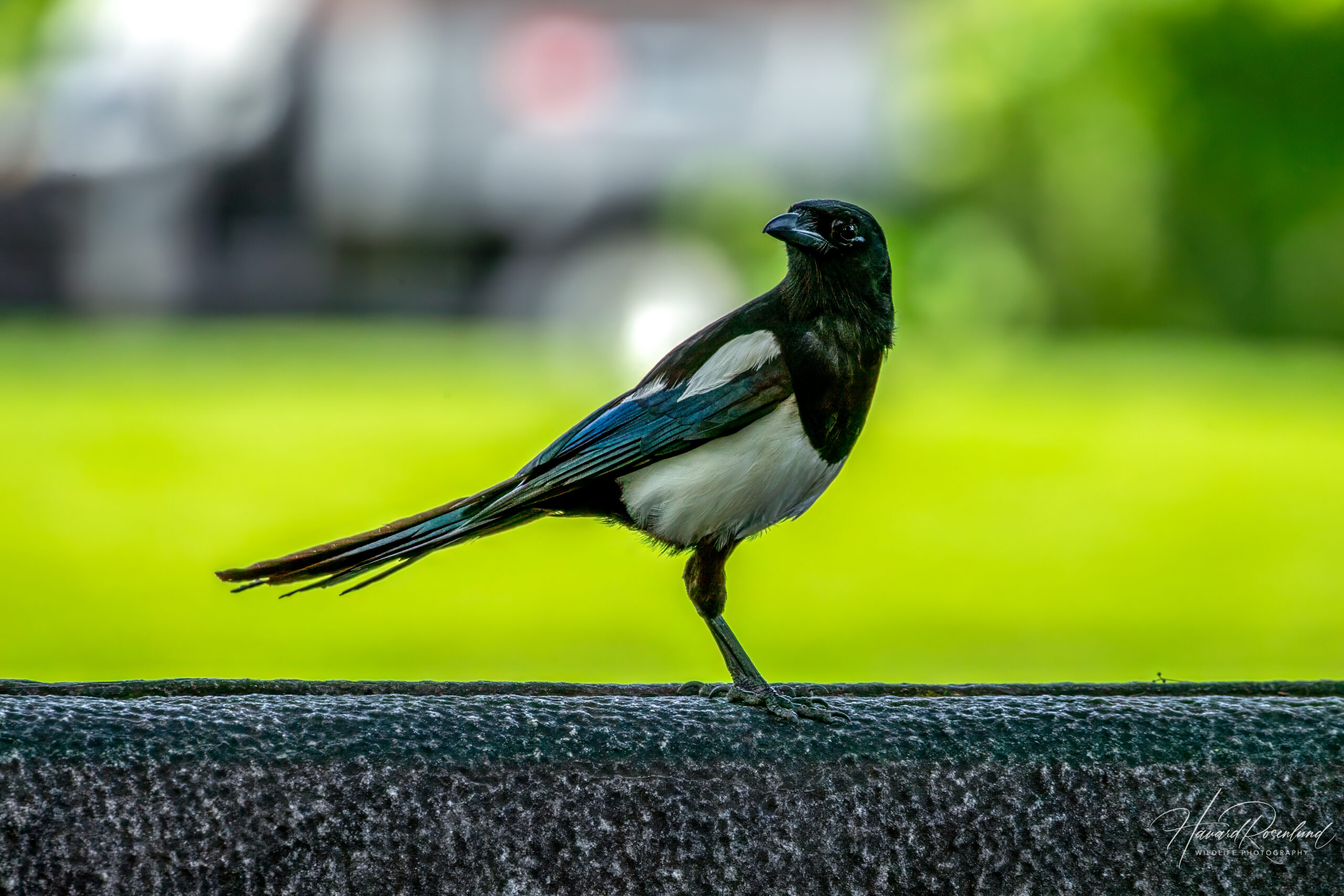
The species adapts particularly well to fragmented and human-modified landscapes where short grass, cultivated ground or roadsides provide feeding areas close to trees and buildings.
Diet
The Eurasian magpie is an opportunistic omnivore. Beetles and other invertebrates often form a large part of the diet, supplemented by seeds, fruit, grain, carrion, refuse, eggs, nestlings and occasional small vertebrates.
Most food is collected while walking on the ground, where magpies pick, probe and turn over loose material, although they also search trees, shrubs, road verges and human structures. Vertebrate prey and nest contents are conspicuous foods but usually form only a relatively small part of the total diet.
Behaviour
Eurasian magpies are diurnal, alert and highly vocal. Adults use harsh calls, postures and conspicuous tail movements during territorial encounters and when responding to predators. Several birds may join in mobbing a cat, raptor or other perceived threat.
Pairs occupy territories during the breeding season, while non-breeding birds range more widely. The species readily investigates novel objects and food sources, a behavioural flexibility that contributes to its success in towns and agricultural landscapes.
Social behaviour
Pairs are usually socially monogamous and can remain together for several years within a stable territory. After breeding, parents and young may remain associated for a time before juveniles become independent.
Outside breeding territories, non-breeding birds can gather in loose groups and larger communal roosts. These gatherings are especially conspicuous outside the breeding season and create repeated opportunities for social interaction, alarm signalling and information exchange.
Intelligence
Eurasian magpies show flexible learning and strong memory, and they cache food for later use. A study published in 2011 also showed that wild magpies could learn to recognise particular people who repeatedly approached their nests. The birds reacted aggressively towards those individuals but not towards people who had not approached the nests.
Their cognitive abilities became especially well known through a 2008 mirror experiment in which two of five hand-reared birds showed behaviour directed towards a coloured mark that could only be seen in the mirror. The authors interpreted this as evidence of mirror self-recognition.
A study published in 2020 did not reproduce the result. Those birds reacted differently to mirrors and control objects but did not show consistent mark-directed behaviour in front of the mirror. The evidence for mirror self-recognition in magpies therefore remains unresolved.
Breeding
Both adults build the nest, most often high in a tree but also in shrubs, hedges, pylons or other structures. The nest is a substantial cup of mud and fine material surrounded by sticks. Many nests have a loose stick dome with one or two side entrances, although open nests also occur.
The clutch normally contains five to seven eggs, with broader variation from about three to ten. The female incubates for roughly 21–22 days while the male supplies food. Both parents feed the nestlings, which leave the nest after about 24–30 days and continue to receive care for several weeks.
Pairs usually raise one brood per year. Breeding success varies strongly with food, weather, predation and the experience of the pair. Eurasian magpies can be remarkably long-lived; European ringing records document a bird that reached 21 years and 8 months.
Cultural significance
The magpie has had a conspicuous place in European folklore, art and everyday language for centuries. Its loud, chatter-like calls and bold behaviour encouraged comparisons with human speech and helped give the bird a reputation for intelligence, curiosity and gossip.
In Britain and parts of western Europe, encounters with one or several magpies became associated with omens and counting traditions, with the meaning changing according to the number of birds seen. Magpies also appear repeatedly in European visual art and literature. These traditions belong to a long European relationship with Pica pica; positive magpie symbolism in China and Korea largely concerns East Asian magpies that are now treated as separate species.
Relationship with humans
Eurasian magpies live readily alongside people and are especially familiar in farmland, suburbs and cities, where gardens, roadsides, buildings and food waste provide feeding and nesting opportunities. Their habit of taking eggs and nestlings has also made them unpopular with some people and has led to deliberate control and persecution. Although magpies can reduce nesting success locally, large-scale British studies have not found evidence that they drive widespread declines in songbird populations.
The idea that magpies are irresistibly attracted to jewellery and other shiny objects is also poorly supported. An experiment published in 2014 found no preference for shiny items; wild and captive birds generally ignored or avoided unfamiliar objects. The familiar image of the “thieving magpie” therefore seems to owe more to folklore and selective human attention than to a real attraction to shiny things.
Status
The Eurasian magpie is classified as least concern on the IUCN Red List. It has an enormous range, a very large population and a broadly stable global trend. Europe alone is estimated to hold about 22.5–57 million individuals.
The species benefits from some agricultural and urban landscapes. Local populations can decline where nesting trees, hedges and open feeding areas disappear, and birds are also killed by traffic, poisoning and collisions, even though the species is not threatened globally.
Image gallery
Loading map and observations…
Have you seen this species?
Independent species archive
Did you find this species page useful?
Wildlife Vagabond is independently built and maintained. Voluntary support helps cover hosting, maps, data storage and continued improvements to the species archive.
Support Wildlife VagabondSpecies content will remain freely available.
References
Information about the species’ global distribution and status is based primarily on global Red List data. See the references below for details.
- BirdLife International. (n.d.). Eurasian Magpie Pica pica species factsheet. https://datazone.birdlife.org/species/factsheet/eurasian-magpie-pica-pica
- Birkhead. (1991). The Magpies: The Ecology and Behaviour of Black-billed and Yellow-billed Magpies. https://books.google.com/books?id=TC0WAQAAIAAJ
- British Trust for Ornithology. (n.d.). Magpie Pica pica – BirdFacts. https://www.bto.org/learn/about-birds/birdfacts/magpie
- Christidis, L., Rheindt, F. E., Iliff, M. J., Lepage, D., Rasmussen, P. C., Donald, P., Alström, P., Areta, J. I., Brammer, F., Chesser, T., Donsker, D., Dowsett, B., Gerbracht, J., Kirsch, M., Kuziemko, M., Lagerqvist, M., Littauer, R., Longmore, W., Norman, J., … Stervander, M. (2026). AviList v2025b. AviList. https://doi.org/10.2173/avilist.v2025b
- Cornell Lab of Ornithology. (n.d.). Eurasian Magpie Pica pica: identification, ecology and behaviour. https://birdsoftheworld.org/bow/species/eurmag1/cur/introduction
- EURING. (2023). European Longevity Records: Pica pica. https://euring.org/files/documents/EURING_longevity_list_20230901.pdf
- International Union for Conservation of Nature. (2017). Pica pica. The IUCN Red List of Threatened Species. https://www.iucnredlist.org/species/103727048/112300389
- Lee, W. Y., Lee, S.-I., Choe, J. C., & Jablonski, P. G. (2011). Wild birds recognize individual humans: experiments on magpies, Pica pica. Animal Cognition, 14(6), 817-825. https://doi.org/10.1007/s10071-011-0415-4
- Prior, H., Schwarz, A., & Güntürkün, O. (2008). Mirror-Induced Behavior in the Magpie (Pica pica): Evidence of Self-Recognition. PLoS Biology, 6(8), e202. https://doi.org/10.1371/journal.pbio.0060202
- Royal Museums Greenwich. (n.d.). Magpie symbolism and counting rhymes in British folklore. https://www.rmg.co.uk/stories/topics/one-sorrow-magpie-nursery-rhyme
- Shephard, T. V., Lea, S. E. G., & Hempel de Ibarra, N. (2015). ‘The thieving magpie’? No evidence for attraction to shiny objects. Animal Cognition, 18(1), 393-397. https://doi.org/10.1007/s10071-014-0794-4
- Soler, M., Colmenero, J. M., Pérez-Contreras, T., & Peralta-Sánchez, J. M. (2020). Replication of the mirror mark test experiment in the magpie (Pica pica) does not provide evidence of self-recognition. Journal of Comparative Psychology, 134(4), 363-371. https://doi.org/10.1037/com0000223
- The Metropolitan Museum of Art. (n.d.). Monet's The Magpie (1868–69). https://www.metmuseum.org/art/collection/search/437853