
Black-winged Cuckooshrike
Lalage melaschistos
At a glance
Habitat
- Broadleaf forest, bamboo, forest edges and other tree-rich habitats from lowlands to submontane areas
Diet
- Mainly caterpillars, beetles and other insects, with some fruit and berries
Activity
- Diurnal
Size
- Length: 19.5–24 cm Weight: about 35–42 g
Range
- From the western Himalayas across northern India and Southeast Asia to southern China; northern populations migrate south in winter
Description
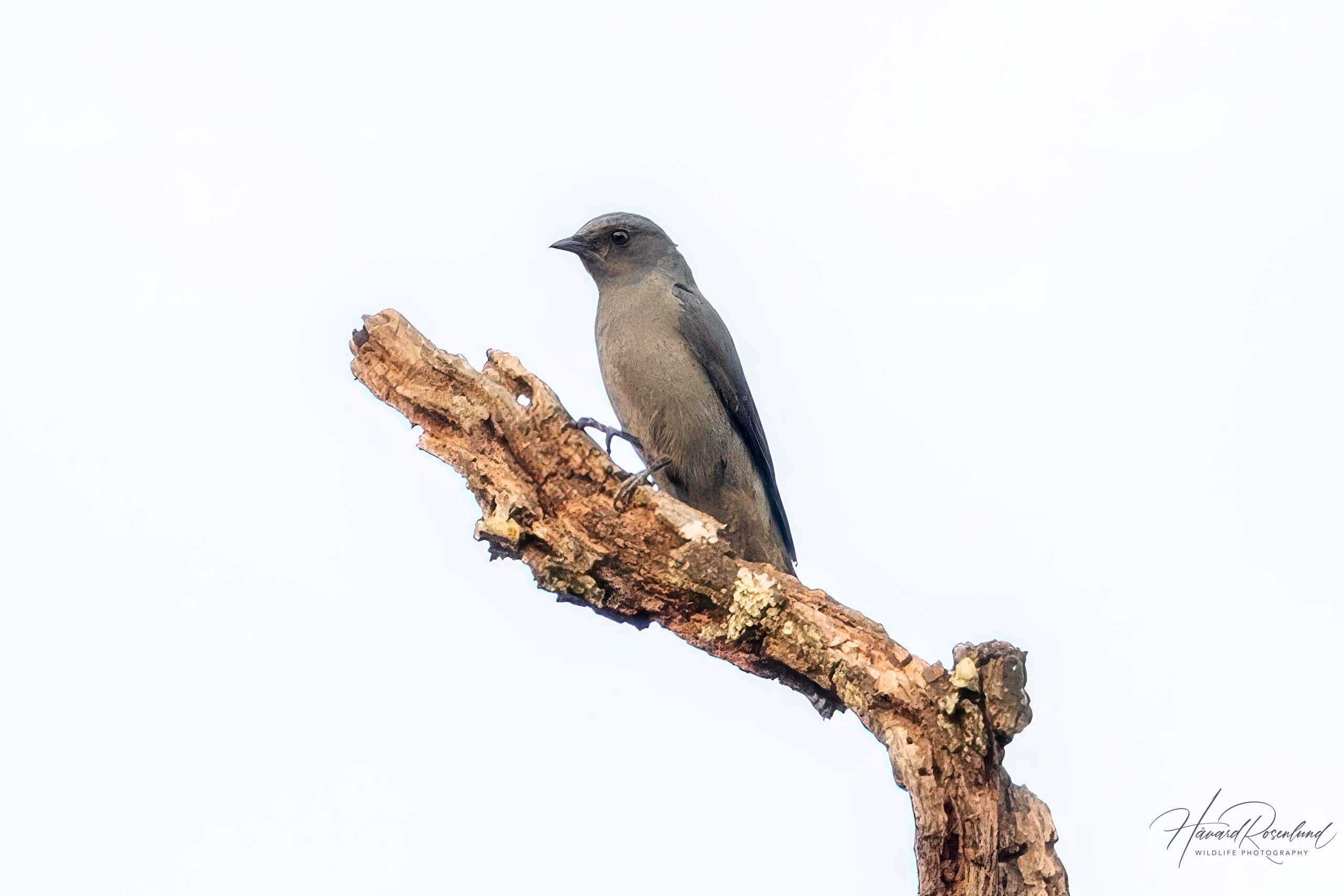
The black-winged cuckooshrike (Lalage melaschistos) is a medium-sized songbird found from the Himalayan region across parts of South and Southeast Asia to southern China. Adults are about 19.5–24 cm long and weigh roughly 35–42 g. Males are mainly dark slate-grey with contrasting black wings and tail, while females are paler and can show faint barring below.
The species is similar to the Indochinese cuckooshrike (Lalage polioptera), but black-winged cuckooshrikes are generally darker and have a more graduated tail. Their rather plain grey plumage can make them surprisingly difficult to notice among leaves and branches despite their size.
Habitat
Black-winged cuckooshrikes use broadleaf forest, bamboo, wooded hills, forest edges and other tree-rich habitats from the lowlands into submontane areas. They also occur in plantations and other modified landscapes where enough mature tree cover remains.
The species spends most of its time in the middle and upper parts of trees rather than on the ground. This makes a well-developed canopy important for both feeding and nesting, even though the bird can tolerate some disturbance and does not require completely untouched forest.
Diet
The diet is dominated by insects and other small arthropods, especially caterpillars, beetles and similar prey found among leaves and branches. Birds move methodically through the canopy, picking prey directly from foliage and bark and occasionally making short flights after insects.
Fruit and berries are also eaten, particularly when readily available. This gives the species some flexibility, but its feeding ecology remains strongly tied to tree canopies where both insects and fruit can be found.
Behaviour
Black-winged cuckooshrikes are often quiet and unobtrusive. They usually move through the middle and upper canopy alone, in pairs or in small groups, and can remain hidden even when feeding quite close by.
They also regularly join mixed-species feeding flocks, often moving with minivets and other insect-eating forest birds. Such flocks allow several species to search the same forest layer together while increasing the number of birds watching for predators.
Migration
The species is partly migratory. Northern populations, including many birds breeding in China and the Himalayan region, move south or to lower elevations outside the breeding season, while populations in milder parts of the range can remain resident.
Wintering birds occur farther south in central India, southern Indochina and Taiwan. In the Himalayas, some of the seasonal movement is mainly downhill rather than a long journey across continents. This mixture of migration and local altitudinal movement explains why the species can be strongly seasonal in one region but present throughout the year in another.
Breeding
Breeding timing varies geographically, but across much of the range it falls mainly from April to July. The nest is a small cup placed high on a branch and built from fine twigs, plant fibres and other light material, often bound together with spider silk and covered with lichen or moss so that it blends into the branch.
A small clutch, usually around two or three eggs, is typical. Both adults take part in caring for the young, especially after hatching. The chicks develop quickly in the exposed canopy nest and leave after a relatively short nestling period, while the parents continue to feed them for some time afterwards.
Status
The black-winged cuckooshrike is classified as least concern on the IUCN Red List and remains widespread across a large part of Asia. The global population trend is nevertheless considered to be decreasing.
Forest loss and degradation are the main long-term concerns. The species can use plantations and secondary woodland, but large-scale removal of mature tree cover reduces both feeding habitat and nesting sites. Adequate tree cover therefore remains important even in modified landscapes.
Image gallery
Loading map and observations…
Have you seen this species?
Independent species archive
Did you find this species page useful?
Wildlife Vagabond is independently built and maintained. Voluntary support helps cover hosting, maps, data storage and continued improvements to the species archive.
Support Wildlife VagabondSpecies content will remain freely available.
References
Information about the species’ global distribution and status is based primarily on global Red List data. See the references below for details.
- Avibase. (n.d.). Black-winged Cuckooshrike. https://avibase.bsc-eoc.org/species.jsp?avibaseid=FAE71B8FB79BE417&lang=EN
- BirdLife International. (n.d.). Black-winged Cuckooshrike species factsheet. https://datazone.birdlife.org/species/factsheet/black-winged-cuckooshrike-lalage-melaschistos
- Birds of India. (n.d.). Lalage melaschistos. https://www.birdsofindia.org/lalage-melaschistos
- Hong Kong Bird Watching Society. (n.d.). Black-winged Cuckooshrike. https://avifauna.hkbws.org.hk/species/0230/031400
- International Union for Conservation of Nature. (n.d.). Black-winged Cuckooshrike. The IUCN Red List of Threatened Species. https://www.iucnredlist.org/species/22706636/130420674
- Oiseaux.net. (n.d.). Black-winged Cuckooshrike. https://www.oiseaux.net/birds/black-winged.cuckooshrike.html