
Square-tailed Drongo
Dicrurus ludwigii
At a glance
Habitat
- Evergreen and riverine forest, dense woodland, forest edge and plantations with native undergrowth
Diet
- Mainly insects and other arthropods; also nectar and occasionally food stolen from other birds
Activity
- Diurnal
Size
- Length: 18–19 cm Weight: females about 31 g; males about 36 g
Range
- Eastern and southern Africa
Description
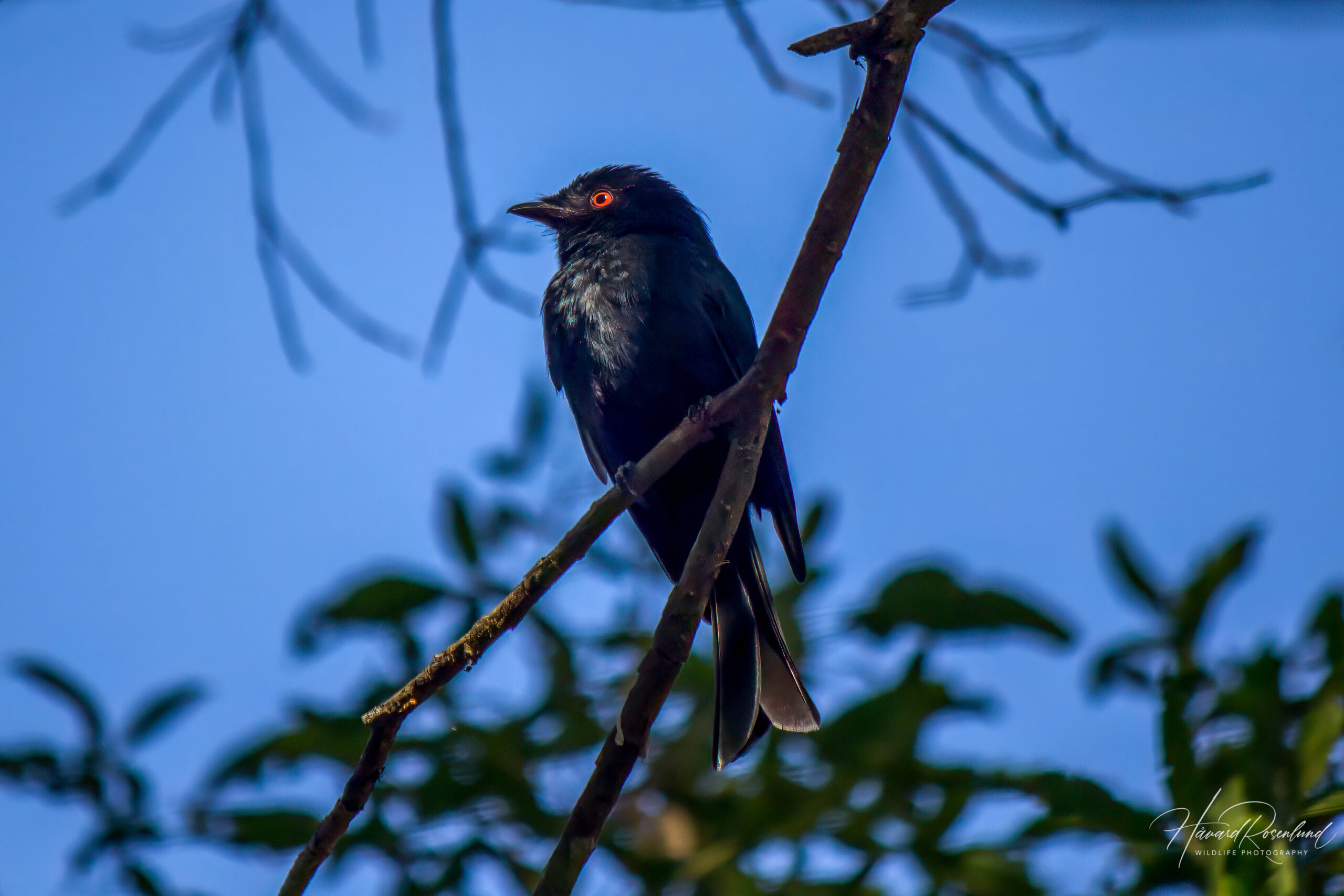
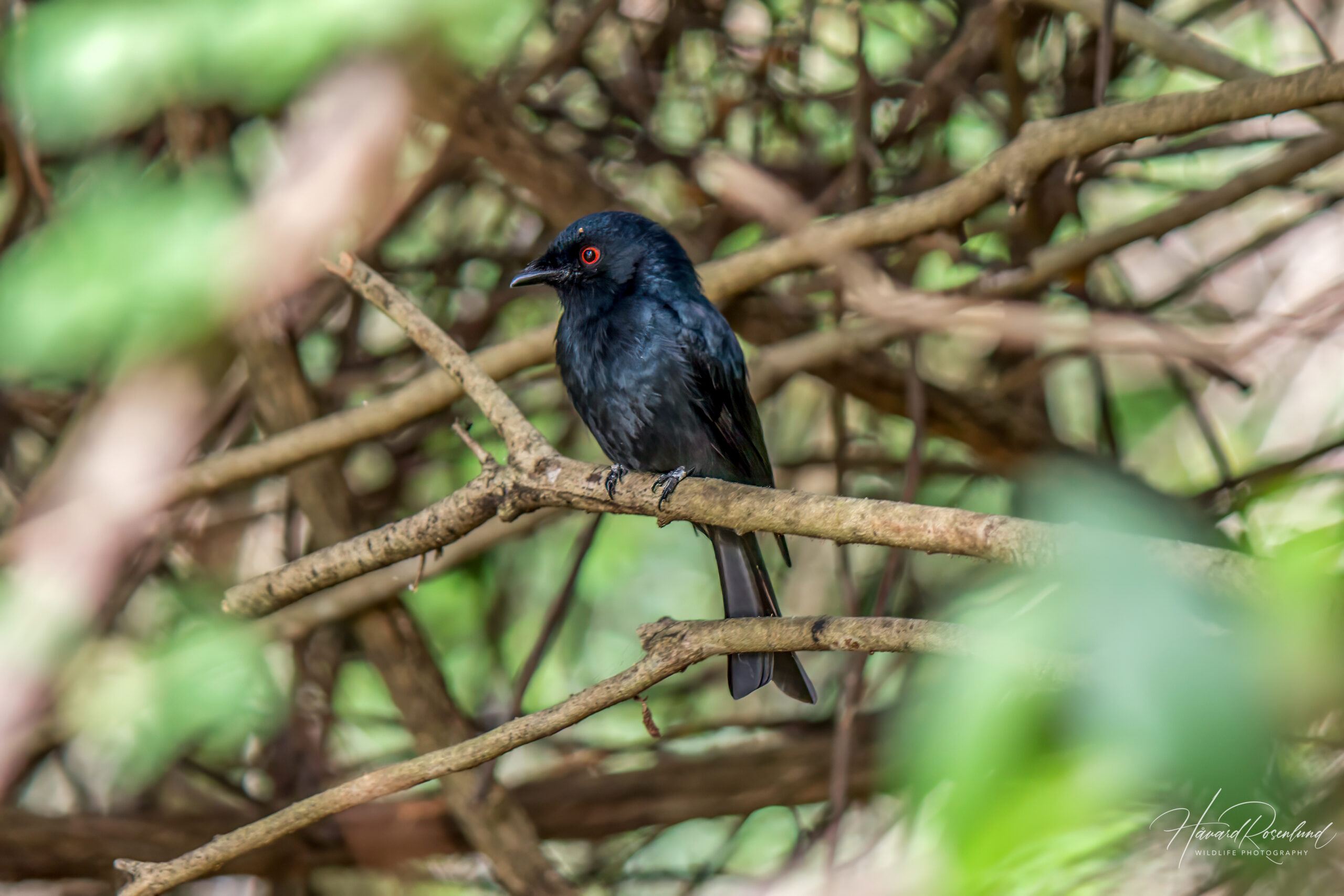
The square-tailed drongo (Dicrurus ludwigii) is a small, glossy black drongo of eastern and southern Africa. It measures about 18–19 cm; adult females weigh around 31 g and males about 36 g. Both sexes have deep red eyes, although males are often slightly glossier.
It resembles the larger fork-tailed drongo (Dicrurus adsimilis) but has a shorter tail with only a shallow notch, which can appear almost square when the feathers are aligned. Habitat is also useful for identification: square-tailed drongos favour forest and dense woodland, while fork-tailed drongos are more characteristic of open savanna and woodland.
Taxonomy
The square-tailed drongo was formerly treated as part of a wider species complex extending far across sub-Saharan Africa. A taxonomic revision published in 2018 found clear genetic and morphological differences within the complex and helped clarify the limits of Dicrurus ludwigii, Sharpe’s drongo (Dicrurus sharpei) and the western populations then described as Dicrurus occidentalis. Under the current AviList treatment, the western form is included within Sharpe’s drongo as Dicrurus sharpei occidentalis, leaving the square-tailed drongo as an eastern and southern African species.
Habitat
The species is closely associated with wooded habitats, including evergreen and riverine forest, dense woodland, forest edge and plantations where native undergrowth remains. It is generally much more dependent on dense vegetation than the fork-tailed drongo (Dicrurus adsimilis), although it can use forest edges and other partly open situations where suitable trees and understorey persist.
Diet
Insects and other arthropods dominate the diet. Recorded prey include grasshoppers, crickets, mantids, beetles, termites and bees. The species also takes nectar and may steal food caught by other birds, a behaviour known as kleptoparasitism.
Square-tailed drongos commonly hunt from a lookout perch, making short sallies after prey in the air, foliage or on the ground before often returning to a perch.
Behaviour
Square-tailed drongos are usually encountered singly or in pairs and are active, conspicuous and vocal within their territories. They also frequently join mixed-species feeding flocks, where their calls appear to play an important role in keeping the flock together.
A study published in 2015 in the East Usambara Mountains of Tanzania found square-tailed drongos in 86% of mixed-species flocks. Flocks containing the species were larger, especially in continuous forest, and the drongos’ calls attracted other flocking birds. The square-tailed drongo therefore acts as a central flock species: its presence and vocalisations help other species assemble and remain together.
Breeding
Pairs are monogamous and both adults help defend the nesting territory. The nest is a shallow, strongly woven cup of fine plant material, rootlets, twigs, fibres, lichen and spider silk, usually suspended in a horizontal fork in a tree, often near the edge of dense forest.
The clutch most often contains two eggs, although three to four have been reported. In southern Africa, egg-laying has been recorded mainly from September to January, with a peak around October–November. Both parents contribute to caring for the young, while detailed incubation and fledging periods remain poorly documented across much of the range.
Status
The square-tailed drongo is classified as Least Concern on the IUCN Red List. It has a broad distribution through eastern and southern Africa and remains locally common in suitable forest and woodland. No global population estimate is available.
Forest loss and degradation can affect both the species and the mixed-species flocks it joins. In the East Usambara Mountains, square-tailed drongos were less common in fragmented forest, and those fragments also held less diverse, less stable flocks than continuous forest. This shows how the loss of a central flock species can have wider ecological effects even when the species itself is not globally threatened.
Image gallery
Loading map and observations…
Have you seen this species?
Independent species archive
Did you find this species page useful?
Wildlife Vagabond is independently built and maintained. Voluntary support helps cover hosting, maps, data storage and continued improvements to the species archive.
Support Wildlife VagabondSpecies content will remain freely available.
References
Information about the species’ global distribution and status is based primarily on global Red List data. See the references below for details.
- Biodiversity Explorer. (n.d.). Dicrurus ludwigii: diet and breeding ecology in southern Africa. Iziko Museums of South Africa. https://www.biodiversityexplorer.info/birds/dicruridae/dicrurus_ludwigii.htm
- BirdLife International. (n.d.). Square-tailed Drongo Dicrurus ludwigii species factsheet. https://datazone.birdlife.org/species/factsheet/square-tailed-drongo-dicrurus-ludwigii
- Christidis, L., Rheindt, F. E., Iliff, M. J., Lepage, D., Rasmussen, P. C., Donald, P., Alström, P., Areta, J. I., Brammer, F., Chesser, T., Donsker, D., Dowsett, B., Gerbracht, J., Kirsch, M., Kuziemko, M., Lagerqvist, M., Littauer, R., Longmore, W., Norman, J., … Stervander, M. (2026). AviList v2025b. AviList. https://doi.org/10.2173/avilist.v2025b
- Cordeiro, N. J., Borghesio, L., Joho, M. P., Monoski, T. J., Mkongewa, V. J., & Dampf, C. J. (2015). Forest fragmentation in an African biodiversity hotspot impacts mixed-species bird flocks. Biological Conservation, 188, 61-71. https://doi.org/10.1016/j.biocon.2014.09.050
- Fuchs, J., Douno, M., Bowie, R. C., & Fjeldså, J. (2018). Taxonomic revision of the Square-tailed Drongo species complex (Passeriformes: Dicruridae) with description of a new species from western Africa. Zootaxa, 4438(1). https://doi.org/10.11646/zootaxa.4438.1.4
- International Union for Conservation of Nature. (2017). Dicrurus ludwigii. The IUCN Red List of Threatened Species. https://www.iucnredlist.org/species/22706927/118758303