
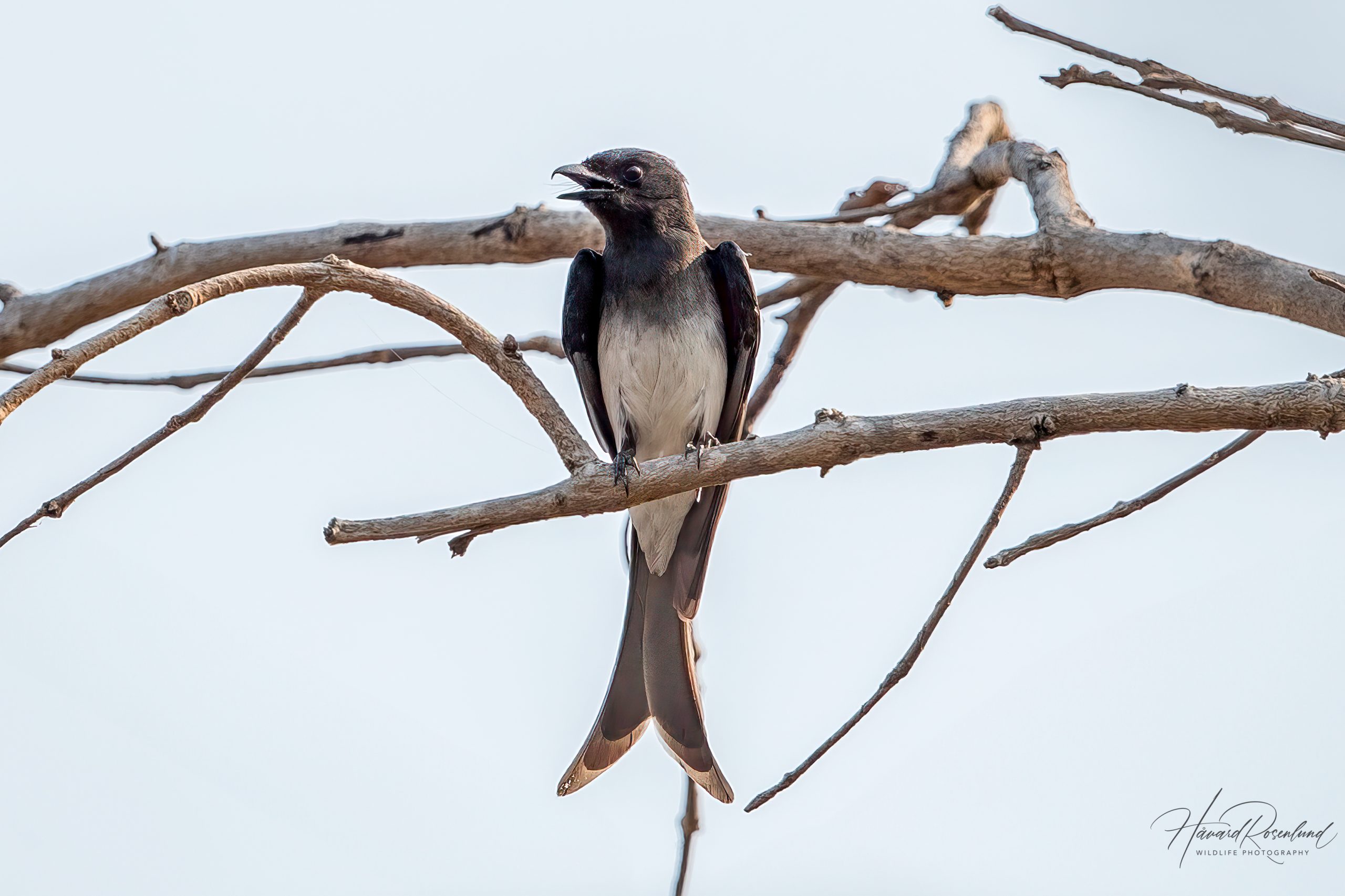
White-bellied Drongo
Dicrurus caerulescens
At a glance
Habitat
- Dry deciduous and open forest, scrub, bamboo, plantations and wooded farmland
Diet
- Mainly insects; also other arthropods, small fruit and nectar
Activity
- Mainly diurnal; may feed around artificial lights after dark
Size
- Length: 23–25 cm Weight: 39–41 g
Range
- Indian subcontinent, chiefly Nepal and India south to Sri Lanka
Description
The white-bellied drongo (Dicrurus caerulescens) is a compact drongo of the Indian subcontinent, about 23–25 cm long and roughly 39–41 g. Adults are dark slate-grey to black above and across the breast, with deep red eyes, a shallowly forked tail and a sharply contrasting white belly and vent.
The mainland form is especially distinctive because of its extensive white underparts. Sri Lankan birds are darker below, with the white concentrated nearer the vent. Juveniles are duller and less contrasting than adults and can be confused with other dark drongos.
Habitat
White-bellied drongos are resident birds of dry deciduous forest, open woodland, scrub, bamboo and forest edge. They also use plantations, wooded farmland, gardens and other modified landscapes where enough trees remain for feeding and nesting.
They favour relatively open vegetation rather than closed, humid forest. Exposed branches at the edge of clearings and woodland provide hunting perches, while mature trees supply nesting sites and cover. The species can therefore persist in mosaics of natural forest and lightly modified land.
Diet
Insects dominate the diet. White-bellied drongos watch from exposed perches and launch short aerial chases after bees, moths, termites, dragonflies and other flying prey. They also pick arthropods from foliage and branches. Rare predation on small birds has been recorded; a note published in 1951 described a white-bellied drongo catching a small Prinia in mid-air.
Nectar and small fruit are also taken. A short note published in 2003 documented white-bellied drongos feeding under street lamps at night, where insects attracted to the lights provide an additional food source for an otherwise mainly diurnal bird.
Behaviour
White-bellied drongos are usually seen alone or in pairs. They are alert and conspicuous, repeatedly returning to favourite exposed perches between hunting flights and using varied contact, alarm and territorial calls. Outside breeding they may join mixed-species feeding flocks and take insects disturbed by other birds.
Like many drongos, they can be remarkably bold towards potential predators and may mob crows, raptors and other much larger birds. Vocal mimicry has also been observed. A 2006 study focused mainly on greater racket-tailed drongos (Dicrurus paradiseus) but explicitly noted field observations of white-bellied drongos mimicking squirrel alarm calls and cat-like meows while mobbing.
Breeding
Breeding on the mainland is concentrated mainly from late winter into the early monsoon, broadly from February or March to June or July depending on locality. Both adults build a shallow cup of twigs, fibres and grass in a tree fork.
A clutch usually contains two to four pale salmon or pinkish eggs marked with reddish-brown, often concentrated toward the broader end. Both parents take part in nest defence and care of the young and become particularly aggressive towards potential predators near the nest. Reliable species-specific figures for incubation and the time to fledging remain poorly documented.
Status
The white-bellied drongo is classified as least concern on the IUCN Red List. It has a broad range across the Indian subcontinent, but the global population trend is considered decreasing.
State of India's Birds reports a long-term national decline of about 37.3% and a current annual decline of about 1.9%. The species is classed as Moderate Priority in India.
Image gallery
Loading map and observations…
Have you seen this species?
Independent species archive
Did you find this species page useful?
Wildlife Vagabond is independently built and maintained. Voluntary support helps cover hosting, maps, data storage and continued improvements to the species archive.
Support Wildlife VagabondSpecies content will remain freely available.
References
Information about the species’ global distribution and status is based primarily on global Red List data. See the references below for details.
- Ali. (1951). White-bellied Drongo catching a bird. https://www.biodiversitylibrary.org/page/48182350
- BirdLife International. (n.d.). White-bellied Drongo species factsheet. https://datazone.birdlife.org/species/factsheet/white-bellied-drongo-dicrurus-caerulescens
- Goodale, E., & Kotagama, S. W. (2006). Context-dependent vocal mimicry in a passerine bird. Proceedings of the Royal Society B: Biological Sciences, 273(1588), 875-880. https://doi.org/10.1098/rspb.2005.3392
- Hume. (1889). The Nests and Eggs of Indian Birds – White-bellied Drongo. https://www.gutenberg.org/cache/epub/13117/pg13117-images.html
- International Union for Conservation of Nature. (n.d.). Dicrurus caerulescens. The IUCN Red List of Threatened Species. https://www.iucnredlist.org/species/22706967/94100118
- State of India's Birds. (n.d.). White-bellied Drongo. https://stateofindiasbirds.in/species/whbdro1/