
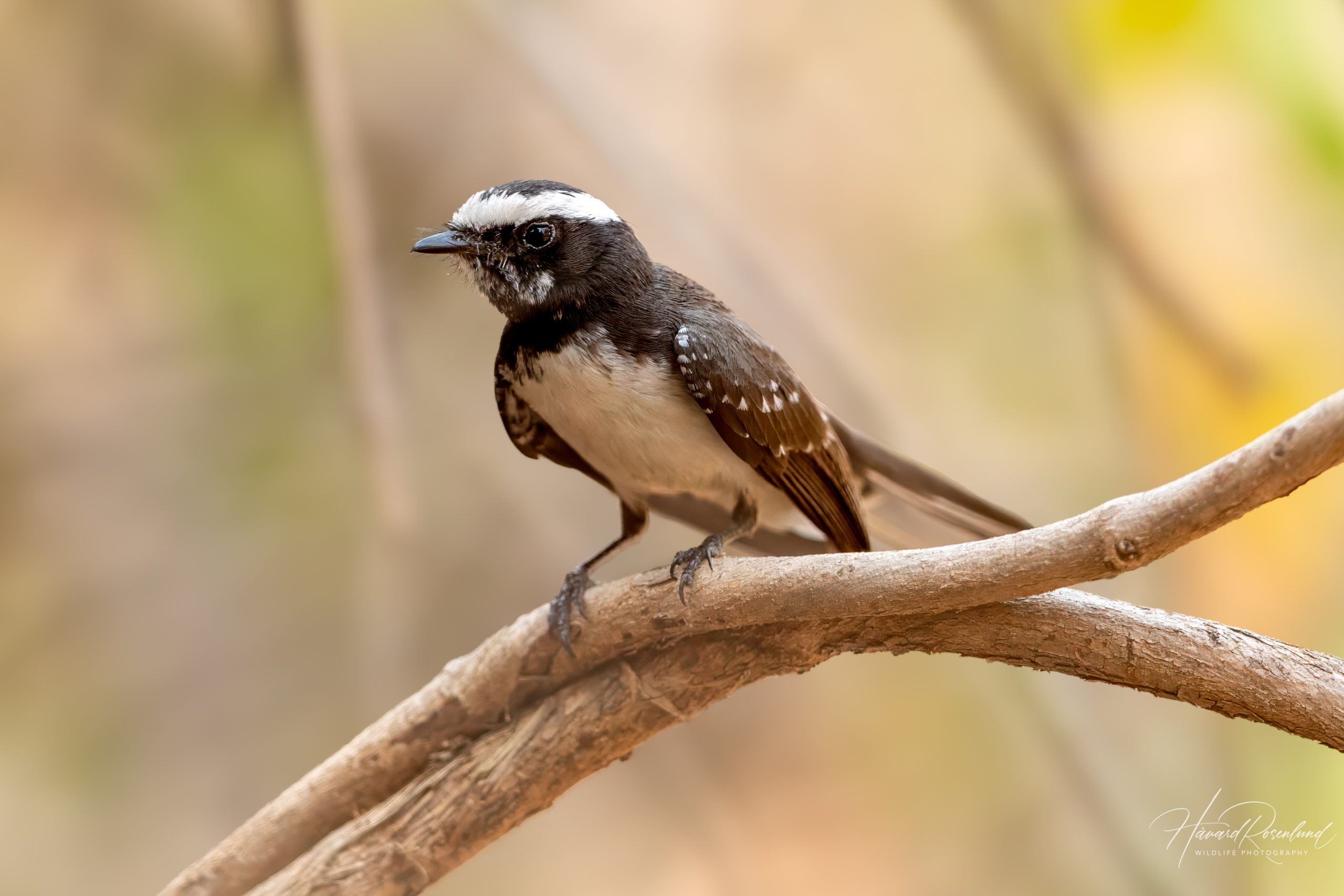
White-browed Fantail
Rhipidura aureola
At a glance
Habitat
- Open woodland, dry and deciduous forest, tall scrub, plantations, gardens and water edges
Diet
- Mainly small flying insects and other arthropods
Activity
- Diurnal
Size
- Length: 17–18 cm Weight: About 11 g
Range
- Indian subcontinent east through Myanmar to southern Indochina; also Sri Lanka
Description
The white-browed fantail (Rhipidura aureola) is a slim, active songbird about 17–18 cm long and around 11 g in weight. Its long white eyebrows meet across the forehead above a black mask and throat, while white moustachial stripes frame the dark face. The underparts are pale and the long dark tail has white outer edges.
The white-spotted fantail (Rhipidura albogularis) is the most likely confusion species across much of India. It has a broad white throat, shorter eyebrows and a dark breast band marked with white spots, whereas the white-browed fantail has a black throat and a much stronger white facial pattern.
Habitat
White-browed fantails inhabit open woodland, dry and deciduous forest, tall scrub, plantations, wooded gardens and the edges of streams and artificial water bodies. They occur widely across the Indian subcontinent and extend east through Myanmar into southern Indochina, with a separate population in Sri Lanka.
The species generally uses the lower and middle levels of vegetation and tolerates a fair amount of habitat modification as long as enough trees, shrubs and feeding cover remain. Gardens, plantations and wooded edges can therefore provide useful habitat alongside natural forest and scrub.
Diet
The diet consists mainly of small flying insects and other arthropods. Birds search actively from low and middle-level perches, then make short aerial sallies to catch prey before returning to vegetation.
The tail is opened, closed and twisted repeatedly during foraging. These movements may help disturb hidden insects and make them easier to detect.
Behaviour
White-browed fantails are usually seen alone or in pairs and are active, restless birds. They move rapidly through the lower and middle vegetation, repeatedly fan the tail, switch perches and make short aerial sallies. Contact and alarm calls are given frequently, and the species can also join mixed-species feeding flocks.
A study published in 2002 from Myanmar described white-browed fantails following other insect-eating birds and taking prey disturbed by their movements. The relationship was usually commensal: the fantails benefited from insects flushed by the other birds without an obvious effect on them. When insects were scarce, however, the fantails were also observed stealing prey from accompanying nuthatches. Most populations are resident, although local and altitudinal movements occur in parts of the range.
Breeding
Breeding timing varies geographically. A six-year study in Sri Lanka followed 14 nests from 2012–2017 and recorded active nests mainly from late March to May. Courtship includes tail-fanning and short flights around the mate. Both adults built the small, neatly constructed cup nests from fibres and roots bound with cobweb, taking 9–13 days to complete them.
Clutches usually contain two or three pale buff to pinkish eggs marked with darker spots and blotches. Both parents incubate, brood and feed the young. The Sri Lankan study found nests in a wide range of settings, including gardens, forest edges, reserves, tea plantations, stream banks and areas beside roads and water bodies, showing how flexibly the species can nest where suitable vegetation remains.
Predation and severe weather can cause nest failure. Cats and birds of prey were among recorded predators, while heavy rain and wind also destroyed nests in the Sri Lankan study.
Status
The white-browed fantail is classified as least concern on the IUCN Red List. It has a broad range and remains common in many natural and human-modified wooded habitats.
State of India's Birds 2025 estimates a long-term national decline of about 35.7% and a current annual decline of about 1.6%. Despite the species' broad global distribution, monitoring in India therefore shows a clear decline.
Image gallery
Loading map and observations…
Have you seen this species?
Independent species archive
Did you find this species page useful?
Wildlife Vagabond is independently built and maintained. Voluntary support helps cover hosting, maps, data storage and continued improvements to the species archive.
Support Wildlife VagabondSpecies content will remain freely available.
References
Information about the species’ global distribution and status is based primarily on global Red List data. See the references below for details.
- BirdLife International. (n.d.). White-browed Fantail (Rhipidura aureola) species factsheet. https://datazone.birdlife.org/species/factsheet/white-browed-fantail-rhipidura-aureola
- Bopitiya Gamage, P. T. S., & Wijeweera, W. P. S. N. (2022). The population trends and distribution of White Browed Fantail (<i>Rhipidura aureola</i>) in Sri Lanka. Rajarata University Journal, 7(1), 27–29. https://www.rjt.ac.lk/wp-content/uploads/2022/07/RUJ-071-Papers.pdf
- Dissanayake, D. S. B., Thewarage, L. D., & Mohan, M. A. (2019). Nesting behaviour and ecology of the White-browed Fantail Flycatcher (Rhipidura aureola) in Sri Lanka. Zoology and Ecology, 29(1), 3-6. https://doi.org/10.35513/21658005.2019.1.1
- International Union for Conservation of Nature. (n.d.). Rhipidura aureola. The IUCN Red List of Threatened Species. https://www.iucnredlist.org/species/22706796/94090600
- King & Rappole. (2002). Commensal foraging relationships of the White-browed Fantail in Myanmar. https://www.biodiversitylibrary.org/page/48604444
- Nyári, Á. S., Benz, B. W., Jønsson, K. A., Fjeldså, J., & Moyle, R. G. (2009). Phylogenetic relationships of fantails (Aves: Rhipiduridae). Zoologica Scripta, 38(6), 553-561. https://doi.org/10.1111/j.1463-6409.2009.00397.x
- State of India's Birds. (2025). 2025 – White-browed Fantail. https://stateofindiasbirds.in/species/wdl-whbfan2/