
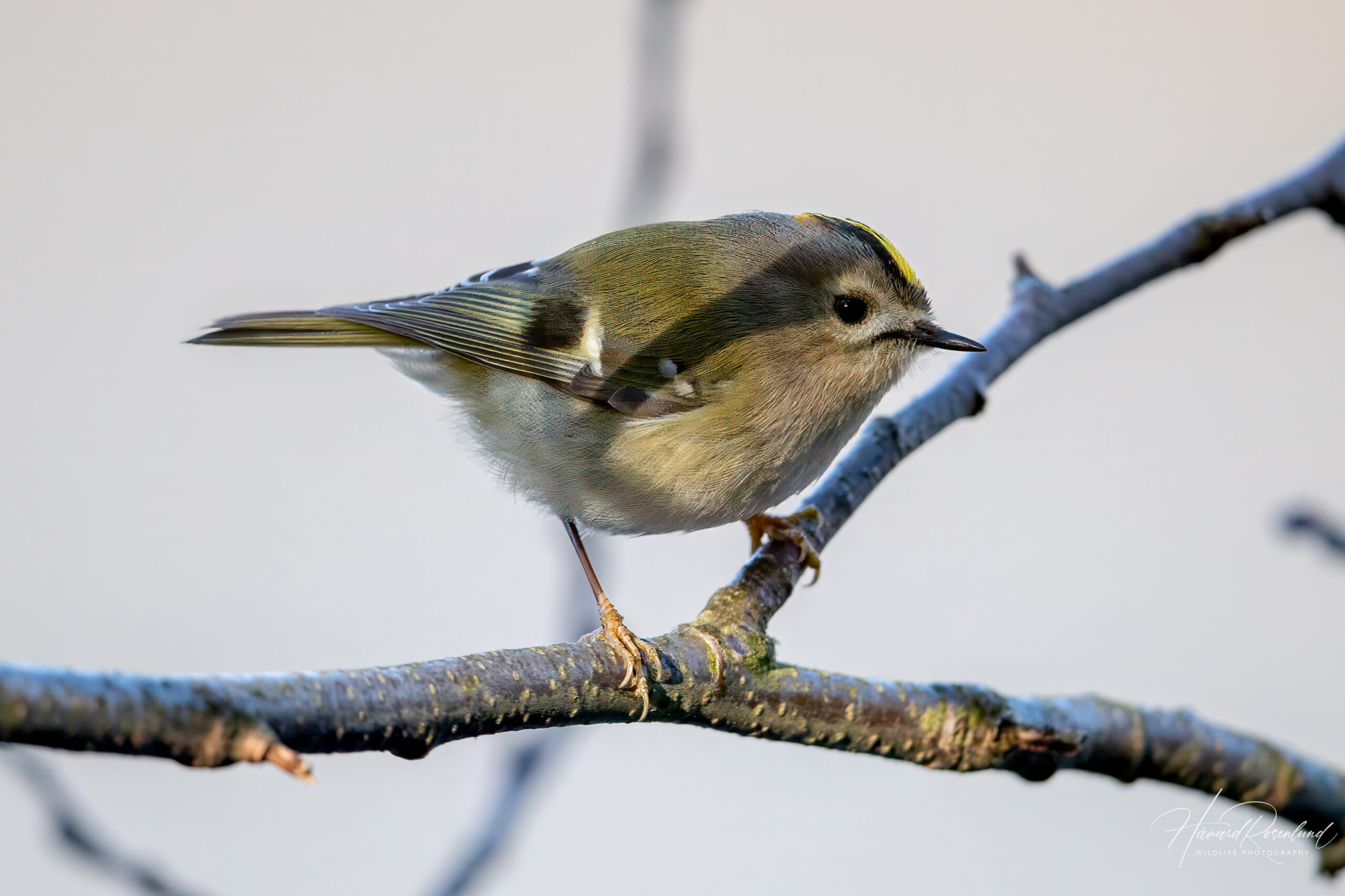
Goldcrest
Regulus regulus
At a glance
Habitat
- Coniferous and mixed woodland, especially mature spruce-rich forest with dense foliage
Diet
- Tiny insects, spiders and other small invertebrates gleaned from needles, twigs and foliage
Activity
- Diurnal
Size
- Length: 8.5–9.5 cm Weight: about 5.3 g
Range
- Europe and temperate Asia; northern populations are partly migratory and move south and west in winter
Description
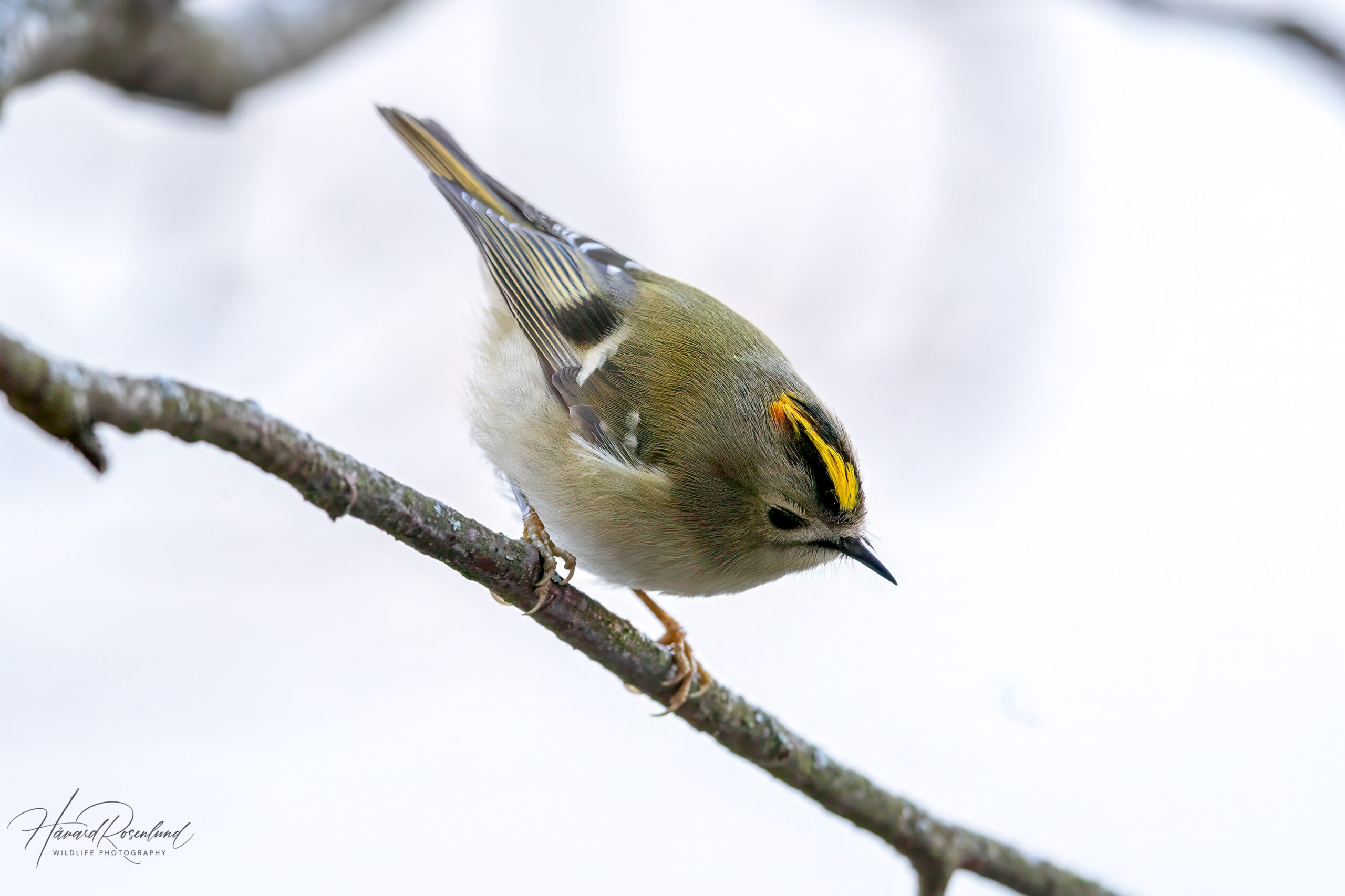
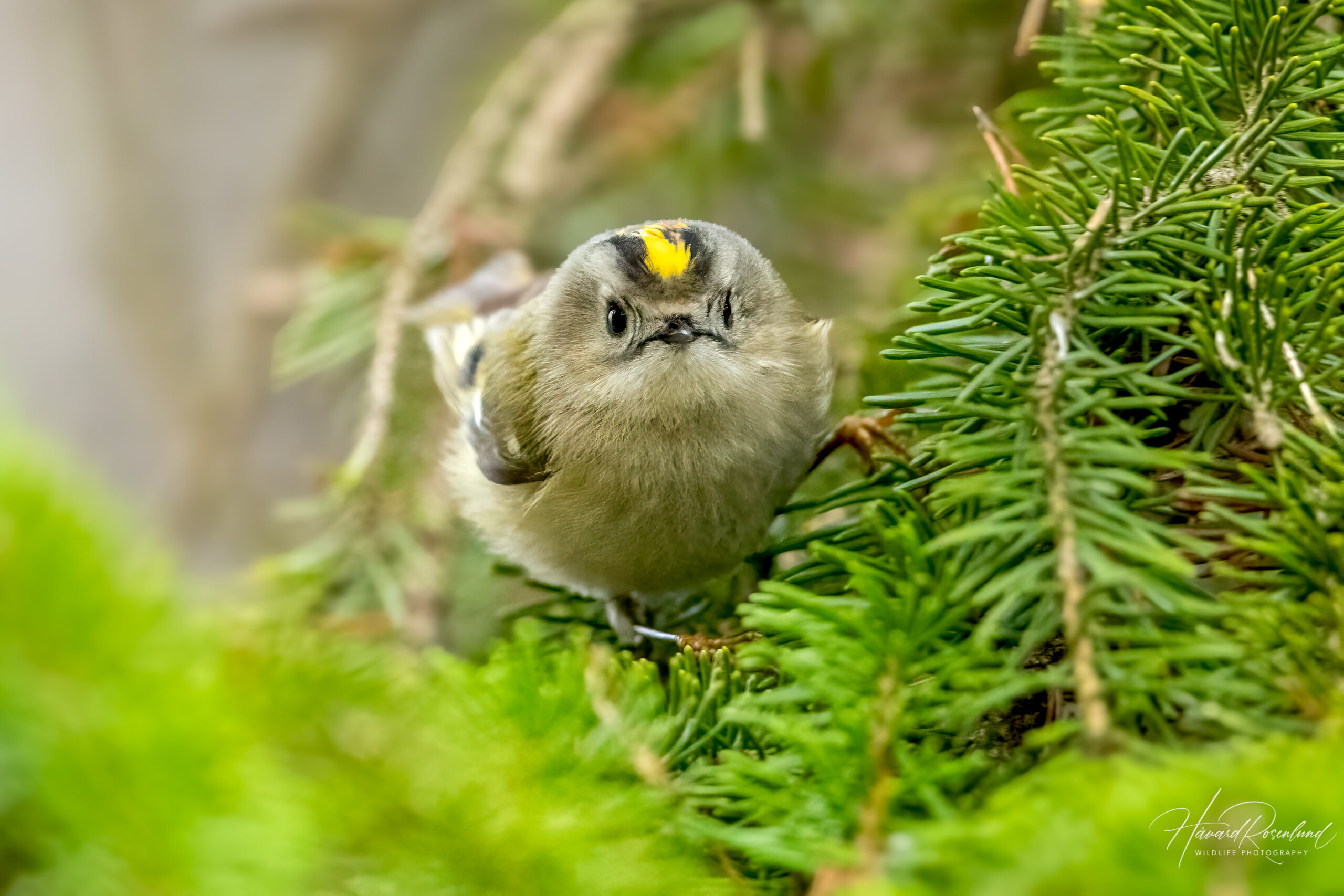
The goldcrest (Regulus regulus) is Europe's smallest bird and one of the lightest birds regularly encountered across the Palearctic. Adults are only about 8.5–9.5 cm long and average roughly 5.3 g. The upperparts are olive-green and the underparts pale, with two pale wing bars and a dark border around the brightly coloured crown stripe. Females have a yellow crown stripe, while adult males show a stronger orange centre that can be raised during displays.
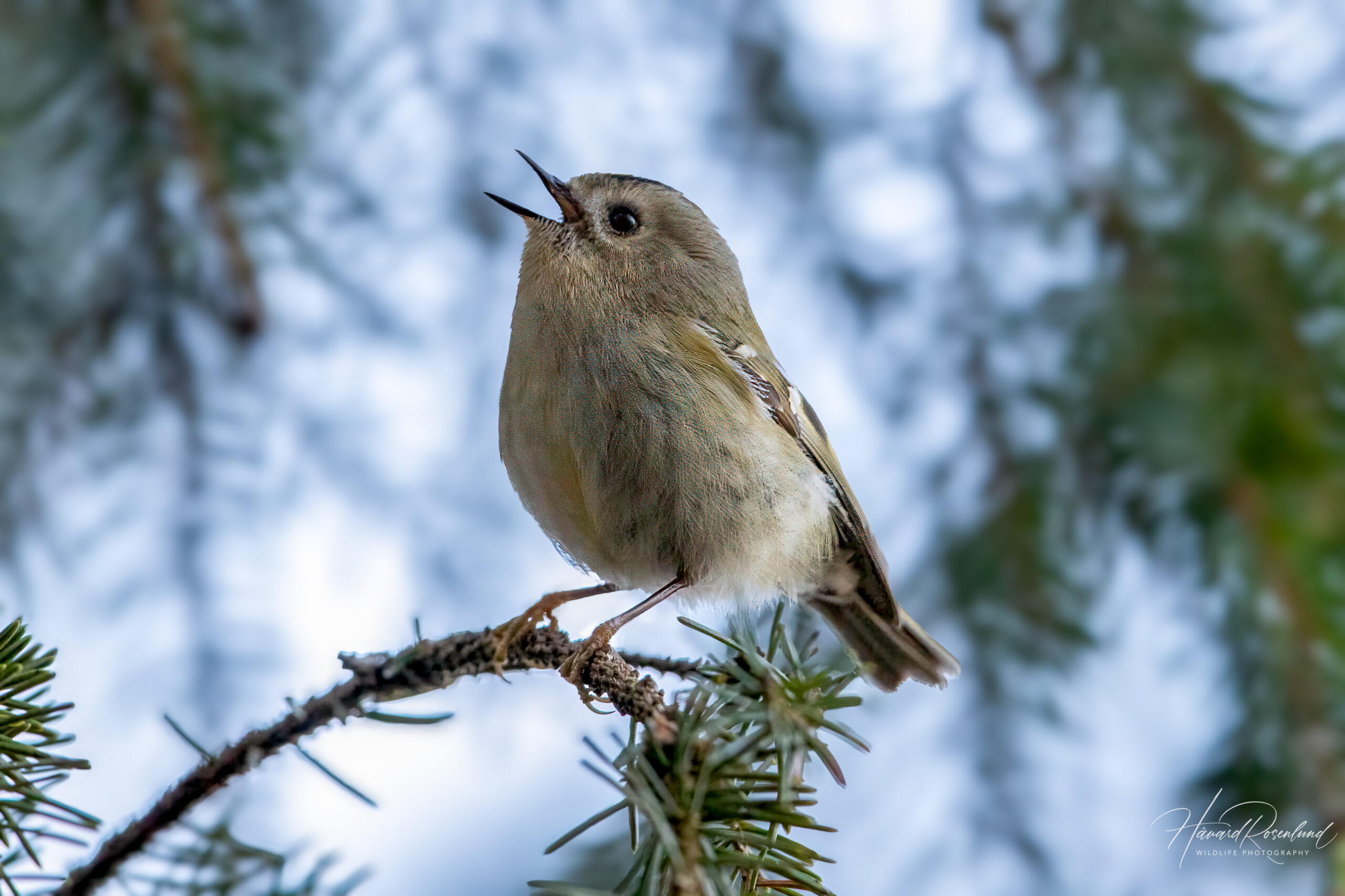
The closely related firecrest (Regulus ignicapilla) is similar in size but has a much more strongly patterned face, including a bold white supercilium and dark eye-stripe. Goldcrests have a plainer face and are especially associated with conifers. Their very high-pitched song and calls are often the easiest way to locate birds moving almost continuously among dense needles. Because these sounds lie at high frequencies, age-related hearing loss can make them much harder for older listeners to detect.
Habitat
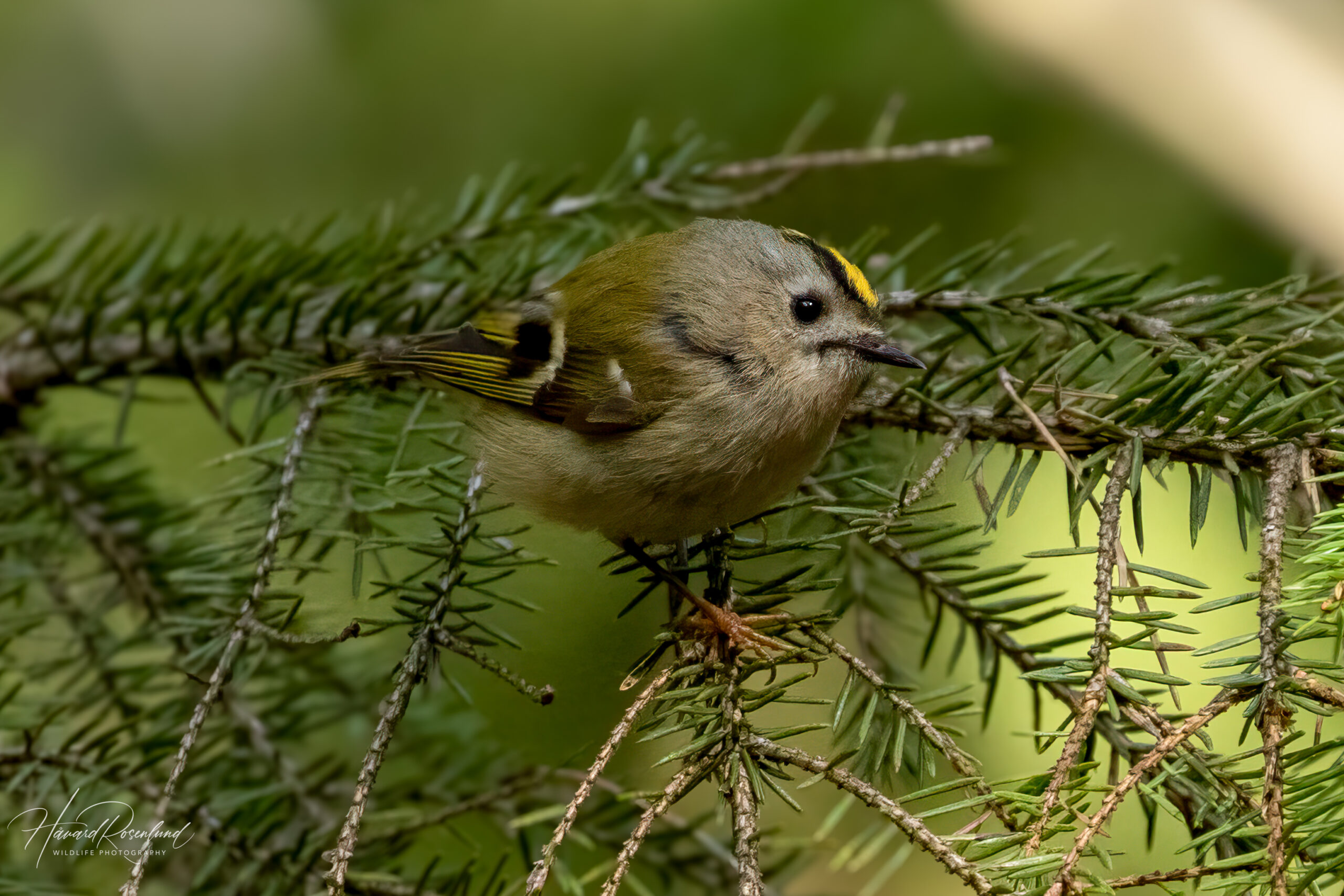
Goldcrests are strongly associated with coniferous woodland, particularly mature spruce-rich forest, although they also use mixed woodland, parks and gardens where suitable conifers are present. Dense foliage provides both places to forage and shelter, and the birds spend much of the day moving through the outer branches and crowns.
Their dependence on fine conifer foliage is especially apparent in winter, when dense needles provide sheltered foraging space during poor weather. Local abundance can therefore vary with both forest structure and winter conditions.
Diet
The diet consists overwhelmingly of tiny invertebrates, including small insects, larvae and spiders. Goldcrests glean prey from needles, twigs and bark and may hang beneath branches or hover briefly to reach the underside of foliage.
Their minute size allows them to exploit very small prey and fine branch structure. Outside the breeding season they may forage in small groups or join mixed-species flocks with tits and other small woodland birds, but they remain active almost continuously because their energy reserves are so limited.
Winter survival
At barely five grams, a goldcrest has very little stored energy and loses heat rapidly, making winter survival a demanding balance between daytime food intake and overnight energy use. Goldcrests do not necessarily need to lower their body temperature sharply each night. Measurements of oxygen consumption in five birds showed that they could remain normothermic overnight when they had obtained enough food during the day.
Food shortage and weather can nevertheless cause severe winter losses. A six-winter study in spruce-dominated forest near Oslo, Norway, recorded a 76–96% reduction in the local population between November and March, with a mean decline of 86%. The decline was related to snowfall and temperature, and spiders were the dominant prey. The results suggest that winter survival depends strongly on continued access to tiny invertebrates, not only on direct tolerance of cold.
Migration
The species is partially migratory. Many birds in milder western and southern areas remain close to their breeding grounds, while large numbers from northern and eastern Europe move south and west in autumn. Scandinavian and Baltic birds can make substantial sea crossings despite weighing only a few grams.
Autumn migration can produce striking coastal arrivals when weather concentrates birds at migration sites. Ringing studies around the Baltic have traced movements from northern breeding areas toward western and southern Europe, and Fennoscandian migrants regularly reach Britain after crossing the North Sea. The proportion that migrates varies between years and regions.
Breeding
The goldcrest builds a remarkably compact suspended nest among drooping conifer branches. Moss, lichen, plant fibres and spider silk are woven into a deep hammock-like cup, which is then lined with soft material and feathers. Its placement among dense needles helps conceal both the nest and incubating bird.
A typical clutch contains six to eight eggs, although two to twelve have been recorded. The female incubates for about 16–19 days. Both parents feed the chicks, which normally leave the nest after roughly 17–18 days. Two broods are typical and can produce many young in a successful breeding season.
Status
The goldcrest is classified as least concern on the IUCN Red List. It remains widespread across Europe and temperate Asia and occupies a very large range.
Population numbers can fluctuate strongly after severe winters. British long-term data show severe weather as a major driver of annual variation, while the causes of longer-term change are less certain.
Image gallery
Loading map and observations…
Have you seen this species?
Independent species archive
Did you find this species page useful?
Wildlife Vagabond is independently built and maintained. Voluntary support helps cover hosting, maps, data storage and continued improvements to the species archive.
Support Wildlife VagabondSpecies content will remain freely available.
References
Information about the species’ global distribution and status is based primarily on global Red List data. See the references below for details.
- BirdLife International. (n.d.). Goldcrest species factsheet. https://datazone.birdlife.org/species/factsheet/goldcrest-regulus-regulus
- British Trust for Ornithology. (n.d.). Goldcrest. https://www.bto.org/learn/about-birds/birdfacts/goldcrest
- Grenmyr, U., & Olsén, B. (1995). Kungsfågelns Regulus regulus höstflyttning över Stora Fjäderägg. Ornis Svecica, 5(1), 15-22. https://doi.org/10.34080/os.v5.23010
- Hogstad, O. (1984). Variation in numbers, territoriality and flock size of a Goldcrest Regulus regulus population in winter. Ibis, 126(3), 296-306. https://doi.org/10.1111/j.1474-919X.1984.tb00252.x
- International Union for Conservation of Nature. (n.d.). Goldcrest. The IUCN Red List of Threatened Species. https://www.iucnredlist.org/species/22734997/132183740
- Reinertsen, R. E., Haftorn, S., & Thaler, E. (1988). Is hypothermia necessary for the winter survival of the GoldcrestRegulus regulus? Journal für Ornithologie, 129(4), 433-437. https://doi.org/10.1007/BF01644486