
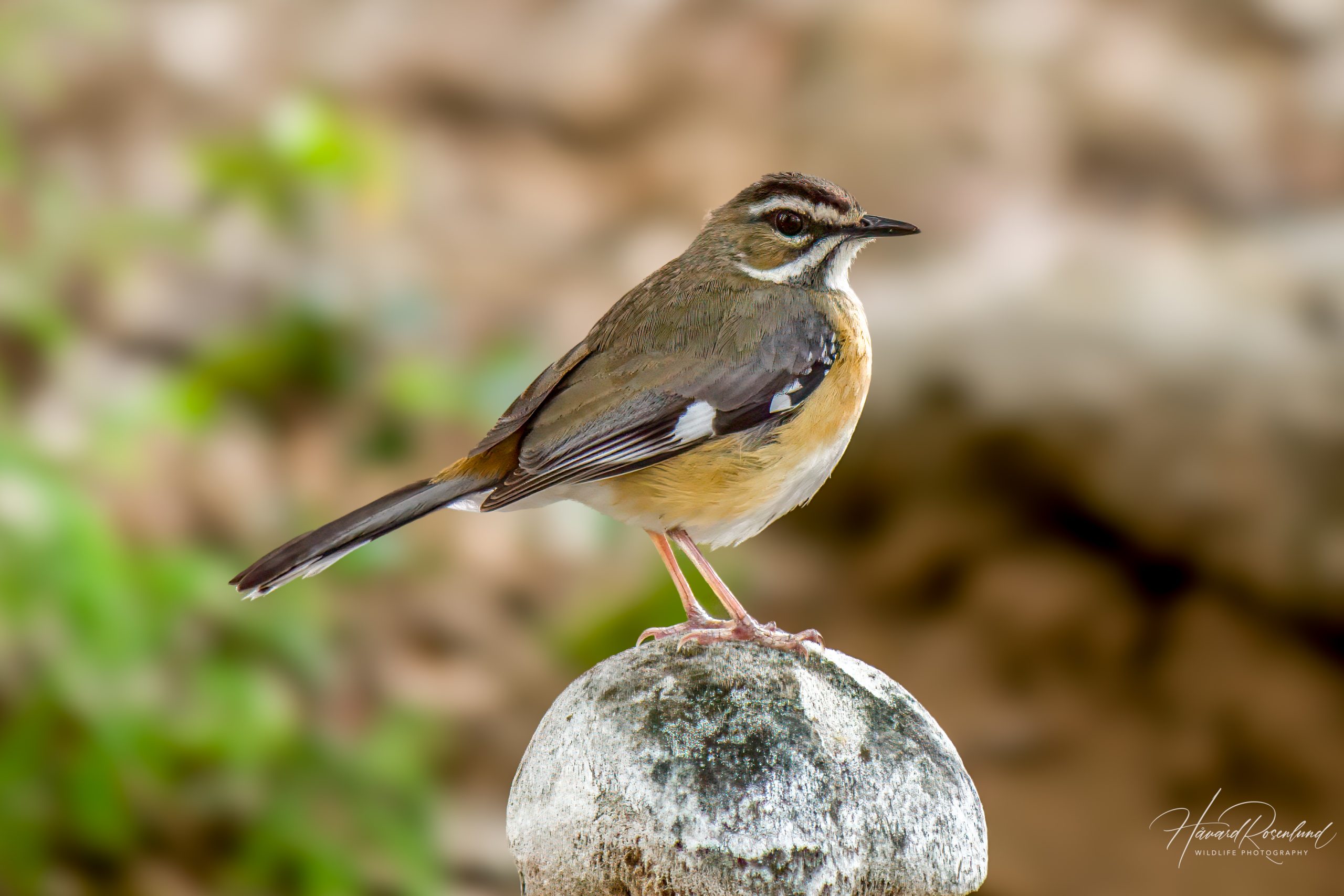
Bearded Scrub-Robin
Tychaedon quadrivirgata
At a glance
Habitat
- Dense thicket, forest understorey, riverine scrub and coastal woodland
Diet
- Mostly insects and other ground-dwelling invertebrates; occasional fruit
Activity
- Diurnal
Size
- Length: 15–16 cm Weight: 25–31 g
Range
- Eastern and southeastern Africa, from southern Somalia and Kenya to northeastern South Africa
Description
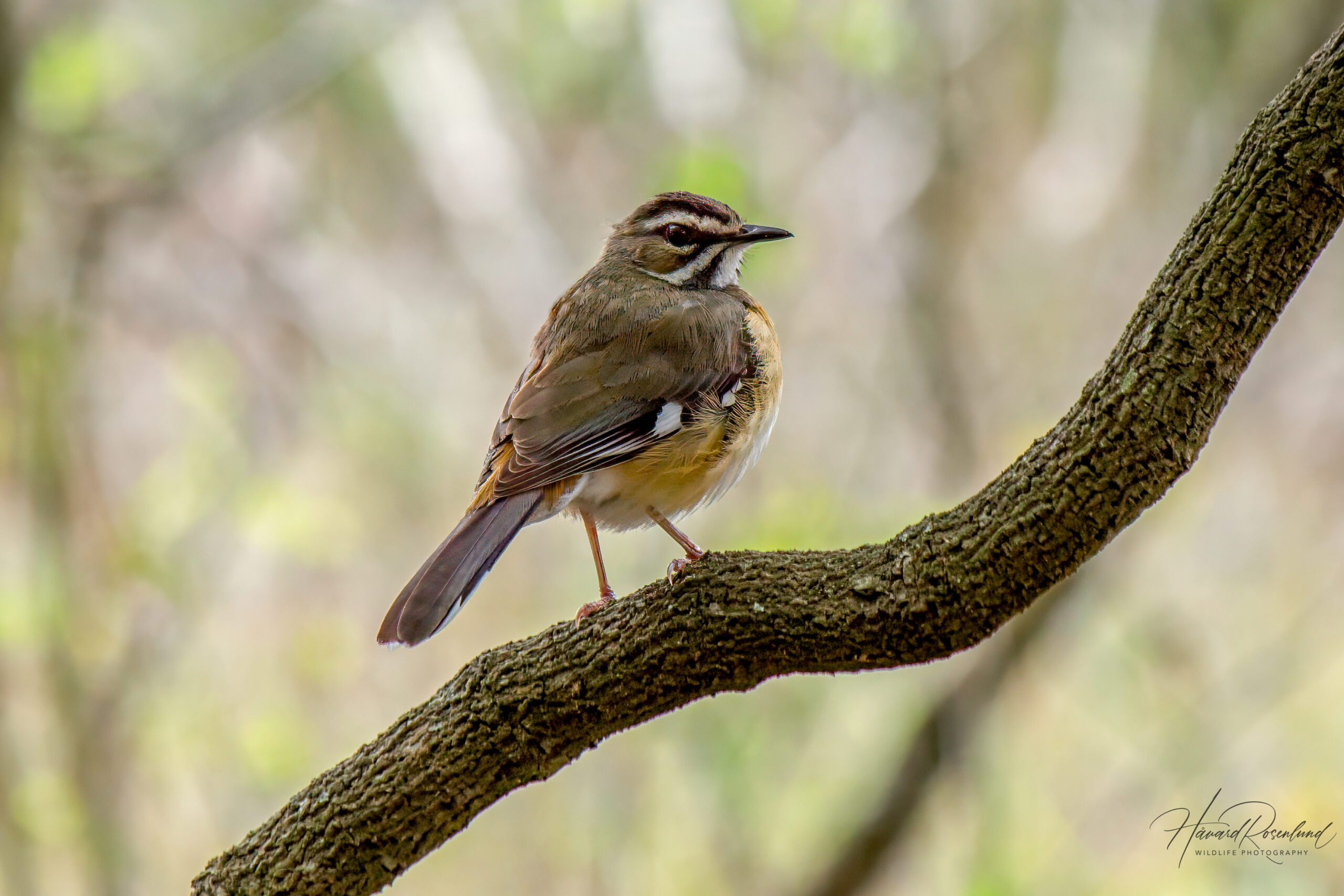
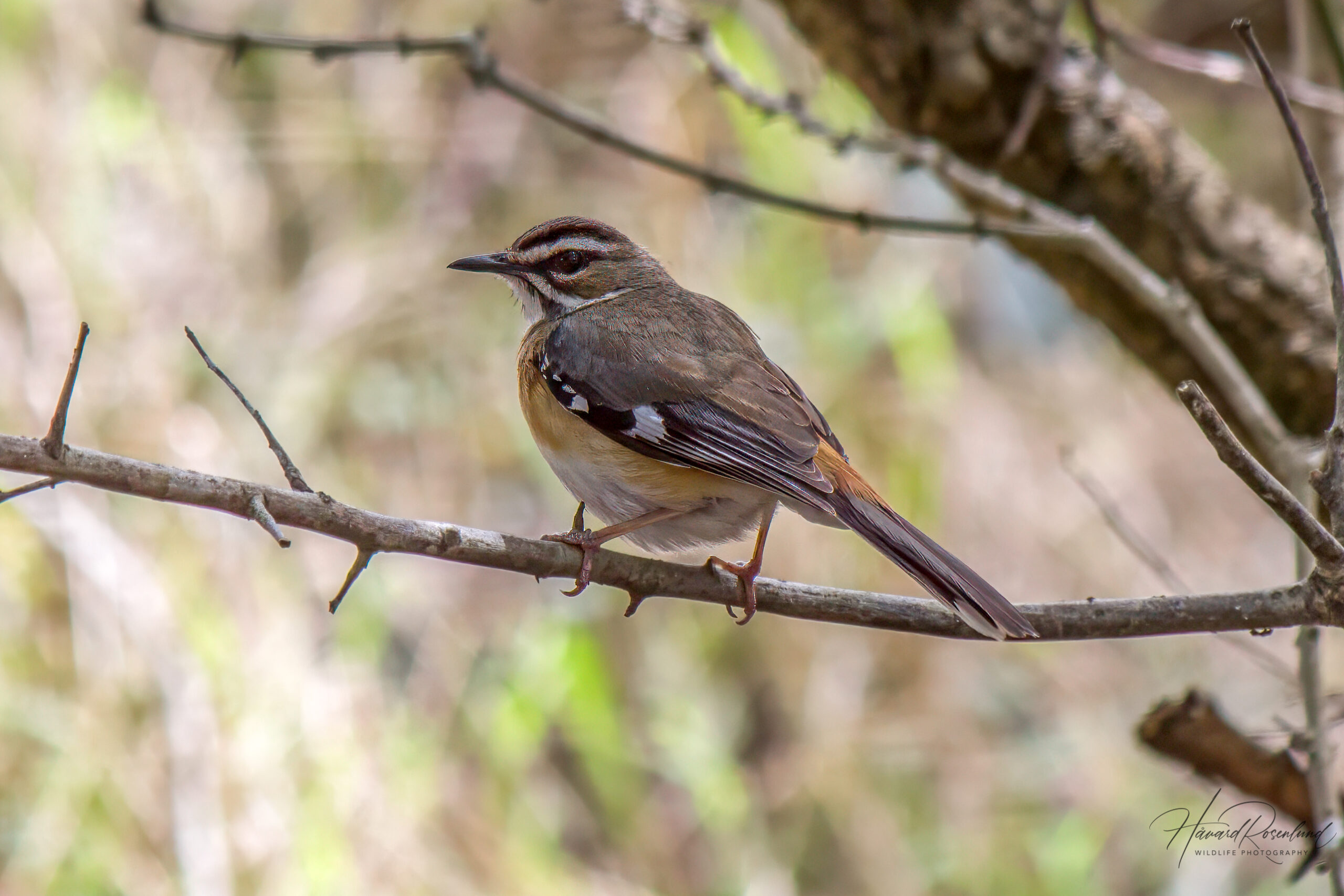
The bearded scrub-robin (Tychaedon quadrivirgata) is a ground-foraging songbird of dense thickets and wooded understorey in eastern and southeastern Africa. Adults are about 15–16 cm long and weigh roughly 25–31 g. The rich cinnamon breast and flanks contrast with a white belly, olive-brown upperparts and a striking face pattern formed by white eyebrow and moustachial stripes separated by dark lines. The wings show conspicuous pale spotting, and the dark tail has white outer markings.
The combination of cinnamon underparts, bold facial stripes and patterned wings makes the species distinctive within much of its range, although its preference for dense low vegetation means it is often heard before it is seen.
Taxonomy
The species was long placed in the genus Cercotrichas and is therefore still widely encountered as Cercotrichas quadrivirgata in older literature. It is now placed in the reinstated genus Tychaedon after phylogenetic analyses showed that the former broad Cercotrichas was paraphyletic, meaning that the genus as then defined did not include all descendants of a common ancestor.
Two subspecies are recognised. The widespread nominate T. q. quadrivirgata occurs from southern Somalia and Kenya south through much of southeastern Africa, while T. q. greenwayi is restricted to Zanzibar and Mafia Island off Tanzania.
Habitat
Bearded scrub-robins favour dense cover: dry and moist thickets, riverine scrub, forest edge, sand forest, coastal woodland and the understorey of mature woodland. They spend much of their time on or close to the ground beneath vegetation and can be difficult to see even when singing nearby.
The species depends particularly on a well-developed lower vegetation layer and leaf litter. Heavy clearing, repeated burning or removal of understorey can therefore make otherwise wooded areas unsuitable even when larger trees remain.
Diet
The diet consists mainly of insects and other invertebrates such as beetles, ants, termites, caterpillars, grasshoppers, spiders and small millipedes. Small fruit is taken occasionally, but animal prey dominates.
Bearded scrub-robins hop and run through leaf litter, pausing to flick leaves aside or seize exposed prey. Much of the feeding takes place beneath dense cover, where the bird can move quickly between open patches and shelter.
Behaviour
The species is usually solitary or found in territorial pairs, with small family groups appearing after breeding. It is resident throughout most of its range and tends to remain within dense habitat rather than making long seasonal movements.
The rich, varied song is one of the easiest ways to detect the bird. Males sing from low or mid-level perches, especially around dawn, while pairs use calls and visual displays in territorial interactions. When disturbed on the ground, a bird often runs rapidly into cover rather than immediately flying far.
Breeding
Breeding timing varies geographically, but in southern Africa egg laying is concentrated mainly in spring and summer. The nest is a well-concealed cup built low in dense vegetation, in a tree cavity, in a hollow beside a trunk or among tangled roots and plant material. Grass, leaves, twigs and rootlets form the structure, with finer material and hair used in the lining.
Clutches normally contain two or three eggs. The female incubates for about two weeks, while both parents contribute to feeding the chicks. Young leave the nest at roughly two weeks of age and remain with the adults for several more weeks before becoming independent.
Status
The bearded scrub-robin is classified as least concern on the IUCN Red List. It has a broad range in eastern and southeastern Africa, can be locally common in suitable thicket and woodland understorey, and the global population trend is considered stable.
The species' dependence on dense vegetation close to the ground means that heavy clearing, repeated burning and removal of understorey can reduce habitat quality locally.
Image gallery
Loading map and observations…
Have you seen this species?
Independent species archive
Did you find this species page useful?
Wildlife Vagabond is independently built and maintained. Voluntary support helps cover hosting, maps, data storage and continued improvements to the species archive.
Support Wildlife VagabondSpecies content will remain freely available.
References
Information about the species’ global distribution and status is based primarily on global Red List data. See the references below for details.
- Avibase. (n.d.). Bearded Scrub-Robin (Tychaedon quadrivirgata). https://avibase.bsc-eoc.org/species.jsp?avibaseid=929089268E68C0EC
- BirdLife International. (n.d.). Bearded Scrub-Robin species factsheet. https://datazone.birdlife.org/species/factsheet/bearded-scrub-robin-tychaedon-quadrivirgata
- Collar, N. (2024). Bearded Scrub-Robin (Tychaedon quadrivirgata). In Birds of the World. Cornell Lab of Ornithology. https://doi.org/10.2173/bow.besrob1.01.1
- International Ornithologists’ Union. (n.d.). IOC World Bird List – Taxonomic updates. https://www.worldbirdnames.org/new/updates/taxonomy/
- International Union for Conservation of Nature. (n.d.). Bearded Scrub-Robin. The IUCN Red List of Threatened Species. https://www.iucnredlist.org/species/22709891/94227114