
Indian Robin
Copsychus fulicatus
At a glance
Habitat
- Dry scrub, rocky ground, open woodland, grassland, cultivation edges and semi-urban areas
Diet
- Mainly insects and other small invertebrates; occasionally small fruits
Activity
- Diurnal
Size
- Length: 15–16 cm Weight: 16–20 g
Range
- Resident across much of the Indian subcontinent
Description
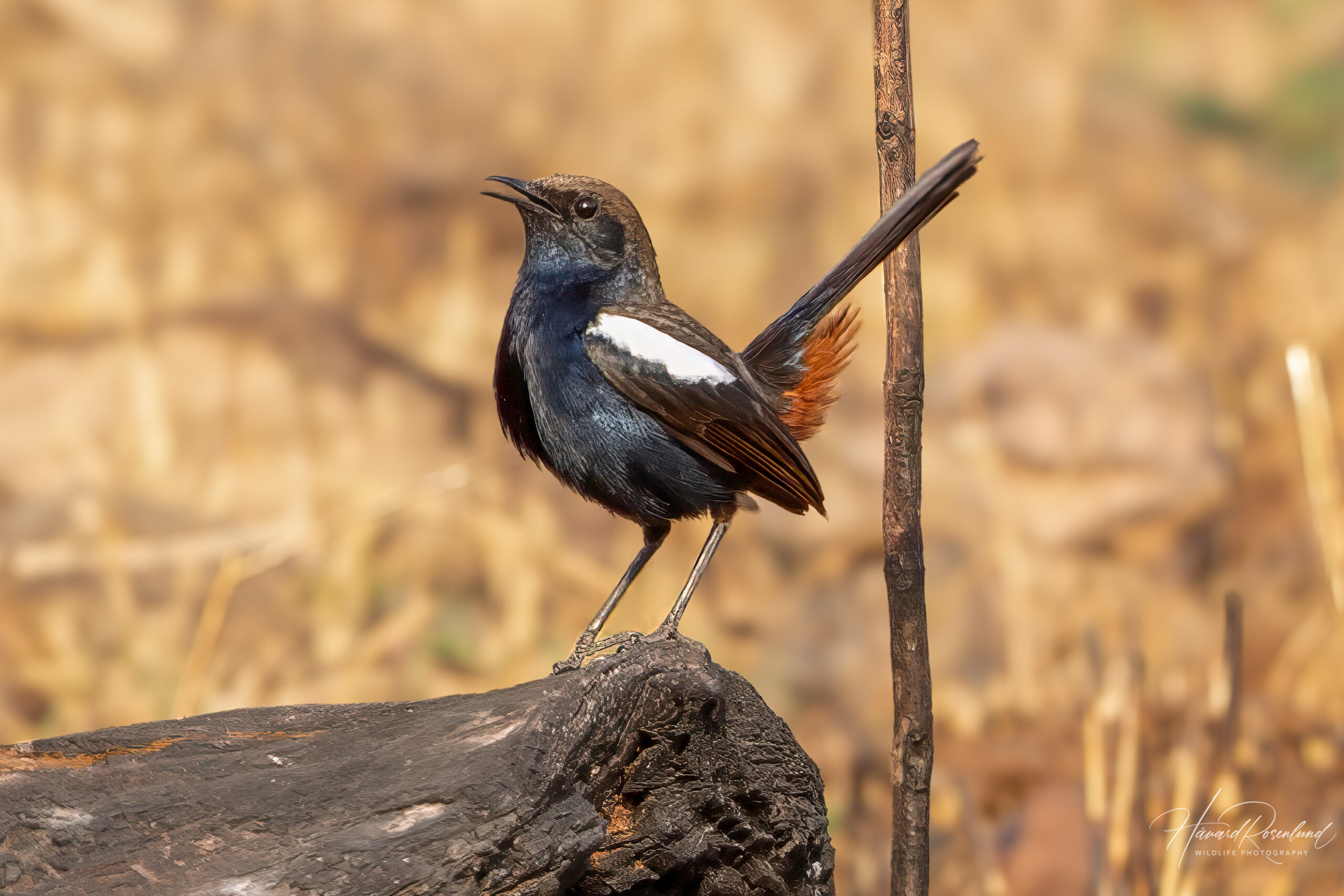
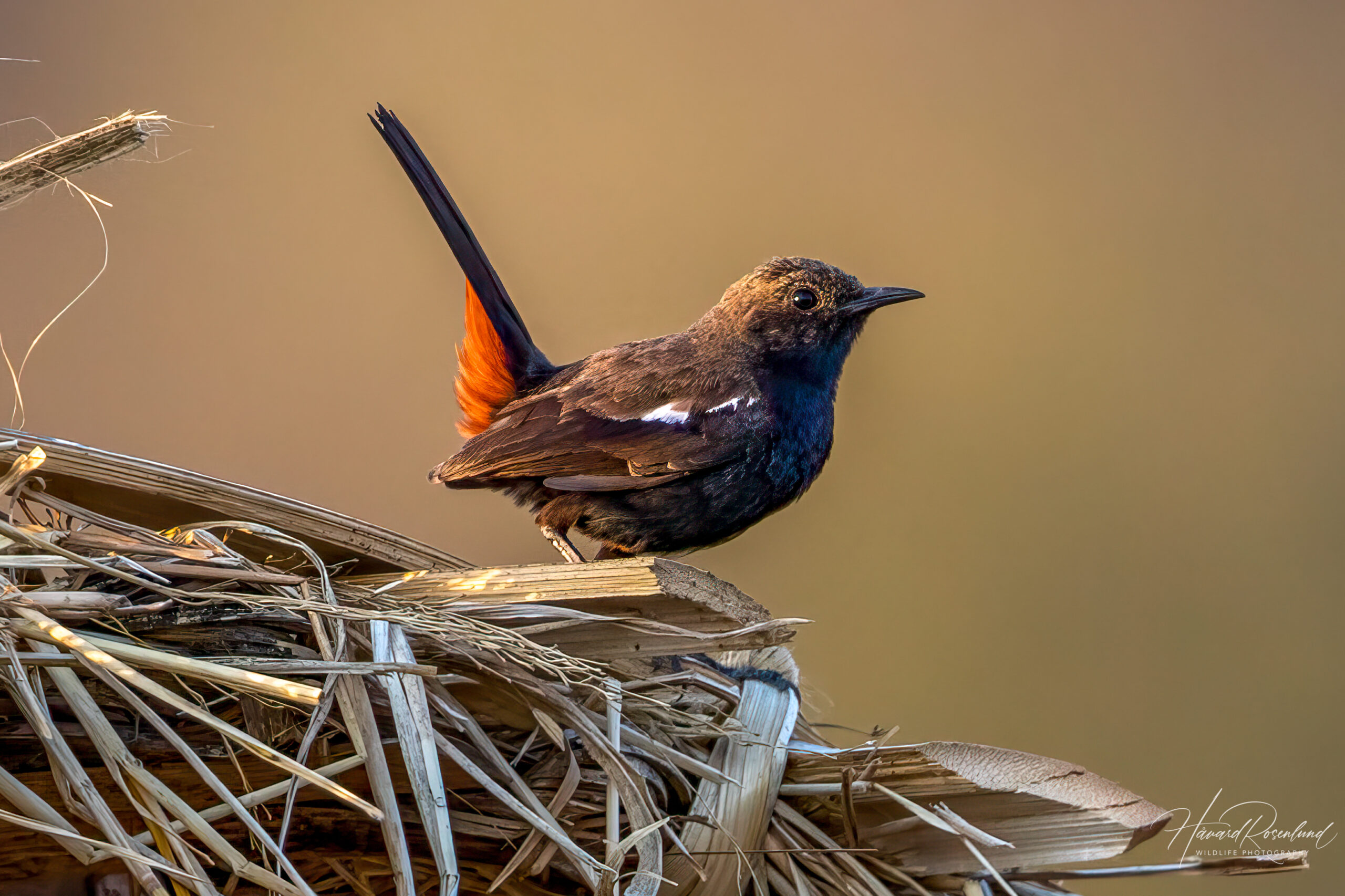
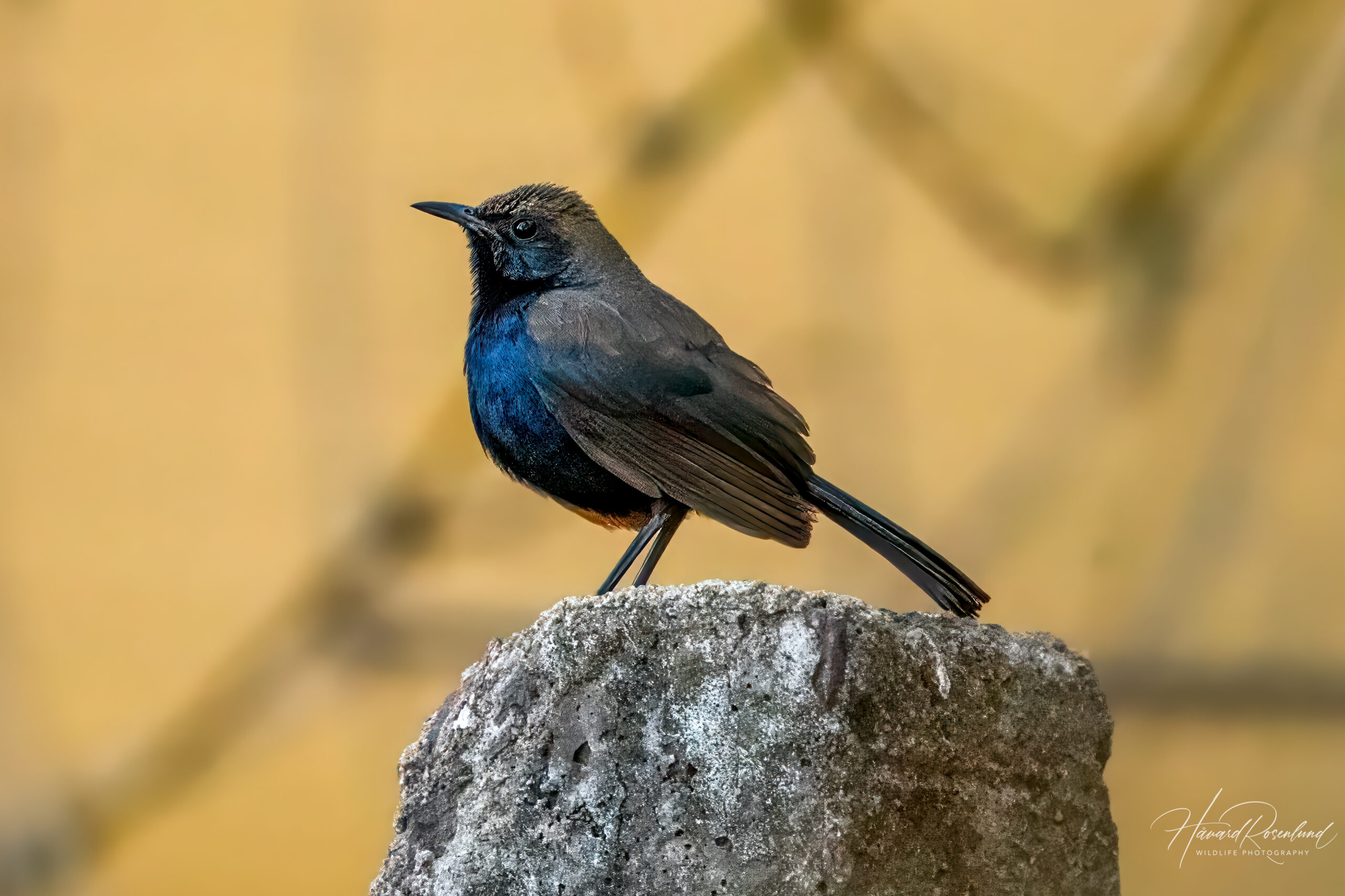
The Indian robin (Copsychus fulicatus) is a small, long-legged songbird of the Indian subcontinent. Adults are about 15–16 cm long and weigh roughly 16–20 g. Males are dark with a chestnut vent and a white shoulder patch that may be partly hidden when the wing is folded, while females are much plainer brown-grey but share the chestnut vent. The tail is frequently held cocked above the back, giving the bird a characteristic posture.
Plumage varies geographically: males in northern populations tend to have browner upperparts, whereas southern males are more uniformly glossy black. The species was formerly placed in the genus Saxicoloides but is now classified in Copsychus, and several recognised regional forms correspond to some of this variation.
Habitat
Indian robins favour open, relatively dry habitats with patches of scrub, bare ground and exposed perches. They occur in rocky country, grassland, open woodland, field margins, village edges, gardens and other semi-urban landscapes.
The species tolerates substantial habitat modification and can remain common around settlements and farmland as long as low cover, open feeding ground and sheltered nesting sites remain available.
Diet
Beetles, ants, grasshoppers and other insects form much of the diet, together with worms and other small invertebrates. Small fruits are taken occasionally.
Behaviour
Indian robins spend much of their time on or close to the ground. They move in short hops or quick runs, pause frequently to scan, and then pick prey from the surface or make a short dash after it. The tail is often held prominently cocked during these movements and in other displays.
Males sing from exposed rocks, walls, wires, branches and sometimes the ground. Song varies geographically: a 2025 study of four regional forms found significant differences in acoustic structure across India, with the eastern form C. f. erythrurus especially distinct.
Breeding
Breeding timing varies substantially across the range and responds to local climate rather than following one fixed monsoon season. Male song has distinct roles in territorial and courtship behaviour. Detailed acoustic work identified a common, relatively stereotyped song used prominently in male–male territorial interactions and a rarer, more complex form associated more closely with females and courtship.
Nests are shallow cups placed in sheltered sites among rocks, vegetation, cavities, walls or other structures, and the species readily uses human-modified environments. A three-year study in the Himalayan foothills found breeding beginning in March. Both sexes took part in nest construction and later fed the young, while the female incubated and the male commonly guarded the nest.
In that northern study population, clutches averaged about 3.3 eggs, incubation lasted close to 12 days and the young left after roughly another 13 days. These figures apply to the northern population that was studied; breeding biology varies across the species' range.
Status
The Indian robin is classified as least concern on the IUCN Red List. It has a very large distribution across the Indian subcontinent and readily occupies many open and human-modified landscapes.
Indian monitoring data published in 2025 show no broad national decline requiring conservation concern. The species remains widespread across both protected and heavily modified landscapes and is in the low conservation-priority category in India.
Image gallery
Loading map and observations…
Have you seen this species?
Independent species archive
Did you find this species page useful?
Wildlife Vagabond is independently built and maintained. Voluntary support helps cover hosting, maps, data storage and continued improvements to the species archive.
Support Wildlife VagabondSpecies content will remain freely available.
References
Information about the species’ global distribution and status is based primarily on global Red List data. See the references below for details.
- BirdLife International. (n.d.). Indian Robin species factsheet. https://datazone.birdlife.org/species/factsheet/indian-robin-copsychus-fulicatus
- eBird. (n.d.). Indian Robin. Cornell Lab of Ornithology. https://ebird.org/species/indrob1
- International Union for Conservation of Nature. (n.d.). Indian Robin. The IUCN Red List of Threatened Species. https://www.iucnredlist.org/species/22710023/132083944
- Kumar, A., & Rawal, P. (2025). Subspecies-level variations in song characteristics of Indian robin Copsychus fulicatus across India. Ornithology Research, 33(1), 44. https://doi.org/10.1007/s43388-025-00249-w
- Kumar, A. (2011). Physical characteristics, categories and functions of song in the Indian Robin Saxicoloides fulicata (Aves: Muscicapidae). Journal of Threatened Taxa, 3(7), 1909-1918. https://doi.org/10.11609/JoTT.o2630.1909-18
- Singh, G., Chaudhary, K., Kumar, S., & Sharma, G. (2023). Nesting Behaviour and Breeding Success in Indian Robin in Semi-urban Area of Himalayan Foothills. Biological Forum, 15(10), 1006–1010. https://www.researchtrend.net/bfij/pdf/Nesting-Behaviour-and-Breeding-Success-in-Indian-Robin-in-Semi-urban-Area-of-Himalayan-Foothills-Garima-Singh-183.pdf
- State of India's Birds. (2025). State of India’s Birds 2025 – Indian Robin. https://stateofindiasbirds.in/species/indrob1/