
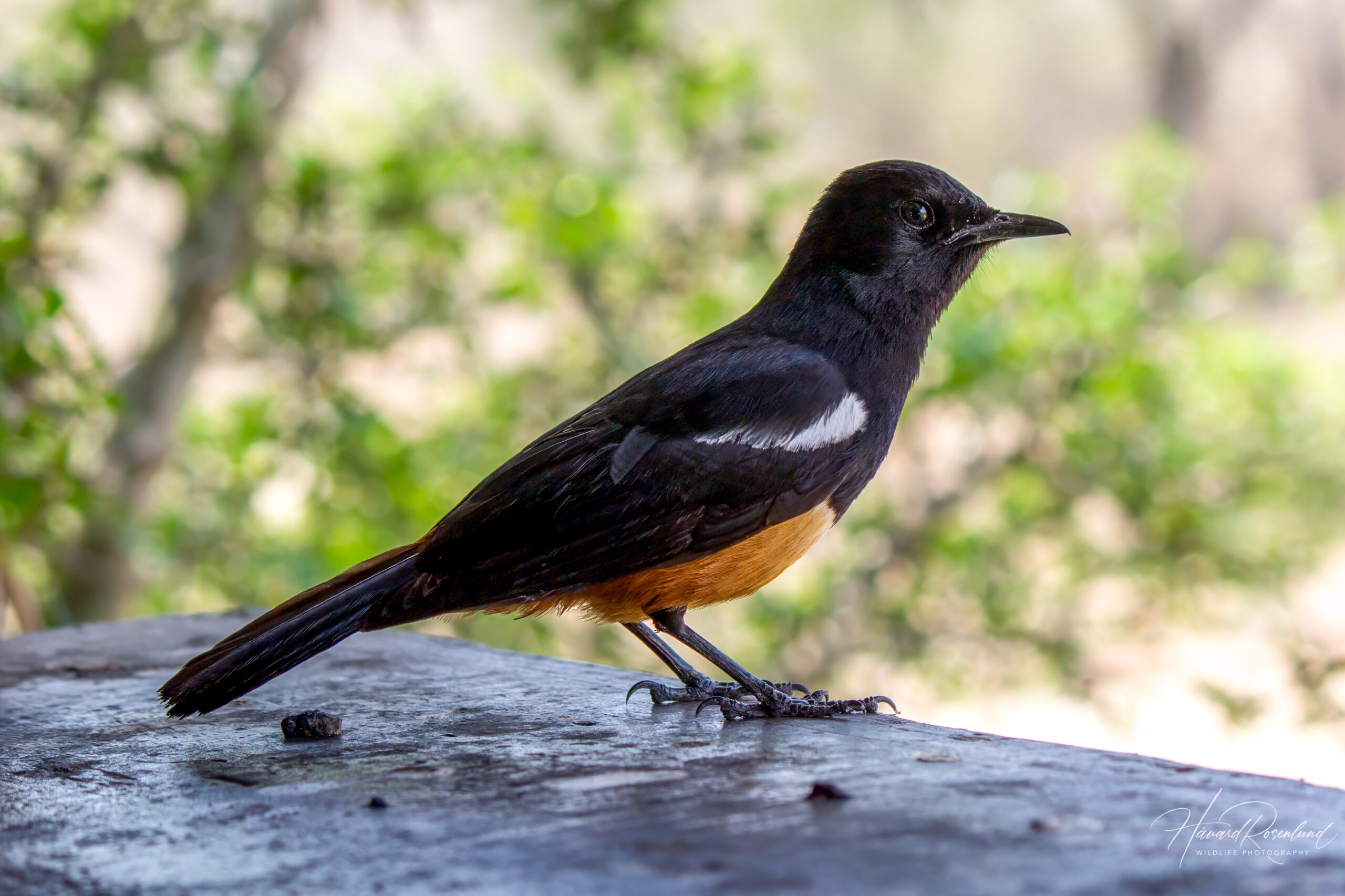
Mocking Cliff-Chat
Thamnolaea cinnamomeiventris
At a glance
Habitat
- Rocky ravines, cliffs, gorges, boulder-strewn hillsides and wooded watercourses
Diet
- Mainly insects and other invertebrates; also fruit and occasional aloe nectar
Activity
- Diurnal; mostly hunts from exposed perches
Size
- Length: 19–21 cm Weight: 41–51 g
Range
- Eastern and southern sub-Saharan Africa, from Ethiopia south to South Africa
Description
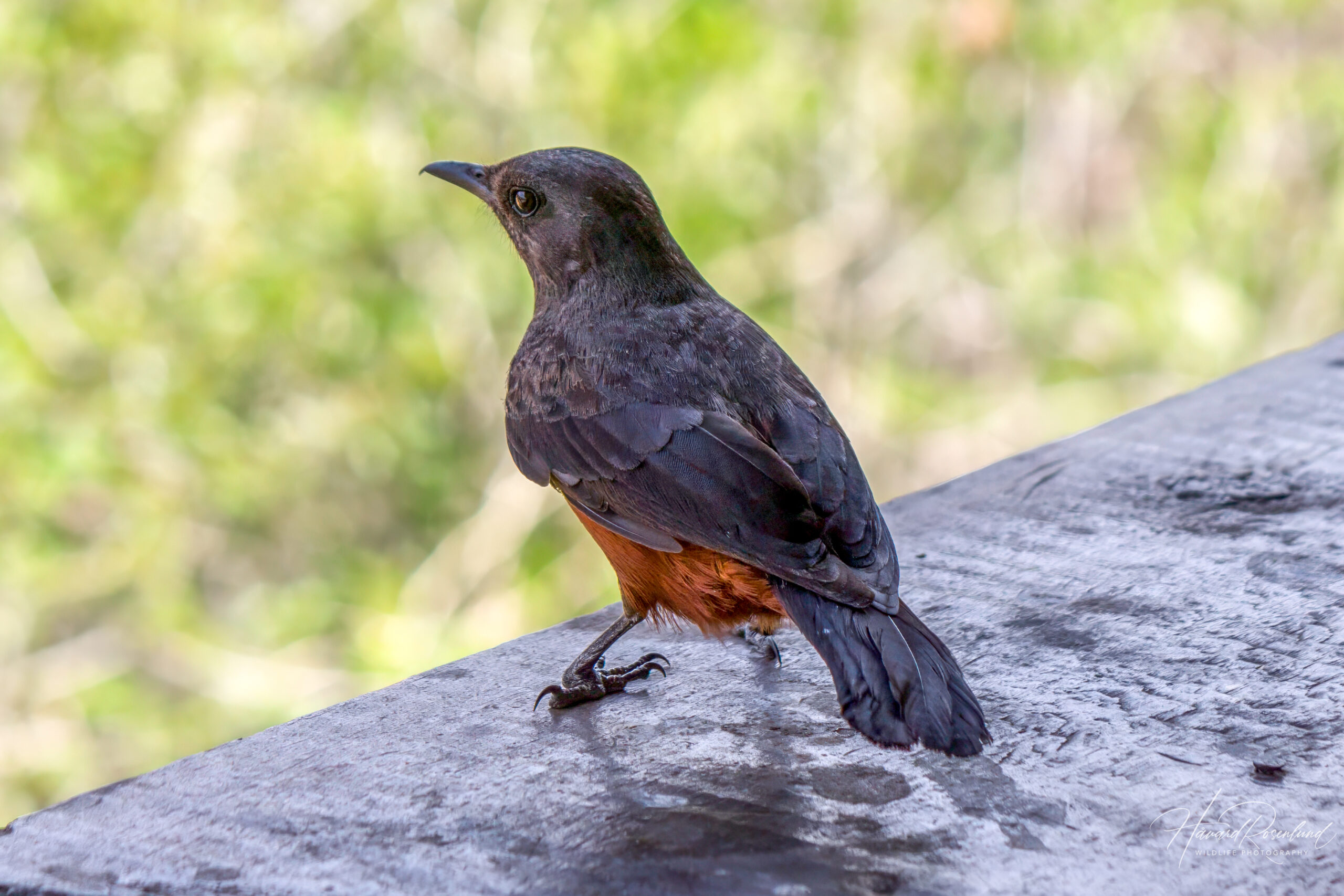
The mocking cliff-chat (Thamnolaea cinnamomeiventris) is a robust chat of rocky landscapes with a patchy distribution across much of sub-Saharan Africa. Adults are about 19–21 cm long and weigh roughly 41–51 g. Males are usually glossy black with a conspicuous white shoulder patch and rich chestnut belly, rump and vent. In parts of western and northeastern Africa, some forms have a white crown; these were formerly often treated as a separate species, Thamnolaea coronata. Females are much duller brown, with warmer rufous-brown underparts and none of the males' bold black-and-white contrast.
The sexes are therefore easy to distinguish at close range, while the species' upright posture and preference for exposed rocks and ledges also help separate it from smaller chats occupying more open ground.
Habitat
Mocking cliff-chats are strongly associated with rocky ravines, cliffs, gorges, boulder-strewn hillsides and watercourses where exposed rock is mixed with woodland or scrub. Elevated lookouts and sheltered ledges are important parts of the habitat, providing feeding perches, territorial song posts and nest sites.
The species also uses bridges, culverts, buildings and other structures that provide ledges and cavities similar to those on natural rock faces. These artificial sites can extend nesting opportunities where suitable feeding habitat remains nearby.
Diet
Insects and other invertebrates form most of the diet, supplemented by fruit and occasional nectar from flowering aloes.
Mocking cliff-chats commonly forage from exposed perches, watching the ground before dropping down to seize prey and then returning to a lookout. The same rocks and ledges may be used repeatedly between feeding attempts. They also glean food from leaves, branches and rock surfaces, allowing them to exploit prey in both open patches and the vegetation surrounding rocky slopes and ravines.
Behaviour
Pairs defend territories through much of the year and repeatedly return to prominent rocks, cliff edges and other lookouts. These exposed positions are used to challenge intruders and advertise the territory, making territorial behaviour particularly conspicuous in rugged rocky terrain.
Song is an important part of territory defence. It is melodic and varied and often includes imitations of other bird species. Males commonly sing from exposed positions, and pairs may also sing in duet. The species is therefore often heard before it is seen. After breeding, parents may remain with their young as small family groups for a time.
Migration
The species is resident across most of its range rather than a long-distance migrant. In mountainous regions, however, some birds make seasonal movements between elevations, descending to lower areas during winter before returning to higher breeding grounds.
Breeding
Both sexes help build the open cup nest, which sits on a bulkier foundation of twigs, leaves, roots and feathers and is lined with softer material such as mammal hair. Nest sites are usually sheltered by rock overhangs, caves, bridges or culverts. In southern Africa, egg-laying occurs mainly from August to December, peaking from September to November.
A particularly characteristic habit is the use of lesser striped swallow (Cecropis abyssinica) nests, both old nests and nests that are still occupied. Cliff-chats may displace the swallows and then build their own cup inside the existing mud structure, effectively turning the swallow nest into a protected outer shell.
Clutches contain two to four eggs. The female incubates alone for about 14–16 days, while both parents feed the chicks. Young leave the nest after roughly 19–21 days and remain associated with the adults for a period afterwards.
Status
The mocking cliff-chat is classified as least concern on the IUCN Red List. It remains locally common in suitable rocky habitat across a broad African range, and no major range-wide threat is currently recognised.
Its ability to use some artificial ledges, culverts and buildings adds flexibility, although populations still depend on rocky or wooded feeding habitat around these nesting sites.
Image gallery
Loading map and observations…
Have you seen this species?
Independent species archive
Did you find this species page useful?
Wildlife Vagabond is independently built and maintained. Voluntary support helps cover hosting, maps, data storage and continued improvements to the species archive.
Support Wildlife VagabondSpecies content will remain freely available.
References
Information about the species’ global distribution and status is based primarily on global Red List data. See the references below for details.
- Avibase. (n.d.). current taxonomy and geographic forms. https://avibase.bsc-eoc.org/species.jsp?avibaseid=F8B6EC31BBF4312F
- Biodiversity Explorer – Thamnolaea cinnamomeiventris. (n.d.). habitat, food and breeding, based on Roberts Birds of Southern Africa. https://biodiversityexplorer.info/birds/muscicapidae/thamnolaea_cinnamomeiventris.htm
- BirdLife International. (n.d.). Mocking Cliff-Chat species factsheet. https://datazone.birdlife.org/species/factsheet/mocking-cliff-chat-thamnolaea-cinnamomeiventris
- International Union for Conservation of Nature. (n.d.). Mocking Cliff-Chat (Thamnolaea cinnamomeiventris). The IUCN Red List of Threatened Species. https://www.iucnredlist.org/species/22710441/132088466