
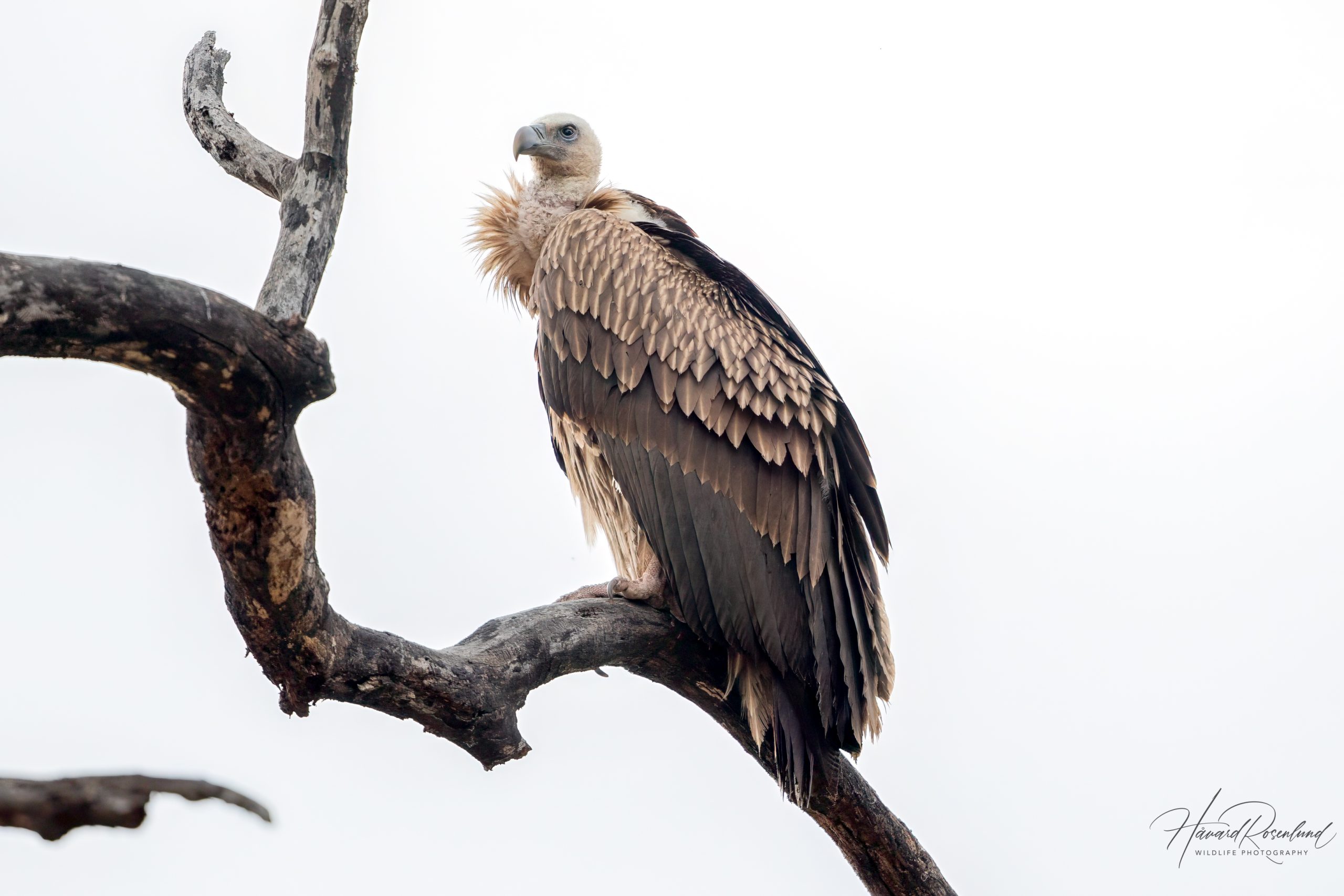
Himalayan Griffon
Gyps himalayensis
At a glance
Habitat
- High mountains, plateaus, alpine grassland and open valleys with cliffs for nesting; juveniles range widely in winter
Diet
- Carrion, especially carcasses of large wild and domestic mammals
Activity
- Diurnal; extensive soaring when thermals provide strong lift
Size
- Length: about 103–110 cm; wingspan roughly 260–290 cm Weight: about 8–12 kg
Range
- Himalayas, Tibetan Plateau and adjoining Central Asian mountains; immatures disperse south into the Indian subcontinent and Southeast Asia
Description
The Himalayan griffon (Gyps himalayensis), also called the Himalayan vulture, is one of the largest Old World vultures. Adults are about 103–110 cm long, span roughly 260–290 cm and commonly weigh around 8–12 kg. The enormous, broad wings, short tail and heavy body are adapted for efficient soaring over mountain landscapes.
Adults are pale buff to creamy brown with contrasting dark flight feathers, a pale downy head and neck and a conspicuous whitish neck ruff. Juveniles are darker and more strongly streaked. Eurasian griffon (Gyps fulvus) is similar but usually smaller and darker-bodied, with less striking contrast between the pale wing coverts and dark flight feathers.
Habitat
Himalayan griffons are centred on the Himalayas, Tibetan Plateau and adjoining mountain systems of Central Asia. They use high plateaus, alpine grassland, open valleys and rugged mountains, where cliffs provide nesting and roosting sites and livestock and wild ungulates supply carrion across the open terrain.
A study published in 2009 on the Tibetan Plateau found that the species occurred mostly above 3,000 m, within an overall elevational range of roughly 600–6,000 m. It reaches higher elevations than any other Gyps vulture.
Breeding birds are strongly associated with cliffs, but feeding areas can extend across enormous landscapes. Immature birds use a much wider elevational range and may descend into foothills and lowland plains in winter, including northern and central India.
Diet
The diet consists almost entirely of carrion from medium-sized and large mammals. Domestic yak, cattle, sheep and goats can be important in pastoral landscapes, alongside wild ungulates and other mammals. The long neck and powerful bill allow birds to reach deep into large carcasses while feeding.
Scavenging
Himalayan griffons search for carcasses while soaring over vast areas, using thermals and rising air along mountain slopes to remain aloft with very little flapping. This energy-efficient soaring is crucial for a scavenger that may find a large amount of food at one carcass but must search widely because carcasses are scattered unpredictably across the landscape.
They locate food both directly and by watching the behaviour of other scavengers. The descent of another vulture can draw birds from a wide area, and several individuals may converge rapidly on a carcass. Once on the ground, competition can be intense, with larger and more assertive birds displacing others while the group consumes the carcass quickly.
Behaviour
Himalayan griffons are highly social at roosts and breeding cliffs and often soar together. Competition can be intense where many birds gather, but watching the movements of other vultures can also help them locate food across the wider landscape.
Ecological role
Himalayan griffons are major carcass consumers in mountain and high-plateau ecosystems where large dead animals can otherwise persist for long periods in cold, sparsely populated landscapes. By rapidly consuming wild ungulates and livestock carcasses, they recycle nutrients and reduce the amount of decomposing tissue available to other scavengers and disease-causing organisms.
The role is especially important in pastoral regions, where livestock mortality can create large but unpredictable amounts of carrion. By moving between these scattered food sources over huge areas, the birds return nutrients to the food web while providing a natural sanitation service across grazing landscapes.
Migration
Adults are largely resident around mountain breeding regions, but young Himalayan griffons are much more mobile. A tracking study published in 2017 followed 18 immature birds from wintering areas in India, Bhutan and Nepal towards summer areas in Tibet and Mongolia. Five died during the first year, and the birds that died had failed to migrate more than 1,500 km northward in spring.
Winter movements can bring juveniles far south of the core breeding range, and wandering birds occasionally reach southern India and Southeast Asia. These movements expose inexperienced birds to very different human landscapes and food sources than they encounter in the high mountains.
Home ranges
A satellite-tracking study published in 2022 followed two Himalayan griffons in western India and along their migration routes. One bird used home ranges of about 710–1,109 km² in Gujarat and about 6,170 km² in Pakistan; the other used about 6,348 km² in Gujarat and 4,360 km² in Kyrgyzstan.
The same study found average daily movements of about 114 and 116 km for the two birds. Home-range figures describe the area used within a given period rather than the full migration route, so individuals can shift between very different seasonal ranges while travelling far greater distances between them.
Breeding
Himalayan griffons breed on inaccessible cliff ledges, singly or in loose colonies. The breeding cycle starts in winter and is exceptionally long. Pairs build a large stick nest and normally lay a single egg. A field study published in 2013 in Xinjiang found strong site fidelity: birds returned to the same nesting and roosting locations year after year and built or repaired nests from January to March.
Both parents incubate for roughly 50–60 days and later feed the chick by regurgitation. The young bird remains on the cliff for several months and typically becomes capable of flight after about four to five months.
A study published in 2020 identified 78 nests in Upper Mustang, Nepal, and found breeding success of about 41%. Almost all productive nests were on steep north-facing cliffs, and nesting sites were located close to water sources.
Cultural significance
The Himalayan griffon has a distinctive place in Tibetan cultural traditions through sky burial, or jhator. In this centuries-old funerary practice, human remains are offered to vultures, and field studies on the Tibetan Plateau identify Himalayan griffons as the principal vultures attending many burial sites.
The relationship links the species directly with Tibetan Buddhist ritual and ideas about returning the body to nature after death. Burial sites also provide predictable food for the birds, while declines in vulture numbers can make the continuation of the practice more difficult in places where suitable scavengers have become scarce.
Status
The Himalayan griffon is classified as near threatened on the IUCN Red List. It remains widespread across the Himalayan and Tibetan region, but declines have been documented in parts of the range. Because reproduction is slow, populations can take a long time to recover from sustained increases in mortality among adults or immature birds.
A study published in 2021 followed the breeding population at Baitadi in Nepal from 2010 to 2020. Occupied nests and productivity showed no clear change over the decade; the estimated trends were negative but uncertain.
Threats
Poisoning from veterinary non-steroidal anti-inflammatory drugs is the best-known threat. Diclofenac is highly toxic to Gyps vultures and caused catastrophic declines in South Asia. Veterinary use was banned in India, Nepal and Pakistan in 2006, but exposure continued after the ban. A study published in 2018 examined 12 dead Himalayan griffons collected in India during 2011–2014 and found diclofenac residues in nine of them; the authors considered it possible that all nine had died from diclofenac poisoning.
Himalayan griffons also face deliberate or accidental poisoning, changes in carrion availability, disturbance at breeding cliffs, collisions and electrocution. Immature birds that disperse into densely populated lowlands encounter many of these hazards before returning to mountain regions.
Conservation
Conservation in South Asia has focused on removing toxic veterinary drugs from livestock carcasses, replacing diclofenac with safer alternatives and protecting important feeding and breeding areas. Monitoring of veterinary drug use and drug residues in livestock carcasses helps reveal whether vultures are still being exposed to toxic compounds.
Vulture Safe Zones are designed to lower poisoning risk across whole landscapes rather than only around individual nest sites. Satellite tracking and population surveys also follow young Himalayan griffons as they cross national borders between high-altitude regions and lowland wintering areas.
Image gallery
Loading map and observations…
Have you seen this species?
Independent species archive
Did you find this species page useful?
Wildlife Vagabond is independently built and maintained. Voluntary support helps cover hosting, maps, data storage and continued improvements to the species archive.
Support Wildlife VagabondSpecies content will remain freely available.
References
Information about the species’ global distribution and status is based primarily on global Red List data. See the references below for details.
- AviList. (n.d.). v2025 – Global avian checklist. https://www.avilist.org/
- Bhusal, K. P., Dangaura, H. L., & McClure, C. J. (2021). Population levels and productivity of the Himalayan Griffon (Gyps himalayensis) in Baitadi District, Nepal. Environmental Challenges, 5, 100318. https://doi.org/10.1016/j.envc.2021.100318
- BirdLife International. (n.d.). Himalayan Griffon (Gyps himalayensis) species factsheet. https://datazone.birdlife.org/species/factsheet/himalayan-griffon-gyps-himalayensis
- International Union for Conservation of Nature. (n.d.). Gyps himalayensis. The IUCN Red List of Threatened Species. https://www.iucnredlist.org/species/22695215/204643889
- Lu, X., Ke, D., Zeng, X., Gong, G., & Ci, R. (2009). Status, Ecology, and Conservation of the Himalayan GriffonGyps himalayensis(Aves, Accipitridae) in the Tibetan Plateau. AMBIO: A Journal of the Human Environment, 38(3), 166-173. https://doi.org/10.1579/0044-7447-38.3.166
- Ma, M., Dao, C., Xu, G., Shan, J., Zhao, X., Maimaitiming, A., Xing, R., & Luo, B. (2013). Why are juvenile Himalayan Vultures <i>Gyps himalayensis</i> in the Xinjiang Tien Shan still at the nest in October? BirdingASIA, 20, 84–89. https://www.chinabirdnet.org/document/funding/china_conservation_fund/reports/Himalayan-Vultures_By%20MaMing.pdf
- Nambirajan, K., Muralidharan, S., Roy, A. A., & Manonmani, S. (2018). Residues of Diclofenac in Tissues of Vultures in India: A Post-ban Scenario. Archives of Environmental Contamination and Toxicology, 74(2), 292-297. https://doi.org/10.1007/s00244-017-0480-z
- Prakash, V., Bishwakarma, M. C., Chaudhary, A., Cuthbert, R., Dave, R., Kulkarni, M., Kumar, S., Paudel, K., Ranade, S., Shringarpure, R., & Green, R. E. (2012). The Population Decline of Gyps Vultures in India and Nepal Has Slowed since Veterinary Use of Diclofenac was Banned. PLoS ONE, 7(11), e49118. https://doi.org/10.1371/journal.pone.0049118
- Ram, M., Sahu, A., Tikadar, S., Gadhavi, D., Rather, T. A., Jhala, L., & Zala, Y. (2022). Home Range, Movement and Activity Patterns of Six vulture Species Using Satellite Telemetry in Saurashtra landscape, Gujarat, India. Ecologies, 3(4), 492-507. https://doi.org/10.3390/ecologies3040035
- Sherub, S., Fiedler, W., Duriez, O., & Wikelski, M. (2017). Bio-logging, new technologies to study conservation physiology on the move: a case study on annual survival of Himalayan vultures. Journal of Comparative Physiology A, 203(6-7), 531-542. https://doi.org/10.1007/s00359-017-1180-x
- Wagley, K., Devkota, R. P., Bhusal, K. P., & Dhamala, M. K. (2020). Breeding success of the Himalayan griffon (Gyps himalayensis) in Upper Mustang, Nepal. Nepalese Journal of Zoology, 4(2), 95–100. https://doi.org/10.3126/njz.v4i2.33891