
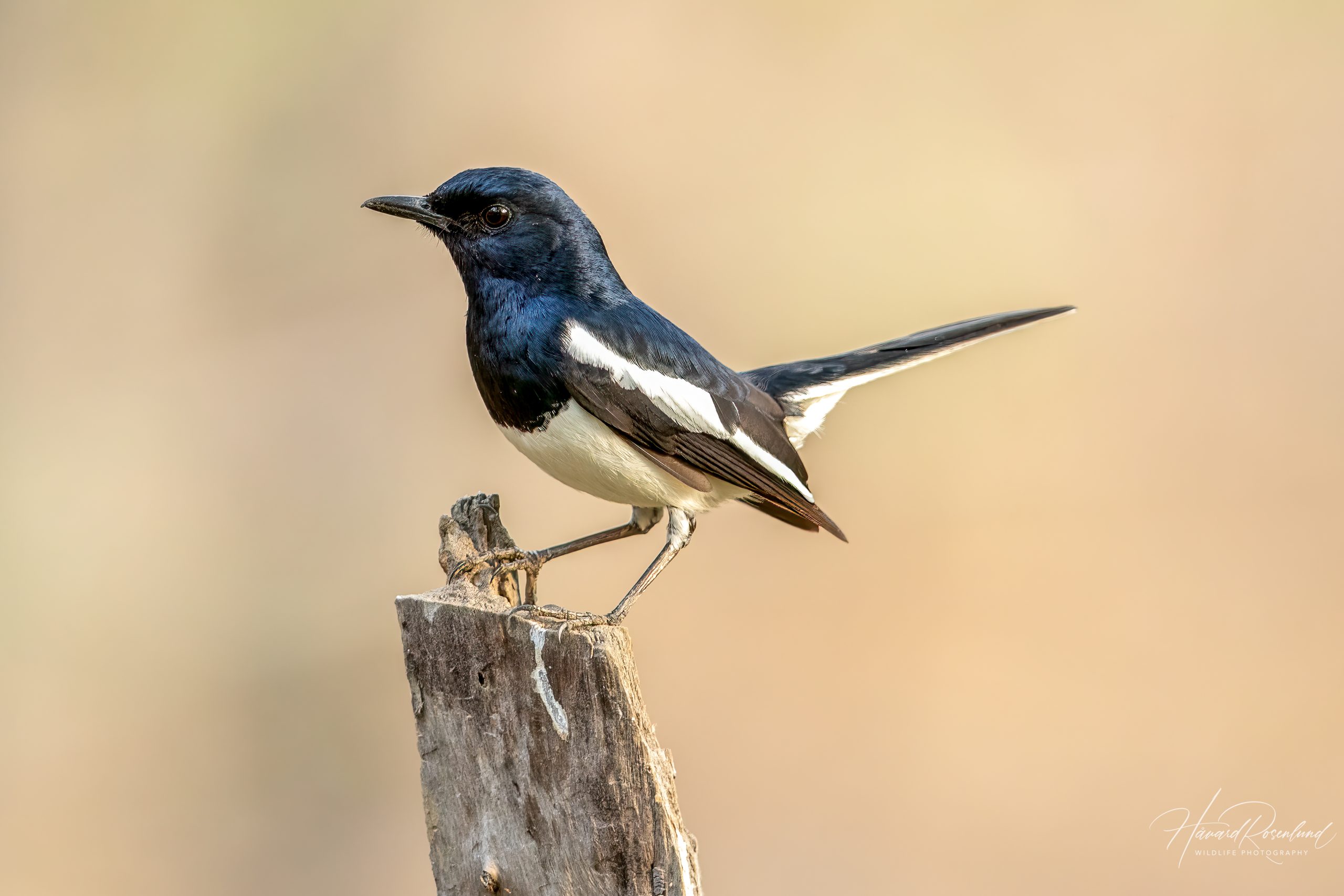
Oriental Magpie-Robin
Copsychus saularis
At a glance
Habitat
- Open woodland, forest edges, scrub, gardens, parks, farmland and towns
Diet
- Mainly insects and other small invertebrates; occasional fruit
Activity
- Diurnal; strong dawn singing during breeding
Size
- Length: 19–21 cm Weight: —
Range
- South and Southeast Asia
Description
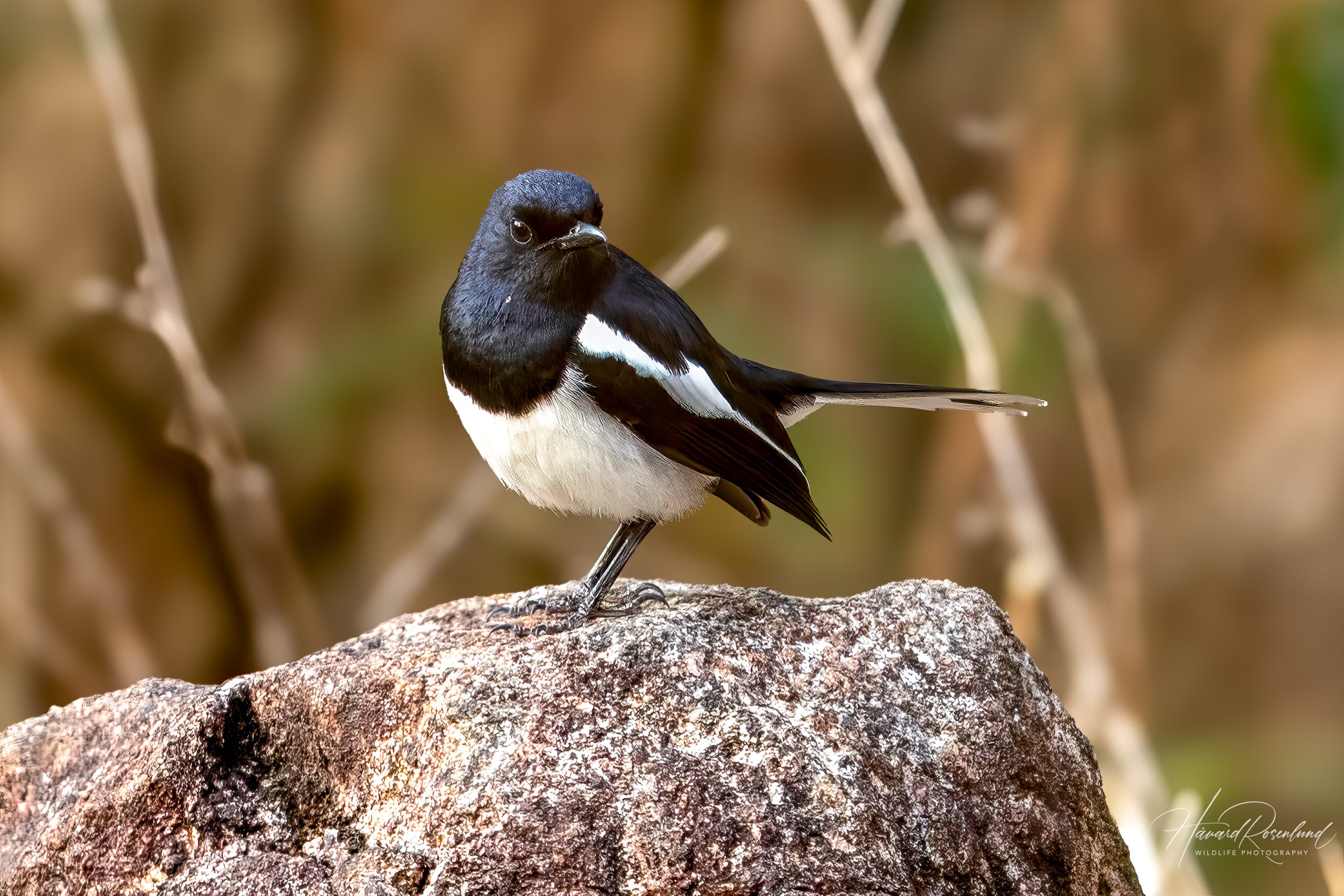
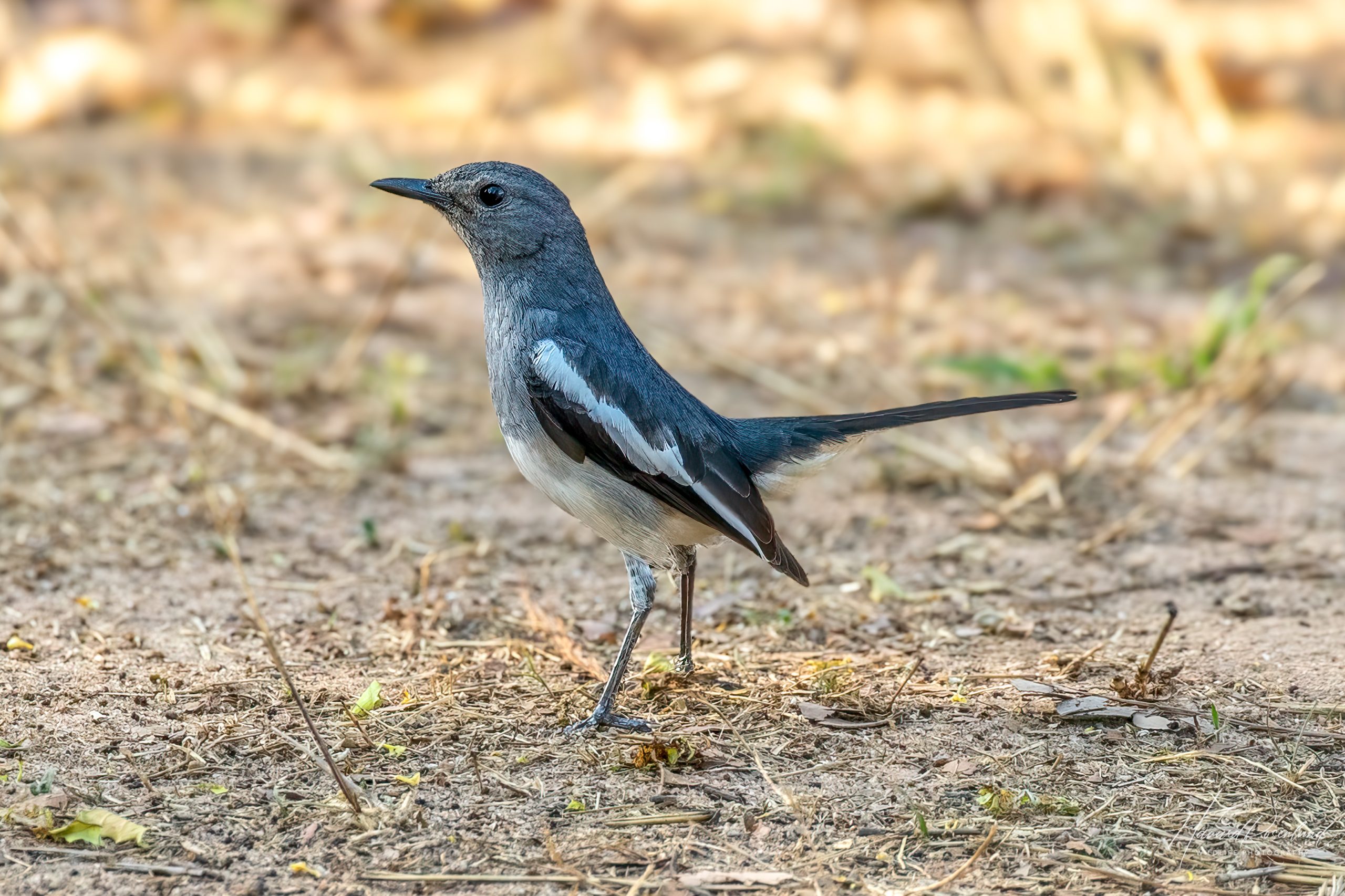
The Oriental magpie-robin (Copsychus saularis) is a slender, long-tailed songbird widespread across South and Southeast Asia. Adults are about 19–21 cm long and weigh roughly 30–36 g. Males are strongly patterned in glossy black and white, with a black head, breast and upperparts contrasting with white underparts and a broad white wing patch. Females show the same pattern in softer slate-grey and white, while juveniles are browner and more mottled.
The tail is often held cocked above the back or flicked while the bird moves across the ground. The similarly shaped Indian robin (Copsychus fulicatus) is darker below and lacks the Oriental magpie-robin's extensive white underparts and large white wing patch.
Habitat
Oriental magpie-robins can live in a wide variety of habitats, including open woodland, forest edges, scrub, orchards, gardens, parks, farmland and settled areas. They often live close to people and can be common in low-rise residential neighbourhoods where scattered trees, shrubs, lawns and buildings provide both feeding sites and nesting cavities.
A study published in 2022 from Wuhu in eastern China found the species most abundant in low-rise residential areas and least abundant among high-rise buildings, suggesting that neighbourhoods with a greater mixture of vegetation and low buildings can provide more suitable habitat and song posts.
Diet
The diet is dominated by insects and other small animals, including beetles, caterpillars, grasshoppers, spiders and worms. Small fruit and other plant food are taken occasionally.
Foraging
Birds forage actively on lawns, bare soil and leaf litter, hopping with the tail raised and making short runs or quick attacks after prey. They also search through low vegetation and may launch short aerial pursuits after flying insects.
This flexible combination of ground feeding and hunting from perches allows the species to use both natural woodland edges and heavily modified gardens and urban green spaces.
Vocalisations
Males sing from conspicuous perches, especially around dawn, and the song is unusually varied. A study published in 2018 of nine colour-ringed males near Haridwar in northern India found individual repertoires of roughly 20–82 different song types. Repertoires changed substantially from year to year, indicating that adult males may continue adding and losing song types through life. The species can also mimic calls and songs of other bird species and incorporate such sounds into its own repertoire.
Another study published in 2018 compared recordings from urban and rural sites in Bangladesh, India, Malaysia, Nepal, Singapore, Sri Lanka and Thailand. Urban birds produced longer songs with slower syllable rates and longer intervals between syllables, while overall song complexity remained similar between urban and rural sites.
Breeding
Breeding timing varies across the range and often extends from spring into the summer rainy season. The species nests in cavities in trees, walls, buildings and other structures and readily accepts nest boxes. Nests are built mainly from dried leaves, twigs and grasses and may also contain feathers. Males defend breeding territories, while the female performs most or all nest construction and incubation; both parents feed the chicks.
A study published in 2014 of 27 pairs in Uttarakhand, India, recorded breeding from March to August, an average clutch of 4.8 eggs and an incubation period of about 12.4 days. The study also recorded frequent conflicts over suitable nesting cavities.
A study published in 2025 using nest boxes in Haikou, China, found a mean clutch of 4.47 eggs, incubation of 13.3 days and a nestling period of 13.3 days. Nest predation affected about 18.6% of nests; recorded predators included Swinhoe's striped squirrel (Tamiops swinhoei), Rattus tanezumi and ants. The study also documented infanticide by males that were not the fathers of the nestlings.
Cultural significance
In Bangladesh the Oriental magpie-robin is known as the doyel or doel and is the country's national bird. Its familiar presence around villages and towns and its conspicuous song have made it one of the most recognisable birds in Bangladeshi public life.
The doyel is used as a national symbol well beyond ornithology and appears alongside other symbols of Bangladeshi identity. Its name and image therefore carry cultural significance far beyond its role as a familiar songbird.
Status
The Oriental magpie-robin is classified as least concern on the IUCN Red List and remains widespread across South and Southeast Asia. In State of India's Birds it is classed as a low conservation priority and is a resident species not strongly tied to one particular habitat.
The 2025 update estimates a national long-term increase in India of about 65.9%, a recent annual increase of roughly 1.58%, and an Indian distribution of about 2.35 million km². The long-term trend nevertheless remains classed as inconclusive, while the recent trend is classed as stable. Its ability to use gardens and towns helps the species cope with change, but trees, shrubs and nesting cavities remain important as landscapes become more densely built up.
The broad global status masks strong local effects of trapping for the cage-bird trade. Between 2015 and 2020, at least 26,950 Oriental magpie-robins were confiscated in 44 incidents involving Malaysia, with most trade directed toward Indonesia. In Singapore, trapping, habitat change and competition with mynas have contributed to a severe local decline.
Image gallery
Loading map and observations…
Have you seen this species?
Independent species archive
Did you find this species page useful?
Wildlife Vagabond is independently built and maintained. Voluntary support helps cover hosting, maps, data storage and continued improvements to the species archive.
Support Wildlife VagabondSpecies content will remain freely available.
References
Information about the species’ global distribution and status is based primarily on global Red List data. See the references below for details.
- Banglapedia. (n.d.). Magpie-robin (national bird of Bangladesh). https://en.banglapedia.org/index.php/Magpie-robin
- Bhatt, D., Sethi, V. K., Kumar, A., & Singh, A. (2014). Some notes on the breeding behaviour of the Oriental Magpie Robin (Copsychus saularis) from Uttarakhand, India. Journal of Sustainability Science and Management, 9(1), 112–119. https://agris.fao.org/search/en/providers/122640/records/6474739e2d3f560f80ab8fdf
- BirdLife International. (n.d.). Oriental Magpie-Robin species factsheet. https://datazone.birdlife.org/species/factsheet/oriental-magpie-robin-copsychus-saularis
- Chen, Y., Li, L., Zhu, X., Shen, Y., Ma, A., Zhang, X., Chen, P., & Lu, C. (2022). Urban Low-Rise Residential Areas Provide Preferred Song Post Sites for a Resident Songbird. Animals, 12(18), 2436. https://doi.org/10.3390/ani12182436
- Hill, S. D., Aryal, A., Pawley, M. D. M., & Ji, W. (2018). So much for the city: Urban-rural song variation in a widespread Asiatic songbird. Integrative Zoology, 13(2), 194-205. https://doi.org/10.1111/1749-4877.12284
- International Union for Conservation of Nature. (n.d.). Oriental Magpie-Robin. The IUCN Red List of Threatened Species. https://www.iucnredlist.org/species/103893432/183088183
- Singh, A., Bhatt, D., & Sethi, V. K. (2019). Singing behaviour of the oriental magpie robin (Copsychus saularis). Journal of Ornithology, 160(1), 185-193. https://doi.org/10.1007/s10336-018-1595-3
- State of India's Birds. (2025). Oriental Magpie Robin. https://stateofindiasbirds.in/species/magrob/
- Xu, Y., Feng, Y., Zheng, Y., Guo, Y., Ma, X., & Rao, X. (2025). Breeding parameters and nest predation of Oriental magpie-robin in artificial nest boxes in Haikou, China. Chinese Journal of Ecology, 44(3), 946–953. https://doi.org/10.13292/j.1000-4890.202503.021