
Common Gull
Larus canus
At a glance
Habitat
- Coasts, wetlands, lakes, farmland, towns and upland areas
Diet
- Invertebrates, fish, crustaceans, grain, carrion and other opportunistic foods
Activity
- Diurnal
Size
- Length: 40–46 cm Weight: 407 g
Range
- Northern Eurasia; disperses and migrates south and west in winter
Description
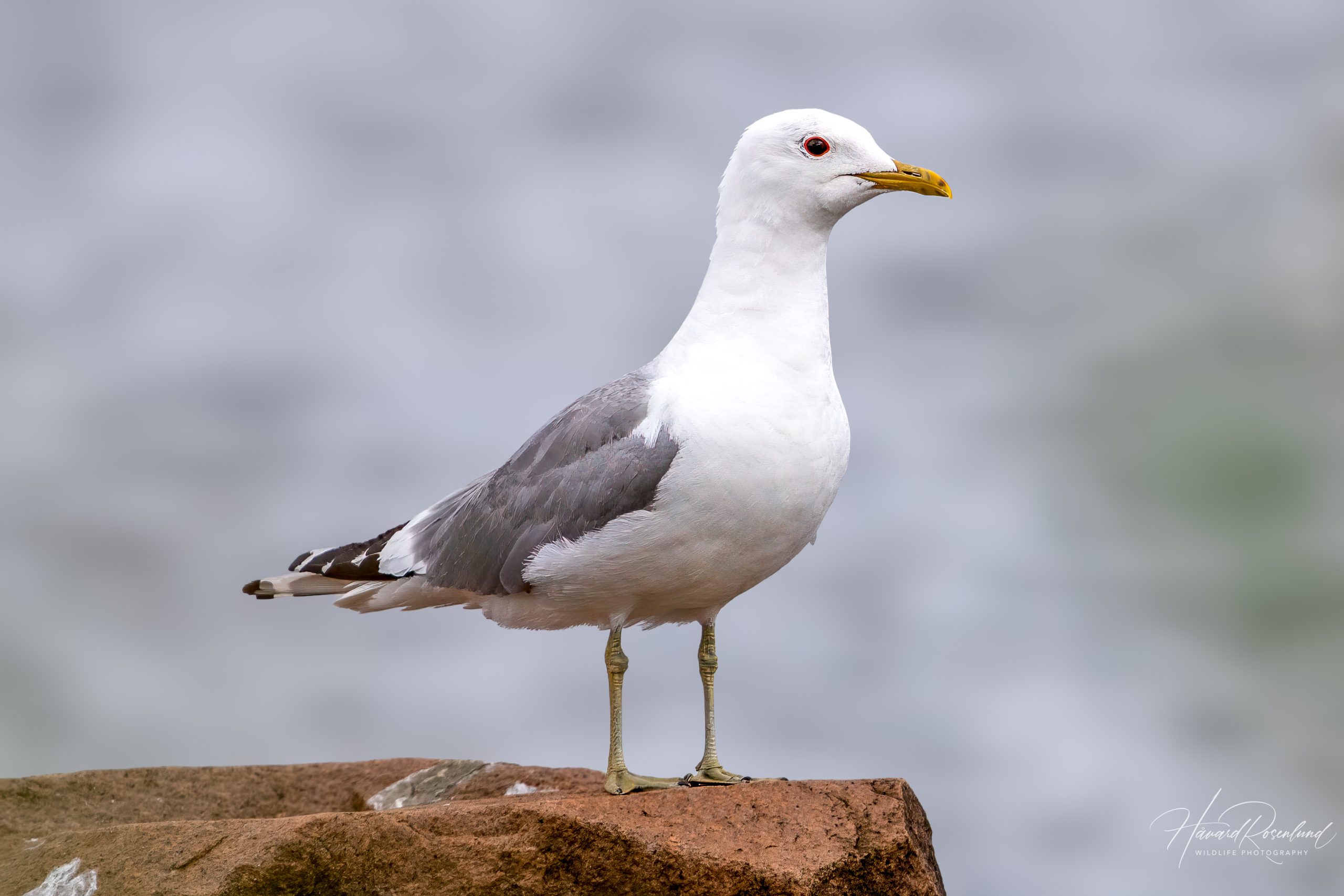
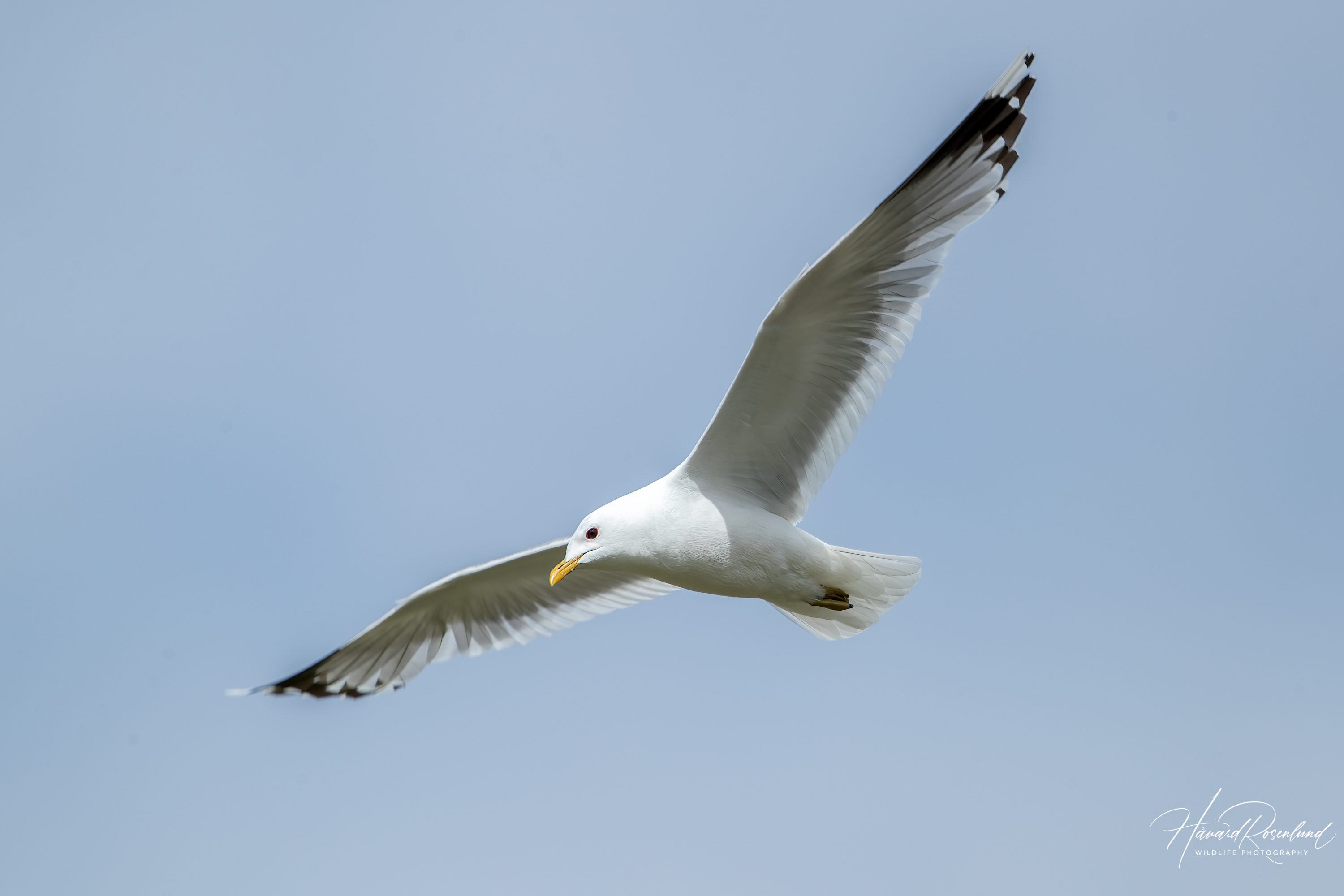
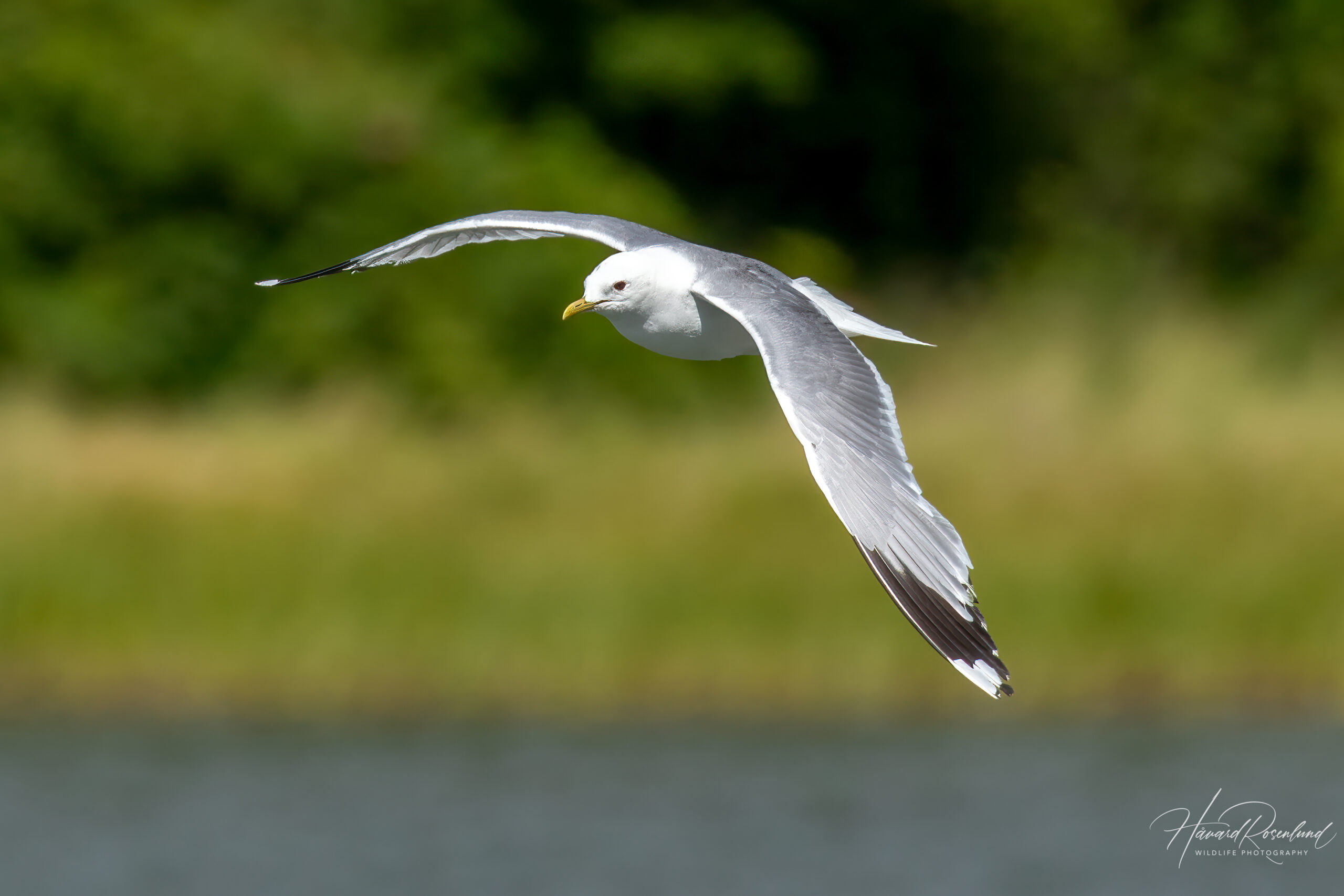
The common gull (Larus canus) is a medium-sized gull breeding across northern Eurasia. Adults are about 40–46 cm long and weigh around 400 g, with a pale grey back, white head and underparts, black wingtips with conspicuous white spots, and yellowish-green legs and bill. In winter the head becomes finely streaked. Immature birds are much browner and take several years to acquire full adult plumage.
Compared with larger gulls such as the herring gull (Larus argentatus), the common gull is smaller and more delicately built, with a slimmer bill that lacks the prominent red spot seen on the lower mandible of adult large Larus gulls.
Taxonomy
The common gull was formerly treated more broadly to include the North American form brachyrhynchus. That population is now widely recognised as a separate species, the short-billed gull (Larus brachyrhynchus), following differences in voice, morphology and genetics.
The name Larus canus therefore now refers to the Eurasian common gull populations. Several geographic forms occur across this broad Palearctic range, and birds from eastern Asia can differ noticeably in size and plumage from the nominate birds of Europe.
Habitat
Common gulls are highly adaptable and occur far beyond the seashore. They breed and feed around coasts, estuaries, lakes, rivers, farmland, wetlands, towns and even upland and mountain habitats. Nest sites may be on islands, marshes, rocky ground, moorland or buildings.
The species often moves freely between aquatic and terrestrial habitats within the same day. Water provides resting and feeding opportunities, while fields, lawns and other open ground can supply abundant invertebrate prey.
Diet
The diet is broad and opportunistic. Earthworms, insects, crustaceans, fish and other aquatic prey are taken alongside grain, small vertebrates, carrion and human-derived food. Common gulls frequently forage on lawns and agricultural fields, where disturbed soil can expose large numbers of invertebrates.
Feeding methods vary with the resource. Birds pick prey from the ground, take food from the water surface and may follow agricultural activity or grazing animals to exploit prey that has become easier to reach.
Social behaviour
Common gulls are flexible in how socially they breed. Pairs may nest alone, in loose groups or in colonies, while outside the breeding season the birds often gather in feeding flocks and at communal resting sites.
A field experiment comparing colonies with solitary nests found that experimental eggs near colonies survived better than eggs around solitary nests, apparently because several adults could join in mobbing an approaching predator. This helps explain why the species can switch between solitary and colonial breeding depending on local conditions.
Migration
Migration varies strongly across the range. Northern and eastern breeders are generally more migratory, moving toward ice-free coasts, lowlands and milder parts of western and southern Europe in autumn, whereas some birds in milder regions remain closer to their breeding areas.
Winter flocks can therefore contain birds that have travelled very different distances. Seasonal movements are flexible and depend strongly on weather, food and the availability of open water.
Breeding
Common gulls may nest alone or in colonies. Nest sites are remarkably varied and include islands, coastal rocks, marshes, lake shores, moorland, mountain terrain and roofs in towns. The nest is built from vegetation and other locally available material, and a typical clutch contains three eggs. Both parents incubate for about 22–28 days.
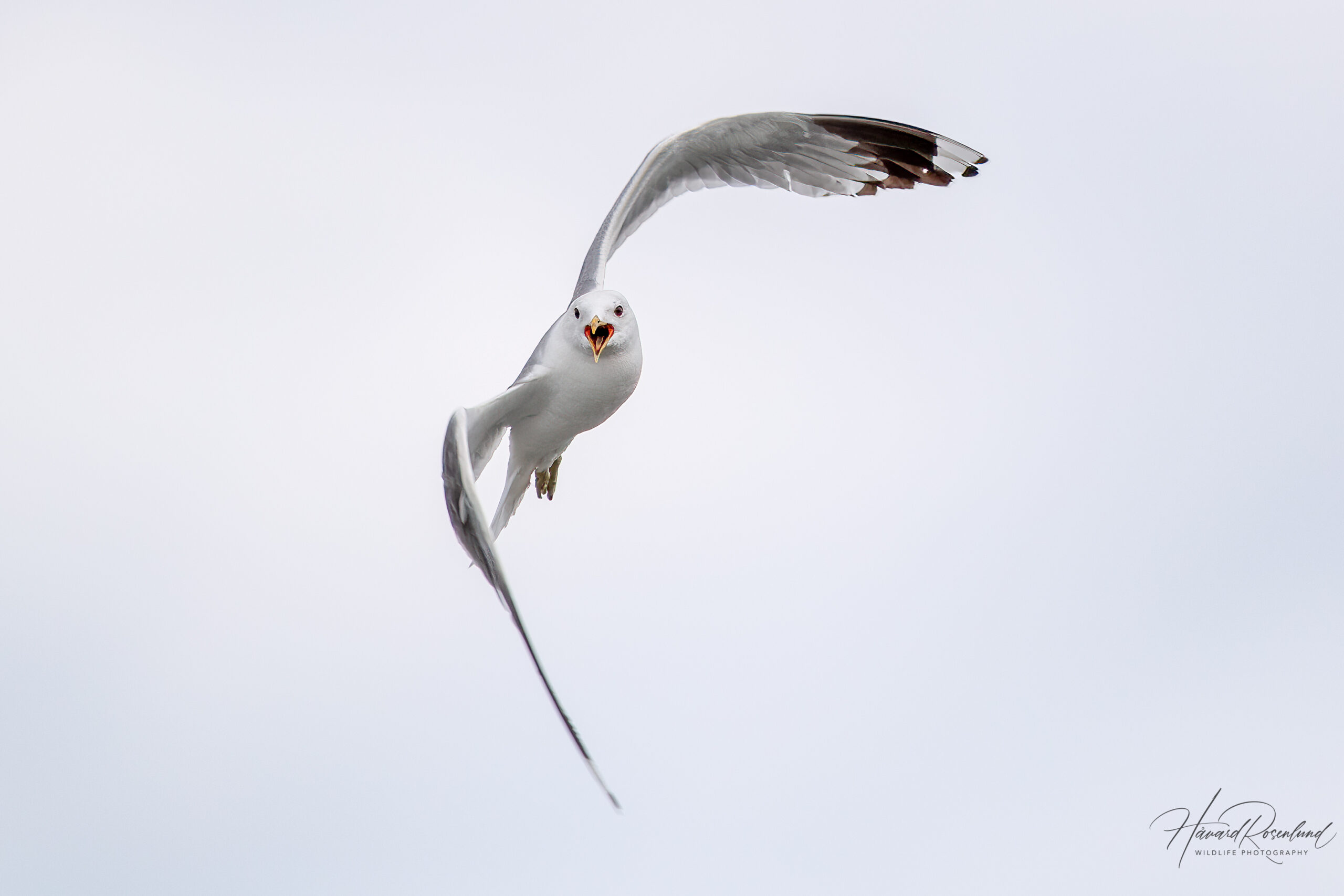
The chicks are semi-precocial: they hatch downy and mobile and leave the immediate nest shortly after hatching, but remain dependent on the adults for food and protection. They become capable of flight after about 34–36 days. Breeding adults can defend eggs and chicks vigorously, repeatedly calling, swooping at and occasionally striking animals or people that approach too closely.
Relationship with humans
Common gulls make extensive use of human-modified landscapes. Farmland, lawns, parks and disturbed ground can provide rich feeding areas, while flat roofs and other structures offer nesting sites in towns where suitable natural sites may be scarce.
This adaptability can bring the birds into conflict with people. A study of roof-nesting common gulls in Malmö documented complaints about noise, droppings and adults defending chicks, even though the same urban environment provided secure breeding opportunities. Such conflicts are strongly seasonal and are usually most noticeable around active nests and newly fledged young.
Status
The common gull is classified as least concern on the IUCN Red List. It has a very large Eurasian range and remains numerous overall.
This global status nevertheless hides substantial regional declines. Breeding populations have fallen in several parts of northern and western Europe, and local colonies can be sensitive to predation, disturbance, wetland change and pollution even though the species is not globally threatened.
Image gallery
Loading map and observations…
Have you seen this species?
Independent species archive
Did you find this species page useful?
Wildlife Vagabond is independently built and maintained. Voluntary support helps cover hosting, maps, data storage and continued improvements to the species archive.
Support Wildlife VagabondSpecies content will remain freely available.
References
Information about the species’ global distribution and status is based primarily on global Red List data. See the references below for details.
- American Ornithological Society. (2021). Split of Short-billed Gull Larus brachyrhynchus from Common Gull Larus canus. https://americanornithology.org/about/committees/nacc/current-prior-proposals/2021-proposals/comments-2021-a/
- BirdLife International. (n.d.). Common Gull species factsheet. https://datazone.birdlife.org/species/factsheet/common-gull-larus-canus
- British Trust for Ornithology. (n.d.). Common Gull. https://www.bto.org/learn/about-birds/birdfacts/common-gull
- Chávez Villavicencio, C. L., & Márquez Bahamonde, M. F. (2019). Mew Gull Larus canus breeding in a residential area of Malmö, Sweden. Ornis Svecica, 29. https://doi.org/10.34080/os.v29.19924
- Götmark, F., & Andersson, M. (1984). Colonial breeding reduces nest predation in the common gull (Larus canus). Animal Behaviour, 32(2), 485-492. https://doi.org/10.1016/S0003-3472(84)80285-7
- International Union for Conservation of Nature. (n.d.). Common Gull. The IUCN Red List of Threatened Species. https://www.iucnredlist.org/species/22694308/155576460