
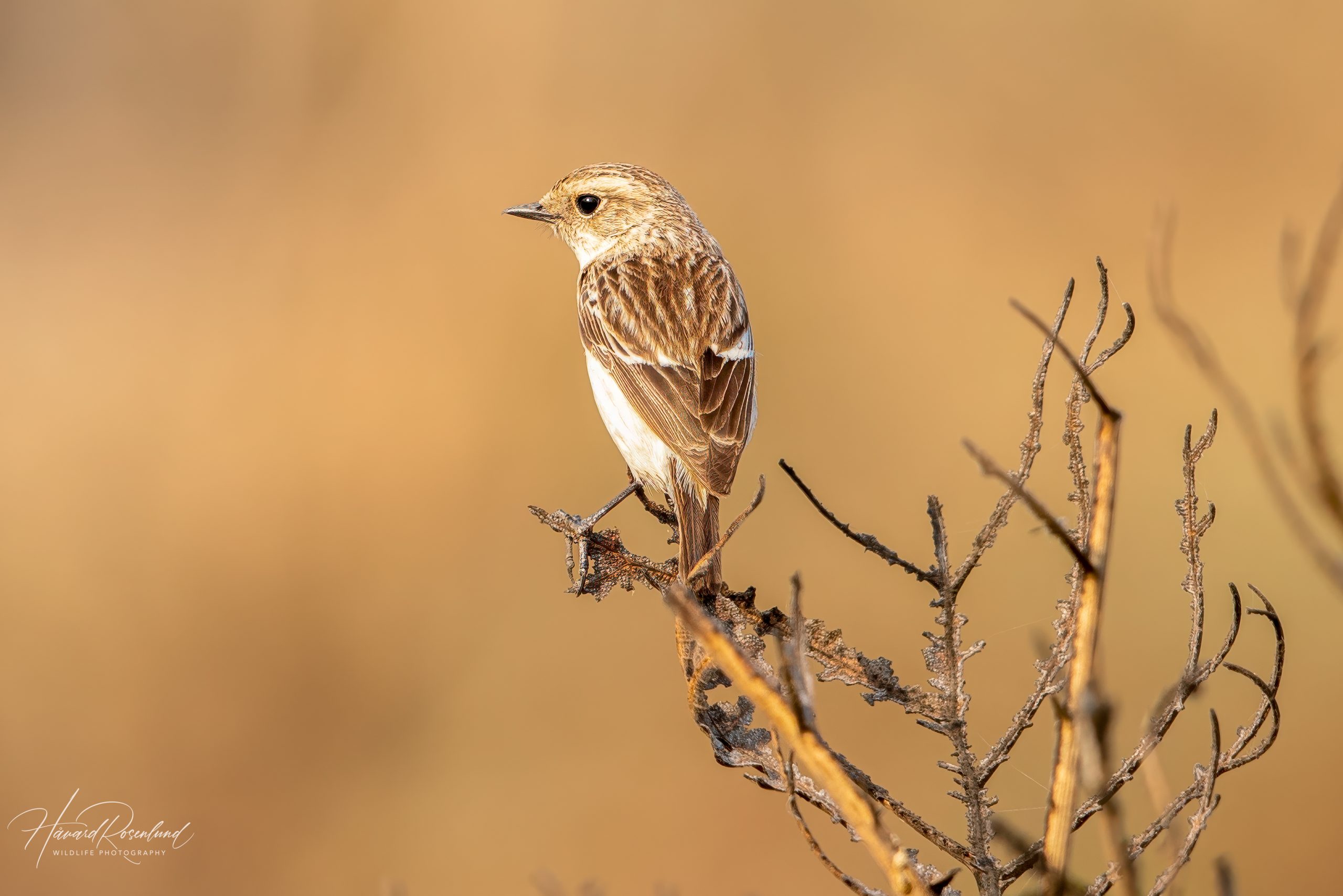
Siberian Stonechat
Saxicola maurus
At a glance
Habitat
- Open grassland, steppe, scrub, farmland, marsh edges and other open country with scattered perches
Diet
- Mainly insects and other small invertebrates; some berries and seeds outside breeding
Activity
- Diurnal
Size
- Length: about 12–13 cm Weight: about 12–16 g
Range
- Breeds across temperate and montane Asia; northern populations winter from the Middle East and Indian subcontinent east into southern and Southeast Asia
Description
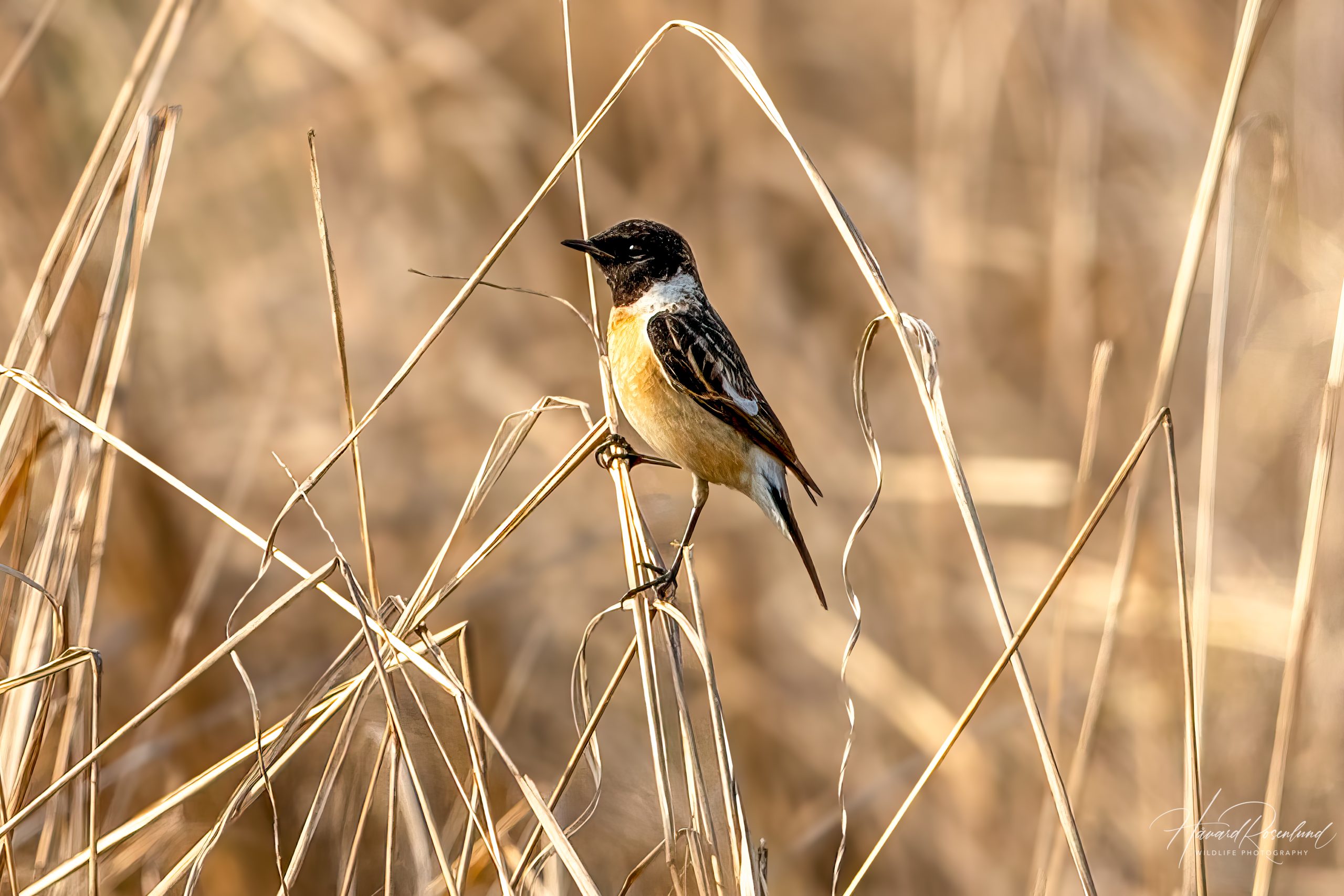
The Siberian stonechat (Saxicola maurus), also known as Asian stonechat, is a small, upright chat of open Eurasian landscapes. Adults are about 12–13 cm long and usually weigh roughly 12–16 g. Breeding males have a black head and throat, broad white neck patches, a warm orange breast and conspicuous pale areas on the rump and wings. Females are browner and less contrasting, with a warm buff-orange breast and paler eyebrow and neck markings.
The species is closely related to other stonechats and has repeatedly been split and lumped with eastern Asian forms. Identification outside the breeding season can be difficult because plumage varies with age, sex and subspecies and because western and eastern forms overlap in appearance.
Taxonomy
The taxonomy of Asian stonechats remains unsettled. The eastern form S. m. stejnegeri was formerly treated by several authorities as a separate species, the Amur stonechat (Saxicola stejnegeri), while the more western birds retained the name Siberian stonechat (Saxicola maurus). AviList reversed that split in 2025 and again includes stejnegeri within S. maurus.
The forms are nevertheless biologically differentiated. Genomic work published in 2026 found extensive hybridisation between maurus and stejnegeri despite the clear differences in their usual migration routes. The combination of differentiation and continued gene flow helps explain why the species boundary remains debated.
Habitat
Siberian stonechats favour open landscapes with enough taller vegetation to provide lookout posts. Breeding habitats include steppe, montane grassland, open scrub, field margins, marsh edges and agricultural land with scattered bushes, fence lines or tall stems.
The same basic structure is used in winter: open ground for feeding combined with elevated perches from which birds can watch for prey.
Diet
The diet consists mainly of insects, spiders and other small invertebrates. Birds typically hunt from an exposed perch, dropping to the ground or making a short aerial sally before returning to another stem, bush or fence post. Beetles, flies, caterpillars, grasshoppers and similar prey are commonly taken.
Berries and seeds can supplement the diet outside the breeding season when insect activity is lower. The perch-and-pounce hunting style makes structurally varied open habitat especially useful, because prey-rich ground and suitable lookout posts occur close together.
Behaviour
Siberian stonechats spend much of the day perched upright on prominent stems, bushes and fence posts and frequently flick the wings and tail before making short flights to a new lookout. Outside breeding they are often solitary, although loose concentrations can form where suitable habitat and food are especially abundant.
During the breeding season, pairs defend territories and males sing from conspicuous elevated perches. The song helps mark and defend the territory and makes breeding birds much easier to detect than wintering individuals.
Migration
Migration varies greatly across the species. Northern populations of S. m. maurus are long-distance migrants, moving from Siberia and central Asia to wintering areas in the Middle East, the Indian subcontinent and farther east in southern Asia, while some southern populations are much more sedentary.
A 2026 tracking and genomic study demonstrated a broad migratory divide between maurus and the eastern stejnegeri form in central Siberia and Mongolia. The two forms generally pass around opposite sides of the Qinghai–Tibet Plateau. Of three genotyped birds that followed intermediate routes across the plateau, two were clear hybrids, while the high-altitude form przewalskii consistently crossed the plateau itself. Different populations therefore use strikingly different routes around or across the same major geographical barrier.
Breeding
The nest is a grass-lined cup placed on or very close to the ground, usually hidden in dense grass, field margins, banks or low vegetation. The female performs most of the nest building and incubation, while both parents feed the young after hatching. Clutches commonly contain about four to six eggs. Incubation lasts roughly two weeks, and the young usually leave the nest about two weeks after hatching.
A case published in 2025 from farmland in northwestern Yunnan, China, documented a male white wagtail (Motacilla alba) repeatedly helping a Siberian stonechat pair feed their five nestlings and remove faecal sacs. The extra helper increased the overall provisioning of the brood, and all five young fledged. This was the first documented case of interspecific parental care involving a white wagtail at a Siberian stonechat nest. The cause remains uncertain.
Status
The broader Saxicola maurus recognised by AviList does not currently have a directly corresponding assessment on the IUCN Red List and is therefore treated here as not evaluated. The previous red-list link associated with this page belongs to Saxicola torquatus, so its category cannot be transferred to the current species concept.
Because the current species treatment is newer than many regional population assessments, such trend data need to be interpreted in light of which forms they actually cover. Open grassland, scrub and low-intensity agricultural mosaics remain important habitat across much of the range.
Image gallery
Loading map and observations…
Have you seen this species?
Independent species archive
Did you find this species page useful?
Wildlife Vagabond is independently built and maintained. Voluntary support helps cover hosting, maps, data storage and continued improvements to the species archive.
Support Wildlife VagabondSpecies content will remain freely available.
References
Information about the species’ global distribution and status is based primarily on global Red List data. See the references below for details.
- BirdGuides. (n.d.). Siberian Stonechat. https://www.birdguides.com/species-guide/ioc/saxicola-maurus/
- BirdLife International. (2026). IUCN Red List for birds. BirdLife DataZone. https://datazone.birdlife.org
- British Trust for Ornithology. (n.d.). Siberian Stonechat BirdFacts. https://www.bto.org/learn/about-birds/birdfacts/siberian-stonechat
- Christidis, L., Rheindt, F. E., Iliff, M. J., Lepage, D., Rasmussen, P. C., Donald, P., Alström, P., Areta, J. I., Brammer, F., Chesser, T., Donsker, D., Dowsett, B., Gerbracht, J., Kirsch, M., Kuziemko, M., Lagerqvist, M., Littauer, R., Longmore, W., Norman, J., … Stervander, M. (2026). AviList v2025b. AviList. https://doi.org/10.2173/avilist.v2025b
- Oiseaux.net. (n.d.). Siberian Stonechat. https://www.oiseaux.net/en/oiseaux/siberian.stonechat.html
- State of India's Birds. (2025). State of India’s Birds 2025 – Siberian Stonechat. https://stateofindiasbirds.in/species/sibsto1/
- Zhao, T., Anisimov, Y., Heim, W., Song, G., Anisimova, V., Batbayar, N., Bossu, C. M., Bours, A., Chen, S., Chen, W., Davaasuren, B., Dule, Jiao, S., Jiao, X., Hellström, M., Langebrake, G., Li, Z., Liao, S.-Y., Liu, A., … Helm, B. (2026). Migration patterns and hybridization within the Asian stonechat complex in response to a major geographical barrier. Evolution Letters, 10(4), 396-412. https://doi.org/10.1093/evlett/qrag019
- Zheng, J., Dai, K., Zhang, Z., Kuang, F., & Li, D. (2025). First Discovery on Interspecific Parental Care of Siberian Stonechat (Saxicola maurus) Nestlings Provided by a Male White Wagtail (Motacilla alba). Ecology and Evolution, 15(4), e71188. https://doi.org/10.1002/ece3.71188