
White-rumped Shama
Copsychus malabaricus
At a glance
Habitat
- Dense forest understorey, secondary woodland, bamboo, ravines and shaded plantations
Diet
- Mainly insects and other small invertebrates; also occasional fruit
Activity
- Diurnal
Size
- Length: about 22–27 cm Weight: about 28–32 g
Range
- Indian subcontinent through mainland Southeast Asia to the Malay Peninsula, Sumatra, Borneo and parts of western Java
Description
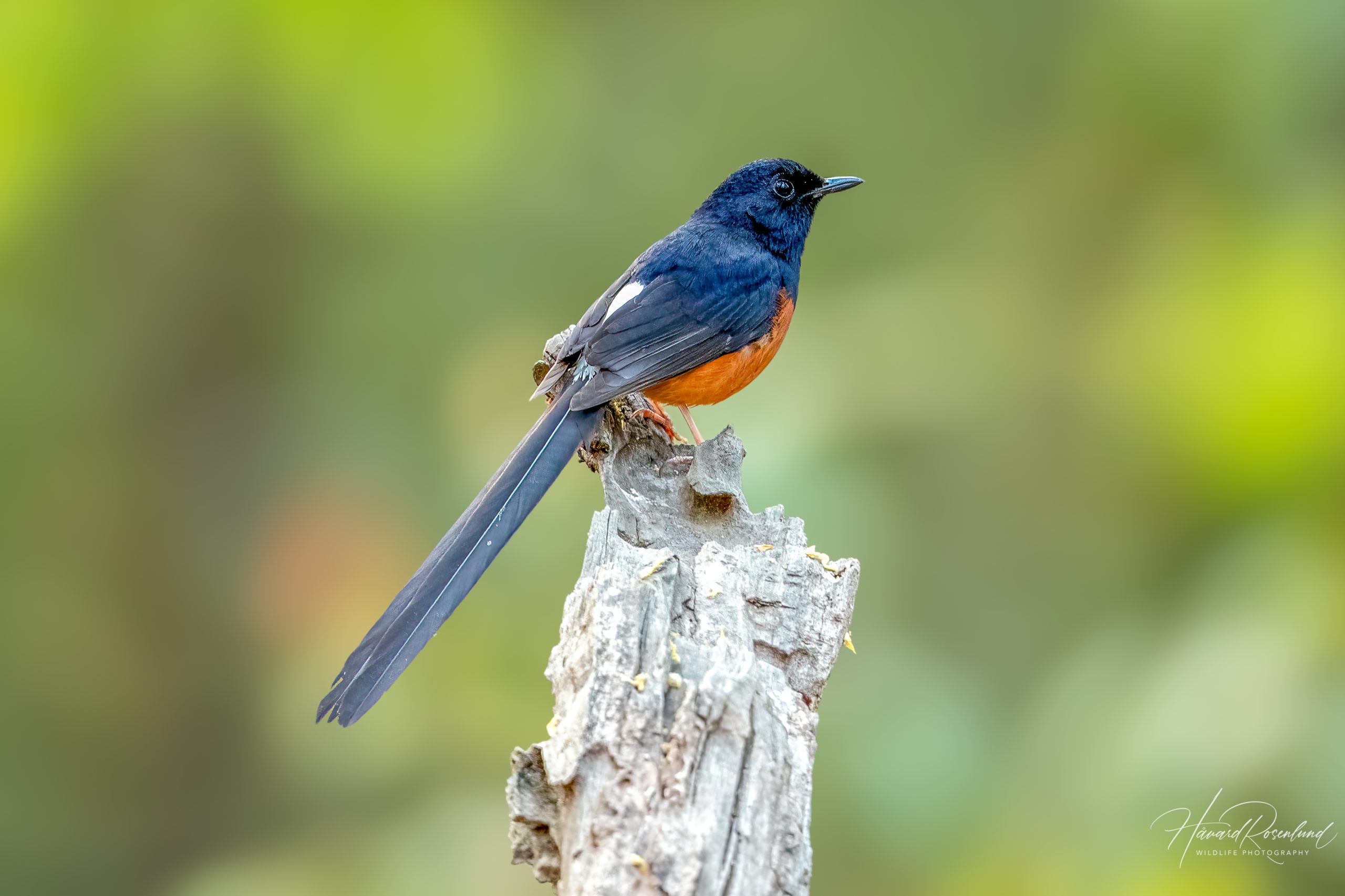
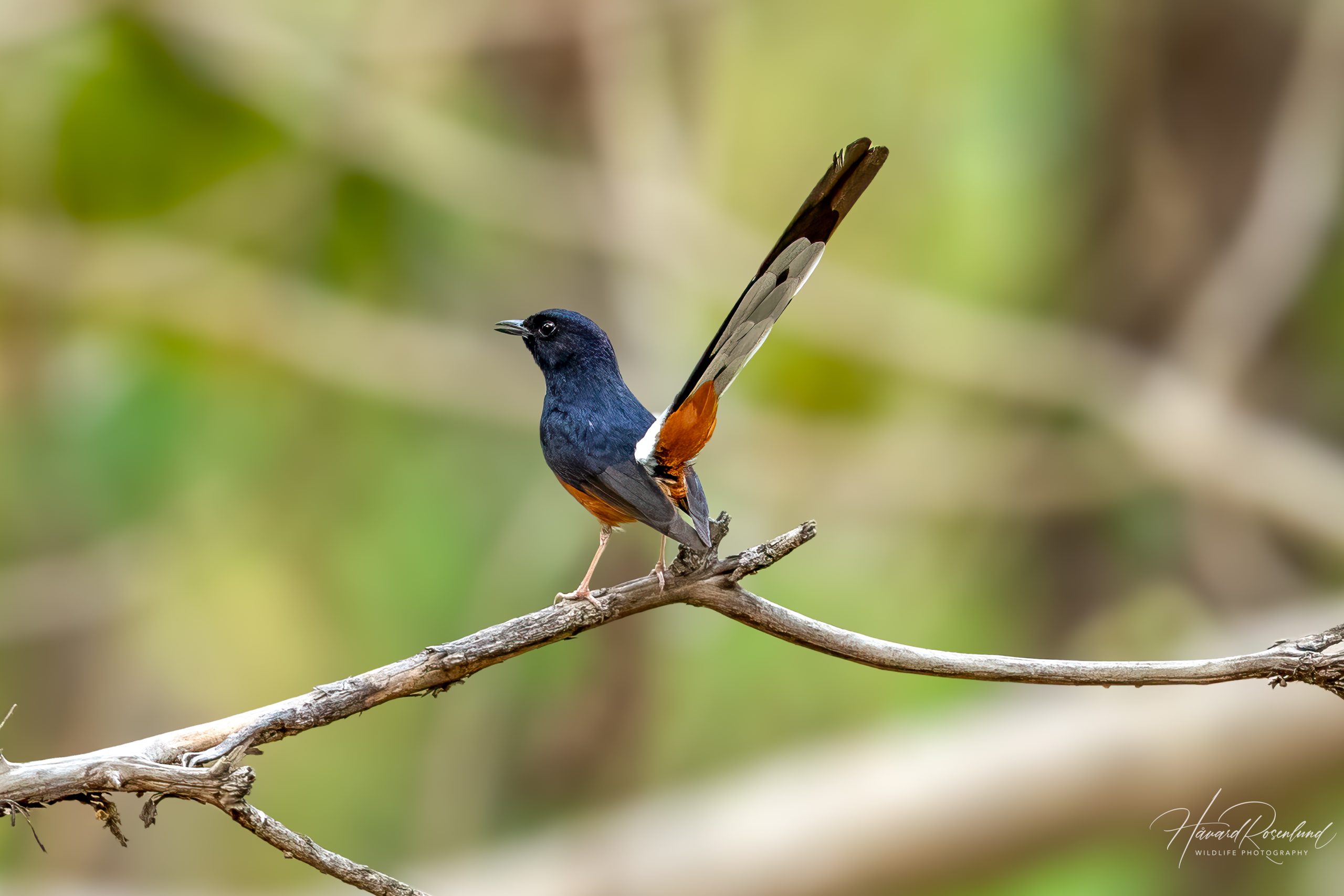
The white-rumped shama (Copsychus malabaricus) is a medium-sized, long-tailed forest songbird of South and Southeast Asia. Adults are about 22–27 cm long and typically weigh around 28–32 g. Males have glossy blue-black upperparts and breast, rich chestnut underparts, a bright white rump and long black-and-white tail. Females follow the same general pattern but are greyer and browner, with a shorter tail and less intense contrast.
The conspicuous white rump often flashes as the bird moves through dark undergrowth. Despite its striking plumage, the species can be difficult to see in dense vegetation and is frequently detected first by its powerful, varied song.
Taxonomy
The modern white-rumped shama is narrower than the species concept used in many older field guides. The former complex was split into four species: white-rumped shama (Copsychus malabaricus), Larwo shama (Copsychus omissus), Kangean shama (Copsychus nigricauda) and Sri Lankan shama (Copsychus leggei). The split was adopted by the Clements Checklist in 2024 and is also used in the current AviList.
A separate taxonomic boundary occurs in northern Borneo, where white-rumped shama meets white-crowned shama (Copsychus stricklandii). The two have sometimes been treated as part of the same broader species complex, but current checklists recognise them as separate species. Genomic work has found only limited introgression between them, and a study published in 2026 found that the two remain strongly genetically differentiated where they meet, with very little evidence of late-generation hybrids or backcrosses.
The revised white-rumped shama still has a broad range from the Indian subcontinent through mainland Southeast Asia to the Malay Peninsula, Sumatra, much of Borneo and parts of western Java. Several geographically restricted forms within the wider shama group have been severely depleted by trapping, illustrating why the taxonomic changes matter for conservation as well as naming.
Habitat
White-rumped shamas are strongly associated with shaded, structurally complex vegetation. They inhabit tropical and subtropical forest, dense secondary growth, bamboo, wooded ravines, forest edge and tree-rich plantations, usually spending much of their time in the lower and middle vegetation layers.
In India, the species is resident and strongly associated with forest. Leaf litter, low branches and tangled understorey provide feeding sites and cover, while cavities and sheltered recesses in mature vegetation provide nesting opportunities.
Diet
The diet consists mainly of insects and other small invertebrates, including beetles, caterpillars, ants, termites, spiders and worms. Small amounts of fruit and other plant food may also be taken.
Much of the feeding occurs close to the ground. Birds hop through leaf litter, inspect low vegetation and pick prey from leaves and branches, but they also launch short sallies from a perch to seize flying insects. This flexible hunting style suits the dense forest understorey in which the species spends much of its time.
Behaviour
White-rumped shamas are usually solitary except when paired and can be strongly territorial. Males use regular song posts and actively chase rival males that enter their area, with singing becoming especially important as breeding approaches.
The species is famous for an exceptionally rich song. A bioacoustic study published in 2023 analysed 373 strophes from 22 males in the Himalayan foothills of Himachal Pradesh, northern India. Each male used two to five recurring strophe types, and variation was greater between individuals than within the same bird, showing that individual males can be acoustically distinctive.
Song learning also includes extensive mimicry. A study published in 2025 recorded 256 introduced male white-rumped shamas across 26 sites in Taiwan. About 95% of the males produced heterospecific mimicry, and together they copied sounds from at least 28 other animal species. Which sounds entered the repertoire varied among individuals and localities, showing how strongly the song can be shaped by individual learning and the surrounding acoustic community.
Breeding
Breeding timing varies geographically; in South Asia it is often concentrated from about April to June, although nesting can occur over a broader part of the year. The species nests in sheltered cavities and recesses, including holes in trees, broken stumps and other protected sites within dense vegetation. The female builds most of the cup-shaped nest from roots, leaves, fibres and other plant material. Clutches usually contain three to five eggs.
A classic study published in 1994 followed an introduced population on Oahu, Hawaii, during 1986–1987. Incubation averaged 13.6 days and the nestling period 12.4 days. Only the female incubated and brooded, while both adults fed the young; some pairs raised two broods in one breeding season. These observations give useful detail on the reproductive cycle, although timing can vary among populations.
Relationship with humans
The white-rumped shama is one of Southeast Asia's most prized cagebirds because of its elaborate song. Regional trade data collected before the recent taxonomic splits used a broader white-rumped shama concept than the species recognised today. Under that broader treatment, a TRAFFIC analysis published in 2019 documented 15,480 shamas seized in Southeast Asia between 2008 and 2018, with 10,376 intended for international trade; a further 8,271 were recorded for sale in open bird markets.
Intensive trapping has caused local disappearances and severe population depletion across parts of the wider shama group, including populations historically treated within white-rumped shama. The popularity of C. malabaricus has also led to introductions outside its natural range, with established non-native populations in places including Taiwan and the Hawaiian Islands.
Status
The white-rumped shama is classified as least concern on the IUCN Red List.
State of India’s Birds 2025 estimates a long-term national change of about +22.27%, but the uncertainty interval includes both a slight decline and a stronger increase. The recent annual estimate is about −0.57%, and its uncertainty interval also crosses zero. Neither period therefore shows a clear directional change in India.
The global category masks much greater regional concern. Forest loss can affect local populations, but intensive trapping for the songbird trade has been particularly damaging in parts of Southeast Asia. Conservation therefore depends not only on retaining forest habitat but also on reducing unsustainable capture from the wild.
Image gallery
Loading map and observations…
Have you seen this species?
Independent species archive
Did you find this species page useful?
Wildlife Vagabond is independently built and maintained. Voluntary support helps cover hosting, maps, data storage and continued improvements to the species archive.
Support Wildlife VagabondSpecies content will remain freely available.
References
Information about the species’ global distribution and status is based primarily on global Red List data. See the references below for details.
- Aguon & Conant. (1994). Breeding biology of the White-rumped Shama on Oahu, Hawaii. https://www.biodiversitylibrary.org/part/209739
- AviList. (n.d.). v2025b – current global bird checklist. https://www.avilist.org/checklist/v2025b/
- BirdLife International. (n.d.). White-rumped Shama species factsheet. https://datazone.birdlife.org/species/factsheet/white-rumped-shama-copsychus-malabaricus
- Cornell Lab of Ornithology. (2024). White-rumped Shama complex split. https://www.birds.cornell.edu/clementschecklist/updates-and-corrections-october-2024/
- International Union for Conservation of Nature. (n.d.). White-rumped Shama. The IUCN Red List of Threatened Species. https://www.iucnredlist.org/species/103894856/183077961
- Kumar, A., Himanshu, & Rawal, P. (2023). Individual-Level Discrimination in Song Characteristics of White-Rumped Shama, Copsychus malabaricus. Current Science, 125(1), 59. https://doi.org/10.18520/cs/v125/i1/59-65
- Lim, H. C., Shakya, S. B., Gawin, D. F., & Sheldon, F. H. (2026). Contrasting Genomic Outcomes of Secondary Contact in Bornean Bird Lineages: Insights From Barrier Loci, Demographic History and Genomic Features. Molecular Ecology, 35(12), e70444. https://doi.org/10.1111/mec.70444
- Shieh, B.-S., Liang, S.-H., & Chang, S.-C. (2025). Learning from the local: the variety and spatial pattern of vocal mimicry in songs of the invasive white-rumped shama in Taiwan. Royal Society Open Science, 12(3), 241676. https://doi.org/10.1098/rsos.241676
- State of India's Birds. (2025). State of India’s Birds 2025 – White-rumped Shama. https://stateofindiasbirds.in/species/whrsha/
- TRAFFIC. (2019). Trade in White-rumped Shamas demands strong national and international responses. https://www.traffic.org/news/international-trade-of-asias-most-popular-songbird/