
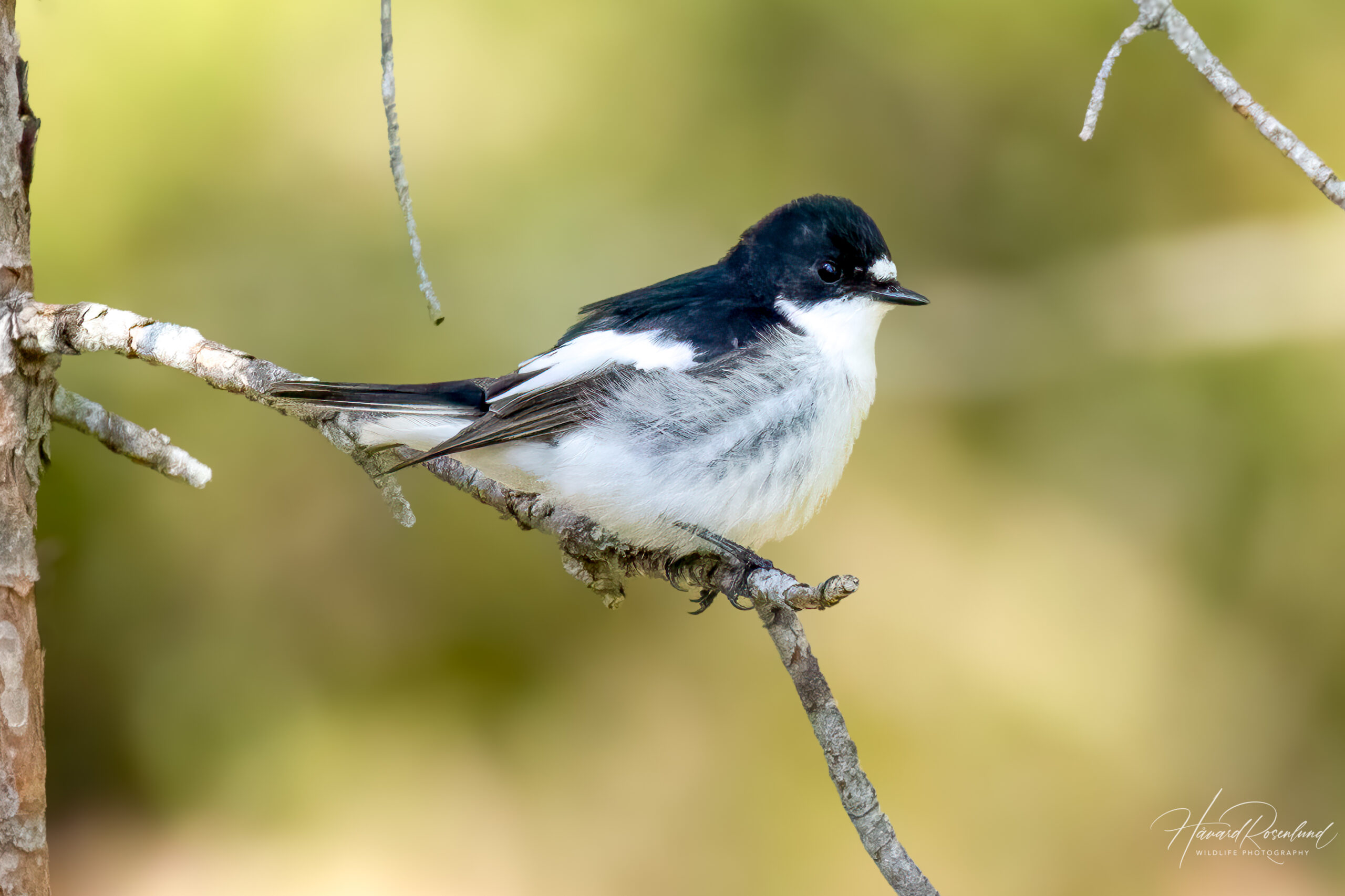
European Pied Flycatcher
Ficedula hypoleuca
At a glance
Habitat
- Deciduous and mixed woodland, forest edges, parks and gardens with natural cavities or nest boxes
Diet
- Mostly insects and other arthropods; caterpillars are especially important for nestlings in some woodland types
Activity
- Diurnal
Size
- Length: 12–13.5 cm Weight: about 13 g
Range
- Breeds across much of Europe and western Asia; winters mainly in West and west-central Africa
Description
The European pied flycatcher (Ficedula hypoleuca) is a small long-distance migratory songbird breeding across much of Europe and into western Asia. Adults are about 12–13.5 cm long, have a wingspan of roughly 21–24 cm and usually weigh 12–15 g. Breeding males are black or dark brown above and white below, with large white wing patches and one or two white forehead patches. Females are grey-brown above and pale below but retain the conspicuous white wing patches. Male upperpart colour varies considerably across the range, from almost entirely black to brownish.
Where it occurs with the collared flycatcher (Ficedula albicollis), females in particular can be difficult to separate. Adult male collared flycatchers normally show a complete white collar, which European pied flycatchers lack.
Habitat
European pied flycatchers breed in deciduous, mixed and open coniferous woodland where suitable cavities are available. Oak woodland is especially important in parts of western Europe, while birch, aspen and other deciduous trees are widely used farther north. Parks, gardens and woodland edges can also provide breeding habitat where old trees or nest boxes supply cavities.
The species readily accepts nest boxes, which has made it one of Europe's best-studied migratory songbirds.
Diet
The diet is dominated by insects and other arthropods taken from foliage, branches and the ground or caught in short aerial pursuits. Caterpillars are especially important for nestlings, while small beetles, flies, spiders and other invertebrates are also taken. Fruit can become more important in late summer and during migration.
Food available to nestlings differs strongly among woodland types. A study published in 2012 compared nestling diets across nine study areas throughout the European breeding range, including Norway and Finland. Across the study areas, caterpillars averaged 37.5% of nestling prey in oak woodland, compared with 23.7% in coniferous and birch woodland. The strong seasonal caterpillar peak in oak woodland also produced a marked decline in caterpillar intake through the breeding season, whereas this seasonal change was much weaker in other woodland types. Chicks receiving a higher proportion of caterpillars reached somewhat higher body mass on average.
Migration
European pied flycatchers are long-distance migrants. After breeding they move southwest through Europe and cross the Sahara to wintering areas in West Africa, particularly wooded savanna and forest habitats. Spring migration brings them back north through Europe, with males reaching the breeding grounds before females.
A 2023 synthesis of tracking data from five European populations showed clear variation in migration routes and wintering areas. Birds from northern and central Europe used different parts of West Africa, and the single Norwegian bird in the dataset wintered furthest west. Individuals could also follow different routes in autumn and spring.
Breeding
European pied flycatchers are cavity nesters and use both natural tree holes and nest boxes. Males arrive first and advertise one or more potential nest sites within a territory. The female chooses the site and builds the nest. A typical clutch contains 6–7 pale blue eggs, incubation lasts about 13–15 days, and the young leave the nest after roughly 14–17 days. The parents normally continue feeding the fledglings for about another week.
The mating system is more flexible than a simple pair bond suggests. Some males establish an additional territory away from the first and may attract a secondary female. Long-term work in Oslo has shown that such males usually provide most care at the primary brood but may also contribute at the secondary nest. The reproductive cost to a secondary female varies with food availability, weather and breeding timing.
Status
The European pied flycatcher is classified as least concern on the IUCN Red List. It has a very large range and remains numerous, but population trends differ substantially between regions.
In the UK, the breeding population in 2024 was about 52% lower than in 1995. Most of the decline occurred from the late 1990s into the early 2000s, after which the trend broadly stabilised and has shown some recent recovery. Climate warming can create an additional challenge in some woodland types by shifting the seasonal caterpillar peak relative to the birds' breeding cycle.
Image gallery
Loading map and observations…
Have you seen this species?
Independent species archive
Did you find this species page useful?
Wildlife Vagabond is independently built and maintained. Voluntary support helps cover hosting, maps, data storage and continued improvements to the species archive.
Support Wildlife VagabondSpecies content will remain freely available.
References
Information about the species’ global distribution and status is based primarily on global Red List data. See the references below for details.
- Adamík, P., Bureš, S., Hahn, S., Oatley, G., & Briedis, M. (2023). Timing of migration and African non-breeding grounds of geolocator-tracked European Pied Flycatchers: a multi-population assessment. Journal of Ornithology, 164(4), 875-886. https://doi.org/10.1007/s10336-023-02081-9
- BirdLife International. (n.d.). European Pied Flycatcher species factsheet. https://datazone.birdlife.org/species/factsheet/european-pied-flycatcher-ficedula-hypoleuca
- British Trust for Ornithology. (n.d.). Pied Flycatcher BirdFacts. https://www.bto.org/learn/about-birds/birdfacts/pied-flycatcher
- Burger, C., Belskii, E., Eeva, T., Laaksonen, T., Mägi, M., Mänd, R., Qvarnström, A., Slagsvold, T., Veen, T., Visser, M. E., Wiebe, K. L., Wiley, C., Wright, J., & Both, C. (2012). Climate change, breeding date and nestling diet: how temperature differentially affects seasonal changes in pied flycatcher diet depending on habitat variation. Journal of Animal Ecology, 81(4), 926-936. https://doi.org/10.1111/j.1365-2656.2012.01968.x
- Huk, T., & Winkel, W. (2006). Polygyny and its fitness consequences for primary and secondary female pied flycatchers. Proceedings of the Royal Society B, 273(1594), 1681–1688. https://doi.org/10.1098/rspb.2006.3485
- International Union for Conservation of Nature. (n.d.). European Pied Flycatcher. The IUCN Red List of Threatened Species. https://www.iucnredlist.org/species/22709308/131952521
- Lifjeld & Slagsvold. (1989). Allocation of parental investment by polygynous Pied Flycatcher males. Ornis Fennica 66. https://ornisfennica.journal.fi/article/view/133271
- Ouwehand, J., Ahola, M. P., Ausems, A. N. M. A., Bridge, E. S., Burgess, M., Hahn, S., Hewson, C. M., Klaassen, R. H. G., Laaksonen, T., Lampe, H. M., Velmala, W., & Both, C. (2016). Light‐level geolocators reveal migratory connectivity in European populations of pied flycatchers Ficedula hypoleuca. Journal of Avian Biology, 47(1), 69-83. https://doi.org/10.1111/jav.00721