
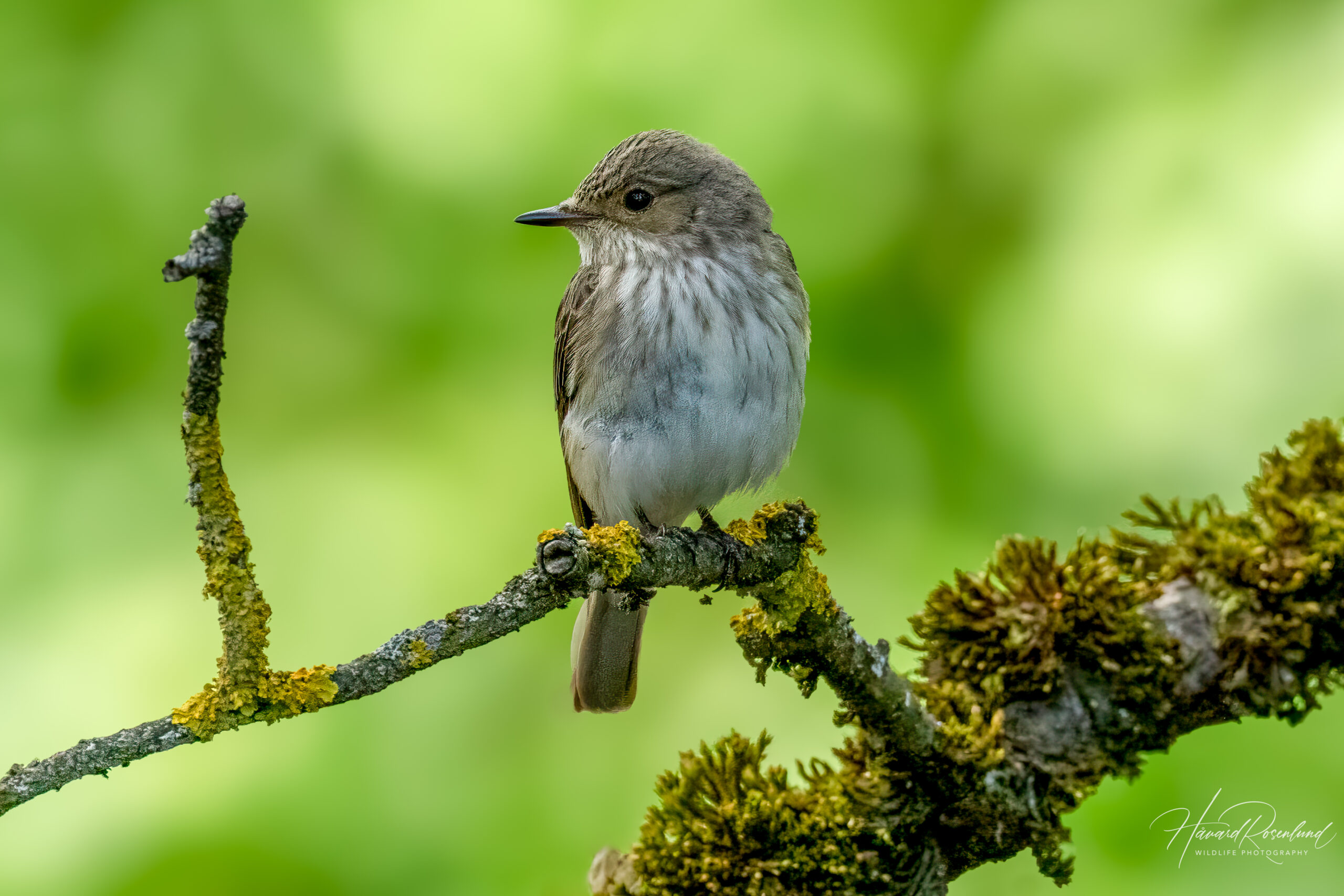
Spotted Flycatcher
Muscicapa striata
At a glance
Habitat
- Open woodland, forest edges, parks and gardens with exposed perches and open airspace for hunting
Diet
- Flying insects and other invertebrates caught mainly in short aerial sallies
Activity
- Diurnal
Size
- Length: 13–14.5 cm Weight: about 14.5 g
Range
- Breeds across much of Europe and western Asia; winters in sub-Saharan Africa
Description
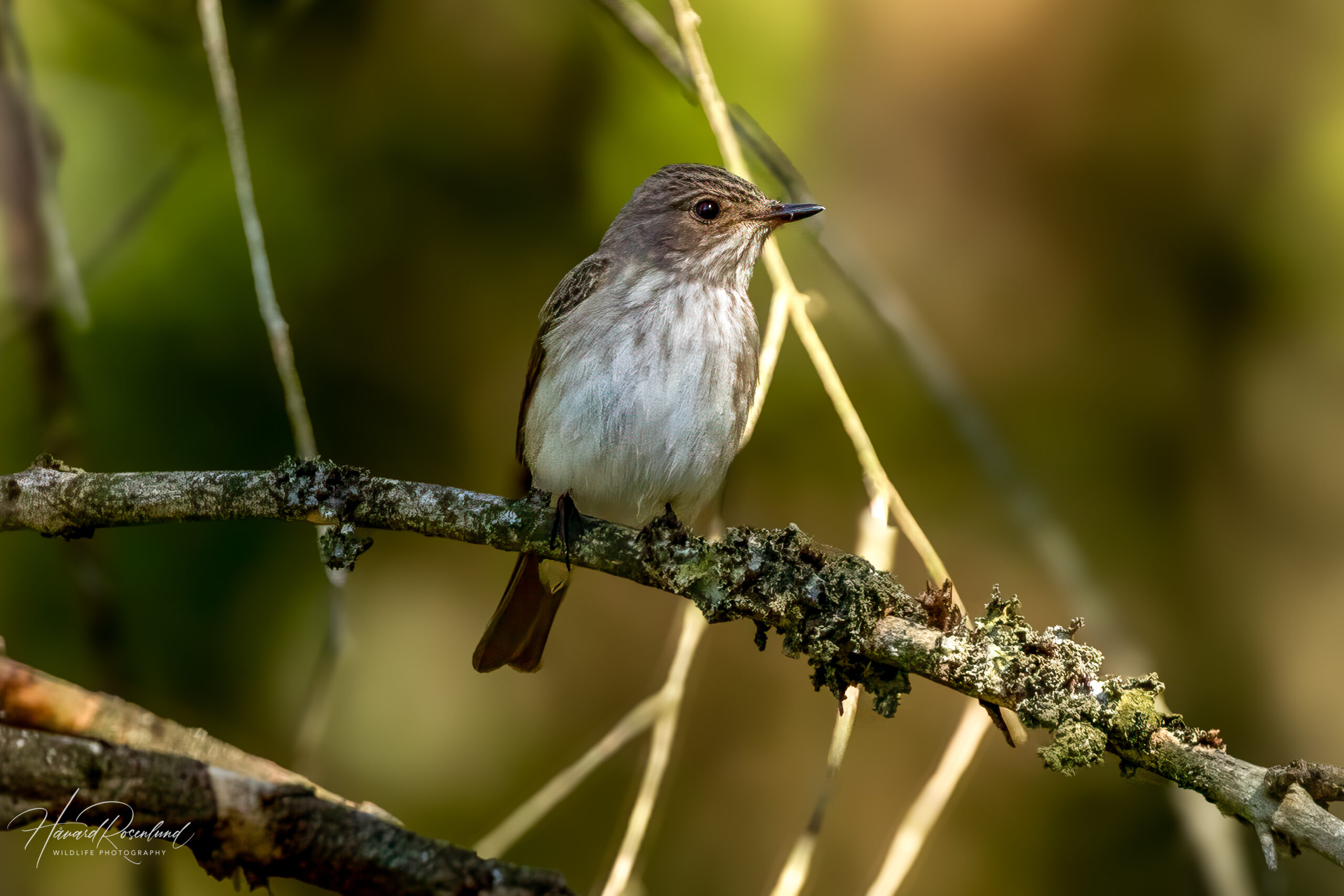
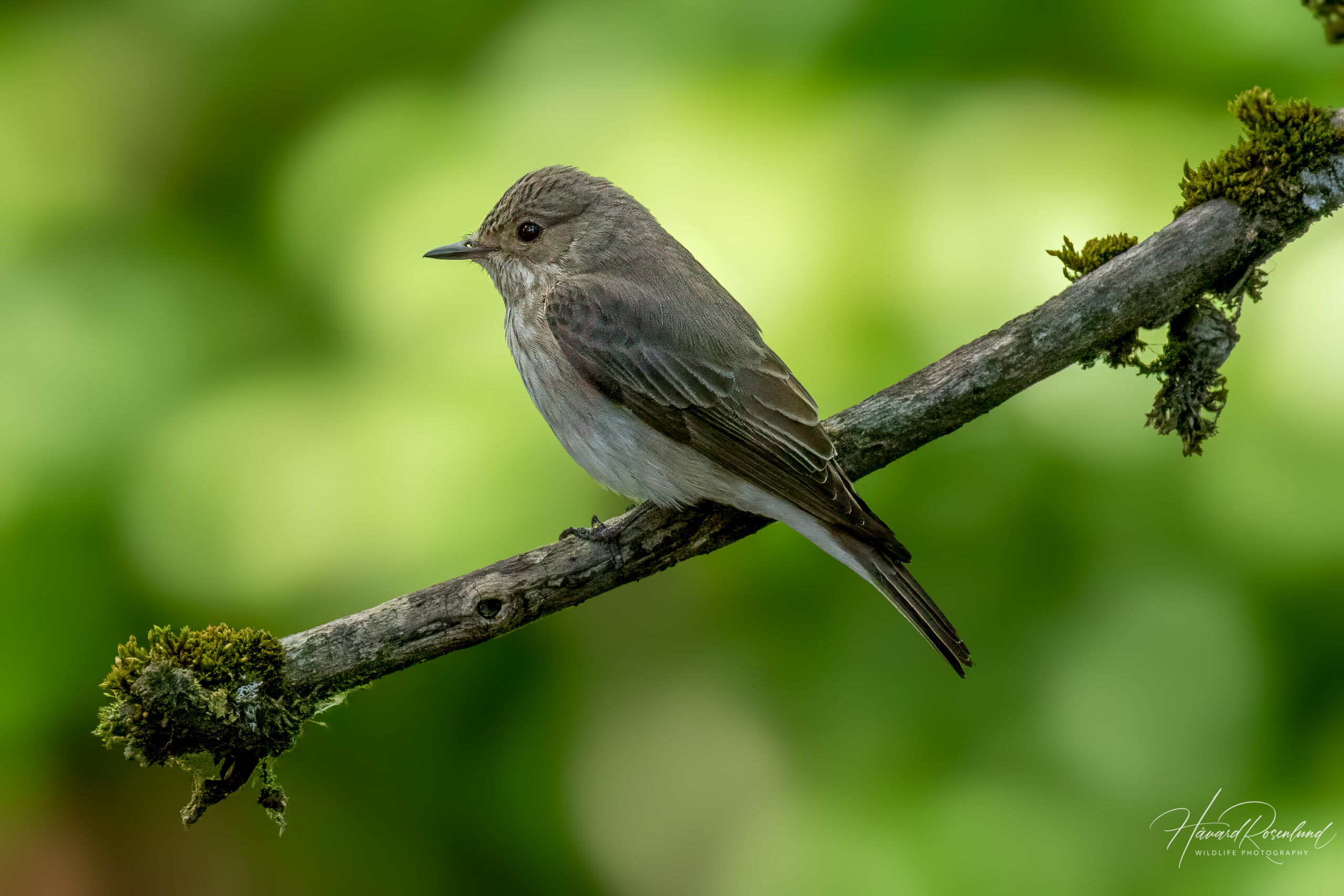
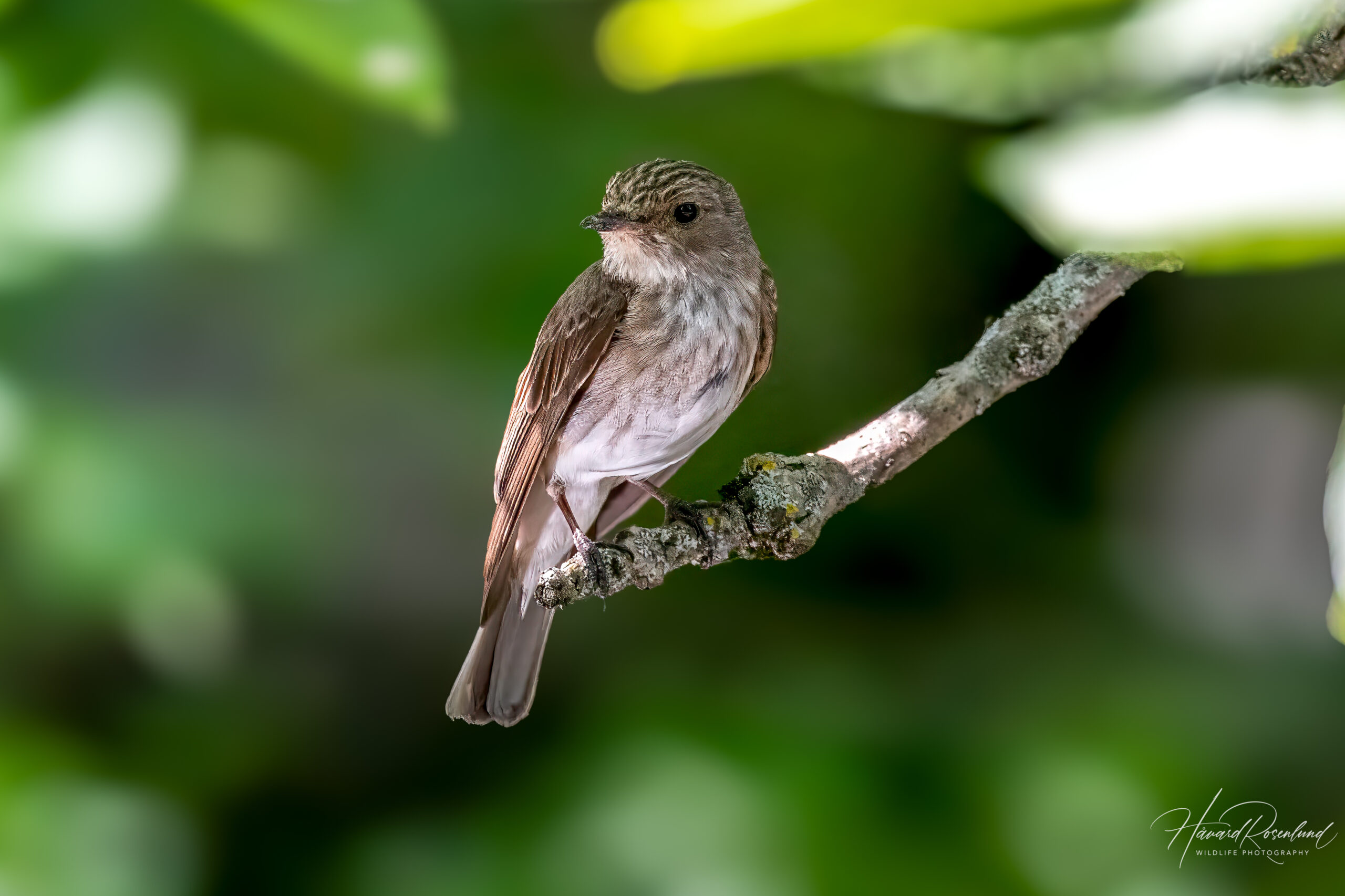
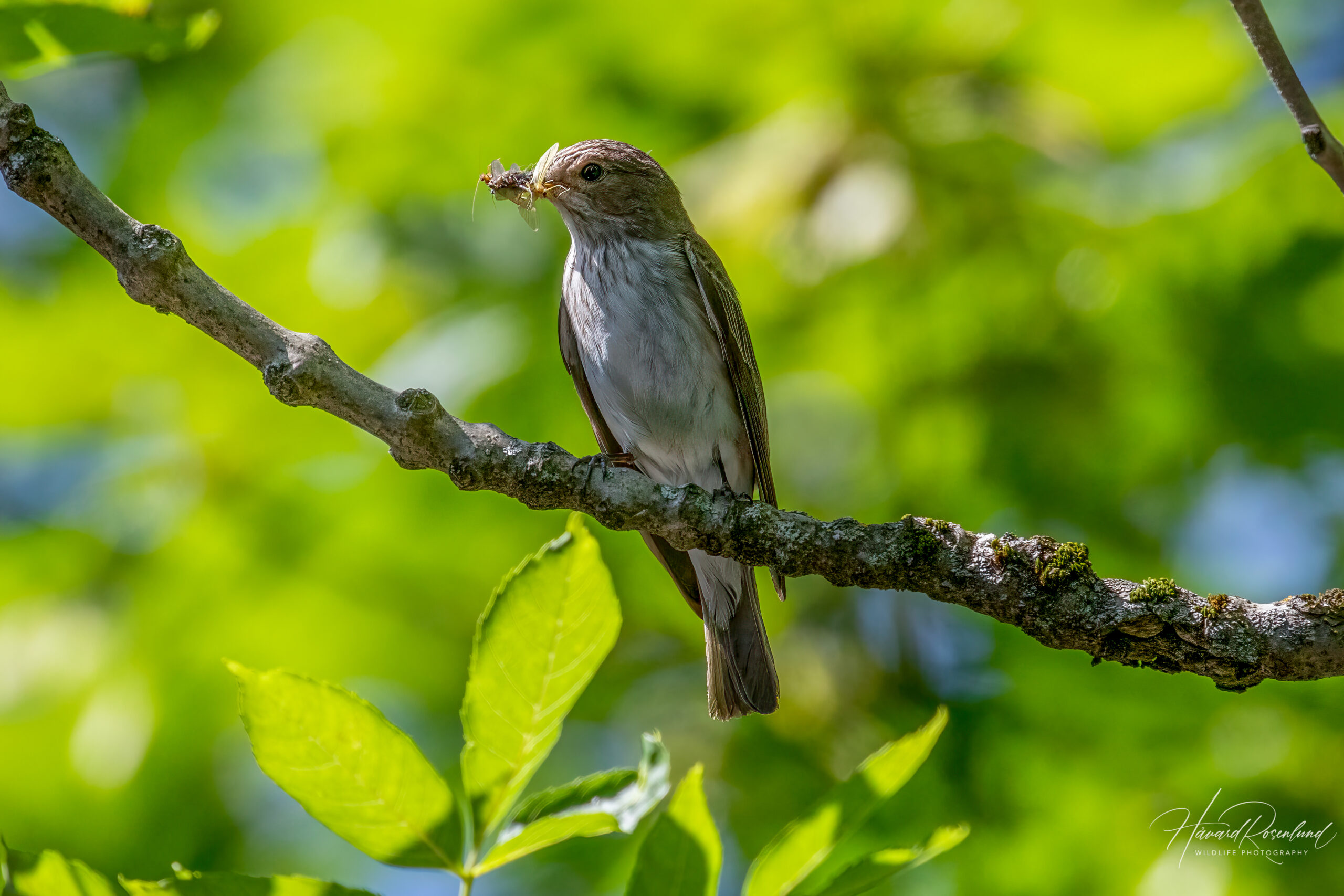
The spotted flycatcher (Muscicapa striata) is a small, understated flycatcher breeding across much of Europe and western Asia. Adults are about 13–14.5 cm long and weigh around 14.5 g. The upperparts are grey-brown and the underparts pale, with fine dark streaks on the crown and upper breast rather than the bold spots suggested by the English name. Males and females are very similar.
The broad-based bill, large eyes and relatively long wings are well suited to catching insects in flight. The bird usually sits upright on an exposed perch, often flicking its wings or tail between short hunting flights.
Habitat
Spotted flycatchers favour open woodland, woodland edges, orchards, parks and mature gardens where scattered trees provide exposed lookout perches beside open airspace. A mixture of mature trees, gaps and sheltered edges is generally more useful than dense closed-canopy forest.
Suitable breeding habitat also needs protected ledges, shallow cavities or branch structures for nesting. This combination allows adults to hunt efficiently while remaining close to the nest, and helps explain why old gardens, parkland and semi-open woodland can support the species even in relatively settled landscapes.
Diet
The species is strongly insectivorous. Flies, beetles, moths, butterflies, bees, wasps and other flying insects form much of the diet, while spiders and other small invertebrates are taken as well.
Prey choice changes with what is locally available. Larger insects can be especially valuable when they are easy to catch, but the birds switch flexibly among prey types rather than specialising on one group.
Behaviour
The characteristic hunting method is a sit-and-wait strategy. A bird watches from a branch, fence, wire or other exposed perch, launches in a short aerial sally and often returns to the same or a nearby lookout. Field experiments have shown that spotted flycatchers alter both how long they search and how far they pursue prey according to the abundance and energetic value of different insects.
The birds can also handle potentially difficult prey. Adults have been observed removing the sting apparatus from bees and wasps before swallowing them. Outside breeding they are usually solitary or loosely associated rather than strongly flocking.
Migration
Spotted flycatchers are long-distance migrants. Most European and western Asian breeders leave from late summer into early autumn and cross the Sahara to winter in sub-Saharan Africa, with some birds travelling as far south as Namibia. They return comparatively late in spring, often during May, when flying insects are becoming abundant.
A 2025 study found a growing number of verified winter records north of the Sahara from the mid-2010s onwards. More than 80% of the Western Palearctic records analysed came from the Iberian Peninsula and Balearic Islands. Warmer winter conditions were strongly associated with this increase. The pattern suggests that some birds are shortening their migration, and this strategy may become more common as winters warm.
Breeding
Nests are usually placed on a sheltered ledge or in a shallow cavity, for example against a tree trunk, in a fork, on a wall, building or other structure. The nest is an open cup made from plant material, moss and fibres and lined with finer material.
A typical clutch contains 4–5 eggs. The female incubates for about 13–14 days, and both parents feed the chicks after hatching. The young normally leave the nest after roughly 13–16 days but remain dependent on the adults for a short period. Two broods are typical where conditions allow.
Status
The spotted flycatcher is classified as least concern on the IUCN Red List, but the broad global category hides major regional differences.
Britain provides one of the clearest examples: long-term monitoring shows a 92% decline in the breeding population from 1967 to 2024. The decline probably has several causes acting at different stages of the annual cycle. Studies suggest that reduced survival of young birds is important, while breeding-habitat change and conditions on migration and African wintering grounds may also contribute.
Image gallery
Loading map and observations…
Have you seen this species?
Independent species archive
Did you find this species page useful?
Wildlife Vagabond is independently built and maintained. Voluntary support helps cover hosting, maps, data storage and continued improvements to the species archive.
Support Wildlife VagabondSpecies content will remain freely available.
References
Information about the species’ global distribution and status is based primarily on global Red List data. See the references below for details.
- BirdLife International. (n.d.). Spotted Flycatcher species factsheet. https://datazone.birdlife.org/species/factsheet/spotted-flycatcher-muscicapa-striata
- British Trust for Ornithology. (n.d.). Spotted Flycatcher. https://www.bto.org/learn/about-birds/birdfacts/spotted-flycatcher
- Davies, N. (1977). Prey selection and the search strategy of the spotted flycatcher (Muscicapa striata): A field study on optimal foraging. Animal Behaviour, 25, 1016-1033. https://doi.org/10.1016/0003-3472(77)90053-7
- International Union for Conservation of Nature. (n.d.). Spotted Flycatcher. The IUCN Red List of Threatened Species. https://www.iucnredlist.org/species/22709192/155605346
- López-Ramírez, S., García-Carrasco, J.-M., Real, R., & Muñoz, A.-R. (2025). Climate-driven shifts in trans-Saharan bird migration illustrated by the spotted flycatcher (Muscicapa striata). Scientific Reports, 15(1), 35201. https://doi.org/10.1038/s41598-025-19138-9