
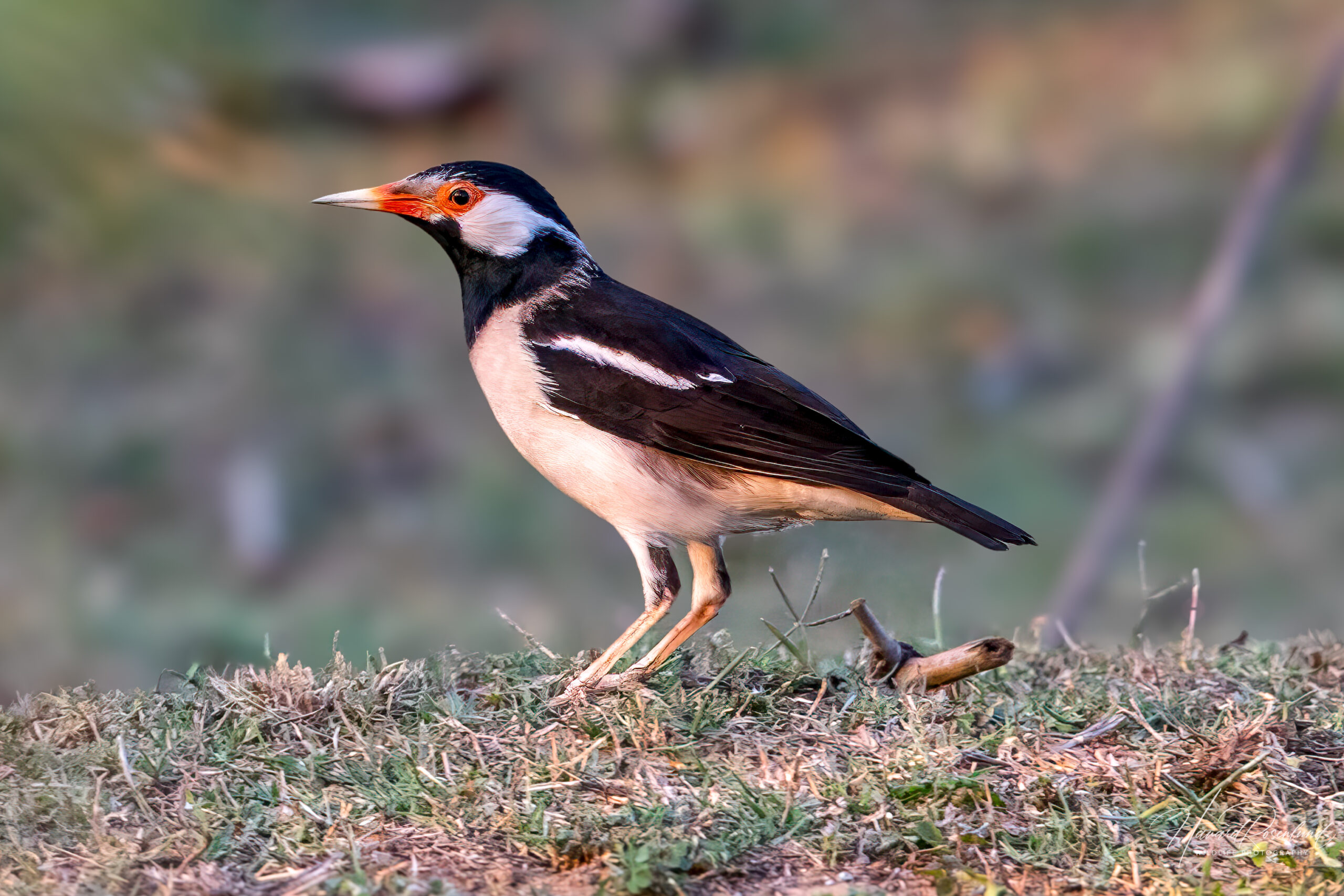
Indian Pied Myna
Gracupica contra
At a glance
Habitat
- Farmland, damp grassland, wetland margins, parks, gardens and settlements
Diet
- Insects and other invertebrates, fruit, nectar, seeds, grain and food scraps
Activity
- Diurnal
Size
- Length: about 22 cm Weight: 72–82 g
Range
- Indian subcontinent east through Myanmar to southwestern China
Description
The Indian pied myna (Gracupica contra) is a medium-sized starling of the Indian subcontinent and adjoining parts of mainland Southeast Asia. Adults are about 22 cm long and weigh roughly 72–82 g. The plumage is sharply black and white, with black upperparts, throat and breast, white cheeks, belly, rump and wing patches, orange-red bare skin around the eye, and a yellowish bill with an orange-red base. The sexes are alike, while juveniles are browner and duller.
In the eastern part of the range it can be confused with the closely related Siamese pied myna (Gracupica floweri), which shows more extensive white streaking on the forehead and a broader area of bare reddish facial skin.
Taxonomy
The pied-myna group was long treated as a single widespread species, but genetic and morphological work revealed three deeply separated lineages. Genome-wide research supported recognition of the Indian pied myna (Gracupica contra), Siamese pied myna (G. floweri) and Javan pied myna (G. jalla) as separate species, a treatment followed by AviList.
Some regional variation remains within G. contra. The eastern form superciliaris, found mainly in Myanmar and adjacent southwestern China, has more conspicuous white forehead streaking and more extensive bare facial skin than birds across most of the Indian subcontinent.
Habitat
Indian pied mynas favour open lowland landscapes with moist ground and scattered trees, including farmland, grazing areas, wetland margins, reservoirs, parks, gardens and settlements. They are particularly common around well-watered cultivated land and readily use highly modified habitats, including refuse sites.
The combination of open feeding ground, nearby trees and reliable water makes farmland and areas around towns and cities especially suitable, and the species often remains common in densely settled landscapes.
Diet
The species is an opportunistic omnivore. It eats insects and other invertebrates, fruit, nectar, seeds and grain, as well as food scraps around people. Much feeding takes place on the ground, where birds often follow grazing livestock or search recently disturbed soil for exposed prey.
Fruit and nectar are also taken in trees and shrubs. This broad diet and willingness to exploit both natural and human-provided food are important parts of the species' success in agricultural and urbanising landscapes.
Behaviour
Indian pied mynas are social and conspicuous. Pairs and small groups are common through much of the year, while larger loose flocks can gather outside the breeding season or wherever food is abundant.
The species is also highly vocal. Its repertoire includes whistles, trills, clicks, buzzes and warbling phrases. Captive birds can learn to imitate other sounds, including other birds and human voices.
Breeding
Breeding timing varies with region and rainfall. Studies in Bangladesh recorded activity from late February to early September, while work in Jammu, India, found nesting from April to August. As breeding begins, larger flocks tend to break up into pairs. Courtship includes calling, feather-ruffling and repeated head movements before pairs settle into breeding territories.
The nest is a bulky, untidy domed structure with a side entrance, usually built high in a tree but also placed on poles and other human-made structures. Plant stems and grasses form much of the structure, with feathers and artificial materials sometimes incorporated. Both sexes help build the nest, incubate and feed the young.
A two-season study conducted in 2015–2016 in Bangladesh found clutches of 2–6 glossy blue eggs, averaging 3.8. Incubation averaged about 17 days, and the nestling period about 23 days. The wide range in breeding dates and nest-site choice reflects the species' flexibility in both natural and human-modified landscapes.
Status
The Indian pied myna is classified as least concern on the IUCN Red List. It has a broad distribution and remains common in many agricultural, wetland and human-modified landscapes.
State of India's Birds lists the species as a low conservation priority. Its 2025 update estimates an Indian range of about 1.67 million km², while the available data remain insufficient to determine either a national long-term trend or a recent annual trend.
Image gallery
Loading map and observations…
Have you seen this species?
Independent species archive
Did you find this species page useful?
Wildlife Vagabond is independently built and maintained. Voluntary support helps cover hosting, maps, data storage and continued improvements to the species archive.
Support Wildlife VagabondSpecies content will remain freely available.
References
Information about the species’ global distribution and status is based primarily on global Red List data. See the references below for details.
- Baveja, P., Garg, K. M., Chattopadhyay, B., Sadanandan, K. R., Prawiradilaga, D. M., Yuda, P., Lee, J. G. H., & Rheindt, F. E. (2021). Using historical genome‐wide DNA to unravel the confused taxonomy in a songbird lineage that is extinct in the wild. Evolutionary Applications, 14(3), 698-709. https://doi.org/10.1111/eva.13149
- BirdLife International. (n.d.). Indian Pied Starling species factsheet. https://datazone.birdlife.org/species/factsheet/indian-pied-starling-gracupica-contra
- Christidis, L., Rheindt, F. E., Iliff, M. J., Lepage, D., Rasmussen, P. C., Donald, P., Alström, P., Areta, J. I., Brammer, F., Chesser, T., Donsker, D., Dowsett, B., Gerbracht, J., Kirsch, M., Kuziemko, M., Lagerqvist, M., Littauer, R., Longmore, W., Norman, J., … Stervander, M. (2026). AviList v2025b. AviList. https://doi.org/10.2173/avilist.v2025b
- eBird. (n.d.). Indian Pied Starling. Cornell Lab of Ornithology. https://ebird.org/species/aspsta2
- International Union for Conservation of Nature. (n.d.). Indian Pied Starling. The IUCN Red List of Threatened Species. https://www.iucnredlist.org/species/216912703/219362605
- Kumari, M., Sahi, D. N., & Langer, S. (2018). Nest characteristics and nesting success of the Indian Pied Myna (Gracupica contra) in Jammu region (J&K). International Journal of Advanced Research, 6(2), 903–909. https://doi.org/10.21474/IJAR01/6509
- Limparungpatthanakij, W. (2022). Indian Pied Starling (Gracupica contra). In Birds of the World. Cornell Lab of Ornithology. https://doi.org/10.2173/bow.aspsta2.02.1
- Shakshi, Choudhary, R., Sharma, V., Dutta, S., & Chandra, S. (2023). Nesting Resource Partitioning of Four Species (Acridotheres tristis, Acridotheres ginginianus, Sturnia pagodarum and Gracupica contra) of Sturnidae Family in Peri-Urban Region of Ajmer City, Rajasthan, India. Asian Journal of Research in Zoology, 6(4), 100-106. https://doi.org/10.9734/ajriz/2023/v6i4127
- Shoma, S. F. (2022). Breeding ecology of the Asian pied starling (Gracupica contra) at Jahangirnagar University campus, Bangladesh. Jahangirnagar University Journal of Biological Sciences, 10(1-2), 49-57. https://doi.org/10.3329/jujbs.v10i1-2.60848
- State of India's Birds. (2025). 2025 – Asian Pied Starling. https://stateofindiasbirds.in/species/aspsta2/
- Tobias, J. A., Sheard, C., Pigot, A. L., Devenish, A. J. M., Yang, J., Sayol, F., Neate‐Clegg, M. H. C., Alioravainen, N., Weeks, T. L., Barber, R. A., Walkden, P. A., MacGregor, H. E. A., Jones, S. E. I., Vincent, C., Phillips, A. G., Marples, N. M., Montaño‐Centellas, F. A., Leandro‐Silva, V., Claramunt, S., … Schleuning, M. (2022). AVONET: morphological, ecological and geographical data for all birds. Ecology Letters, 25(3), 581-597. https://doi.org/10.1111/ele.13898