
Saddle-billed Stork
Ephippiorhynchus senegalensis
At a glance
Habitat
- Rivers, floodplains, marshes, pans and other shallow wetlands
Diet
- Mainly fish; also amphibians, small reptiles, small mammals, molluscs and aquatic invertebrates
Activity
- Diurnal; hunts mainly in shallow water
Size
- Length: Up to about 150 cm tall Weight: About 7 kg
Range
- Patchy distribution across sub-Saharan Africa
Description
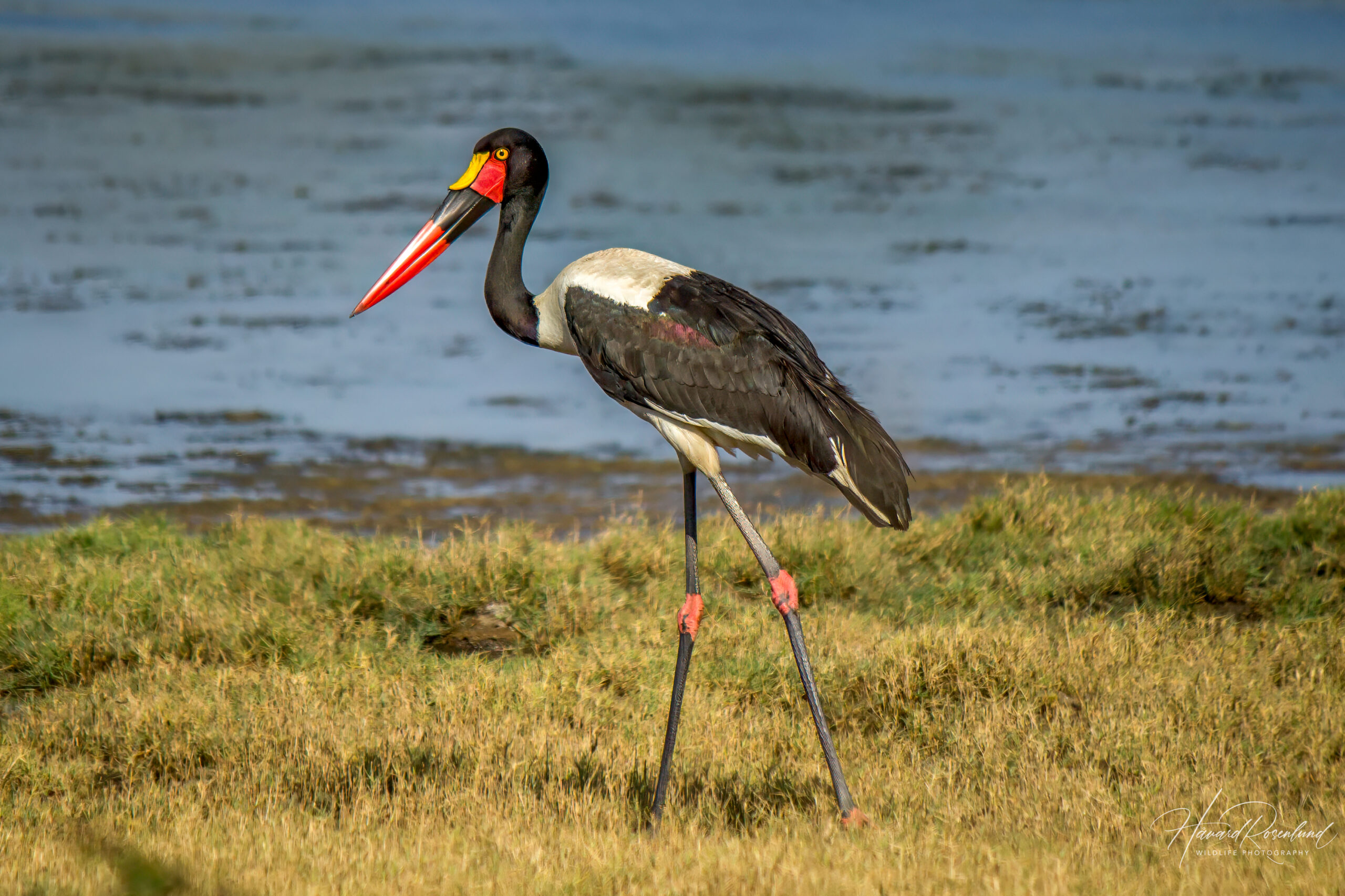
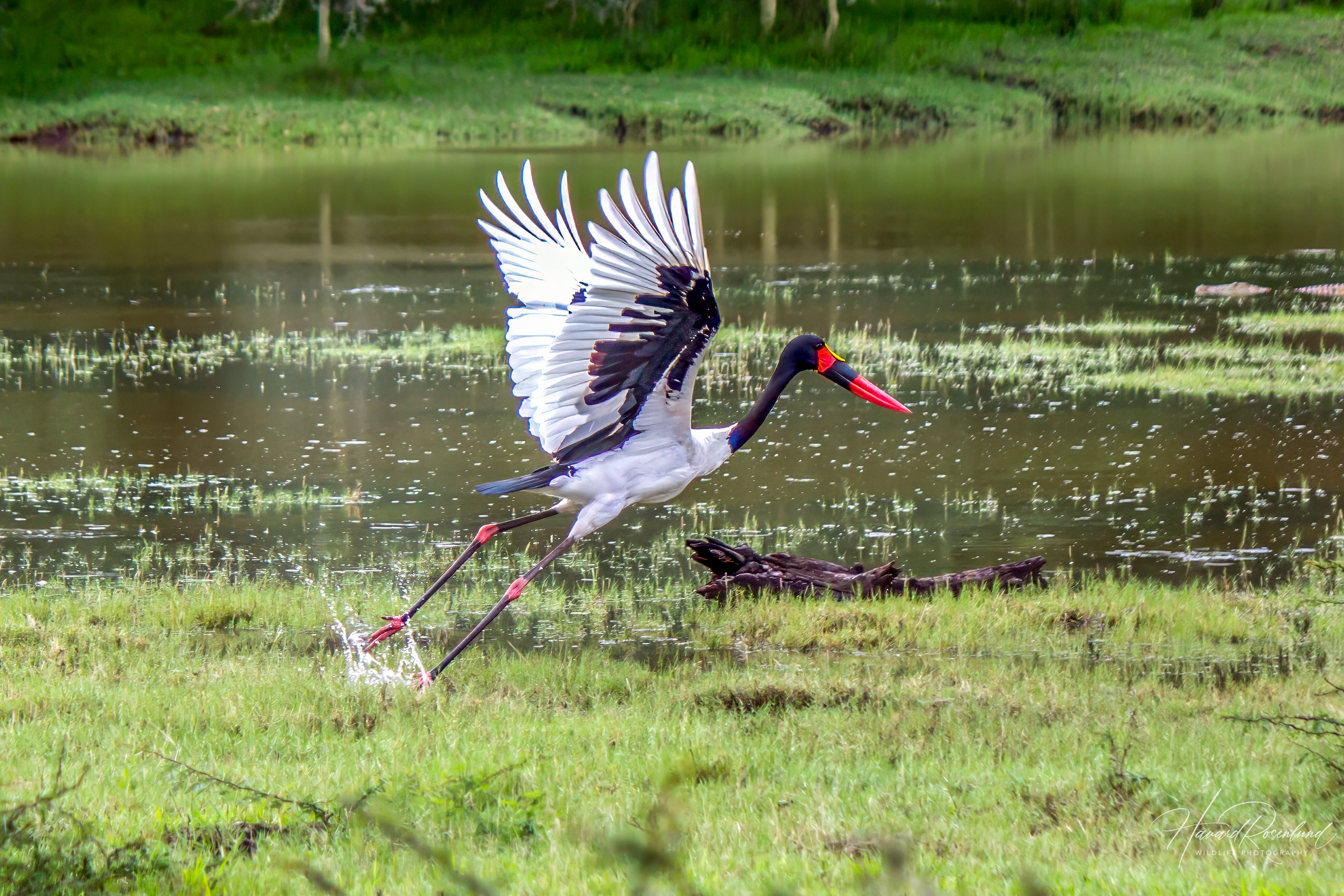
The saddle-billed stork (Ephippiorhynchus senegalensis) is one of Africa's tallest storks, reaching about 150 cm in height, with a wingspan of roughly 2.4–2.7 m and a mass of around 7 kg. The crisp black-and-white plumage is striking, but the enormous bill is even more distinctive: bright red with a broad black band and a yellow shield or “saddle” at the base.
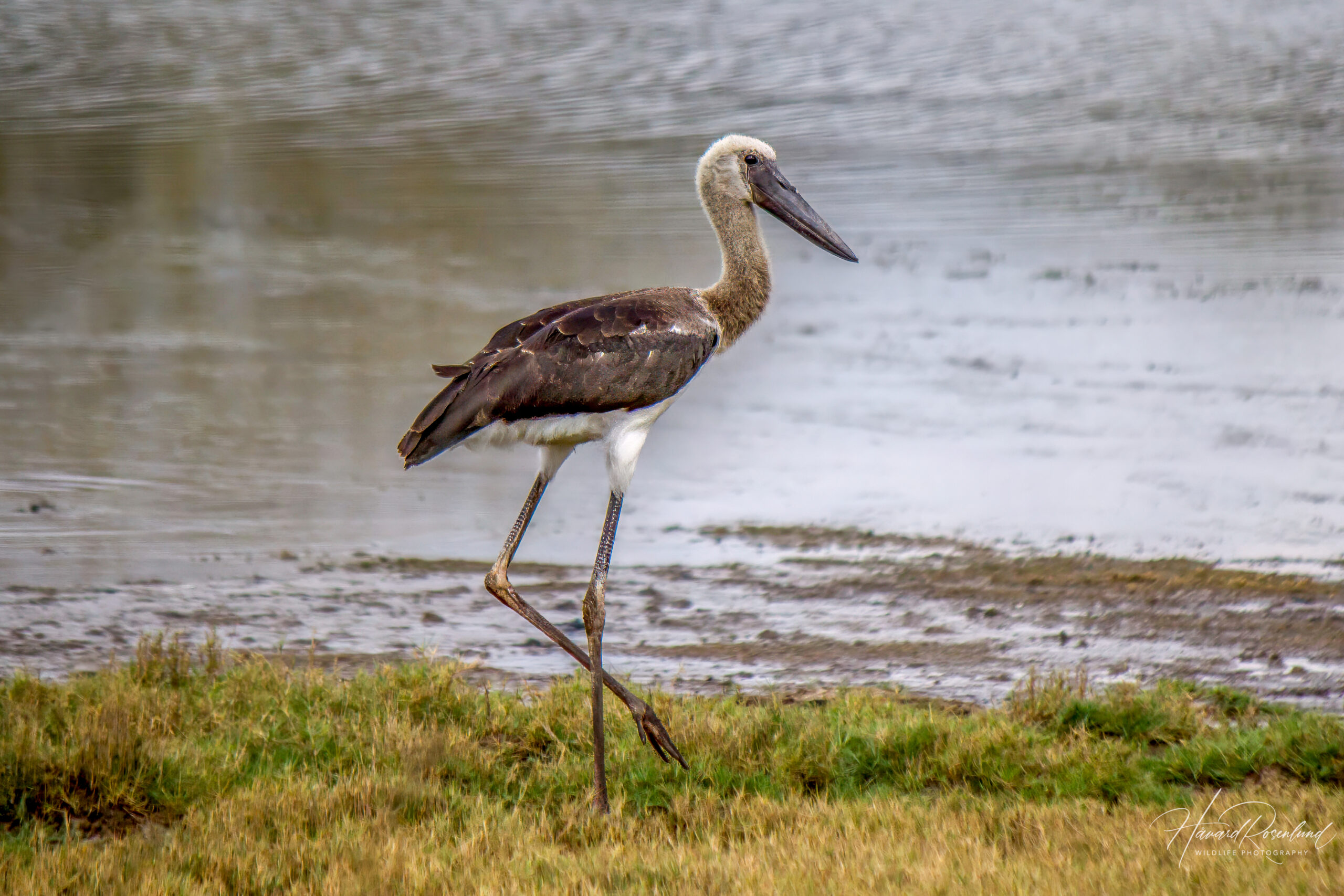
Adults can be sexed by iris colour. Males are generally larger and have dark brown irises, while females have conspicuous yellow irises. Small yellow to orange-red wattles at the base of the bill may occur in either sex and are therefore not a reliable sex character. Juveniles are much duller, with grey and brown replacing the adults' sharp black and white.
Habitat
Saddle-billed storks depend on large wetlands and adjoining shallow-water habitats, including rivers, floodplains, marshes, pans, lake margins and seasonally flooded grassland. They are especially associated with extensive, relatively undisturbed river and floodplain systems.
Large trees are also important because pairs nest and roost above the ground, sometimes some distance from the wetlands where they feed. The combination of secure nesting trees and productive shallow water helps explain the species' patchy distribution across sub-Saharan Africa.
Diet
Fish form the core of the diet, but frogs, small reptiles, small mammals and occasionally birds are also taken, together with molluscs, crustaceans and other aquatic invertebrates. The balance changes with water level and local prey availability.
Hunting
Much feeding consists of walking slowly through shallow water or flooded vegetation, pausing to watch before making a rapid downward strike with the bill. The long legs allow saddle-billed storks to forage in deeper water than many smaller wading birds.
Large prey can be subdued with the powerful bill, while smaller aquatic animals are swallowed quickly. The birds may range widely around river systems and move between feeding sites as water levels and prey availability change, taking advantage of seasonal concentrations of prey as the extent of shallow water expands and contracts.
Behaviour
Adults are usually encountered alone or with their long-term mate and are generally resident where suitable wetlands remain available throughout the year. Immature birds disperse more widely than established adults and may appear far from regular breeding territories.
Breeding
Saddle-billed storks form strong long-term pair bonds and nest as isolated pairs rather than in dense colonies. Pairs build a massive stick platform in a tall tree, and the same nest can be reused and enlarged over successive breeding attempts.
Breeding timing varies geographically and is closely linked to local water conditions. Clutches usually contain two to four eggs, and both parents share incubation and chick care. Incubation lasts roughly 30–35 days, and the young normally fledge after about 70–100 days. Pairs may remain together in the same territory across several breeding seasons.
Status
The saddle-billed stork is classified as least concern globally on the IUCN Red List, but the global population is relatively small and considered to be decreasing. The current global estimate is about 670–17,000 mature individuals.
The picture is much more serious at the southern edge of the range. The 2025 Red Data Book for South Africa, Lesotho and Eswatini classifies the species as Endangered and estimates only about 160 mature individuals in the region. The estimate is uncertain and partly based on older data, but it still points to a very small regional population.
Degradation of rivers and wetlands through water extraction, impoundment, pollution and severe drought are among the main regional threats. A 2022 study across the species' range found that its distribution is fragmented and strongly associated with protected areas. Intact river and floodplain systems are therefore especially important for its long-term survival.
Image gallery
Loading map and observations…
National Red List status
| Country | Status | Assessment | Source |
|---|---|---|---|
| South Africa | ENEndangered | Regional Red Data Book of Birds of South Africa, Lesotho and Eswatini 2025 | BirdLife South Africa – Regional Red Data Book 2025 |
Have you seen this species?
Independent species archive
Did you find this species page useful?
Wildlife Vagabond is independently built and maintained. Voluntary support helps cover hosting, maps, data storage and continued improvements to the species archive.
Support Wildlife VagabondSpecies content will remain freely available.
References
Information about the species’ global distribution and status is based primarily on global Red List data. See the references below for details.
- Biodiversity Explorer. (n.d.). Saddle-billed Stork. Iziko Museums of South Africa. https://www.biodiversityexplorer.info/birds/ciconiidae/ephippiorhynchus_senegalensis.htm
- BirdLife International. (n.d.). Saddle-billed Stork species factsheet. https://datazone.birdlife.org/species/factsheet/saddle-billed-stork-ephippiorhynchus-senegalensis
- BirdLife South Africa. (2025). Saddle-billed Stork regional Red List assessment. https://www.birdlife.org.za/red-list/saddle-billed-stork/
- Gula, J., Clay Green, M., Fritts, S., Dean, W. R. J., & Gopi Sundar, K. (2022). Assessments of range-wide distribution of six African storks and their relationships with protected areas. Ostrich, 93(1), 34-52. https://doi.org/10.2989/00306525.2022.2045642
- International Union for Conservation of Nature. (n.d.). Saddle-billed Stork. The IUCN Red List of Threatened Species. https://www.iucnredlist.org/species/22697706/93631820
- The Maryland Zoo. (n.d.). Maryland Zoo – Saddle-billed Stork natural history. https://www.marylandzoo.org/animal/saddle-billed-stork/
- Weibel, C. J., Abreu, R., Becker, K. K., Solomon, M., & Ferrie, G. M. (2021). Assessing saddle‐billed stork (Ephippiorhynchus senegalensis) pair‐bonds and breeding behavior using behavior observed during multiple breeding seasons. Zoo Biology, 40(4), 352-359. https://doi.org/10.1002/zoo.21609