
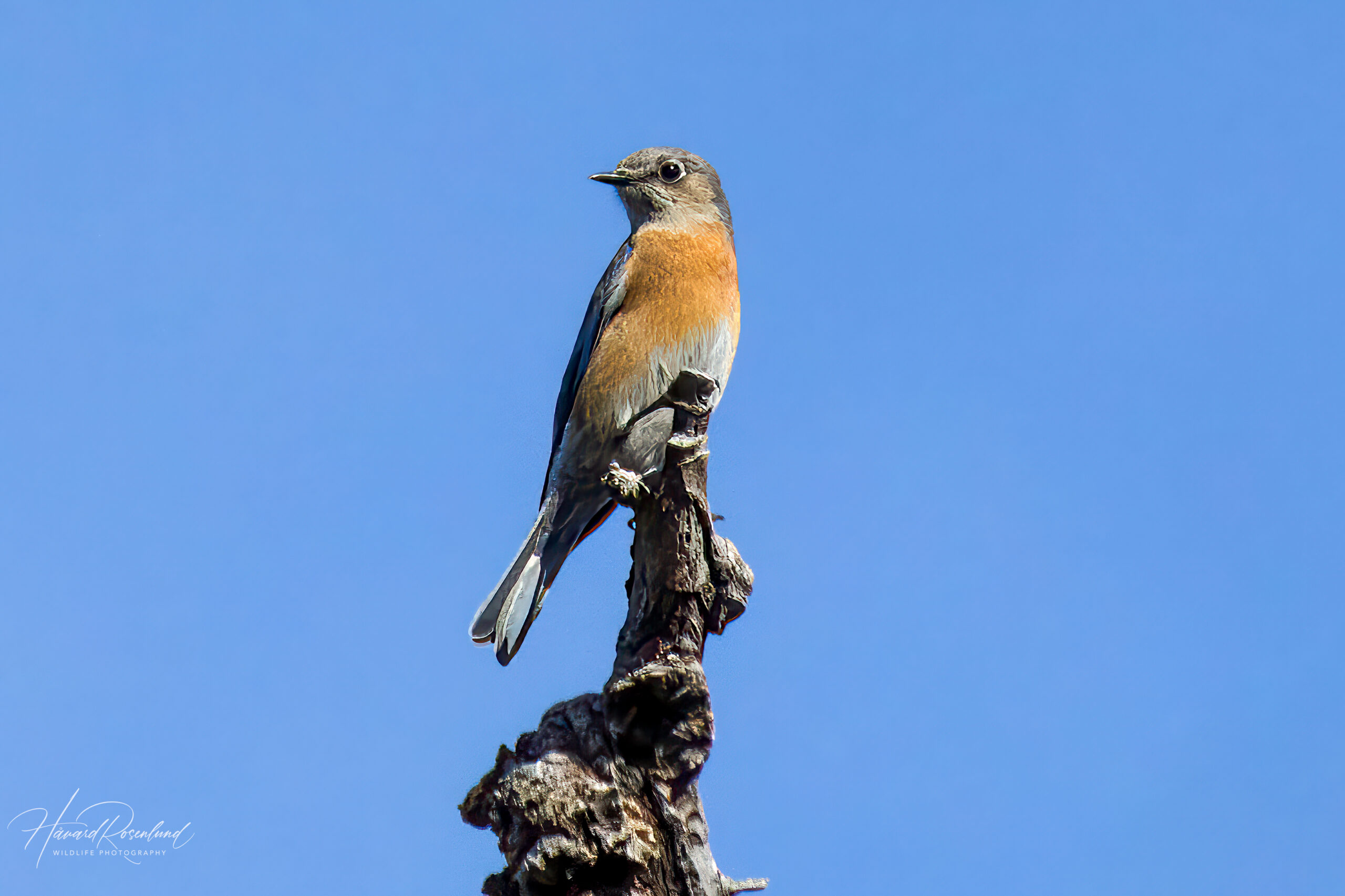
Western Bluebird
Sialia mexicana
At a glance
Habitat
- Open pine and oak woodland, forest edges, burned woodland, ranchland and orchards
Diet
- Mostly insects and other arthropods in warmer months; berries and fruit become important in winter
Activity
- Diurnal
Size
- Length: 16–19 cm Weight: 24–31 g
Range
- Southwestern Canada through the western United States to Mexico
Description
The western bluebird (Sialia mexicana) is a small thrush of open woodlands in western North America. Adults are about 16–19 cm long and weigh roughly 24–31 g. Males have deep blue upperparts and throat, with a warm chestnut-orange breast and flanks. Females are greyer and browner, but retain blue in the wings and tail and usually show a muted orange wash across the breast.
The species often sits upright on low branches, fence posts or signs. Its combination of rounded body, short bill, blue wings and tail and rusty breast makes it distinctive within much of its range. Where it overlaps with the Eastern Bluebird (Sialia sialis), males are readily separated by the blue throat; male Eastern Bluebirds have rusty-orange extending onto the throat and a cleaner white belly.
Habitat
Western bluebirds favour open pine and oak woodland, woodland edges, partly burned forest, ranchland and orchards where scattered trees or nest boxes provide cavities and open ground offers good hunting. They occur from lowlands into mountain country and often benefit from landscapes that combine perches, short vegetation and old trees. In parts of the southwestern mountains they breed above 2,500 m.
Open structure is particularly important. Dense closed forest provides fewer hunting opportunities, while the loss of old or dead cavity-bearing trees can sharply reduce nesting sites even where feeding habitat remains suitable.
Diet
Insects and other arthropods dominate the diet during the warmer months. Beetles, grasshoppers, caterpillars and many other small prey are taken, while berries and other fruit become increasingly important in autumn and winter, including mistletoe and juniper.
Western bluebirds typically watch from a low perch and drop to the ground to seize prey, but they also make short aerial sallies after flying insects. In winter they shift much more strongly toward fruiting trees and shrubs. Good winter fruit crops can influence whether young birds remain with their family group or disperse earlier.
Social behaviour
Western bluebird family groups can remain together long after the breeding season. Long-term work in coastal California showed that sons commonly stayed with their parents through winter, while daughters were more likely to disperse. Parents and offspring were not simply sharing space: family members showed greater tolerance toward relatives than toward unrelated birds within winter groups.
Young birds are more likely to disperse when winter food becomes scarce, while rich territories make delayed dispersal more worthwhile. Staying with parents preserves family connections and can later create clusters of related birds in which occasional helping becomes possible.
Winter groups still contain competition. Both males and females defend winter territories and can be aggressive toward unrelated birds of the same sex, so group living combines kin tolerance with clear competition over food, space and future breeding opportunities.
Migration
The species is partially migratory. Some populations remain close to the breeding area throughout the year, while others make short- to medium-distance movements after breeding. In mountainous regions much of this movement is altitudinal, with birds shifting downslope toward milder valleys and more reliable winter food.
Migration strategy varies geographically and among individuals, so winter populations can include both local residents and birds arriving from higher elevations or more northerly breeding areas.
Breeding
Western bluebirds cannot excavate their own nest holes and depend on existing cavities in living or dead trees, old woodpecker holes and artificial nest boxes. A pair inspects potential sites together, but the female performs almost all nest construction, using grasses, pine needles, plant fibres, moss and fur.
Clutches contain 2–8 eggs, with 4–6 common. The eggs are usually pale blue and unmarked, but are occasionally white. The female performs most incubation for about 12–17 days, while both parents feed the young. Nestlings remain in the cavity for roughly 18–25 days. One to three broods may be attempted in a year where conditions allow.
Some nests receive help from additional relatives, often sons, brothers or other male kin that feed chicks alongside the breeding pair. This is a form of cooperative breeding, but it is not the normal system at every nest. It occurs where delayed dispersal and persistent family relationships bring relatives together around a breeding pair.
Status
The western bluebird is classified as least concern on the IUCN Red List. It remains widespread across western North America and Mexico and is locally common where open woodland and suitable nest cavities persist.
Local populations can nevertheless be limited by loss of open woodland, removal of dead or cavity-bearing trees and competition for nest holes. Introduced European Starlings (Sturnus vulgaris) and House Sparrows (Passer domesticus) are among the species that can take over cavities otherwise available to bluebirds.
Conservation
Western bluebirds depend strongly on nest cavities, so retaining dead and old cavity-bearing trees is important in managed woodland and farmland. Nest boxes can compensate where natural cavities are scarce and have supported substantial local recoveries in suitable habitat.
In California vineyards, providing nest boxes greatly increased western bluebird abundance, and the birds removed more insect prey. This shows how conserving native cavity-nesting insectivores can support both biodiversity and pest control in farmland.
Image gallery
Loading map and observations…
Have you seen this species?
Independent species archive
Did you find this species page useful?
Wildlife Vagabond is independently built and maintained. Voluntary support helps cover hosting, maps, data storage and continued improvements to the species archive.
Support Wildlife VagabondSpecies content will remain freely available.
References
Information about the species’ global distribution and status is based primarily on global Red List data. See the references below for details.
- BirdLife International. (n.d.). Western Bluebird species factsheet. https://datazone.birdlife.org/species/factsheet/western-bluebird-sialia-mexicana
- Charmantier, A., Keyser, A. J., & Promislow, D. E. L. (2007). First evidence for heritable variation in cooperative breeding behaviour. Proceedings of the Royal Society B: Biological Sciences, 274(1619), 1757–1761. https://doi.org/10.1098/rspb.2007.0012
- Cornell Lab of Ornithology. (n.d.). Western Bluebird life history. https://www.allaboutbirds.org/guide/Western_Bluebird/lifehistory
- Cornell Lab of Ornithology. (n.d.). Western Bluebird overview and identification. https://www.allaboutbirds.org/guide/Western_Bluebird/overview
- Dickinson, J. L., & McGowan, A. (2005). Winter resource wealth drives delayed dispersal and family-group living in western bluebirds. Proceedings of the Royal Society B: Biological Sciences, 272(1579), 2423-2428. https://doi.org/10.1098/rspb.2005.3269
- International Union for Conservation of Nature. (n.d.). Western Bluebird. The IUCN Red List of Threatened Species. https://www.iucnredlist.org/species/22708553/137565063
- Jedlicka, J. A., Greenberg, R., & Letourneau, D. K. (2011). Avian conservation practices strengthen ecosystem services in California vineyards. PloS one, 6(11), e27347. https://doi.org/10.1371/journal.pone.0027347