
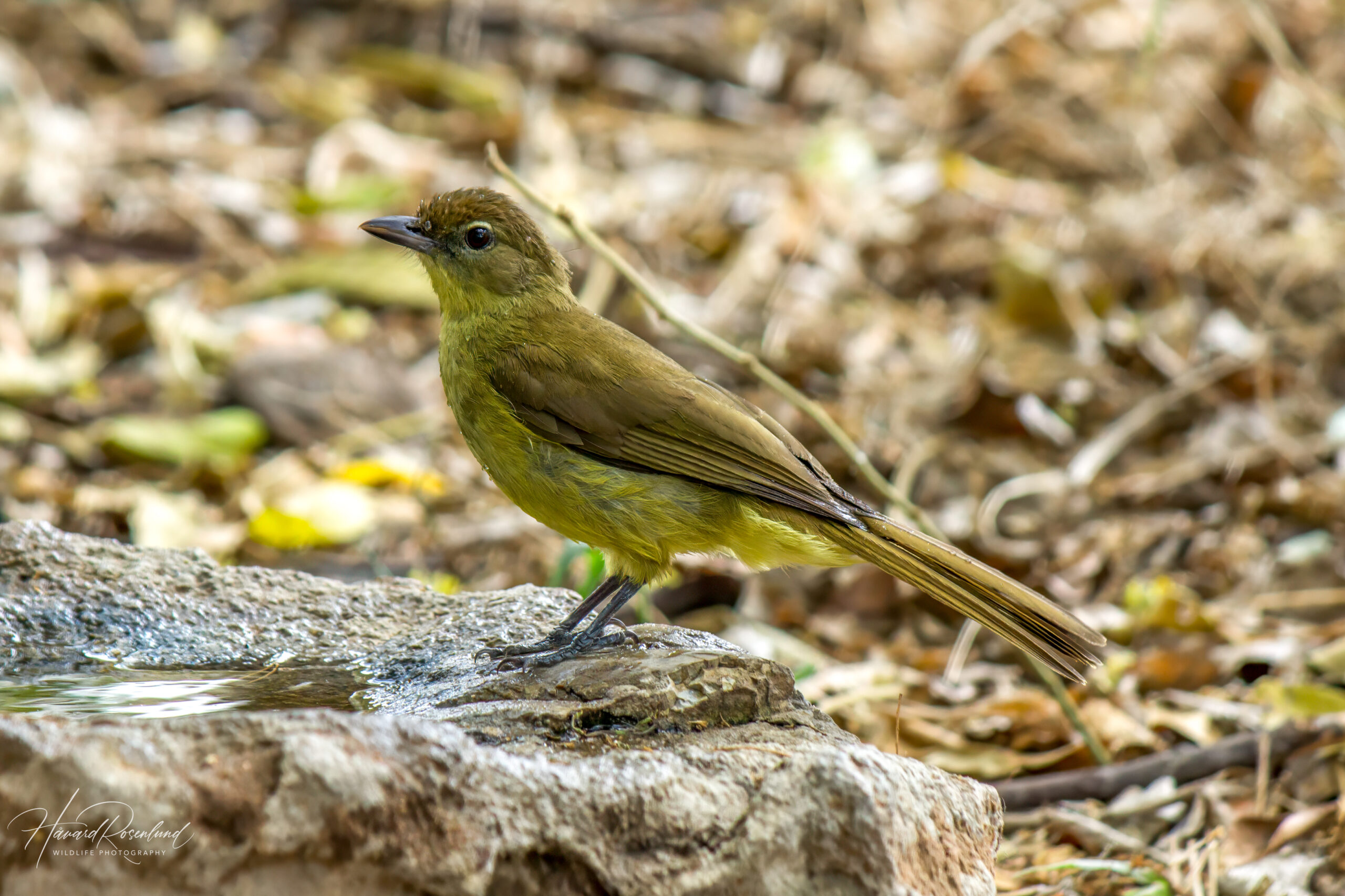
Yellow-bellied Greenbul
Chlorocichla flaviventris
At a glance
Habitat
- Thickets, riverine and coastal forest, woodland, mangroves, scrub, forest edges, gardens and parks
Diet
- Mainly fruit and other plant foods; also insects, spiders and other invertebrates
Activity
- Diurnal; forages mainly in the lower and middle vegetation layers
Size
- Length: 20–23 cm Weight: About 37–43 g
Range
- Eastern and southern Africa from Kenya and southeastern DR Congo south to Angola, Namibia and South Africa
Description
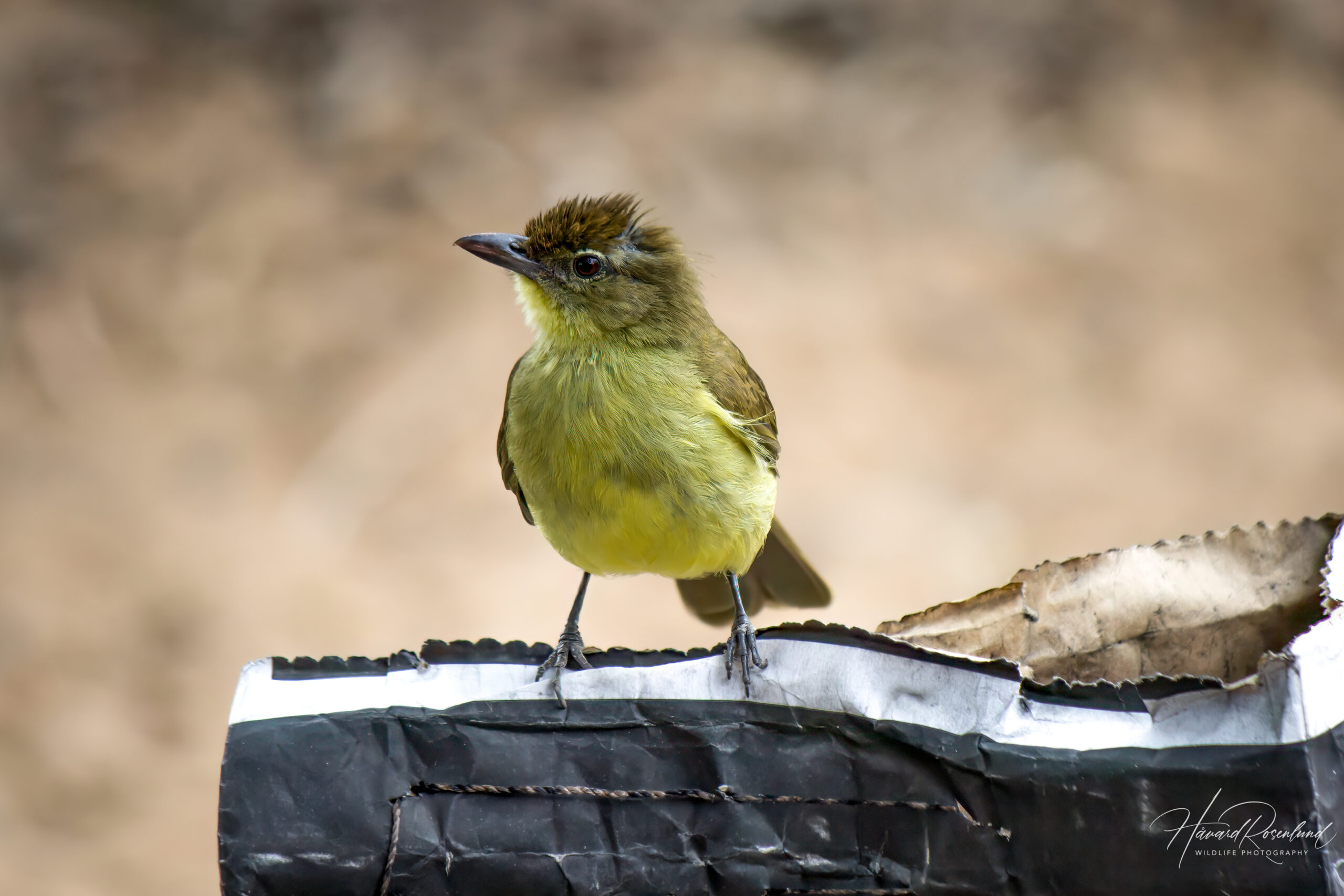
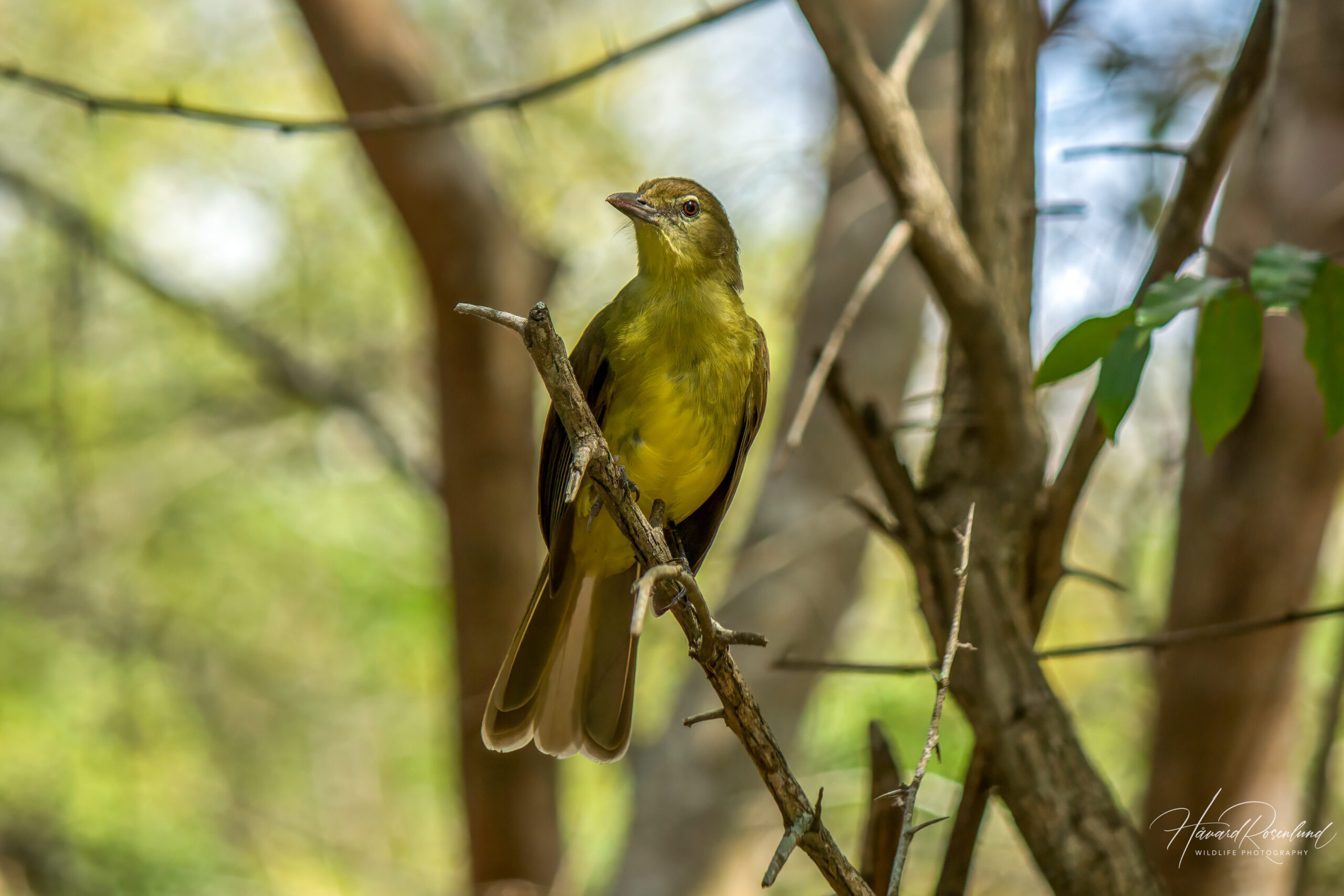
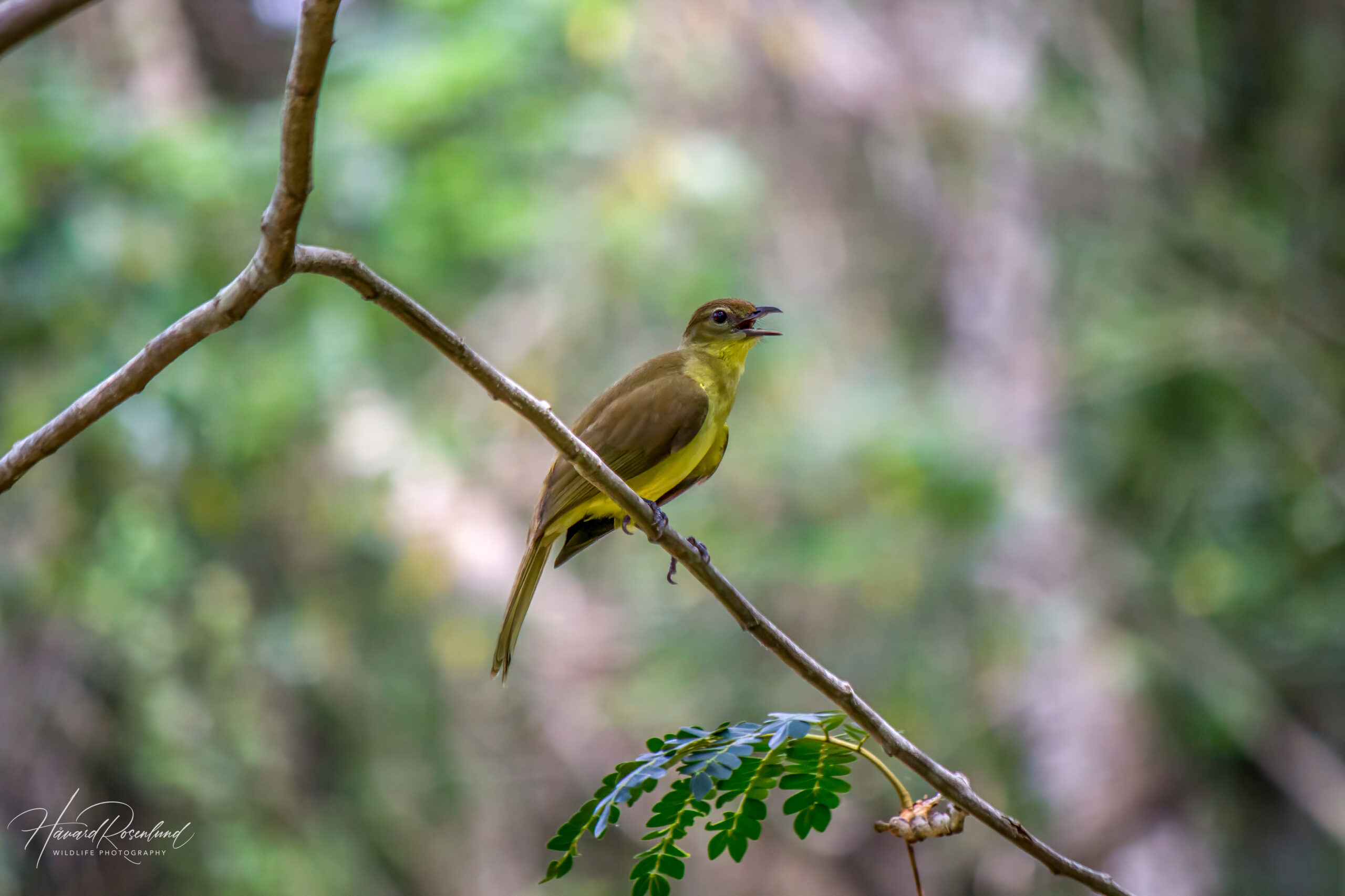
The yellow-bellied greenbul (Chlorocichla flaviventris) is a robust African bulbul of dense woodland and thickets. Adults are about 20–23 cm long. Males average roughly 43 g and females about 37 g. The upperparts are olive-green, contrasting with a bright yellow throat and underparts, while a pale eyebrow and deep reddish eye are useful field marks.
In flight, the bright yellow underwings can be conspicuous. In southern Africa the species can be confused with the sombre greenbul (Andropadus importunus), which lacks the bright yellow underparts and has striking whitish eyes rather than reddish eyes.
Habitat
Yellow-bellied greenbuls favour dense vegetation, including riverine and coastal forest, thickets, woodland, mangroves, semi-arid scrub and well-vegetated gardens. They usually remain in the lower and middle vegetation layers and can persist in modified landscapes where a dense shrub layer and fruiting vegetation remain.
Diet
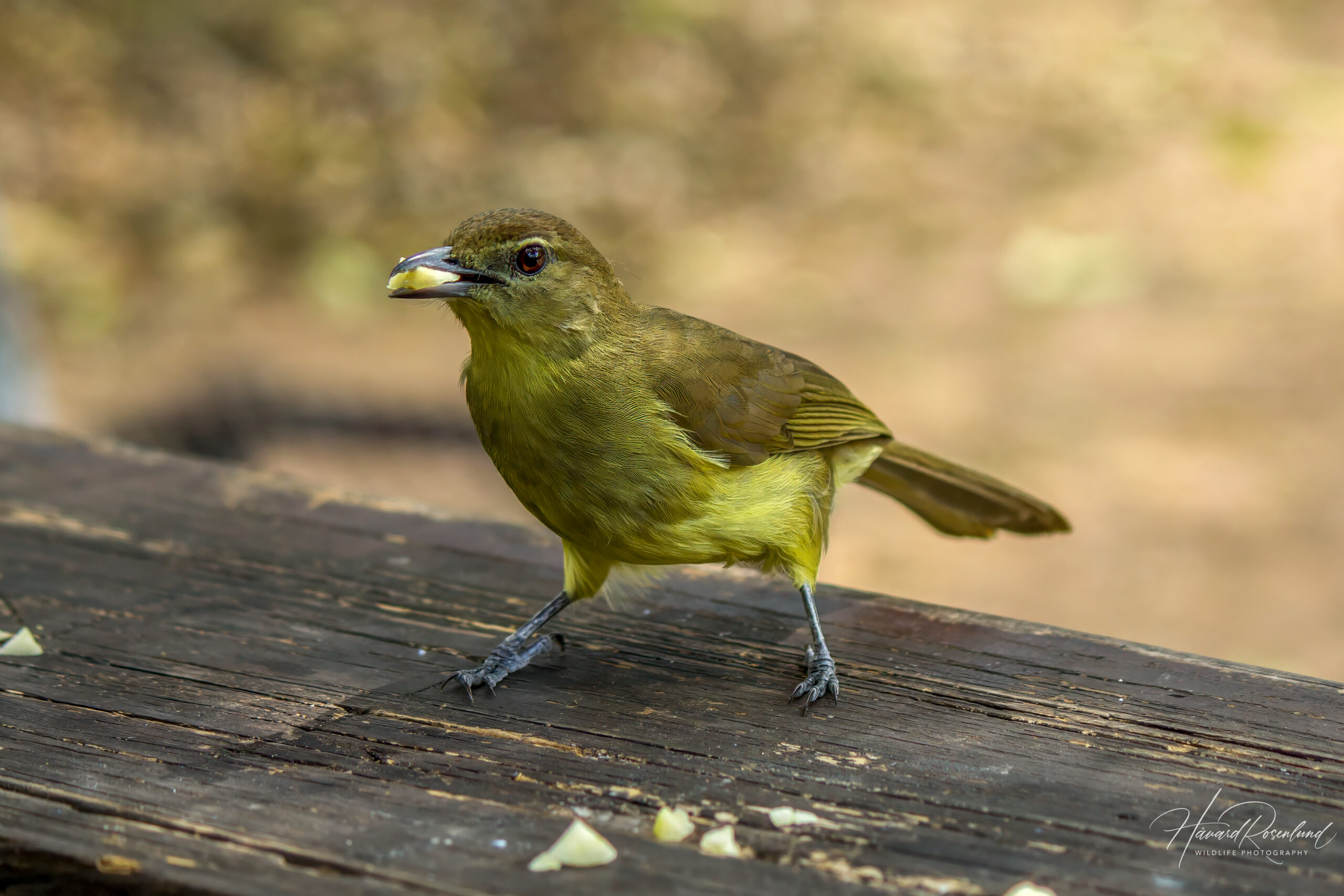
Fruit forms an important part of the diet, together with seeds, flowers and a wide range of invertebrates such as insects and spiders. The balance between plant and animal food changes with local and seasonal availability.
Foraging
Most food is gleaned from leaves, branches and fruiting shrubs as the birds move through the lower and middle vegetation layers, often alongside other bulbuls. They may also make short sallies after moving insects.
An unusual part of the feeding repertoire is association with large mammals. Yellow-bellied greenbuls have repeatedly been recorded perching directly on antelopes and other mammals and taking ticks or other ectoparasites from their bodies. A 2017 review showed that the behaviour occurs with several mammal species. It appears opportunistic rather than essential to the diet, but provides an unusual additional food source for an otherwise generalist fruit- and insect-eater.
Behaviour
The species is diurnal and is usually encountered in pairs or small groups. It often moves quietly inside dense cover and can be difficult to see even where common.
Its loud, nasal and repetitive calls carry well through thickets and are often the easiest way to locate a bird. In the field, the voice has a shrill, repetitive, almost laughing quality that is highly distinctive once familiar. Calling individuals may remain partly hidden at close range, making the species much more conspicuous by sound than by sight.
Breeding
The nest is a delicate, thin-walled cup of dry grass, tendrils, twigs and other plant fibres, usually attached with spider web to foliage in a shrub, sapling or creeper. Some nests are so lightly constructed that the eggs can be visible from below.
One to three eggs are laid, most often two. The female incubates for about 14 days, while both parents feed and care for the chicks after hatching. The young usually leave the nest after roughly 16–18 days. In southern Africa most egg-laying occurs from spring into summer, although timing varies across the wider range.
Status
The yellow-bellied greenbul is globally classified as Least Concern. The current IUCN assessment was published in 2018, and the species has a broad distribution across eastern and southern Africa. The overall population trend is considered stable.
It remains common in many suitable habitats and can use gardens and other human-modified areas where dense vegetation persists. Forest and thicket clearance can reduce local populations, but no threat across the full range is currently severe enough to place the species near a globally threatened category.
Image gallery
Loading map and observations…
Have you seen this species?
Independent species archive
Did you find this species page useful?
Wildlife Vagabond is independently built and maintained. Voluntary support helps cover hosting, maps, data storage and continued improvements to the species archive.
Support Wildlife VagabondSpecies content will remain freely available.
References
Information about the species’ global distribution and status is based primarily on global Red List data. See the references below for details.
- AviList. (2026). The Global Avian Checklist, v2025b. https://www.avilist.org/checklist/v2025b/
- Biodiversity Explorer. (n.d.). Yellow-bellied Greenbul. Iziko Museums of South Africa. https://www.biodiversityexplorer.info/birds/pycnonotidae/chlorocichla_flaviventris.htm
- BirdLife International. (n.d.). Yellow-bellied Greenbul species factsheet. https://datazone.birdlife.org/species/factsheet/yellow-bellied-greenbul-chlorocichla-flaviventris
- Fishpool, L., & Tobias, J. (2020). Yellow-bellied Greenbul (Chlorocichla flaviventris). Birds of the World. https://doi.org/10.2173/bow.yebgre1.01
- International Union for Conservation of Nature. (2018). Yellow-bellied Greenbul. The IUCN Red List of Threatened Species. https://www.iucnredlist.org/species/22712865/131967581
- Symes, C. T. (2017). Mammal-associated perching in Yellow-bellied Greenbul <i>Chlorocichla flaviventris</i>. Biodiversity Observations, 8. https://doi.org/10.15641/bo.464