
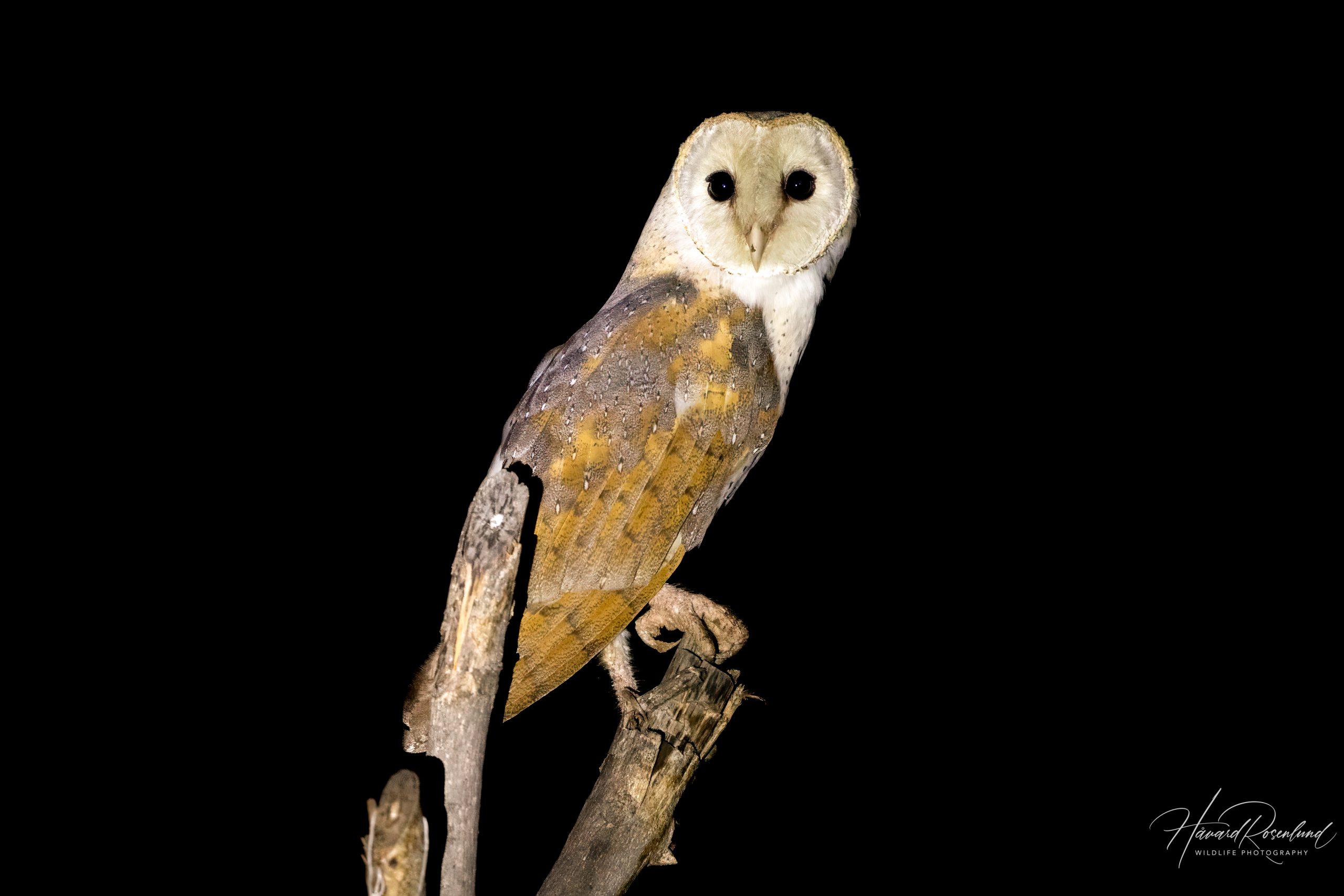
Eastern Barn Owl
Tyto javanica
At a glance
Habitat
- Open grassland, farmland, savanna, wetlands and settled areas
Diet
- Mainly small mammals, especially rodents
Activity
- Nocturnal
Size
- Length: 30–40 cm Weight: 230–480 g
Range
- South and Southeast Asia, Australia and western Pacific islands
Description
The eastern barn owl (Tyto javanica) is a medium-sized barn owl with a distinctive heart-shaped facial disc, long legs and dark eyes. Adults are usually about 30–40 cm long and weigh roughly 230–480 g, with females generally larger and darker than males. The upperparts are golden-brown and grey with fine mottling, while the underparts vary from white to buff and may carry dark spots.
It is very similar to the western barn owl (Tyto alba) and other members of the barn-owl complex. Plumage varies considerably within each species, so range and vocalisations can be more useful than colour alone when separating closely related forms.
Taxonomy
The barn-owl complex has been treated differently by major taxonomic authorities. AviList recognises the eastern populations as the full species Tyto javanica, separate from the western barn owl (Tyto alba) and American barn owl (Tyto furcata). Under this treatment, the Indian population belongs to the subspecies T. j. stertens.
BirdLife International and the IUCN Red List currently use a broader taxonomy in which these eastern populations remain within Tyto alba. This difference matters when interpreting conservation status: an assessment of the broader T. alba concept is not a separate assessment of T. javanica under the taxonomy used on this page.
Habitat
Eastern barn owls favour open and semi-open landscapes such as grassland, farmland, savanna, wetlands and settled areas. They usually avoid dense forest, because most hunting is done over open ground where small mammals can be detected and captured efficiently.
Suitable daytime roosts and nesting cavities are also important. These may occur in hollow trees, palms, cliffs, old buildings, barns and other structures, allowing the species to live successfully in agricultural and even urban landscapes when prey and safe cavities are available.
Diet
Small mammals dominate the diet, especially rats, mice and other rodents. Small birds, reptiles, amphibians and large insects are also taken. Like other barn owls, the species swallows much of its prey whole and later regurgitates compact pellets containing indigestible fur, feathers and bones.
Diet can change rapidly with local prey abundance. Studies in eastern Australia have found the introduced house mouse (Mus musculus) dominating prey samples during periods when mice were abundant, illustrating how strongly this owl can track outbreaks of small mammals.
Hunting
The heart-shaped facial disc helps collect and direct sound towards the ears, allowing the owl to locate prey with remarkable precision in darkness. Specialised feather structure also reduces flight noise, helping the bird approach small mammals without masking the faint sounds it is using to track them.
A field study published in 2025, based on observations made in an agricultural area of north-western Victoria in 1988–1990, recorded 97 foraging observations and 55 attacks whose outcome could be assessed. Perch-hunting accounted for 75% of observations, low quartering flight for 21% and sustained hovering for 4%. Overall capture success was 60%, with glide attacks from perches succeeding more often than hover-drop attacks. The balance between hunting methods also shifted with season and habitat, showing that the species adjusts its hunting strategy to local conditions.
Behaviour
The eastern barn owl is mainly nocturnal, becoming active around dusk and hunting through the night, although occasional daytime activity occurs. Adults are usually solitary outside the breeding pair and spend the day roosting in sheltered cavities, dense cover or quiet structures.
Unlike many typical owls, barn owls do not give a familiar hooting call. Their vocal repertoire includes long rasping screeches, hisses and snoring sounds used in territorial and pair communication, and vocalisations are often the first sign that an otherwise hidden bird is nearby.
Breeding
Breeding timing varies greatly across the wide range and can respond strongly to local prey abundance rather than following one fixed season. Pairs use cavities in trees, cliffs, palms or buildings and do not build a conventional nest.
A study published in 2025 followed 14 nests of T. j. delicatula in north-western Victoria during 1987–1990. Clutches contained three to six eggs, usually four or five, with a mean of 4.7. Incubation lasted 33 ± 1.5 days, the nestling period about 46–57 days, and fledged young remained dependent on the adults for another three to five weeks. Successful pairs could raise one brood in autumn and another in spring when prey was especially abundant, whereas lower prey availability was associated with smaller clutches and breeding concentrated in spring. The study also found evidence that pair bonds were maintained outside the breeding period.
Status
Under the AviList treatment used on this page, the eastern barn owl has not been separately evaluated by the IUCN Red List as Tyto javanica. Its status is therefore shown here as not evaluated, rather than borrowing the Least Concern category from the broader Tyto alba concept.
Eastern populations are nevertheless widespread and often tolerate agricultural and settled landscapes. Local pressures include loss of nesting and roosting cavities, road collisions and secondary poisoning from rodenticides when owls consume contaminated rodents.
Image gallery
Loading map and observations…
Have you seen this species?
Independent species archive
Did you find this species page useful?
Wildlife Vagabond is independently built and maintained. Voluntary support helps cover hosting, maps, data storage and continued improvements to the species archive.
Support Wildlife VagabondSpecies content will remain freely available.
References
Information about the species’ global distribution and status is based primarily on global Red List data. See the references below for details.
- Australian Museum. (n.d.). Eastern Barn Owl. https://australian.museum/learn/animals/birds/eastern-barn-owl/
- Avibase. (n.d.). Eastern Barn Owl (Tyto javanica). https://avibase.bsc-eoc.org/species.jsp?avibaseid=9E668317A0504D2B
- AviList. (n.d.). Eastern Barn Owl (Tyto javanica) taxonomy. https://explore.avilist.org/
- BirdLife International. (n.d.). Common Barn-owl (Tyto alba) species factsheet. https://datazone.birdlife.org/species/factsheet/common-barn-owl-tyto-alba
- Debus et al. (n.d.). Dietary samples of the Eastern Barn Owl in the eastern Australian arid zone. https://afo.birdlife.org.au/afo/index.php/afo/article/view/2401
- McLaughlin & Debus. (2025). Breeding biology and behaviour of the Eastern Barn Owl. https://afo.birdlife.org.au/afo/index.php/afo/article/view/2371
- McLaughlin & Debus. (2025). Foraging patterns and hunting success of the Eastern Barn Owl. https://afo.birdlife.org.au/afo/index.php/afo/article/view/2372