
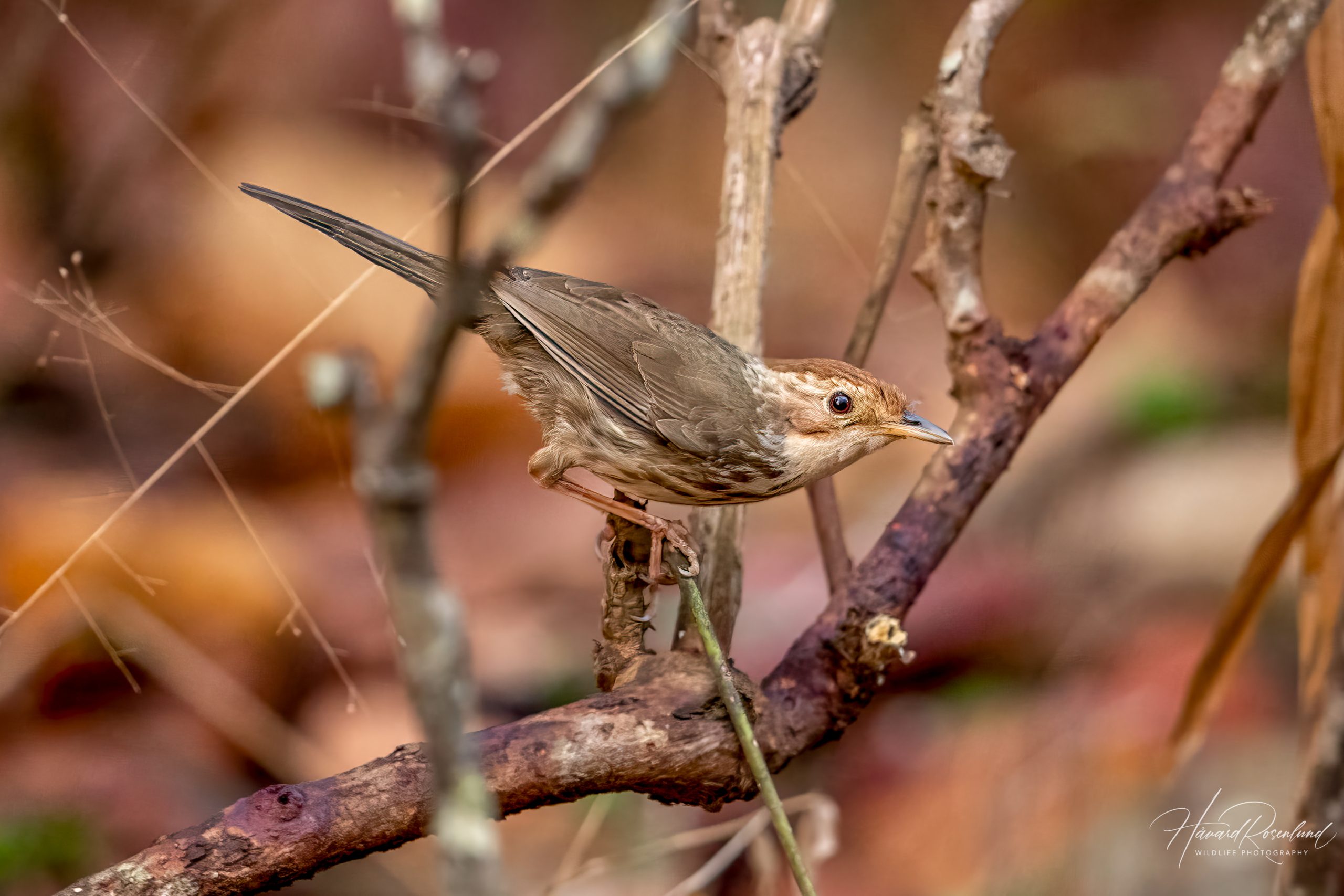
Puff-throated Babbler
Pellorneum ruficeps
At a glance
Habitat
- Dense understorey in broadleaf forest, bamboo, secondary growth, scrub and thickets
Diet
- Mainly insects, spiders and other small invertebrates found in leaf litter and low vegetation
Activity
- Diurnal
Size
- Length: about 15–17 cm Weight: about 21–31 g
Range
- From the Indian subcontinent east through the Himalayan foothills and mainland Southeast Asia to southern China and the Malay Peninsula
Description
The puff-throated babbler (Pellorneum ruficeps) is a small, ground-oriented songbird of dense forest undergrowth across South and Southeast Asia. Adults are about 15–17 cm long and weigh roughly 21–31 g. The warm rufous crown and nape contrast with an olive-brown back, while the underparts are pale with darker streaking across the breast and flanks. The throat is clean whitish and can look conspicuously puffed when the bird is calling.
Males and females are similar in appearance. The combination of rufous crown, pale throat, streaked underparts and a habit of staying close to the forest floor helps distinguish the species, although its secretive behaviour often makes voice a more useful clue than plumage.
Habitat
Puff-throated babblers favour dense understorey in broadleaf forest, bamboo, secondary growth, scrub and tangled thickets. They occur from lowlands into foothills and spend most of their time close to the ground, where leaf litter and low vegetation provide both food and concealment.
The species can tolerate some disturbed and secondary habitat, but it remains closely associated with structurally complex woody vegetation rather than open country. In India it occurs in both forest and plantation habitats where dense lower vegetation remains.
Diet
The diet consists mainly of insects, spiders and other small invertebrates. Birds forage almost continuously through leaf litter and low vegetation, walking and hopping on the ground, turning leaves aside and probing among dead plant material for hidden prey.
This ground-based feeding style is closely tied to the species' habitat. A deep litter layer and dense lower vegetation provide both prey and protection, while the bird's strong legs allow it to disturb and search through the litter more effectively than many more arboreal insectivores.
Behaviour
Puff-throated babblers are shy, active birds that spend most of their time low in dense undergrowth. They are usually encountered alone or in pairs, with small family groups sometimes remaining together after breeding. Their tendency to stay close to the ground and move through cover means they are heard far more often than they are seen.
A 2024 experimental study in Nam Cat Tien National Park in southern Vietnam distinguished a simple song, a much longer complex song and a quieter subsong in males, with the complex song used particularly during territorial confrontation. Females could join the male during aggressive encounters, adding repeated trills over his complex song to form a coordinated duet. In playback experiments, birds responded more strongly to duets than to male complex songs alone, suggesting that the duet functions as a particularly strong joint territorial signal from the pair.
The pale throat can also be puffed out conspicuously during social interactions and displays, making the feature that gives the species its English name part of its communication as well as its appearance.
Breeding
Breeding timing varies geographically. Across much of the range nesting is concentrated from about March to May, with later or second broods recorded into August. The species builds a domed nest directly on the forest floor, commonly sheltered by a bush, stone or other low cover. The structure is made largely from dry leaves, grasses and other plant material and blends closely with the surrounding litter. Clutches usually contain two to five eggs.
A study published in 2024 at Sakaerat in northeastern Thailand followed nesting over nine breeding seasons from 2013 to 2021. It consistently found the species nesting in domed structures on the ground and estimated overall nest success at about 42%. Nests survived less well during wetter periods. Young are reported to leave the nest about 12–13 days after hatching, although the incubation period remains poorly documented.
Status
The puff-throated babbler is classified as least concern on the IUCN Red List and remains widespread across a large part of tropical Asia.
Its broad distribution and use of secondary vegetation provide some resilience, but the species depends on dense ground-level cover and leaf litter. Intensive clearing of understorey, simplification of forest structure and conversion to open land can therefore reduce habitat quality even where some tree cover remains.
Image gallery
Loading map and observations…
Have you seen this species?
Independent species archive
Did you find this species page useful?
Wildlife Vagabond is independently built and maintained. Voluntary support helps cover hosting, maps, data storage and continued improvements to the species archive.
Support Wildlife VagabondSpecies content will remain freely available.
References
Information about the species’ global distribution and status is based primarily on global Red List data. See the references below for details.
- Avibase. (n.d.). /AviList 2025 – Pellorneum ruficeps taxonomic concept. https://avibase.bsc-eoc.org/species.jsp?avibaseid=D680099730C3EFEB
- BirdLife International. (n.d.). Puff-throated Babbler species factsheet. https://datazone.birdlife.org/species/factsheet/puff-throated-babbler-pellorneum-ruficeps
- International Union for Conservation of Nature. (n.d.). Puff-throated Babbler. The IUCN Red List of Threatened Species. https://www.iucnredlist.org/species/22715859/94471991
- Khamcha, D., Powell, L. A., & Gale, G. A. (2018). Effects of roadside edge on nest predators and nest survival of Asian tropical forest birds. Global Ecology and Conservation, 16, e00450. https://doi.org/10.1016/j.gecco.2018.e00450
- Phringphroh, M., Khamcha, D., Sankamethawee, W., Powell, L. A., Angkaew, R., Pierce, A. J., & Gale, G. A. (2024). Nest site vegetation structure influences nest predators and nesting success of understory birds in a dry evergreen forest in northeastern Thailand. Ornithology, 141(4), ukae031. https://doi.org/10.1093/ornithology/ukae031
- Shishkina, M. E., Van Linh, N., & Opaev, A. (2024). Vocal and territorial behaviour of Puff-throated Babbler, a South-Asian duetting passerine. Avocetta, 48. https://doi.org/10.30456/avo.2024116
- State of India's Birds. (n.d.). State of India’s Birds 2023 – Range, trends and conservation status. https://stateofindiasbirds.in/wp-content/uploads/SoIB_2023_report.pdf