
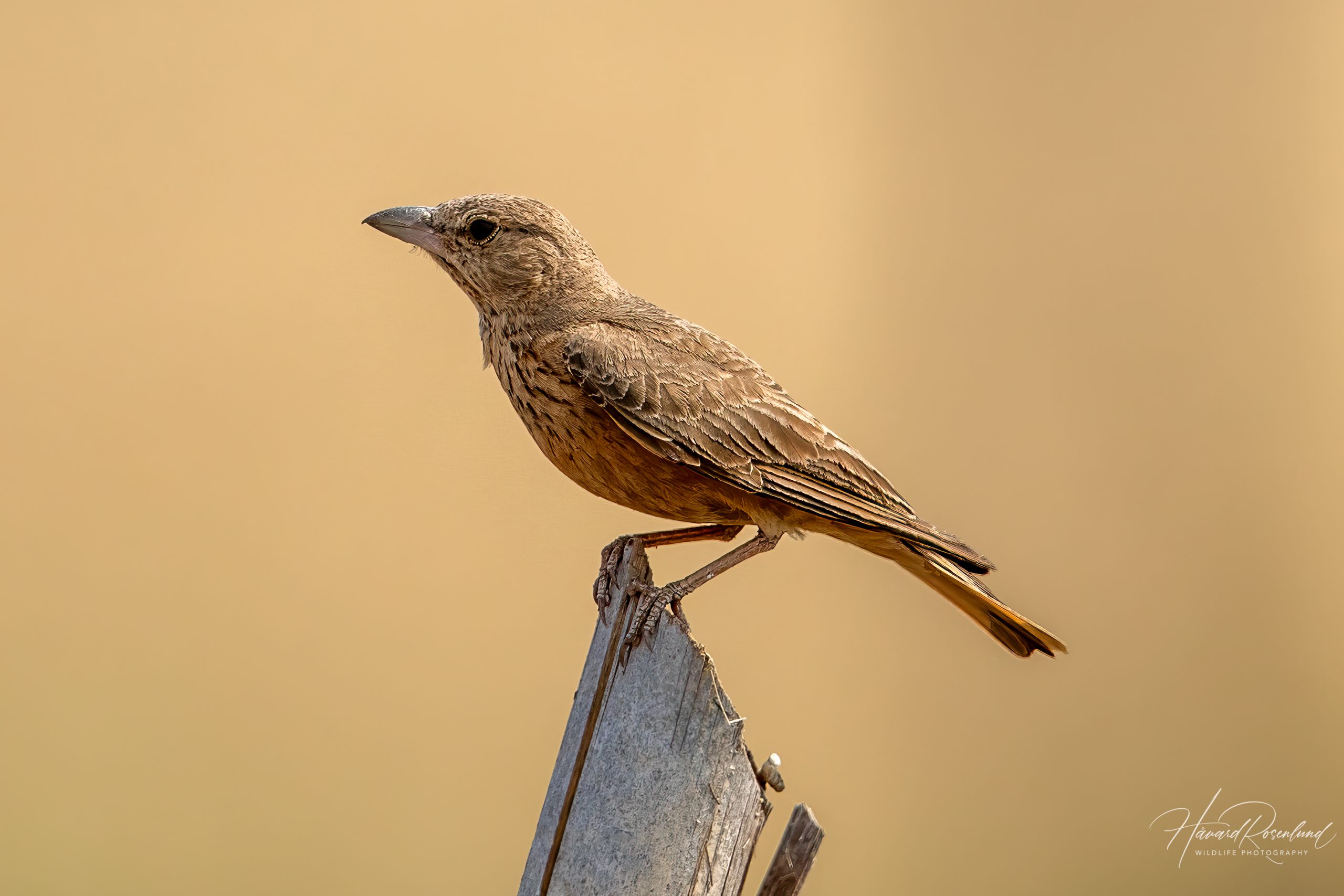
Rufous-tailed Lark
Ammomanes phoenicura
At a glance
Habitat
- Dry open scrub, rocky plains, fallow fields, cropland and other sparsely vegetated open ground
Diet
- Seeds and grain, together with insects and other small invertebrates
Activity
- Diurnal
Size
- Length: about 16 cm Weight: about 25–26 g
Range
- Indian subcontinent, mainly India with smaller populations in Pakistan and Nepal
Description
The rufous-tailed lark (Ammomanes phoenicura) is a compact, strongly built lark of the Indian subcontinent, about 16 cm long and roughly 25–26 g in weight. It has a stout bill, warm brown upperparts, a paler breast and strongly rufous underparts, rump and tail. The reddish tones can vary with wear and local soil colour but usually make the species distinctive.
The head is fairly plain, with only weak facial markings, and the wings are broad and rounded compared with many more slender larks. Its combination of heavy bill, earthy upperparts and warm rufous tail and belly fits well with the dry, open ground where the bird spends most of its time.
Habitat
Rufous-tailed larks favour dry, open landscapes with sparse vegetation. Typical habitats include stony plains, dry scrub, open natural grassland, fallow fields, lightly cultivated country and bare or rocky ground around seasonal wetlands.
In India the species is an open-habitat specialist and is endemic to the Indian subcontinent. Systematic surveys in the northern Deccan reported during the 2025 Red List reassessment also found it regularly in cropland as well as open natural ecosystems, showing that it can use modified landscapes where enough open ground and suitable feeding habitat remain.
Diet
Seeds and grain form an important part of the diet, together with beetles, ants and other small invertebrates. The balance changes with season and local rainfall, with animal prey becoming more available when insects increase after rain.
Food is collected almost entirely on the ground. Birds walk or make short runs across open soil and sparse vegetation, picking seeds and small prey from the surface and occasionally probing into loose soil or plant litter.
Behaviour
Rufous-tailed larks are resident across most of their range and are usually encountered in pairs or small groups. Their plumage blends extremely well with reddish and brown soil, and birds often remain on the ground until approached closely before flying a short distance and landing again.
Males mark and defend territories with song flights. During display a male can rise steeply above the open ground and then descend in a series of dipping, wave-like dives while calling. Outside the breeding season birds are less territorial and may gather where seed or insect food is concentrated.
Breeding
Breeding timing varies across India, with many records between February and May and additional regional variation linked to rainfall and vegetation. The nest is placed on the ground in a shallow depression, often sheltered by a grass tuft, stone or low plant.
A typical clutch contains two to four pale, spotted eggs. Historical nest records describe the eggs in detail, but the incubation period was not established, and modern field data on incubation, nestling survival and breeding success remain scarce. The young leave the nest before they are fully grown and remain dependent on the adults nearby.
Status
The rufous-tailed lark is classified as near threatened following the 2025 BirdLife/IUCN reassessment. Available evidence indicates a substantial population decline, although monitoring remains uneven across the species’ range.
State of India’s Birds 2025 classifies the species as High Priority. The updated national estimates show a long-term decline of about 70.7% and a current annual decline of about 4.25%; both are classified as Rapid Decline. Declines are also evident in open natural ecosystems and cropland, while the causes remain uncertain.
Threats
The causes of the decline are not yet well resolved. BirdLife’s 2025 reassessment found no single well-supported factor that could explain the national trend, so habitat change cannot currently be identified as the sole cause.
Potential pressures include conversion or intensive management of grassland, scrub, fallow land and other open natural ecosystems, together with changing cropping patterns in agricultural areas. Such changes can reduce the mosaic of bare ground and sparse vegetation used for feeding and breeding, but their relative importance probably varies across the range.
Conservation
Open natural ecosystems, lower-intensity farmland and fallow areas all support the species in parts of its range. Their relative importance, and the pressures acting within each, remain poorly understood because systematic population data are still sparse across much of the range.
Image gallery
Loading map and observations…
Have you seen this species?
Independent species archive
Did you find this species page useful?
Wildlife Vagabond is independently built and maintained. Voluntary support helps cover hosting, maps, data storage and continued improvements to the species archive.
Support Wildlife VagabondSpecies content will remain freely available.
References
Information about the species’ global distribution and status is based primarily on global Red List data. See the references below for details.
- AviList. (n.d.). v2025 – Global avian checklist. https://www.avilist.org/
- BirdLife International. (2025). Global Red List reassessment forum for Rufous-tailed Lark. https://forums.birdlife.org/2025-2-rufous-tailed-lark-ammomanes-phoenicura/
- BirdLife International. (n.d.). Rufous-tailed Lark (Ammomanes phoenicura) species factsheet. https://datazone.birdlife.org/species/factsheet/rufous-tailed-lark-ammomanes-phoenicura
- Birds of India. (n.d.). Ammomanes phoenicura species account. https://www.birdsofindia.org/Ammomanes-phoenicura
- State of India's Birds. (2025). State of India’s Birds (2025 update) – Rufous-tailed Lark. https://stateofindiasbirds.in/species/rutlar2/
- Store norske leksikon. (n.d.). rusthalelerke (Ammomanes phoenicura). https://snl.no/rusthalelerke