
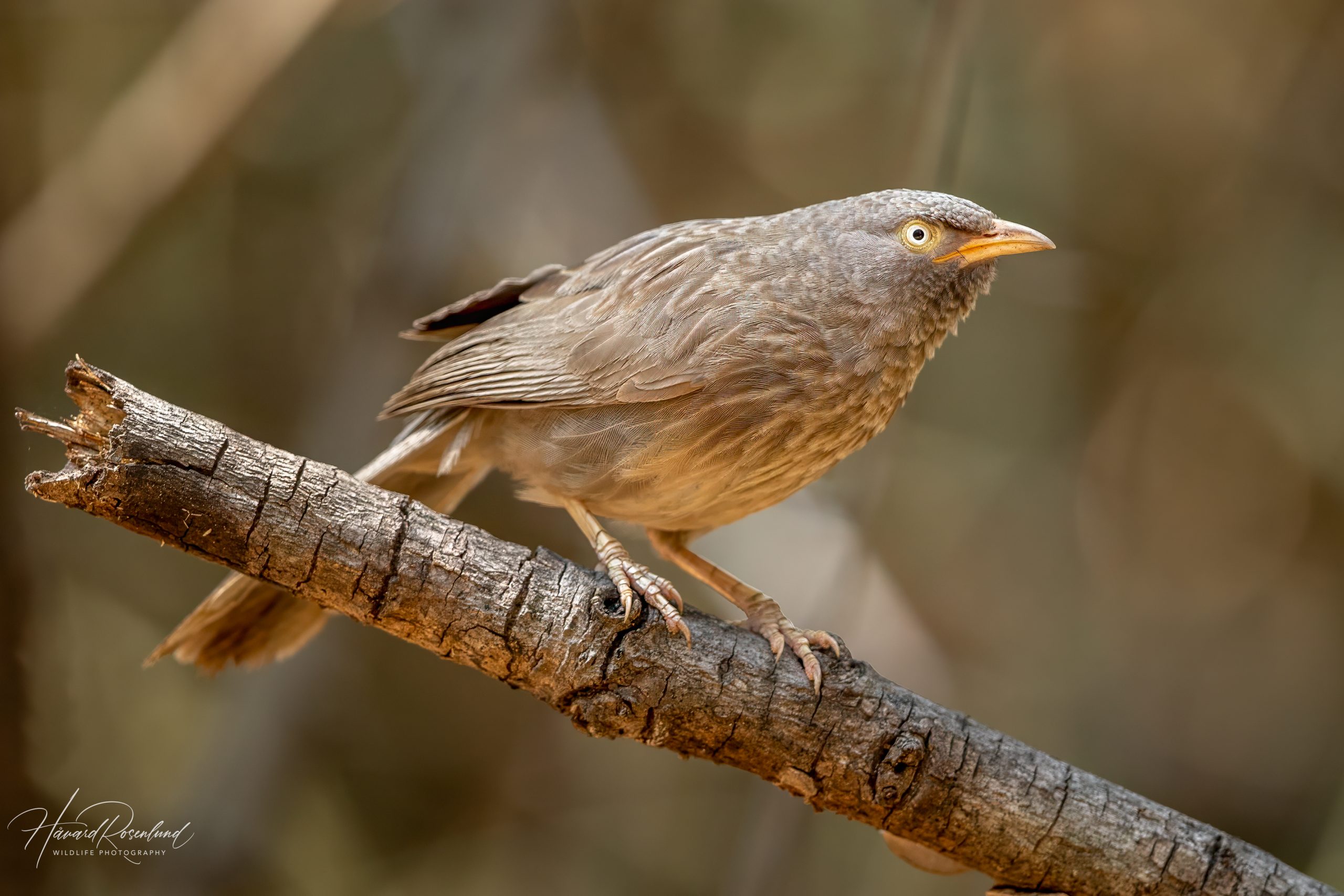
Jungle Babbler
Argya striata
At a glance
Habitat
- Open woodland, scrub, forest edge, farmland, parks, gardens and well-vegetated settlements
Diet
- Omnivorous; mainly insects and other invertebrates, with fruit, seeds, grain and nectar also taken
Activity
- Diurnal
Size
- Length: about 25 cm Weight: about 50–80 g
Range
- Indian subcontinent, where it is a widespread resident
Description
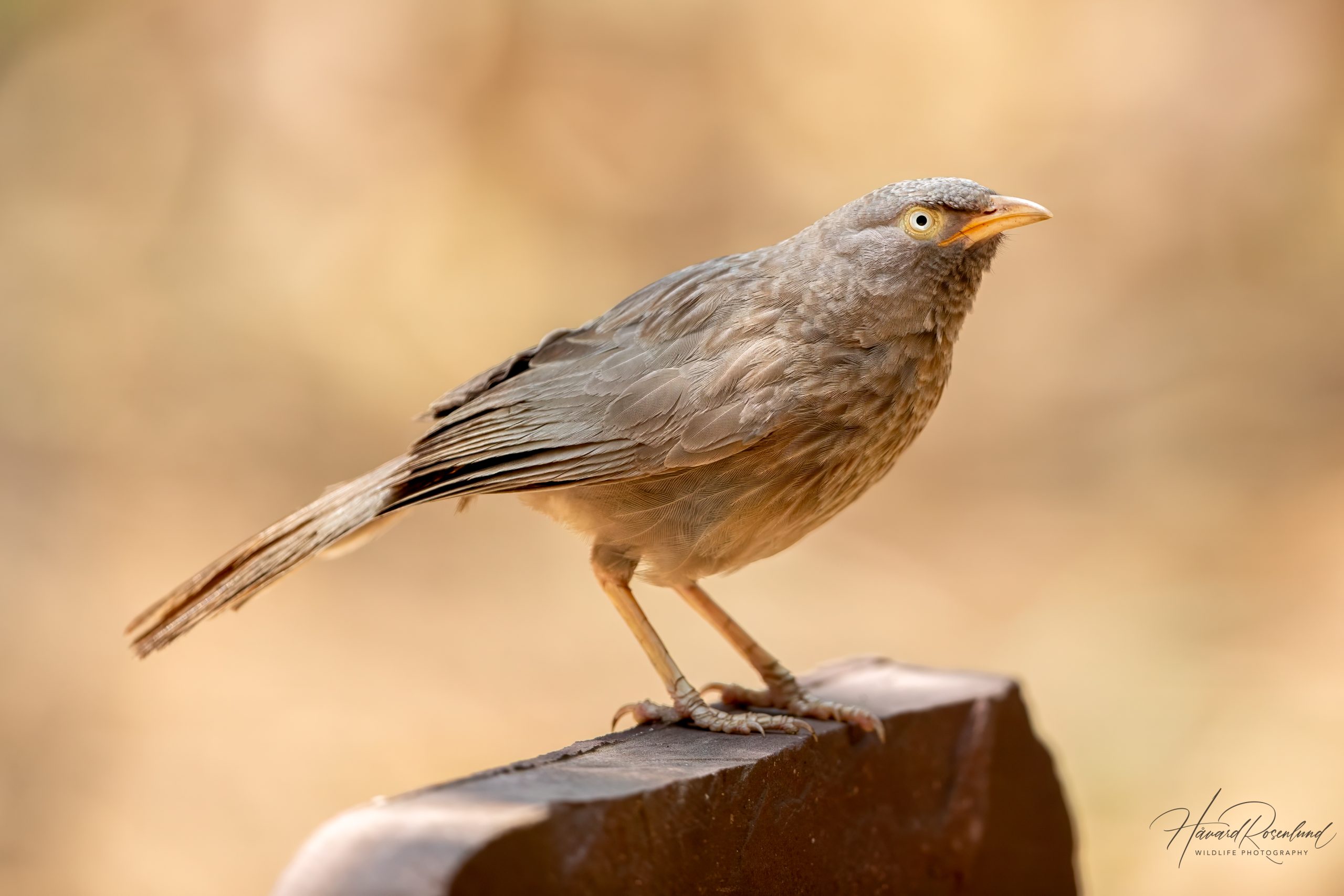
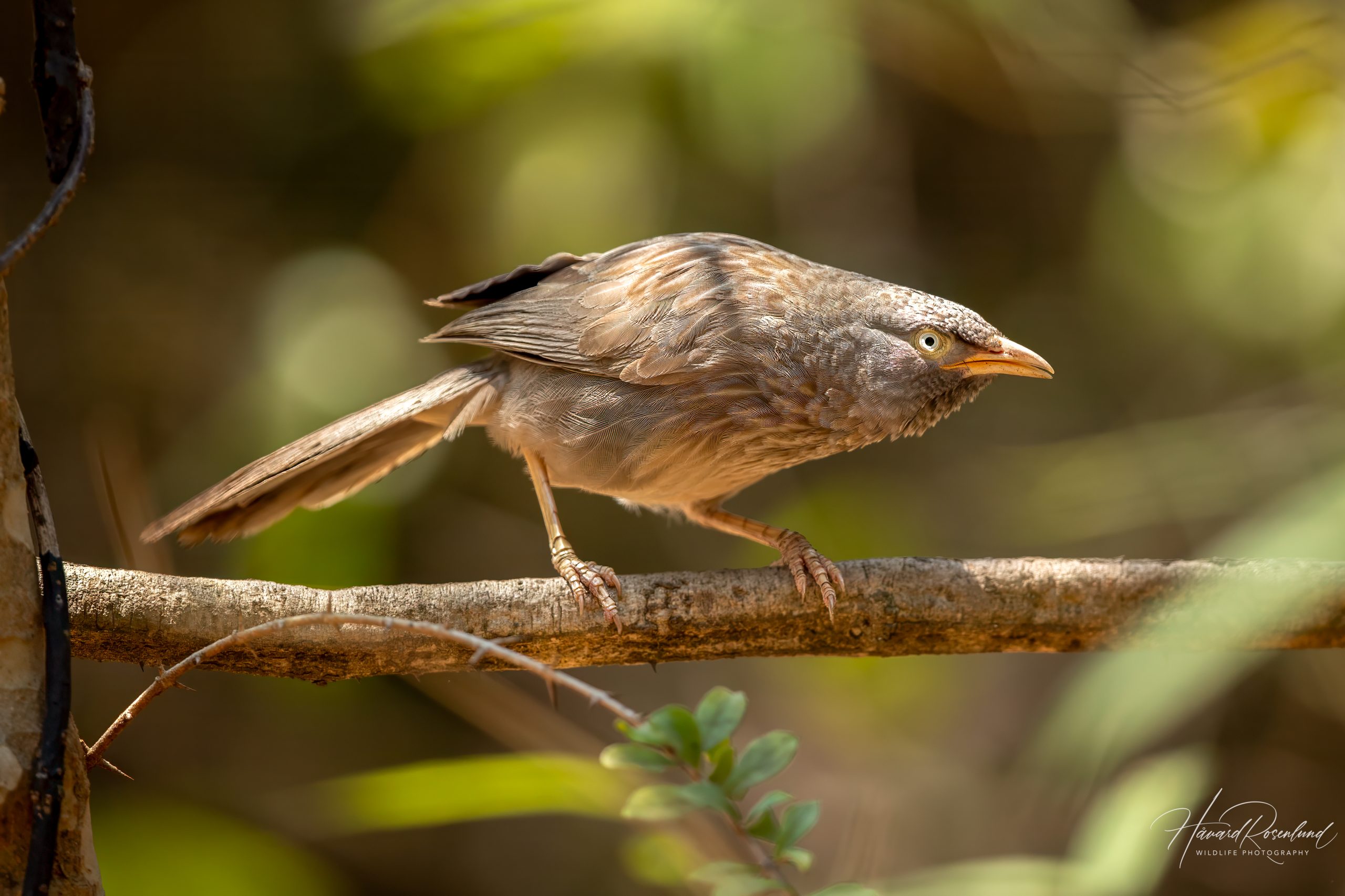
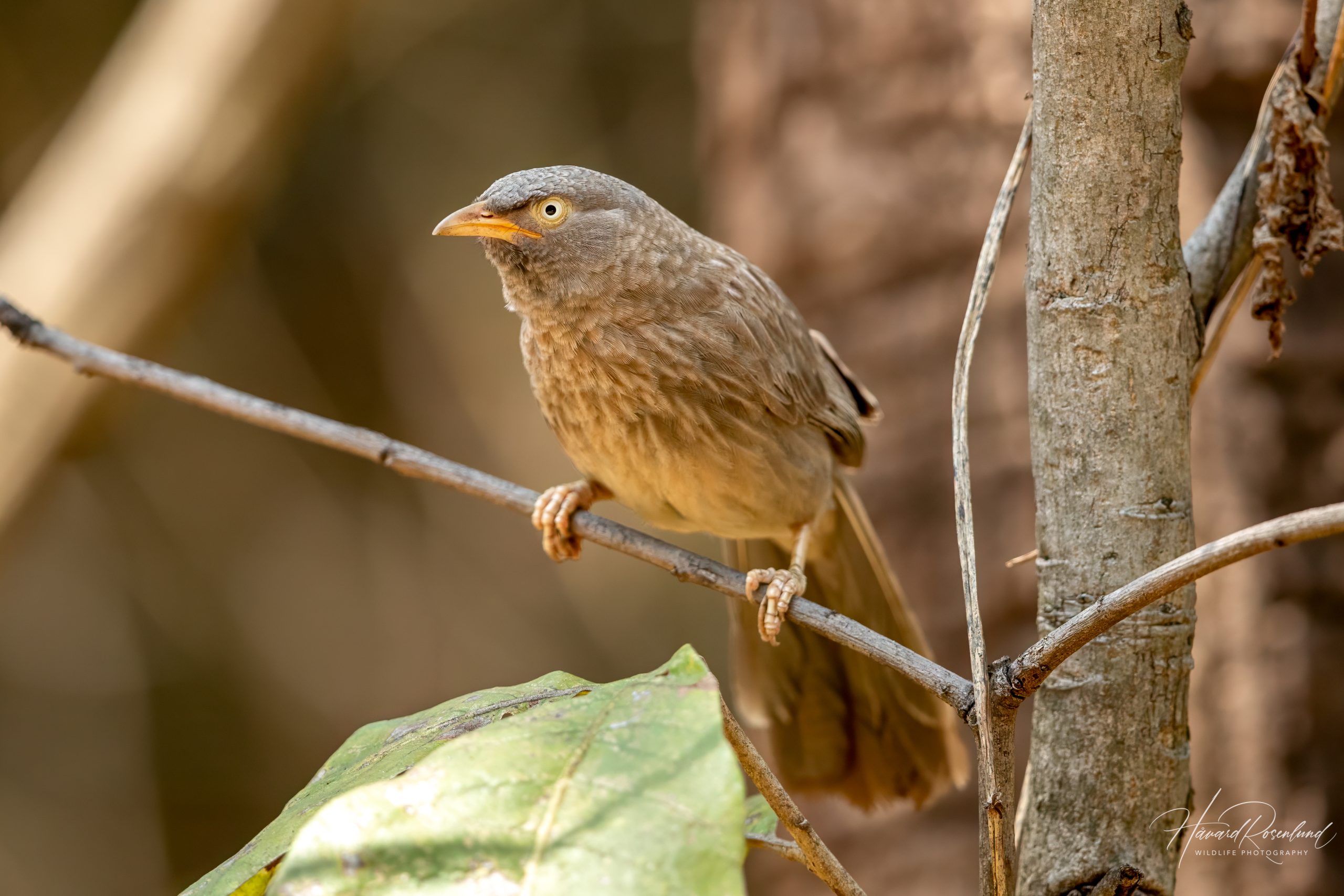
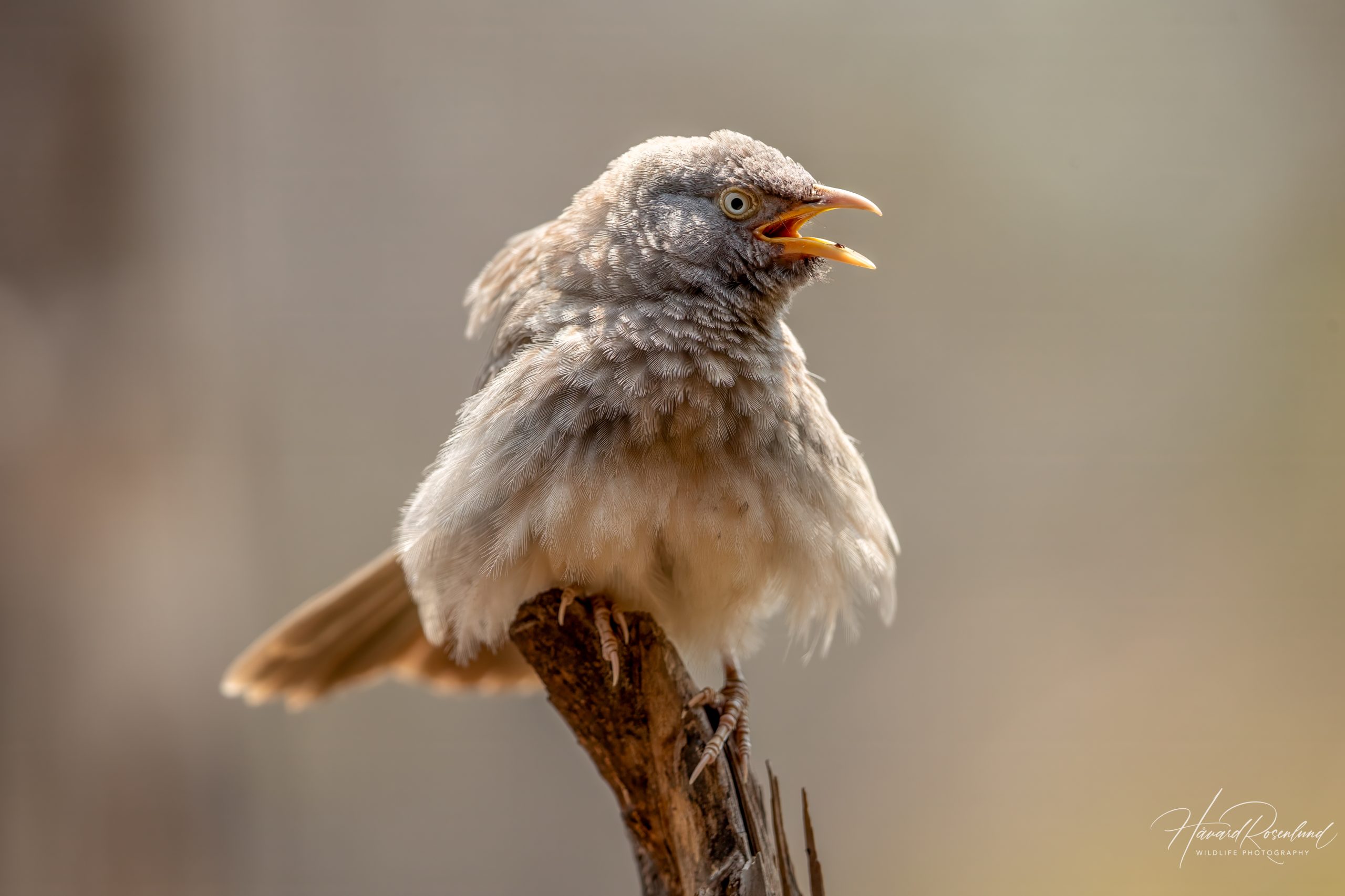
The jungle babbler (Argya striata) is a medium-sized, long-tailed songbird endemic to the Indian subcontinent. Adults are about 25 cm long and usually weigh around 50–80 g. The plumage is rather scruffy-looking grey-brown to earthy brown, with pale streaking on the throat and breast, a pale iris and a yellowish bill. Males and females look alike.
The closely related yellow-billed babbler (Argya affinis) of southern India and Sri Lanka is generally paler and greyer-headed. Jungle babblers are usually easier to recognise by their noisy groups than by any single plumage feature. The Sri Lankan orange-billed babbler (Argya rufescens) was formerly treated as a subspecies of the jungle babbler but is now recognised as a separate species.
Habitat
Jungle babblers are highly adaptable and use open woodland, scrub, forest edges, secondary growth, farmland, orchards, parks, gardens and well-vegetated villages and towns. Dense shrubs and low trees provide cover, resting places and nest sites, while open ground and leaf litter are important for feeding.
In India the species is resident and uses a broad range of habitats rather than being restricted to forest. This flexibility helps it remain common in many human-modified landscapes, provided that enough vegetation, leaf litter and small feeding patches remain.
Diet
Jungle babblers are omnivorous, but insects and other invertebrates form a major part of the diet. Beetles, caterpillars, ants, termites and other small animals are taken together with fruit, berries, seeds, grain, nectar and other plant food. Small vertebrates may occasionally be eaten.
Much of the feeding takes place on the ground. Birds repeatedly flick aside dead leaves, probe loose soil and pick exposed prey. A 2013 field study in Jammu found insects to dominate the diet and leaf-turning to be the most frequently observed feeding technique.
Behaviour
Jungle babblers are active, ground-oriented birds that spend much of the day moving through leaf litter, low vegetation and shrubs. They rarely stay still for long, and their regular short movements through the lower vegetation give a group its characteristic restless appearance.
Communication is frequent during these movements. A study published in 2021 documented 15 distinct call types used in contexts including movement, feeding, brood care, aggression and vigilance, showing that the apparently chaotic chatter carries a surprisingly varied set of signals.
Social behaviour
Social life is one of the defining features of the jungle babbler. Birds live in stable cooperative groups in which individuals forage, rest, preen and watch for danger together. The familiar Indian nickname “seven sisters” reflects this conspicuous group life rather than a fixed group size; real groups can contain fewer or more than seven birds.
Fieldwork conducted near New Delhi from 1971 to 1974 found groups of 2–20 birds and showed that participation in sentinel duty, movement initiation and allopreening varied with age and breeding status. Eight of the 15 documented call types were associated with vigilance. Social organisation therefore extends well beyond simply travelling in a flock.
Breeding
Jungle babblers are cooperative breeders. Typically one pair breeds, while other members of the group can help guard the nest, watch for predators and feed dependent young. This allows a family group to contribute collectively to the survival of the chicks rather than leaving all care to two adults.
Breeding can occur through much of the year, but in northern India peaks have been reported in March–April and again from July–September. The nest is a loose cup of twigs, roots and plant fibres placed in a shrub or small tree. A clutch usually contains three or four eggs, though as many as seven have been reported. The eggs are deep blue to greenish-blue and unspotted. Incubation lasts roughly 14–16 days, and group members may continue helping with young after they leave the nest.
Status
The jungle babbler is classified as least concern on the IUCN Red List and remains one of the familiar resident birds of much of India.
State of India’s Birds 2025 estimates a long-term national increase of about 41.17%. The current annual estimate is about +0.86%, but the uncertainty interval includes both a slight decline and an increase, so there is no clear recent change. Removal of shrubs, trees and leaf-litter-rich feeding areas can nevertheless reduce local groups in increasingly simplified urban and agricultural landscapes.
Image gallery
Loading map and observations…
Have you seen this species?
Independent species archive
Did you find this species page useful?
Wildlife Vagabond is independently built and maintained. Voluntary support helps cover hosting, maps, data storage and continued improvements to the species archive.
Support Wildlife VagabondSpecies content will remain freely available.
References
Information about the species’ global distribution and status is based primarily on global Red List data. See the references below for details.
- Anthal & Sahi. (2013). Food and Feeding Ecology of Jungle Babbler in Jammu, India. https://www.isca.in/IJENS/Archive/v2/i7/10.ISCA-IRJEvS-2013-118.php
- BirdLife International. (n.d.). Jungle Babbler species factsheet. https://datazone.birdlife.org/species/factsheet/jungle-babbler-argya-striata
- Collar, N., del Hoyo, J., Robson, C., & Christie, D. (2021). Jungle Babbler (Argya striata). In Birds of the World. Cornell Lab of Ornithology. https://doi.org/10.2173/bow.junbab2.01.1
- Gaston, A. (1977). Social behaviour within groups of jungle babblers (Turdoides striatus). Animal Behaviour, 25, 828-848. https://doi.org/10.1016/0003-3472(77)90036-7
- Gupta, N., & Talukdar, G. (2018). A Babbler’s tale: assessing the distribution of <i>Turdoides striata</i> (Dumont, 1823) (Aves: Passeriformes: Leiothrichidae) in India. Journal of Threatened Taxa, 10(3), 11450. https://doi.org/10.11609/jott.3773.10.3.11450-11453
- International Union for Conservation of Nature. (n.d.). Jungle Babbler. The IUCN Red List of Threatened Species. https://www.iucnredlist.org/species/103871402/94493697
- State of India's Birds. (2025). State of India’s Birds 2025 – Jungle Babbler. https://stateofindiasbirds.in/species/tn-junbab2/
- Yambem, S. D., & Jain, M. (2023). Temporal variation in the behaviour of a cooperatively breeding bird, Jungle Babbler (Argya striata). Tropical Ecology, 64(1), 133-145. https://doi.org/10.1007/s42965-022-00254-w
- Yambem, S. D., Chorol, S., & Jain, M. (2021). More than just babble: functional and structural complexity of vocalizations of Jungle Babbler. Behavioral Ecology and Sociobiology, 75(8), 118. https://doi.org/10.1007/s00265-021-03018-z