
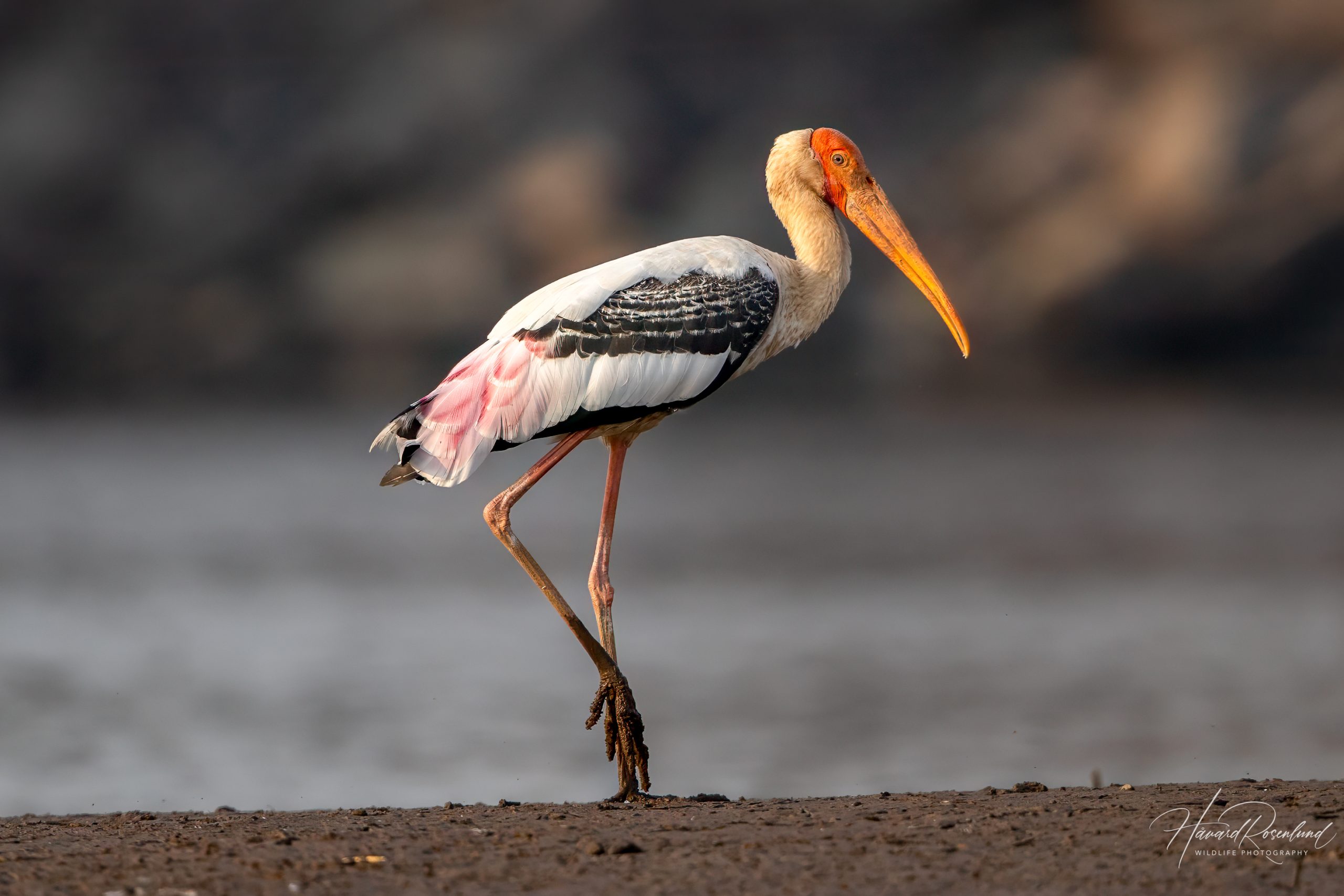
Painted Stork
Mycteria leucocephala
At a glance
Habitat
- Shallow freshwater wetlands, lakes, marshes, reservoirs, rivers and flooded agricultural land
Diet
- Mainly fish; occasionally other aquatic prey
Activity
- Diurnal
Size
- Length: 93–102 cm; wingspan 150–160 cm Weight: 2–3.5 kg
Range
- Indian subcontinent and parts of mainland Southeast Asia
Description
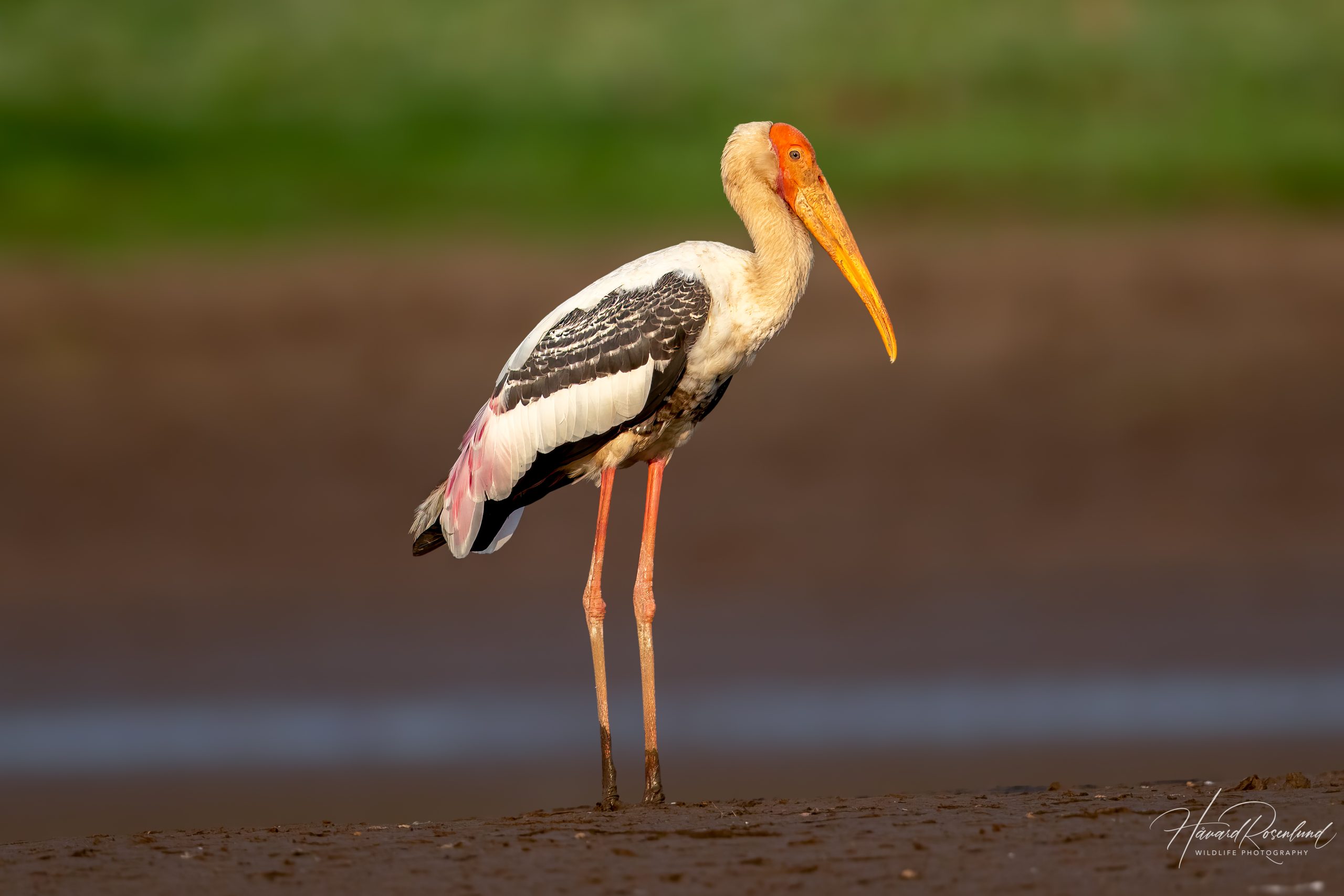
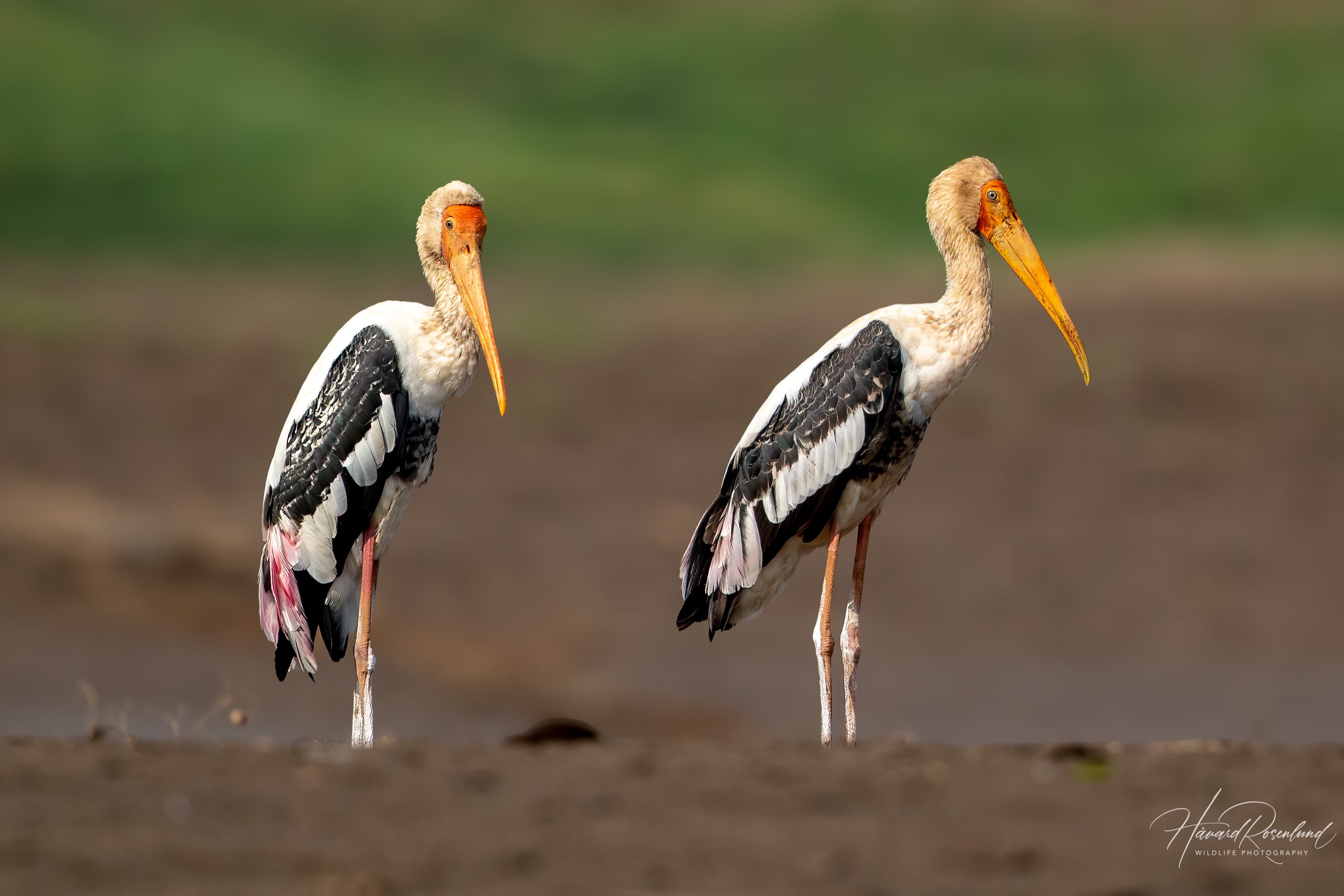
The painted stork (Mycteria leucocephala) is a large Asian stork measuring about 93–102 cm in length, with a wingspan of roughly 150–160 cm and a mass of about 2–3.5 kg. Adults are mostly white with bold black barring across the wings and breast, rose-pink tertial feathers over the rear of the body, a bare orange to reddish face and a long yellow bill that curves gently downward.
Young birds are much duller, with grey-brown plumage and a feathered head. Adults of both sexes look similar, although males average somewhat larger. The combination of the pink rear plumage, patterned wings and long yellow bill makes the species distinctive.
Habitat
Painted storks feed in shallow freshwater wetlands, marshes, lakes, reservoirs, river margins, seasonal pools and flooded agricultural land such as rice fields. They are particularly effective in water shallow enough for the bill to sweep close to the bottom.
In India they frequently use human-modified wetlands and agricultural landscapes as well as natural wetlands. Successful breeding still depends on suitable nesting trees within reach of productive feeding areas. Large colonies may occur in trees standing in or beside villages, reservoirs and protected wetlands.
Diet
Fish dominate the diet. A detailed study around Delhi recorded fish in all observed captures and showed that birds adjusted prey size during the breeding season. Amphibians, crustaceans and other aquatic animals are also taken occasionally, but fish are clearly the principal food.
Hunting
Painted storks hunt mainly by touch. They walk through shallow water with the bill partly open and sweep it from side to side close to the bottom, snapping it shut when prey makes contact.
Foot-stirring can flush fish hidden among vegetation or sediment, and birds may occasionally use wing movements to disturb or direct prey. Feeding rate changes with breeding demands and local prey conditions.
Behaviour
Painted storks soar efficiently on rising warm air when travelling between wetlands and nesting colonies and may make substantial local movements as water levels and food availability change. These movements are flexible rather than a regular long-distance migration system across most of the range.
A study published in 2024 of nesting birds at the National Zoological Park in Delhi documented two forms of heat regulation: urohidrosis, in which birds wet their legs with excreta, and wing-spreading. Both behaviours increased during the hottest parts of the day, and males used them more frequently than females.
Social behaviour
Painted storks are social birds that often feed and rest in groups and may associate with other storks, herons, ibises and pelicans. Groups can spread through shallow water while feeding and later gather on exposed banks, islands or trees to rest and preen.
Breeding
Breeding timing varies strongly across the range and usually follows local rainfall and wetland conditions rather than one fixed calendar. Painted storks nest colonially in trees, often together with other large waterbirds. Both adults build and maintain the bulky stick nest, and clutches commonly contain two to five eggs.
Both parents incubate for about a month and feed the chicks by regurgitating fish. The young hatch blind and largely helpless and become capable of flight at around 60 days. A 2024 study at the National Zoological Park in Delhi and Keoladeo National Park found males more vigilant than females at nesting colonies; vigilance also increased as nestlings grew and varied with visitor numbers and local site conditions.
A five-year study at Telineelapuram in Andhra Pradesh found substantial year-to-year variation in reproduction. Recruitment varied from about 29.3% to 46.7% among years and averaged 40.9%, while average chick mortality was 18.6%. Cyclones, predation, accidents and young falling from nests were among the recorded causes of mortality.
Status
The painted stork is classified as least concern on the IUCN Red List. It was moved from Near Threatened to Least Concern in the 2023 Red List update. At that reassessment, BirdLife reported more than 20,000 mature individuals and an apparently increasing global population associated with conservation efforts.
State of India's Birds 2025 places the species in the Low Priority category nationally. Its updated estimates indicate a long-term increase of about 24.7% but a current annual decline of about 1.5%. Wetland loss, pollution, disturbance and removal of nesting trees remain important local threats.
Image gallery
Loading map and observations…
Have you seen this species?
Independent species archive
Did you find this species page useful?
Wildlife Vagabond is independently built and maintained. Voluntary support helps cover hosting, maps, data storage and continued improvements to the species archive.
Support Wildlife VagabondSpecies content will remain freely available.
References
Information about the species’ global distribution and status is based primarily on global Red List data. See the references below for details.
- Ahmed, P., & Urfi, A. J. (2024). Environmental drivers of vigilance behaviour in painted stork (Mycteria leucocephala) nesting colonies. Scientific Reports, 14(1), 28498. https://doi.org/10.1038/s41598-024-78276-8
- Ahmed, P., & Urfi, A. J. (2024). Sex-based differences, diurnal and seasonal trends in thermoregulatory behaviour of nesting Painted Stork (Mycteria leucocephala). Behavioural Processes, 223, 105115. https://doi.org/10.1016/j.beproc.2024.105115
- AviList. (n.d.). v2025 – Global avian checklist. https://www.avilist.org/
- BirdLife International. (n.d.). Painted Stork (Mycteria leucocephala) species factsheet. https://datazone.birdlife.org/species/factsheet/painted-stork-mycteria-leucocephala
- BirdLife International. (n.d.). State of the World’s Birds 2024 annual update. https://datazone.birdlife.org/articles/state-of-the-worlds-birds-2024-annual-update
- International Union for Conservation of Nature. (n.d.). Painted Stork (Mycteria leucocephala). The IUCN Red List of Threatened Species. https://www.iucnredlist.org/species/22697658/228020407
- Kalam, A., & Urfi, A. J. (2008). Foraging behaviour and prey size of the painted stork. Journal of Zoology, 274(2), 198-204. https://doi.org/10.1111/j.1469-7998.2007.00374.x
- Ramamohan, H., & Rao, K. K. (2024). Breeding success and mortality rates in Painted Stork (Mycteria leucocephala) at Telineelapuram Bird Protected Area, India. Journal of Asia-Pacific Biodiversity, 17(4), 624-630. https://doi.org/10.1016/j.japb.2024.02.004
- State of India's Birds. (2025). State of India’s Birds (2025 update) – Painted Stork. https://stateofindiasbirds.in/species/paisto1/