
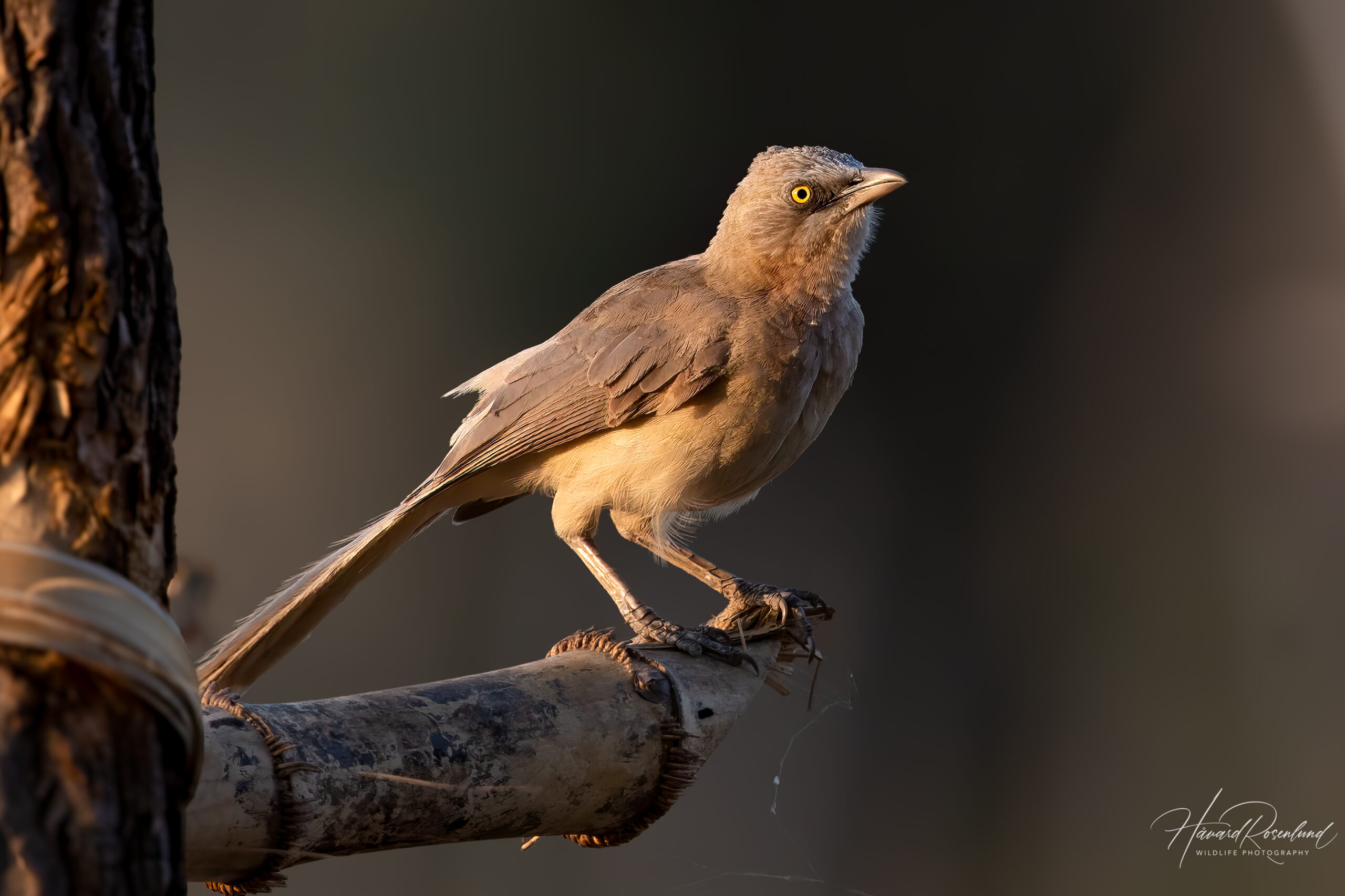
Large Grey Babbler
Argya malcolmi
At a glance
Habitat
- Dry scrub, open woodland, thorn forest, farmland and village edges across the Indian subcontinent
Diet
- Mainly insects and other invertebrates; also seeds, grains, berries and occasional small vertebrates
Activity
- Diurnal
Size
- Length: 27–28 cm Weight: ca. 75 g
Range
- Indian subcontinent, mainly India with local occurrence into neighbouring Nepal
Description
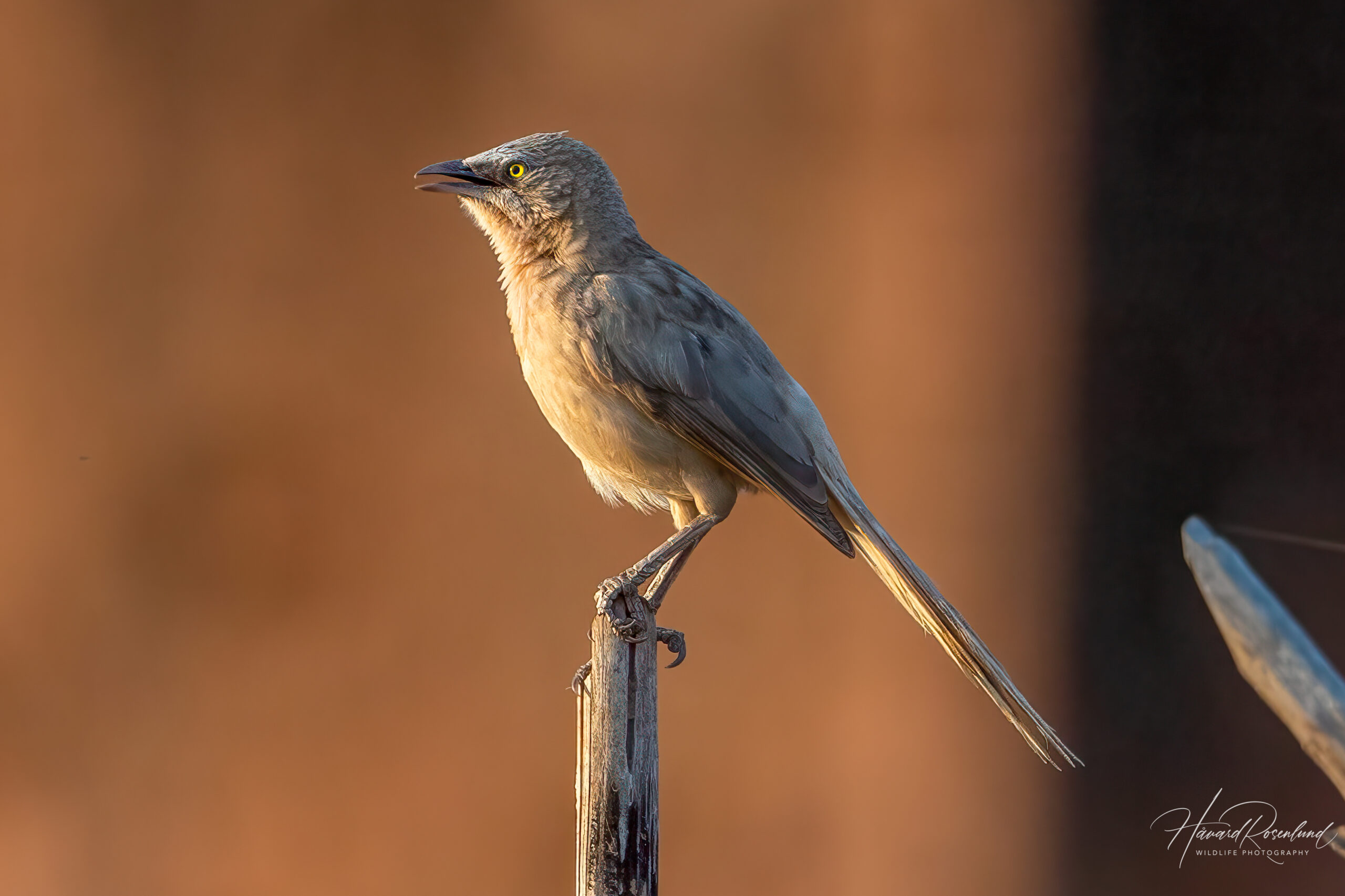
The large grey babbler (Argya malcolmi) is a large, long-tailed laughingthrush relative endemic to the Indian subcontinent. It is about 27–28 cm long and weighs roughly 75 g. The plumage is dusty grey-brown above and paler below, with a long graduated tail whose outer feathers show pale tips. The strong bill is dark above and paler on the lower mandible, while the pale yellow iris is one of the most conspicuous facial features.
It can be confused with other ground-foraging Argya babblers, including the jungle babbler (Argya striata) and common babbler (Argya caudata). The large grey babbler is generally larger and longer-tailed, with a paler, greyer overall appearance.
Habitat
Large grey babblers inhabit dry scrub, thorny woodland, open deciduous country, farmland and the edges of villages and towns. They are especially characteristic of dry, open landscapes with scattered bushes and trees rather than dense forest.
The species tolerates substantial human modification and readily uses agricultural mosaics and lightly urbanised landscapes, provided that enough scrub, trees and open ground remain for feeding, shelter and nesting.
Diet
The diet is dominated by insects and other invertebrates. A detailed feeding study found a broad range of arthropods, supplemented by seeds, grains, berries and other plant material; small vertebrates may occasionally be taken.
Social behaviour
Group living is one of the defining features of the large grey babbler. Birds normally move in cohesive, noisy parties, often of about five to twelve individuals, maintaining contact with repeated nasal and chattering calls while travelling and feeding. Groups react collectively to disturbance and may jointly confront predators or neighbouring groups.
The groups spend much of the day searching on or close to the ground, turning through leaf litter and moving between patches of low cover together. Members remain in frequent visual and vocal contact as they move through scrub and open woodland, and the species is consequently far more often encountered as a noisy party than as a solitary bird.
Breeding
Large grey babblers can breed during much of the year, but nesting is most frequent from spring through the monsoon season. The nest is a relatively shallow open cup of twigs, roots, grass and other plant material, usually placed in a thorny bush or small tree. A typical clutch contains about three or four pale blue eggs.
The breeding pair provides the core parental care, but field observations show that extra adults sometimes help feed or defend the young. At other nests only the pair attended the young. Cooperative care therefore occurs in the species, but it does not appear to be a fixed feature of every group.
The species is also a known host of brood parasites including the common hawk-cuckoo (Hierococcyx varius) and pied cuckoo (Clamator jacobinus), adding another source of reproductive pressure.
Status
The large grey babbler is classified as least concern on the IUCN Red List. It has a very large range across the Indian subcontinent and is not restricted to intact natural forest.
Indian monitoring estimates updated in 2025 are close to flat: about +1.1% over the long term and −0.23% per year more recently, with uncertainty intervals spanning both increase and decline. The 2025 update did not recalculate the trend or conservation-priority categories; the underlying 2023 assessment classified the long-term trend as decline and the current annual trend as rapid decline, while the species remained in the low conservation-priority category.
Image gallery
Loading map and observations…
Have you seen this species?
Independent species archive
Did you find this species page useful?
Wildlife Vagabond is independently built and maintained. Voluntary support helps cover hosting, maps, data storage and continued improvements to the species archive.
Support Wildlife VagabondSpecies content will remain freely available.
References
Information about the species’ global distribution and status is based primarily on global Red List data. See the references below for details.
- Anju & Rai. (2026). Partial leucism in Argya malcolmi, with current distribution and conservation context. https://www.lillo.org.ar/journals/index.php/acta-zoologica-lilloana/article/view/2320
- BirdLife International. (n.d.). Large Grey Babbler species factsheet. https://datazone.birdlife.org/species/factsheet/large-grey-babbler-argya-malcolmi
- International Union for Conservation of Nature. (n.d.). Large Grey Babbler. The IUCN Red List of Threatened Species. https://www.iucnredlist.org/species/22716361/94492467
- Skutch, A. F. (1961). Helpers among Birds. The Condor, 63(3), 198-226. https://doi.org/10.2307/1365683
- State of India's Birds. (2025). State of India’s Birds 2025 – Large Grey Babbler. https://stateofindiasbirds.in/species/dl-lagbab2/
- Toor, H. S., & Saini, M. S. (1986). Feeding ecology of the large grey babblerTurdoides malcolmi. Proceedings: Animal Sciences, 95(4), 429-436. https://doi.org/10.1007/BF03179379