
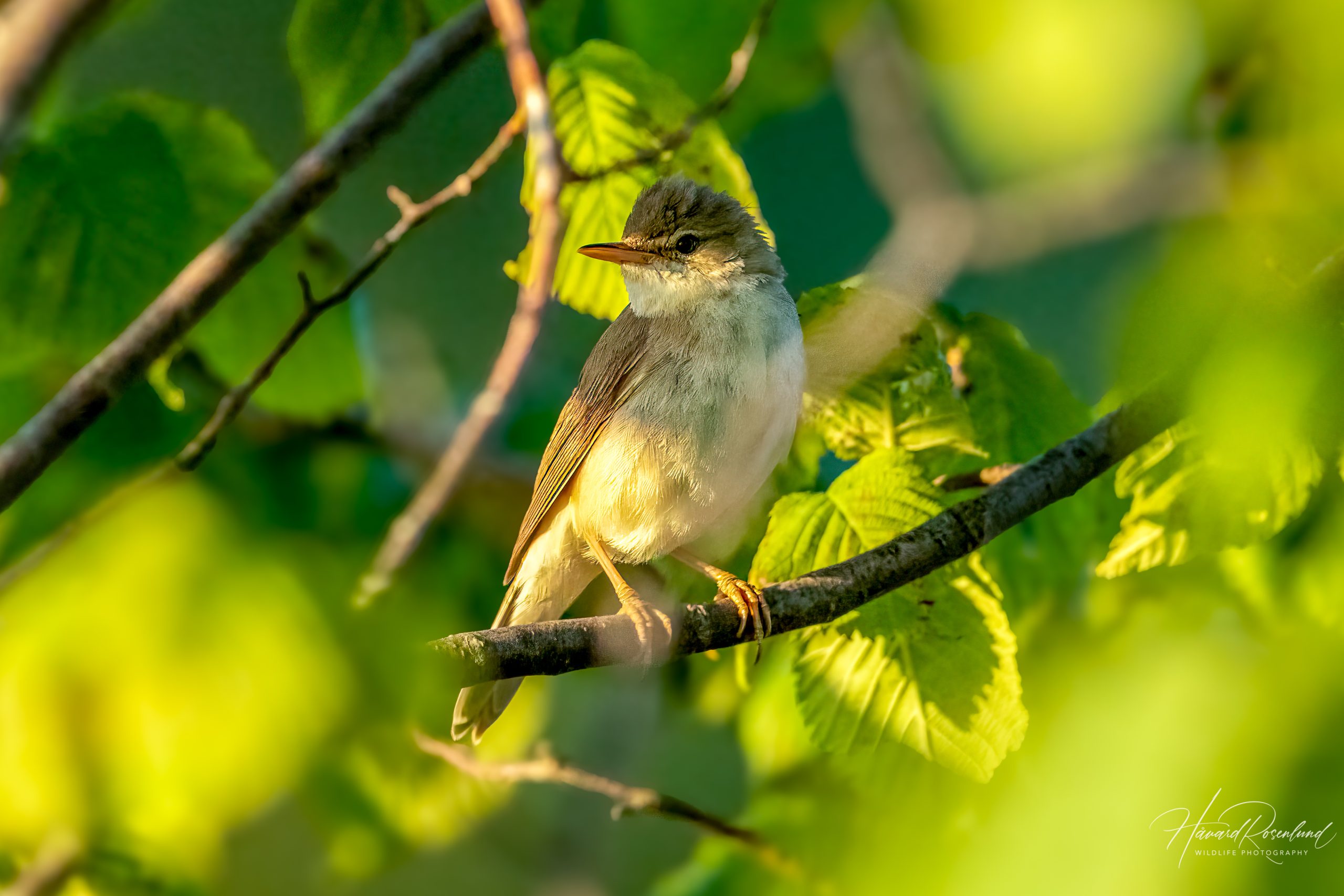
Marsh Warbler
Acrocephalus palustris
At a glance
Habitat
- Tall, dense herbaceous vegetation in wet meadows, ditches, river margins and overgrown lowland habitats
Diet
- Mainly insects, spiders and other small invertebrates; some berries and fruit during migration
Activity
- Diurnal, but males also sing extensively at night during the breeding season
Size
- Length: 12–15 cm Weight: about 10–14 g
Range
- Breeds in Europe and western Asia; migrates through eastern Africa to winter mainly in southeastern and southern Africa
Description
The marsh warbler (Acrocephalus palustris) is a small, rather plain warbler that breeds across much of Europe and western Asia and spends the non-breeding season in Africa. Adults are about 12–15 cm long, have a wingspan of roughly 18–21 cm and weigh around 10–14 g. The upperparts are olive-brown to brownish green, with pale underparts and a fairly subtle pale eyebrow.
It closely resembles the common reed warbler (Acrocephalus scirpaceus) and is often difficult to identify by appearance alone. Marsh warblers tend to look slightly greener or colder-toned and often have paler legs, but the song is by far the best field character in spring and early summer.
Habitat
Despite its English name, the marsh warbler is not mainly a bird of open marshes or dense reedbeds. It favours tall, lush herbaceous vegetation in lowland areas, often along ditches, streams, wet meadows, field edges and nutrient-rich wetlands. Nettles, meadowsweet and other tall plants can provide both nest sites and feeding cover.
The species can also breed in overgrown gardens, scrubby field margins and other secondary vegetation. What matters most is a dense vertical layer of herbs and low shrubs rather than standing water itself. This helps separate its breeding habitat from that of the closely related reed warbler, which is more strongly associated with reeds.
Diet
Marsh warblers feed mainly on insects, spiders and other small invertebrates. They move through dense vegetation and pick prey from leaves and stems, but also make short flights after flying insects. Caterpillars, beetles, flies, bugs and small spiders are among the typical foods.
Berries and other small fruits can supplement the diet during migration. Because the birds feed inside rapidly growing summer vegetation, the abundance of insects in tall herbs, field margins and wetland edges is especially important while adults are raising chicks.
Behaviour
Marsh warblers spend much of their time concealed within dense vegetation and become especially difficult to detect once the main song period is over. Outside the breeding season they are usually solitary, including during migration and on the African wintering grounds.
Breeding males establish territories with one of the most complex songs in Europe. They sing rapidly for long periods, often from deep inside vegetation and sometimes through much of the night. The song is packed with imitations of other birds rather than a short repeated phrase.
A classic study published in 1979 analysed nearly 30 recorded repertoires, most of them from Belgium, and identified imitations of 212 bird species: 99 European and 113 African. An individual repertoire contained about 76 imitated species on average, with a range of 63–84 in the material studied. The African sounds and other observations also suggested that young marsh warblers continue learning new song motifs while migrating south and probably until shortly after reaching their wintering areas.
Migration
Marsh warblers are long-distance migrants. European birds leave in late summer and move mainly southeast through eastern Europe and the eastern Mediterranean before continuing through north-eastern and eastern Africa. Many spend an extended period in eastern Africa before moving farther south to the main wintering areas in southeastern and southern Africa.
Young birds make this journey without having followed their parents. Orientation experiments published in 1993 with juvenile marsh warblers in Sweden and Kenya found markedly different directional behaviour at different stages of the migration. Birds in Sweden oriented southeast as expected under clear skies, whereas birds in Kenya showed a different orientation. When visual sky cues were removed under simulated overcast conditions, clear directional preference disappeared, while artificial changes to the magnetic field produced no consistent response. The results therefore pointed to an important role for visual orientation cues during migration.
Breeding
Breeding begins late in spring, after the birds return from Africa. The female builds a deep cup nest suspended between upright stems in dense herbaceous vegetation. The nest is usually low above the ground but well hidden among leaves.
A clutch normally contains three to six eggs. Both adults incubate for about 12–14 days and feed the chicks after hatching. The young leave the nest after only about 10–11 days, before they are fully independent, and remain hidden in nearby vegetation while the parents continue to bring food.
Status
The marsh warbler is classified as least concern on the IUCN Red List. It has a large breeding range and remains numerous, although trends vary between countries and parts of Europe have shown recent declines.
Because the species depends on tall, structurally varied vegetation, drainage, intensive mowing and removal of field margins can make breeding areas unsuitable. At the same time, the bird can colonise new areas quickly when lush secondary vegetation develops, which helps explain why its range has expanded in parts of northern Europe.
Image gallery
Loading map and observations…
Have you seen this species?
Independent species archive
Did you find this species page useful?
Wildlife Vagabond is independently built and maintained. Voluntary support helps cover hosting, maps, data storage and continued improvements to the species archive.
Support Wildlife VagabondSpecies content will remain freely available.
References
Information about the species’ global distribution and status is based primarily on global Red List data. See the references below for details.
- BirdLife International. (n.d.). Marsh Warbler species factsheet. https://datazone.birdlife.org/species/factsheet/marsh-warbler-acrocephalus-palustris
- BirdLife International. (n.d.). State of the World’s Birds 2022. https://www.birdlife.org/papers-reports/state-of-the-worlds-birds-2022/
- British Trust for Ornithology. (n.d.). Identification of Marsh and Reed Warblers on autumn migration. https://www.bto.org/our-work/science/publications/papers/identification-marsh-warblers-acrocephalus-palustris
- British Trust for Ornithology. (n.d.). Marsh Warbler. https://www.bto.org/learn/about-birds/birdfacts/marsh-warbler
- Dowsett-Lemaire, F. (1979). The imitative range of the song of the marsh warbler Acrocephalus palustris, with special reference to imitations of African birds. Ibis, 121(4), 453-468. https://doi.org/10.1111/j.1474-919X.1979.tb06685.x
- International Union for Conservation of Nature. (n.d.). Marsh Warbler. The IUCN Red List of Threatened Species. https://www.iucnredlist.org/species/22714741/155434933
- Store norske leksikon. (n.d.). Myrsanger. https://snl.no/myrsanger
- Åkesson, S. (1993). Effect of geomagnetic field on orientation of the marsh warbler, Acrocephalus palustris, in Sweden and Kenya. Animal Behaviour, 46(6), 1157-1167. https://doi.org/10.1006/anbe.1993.1305