
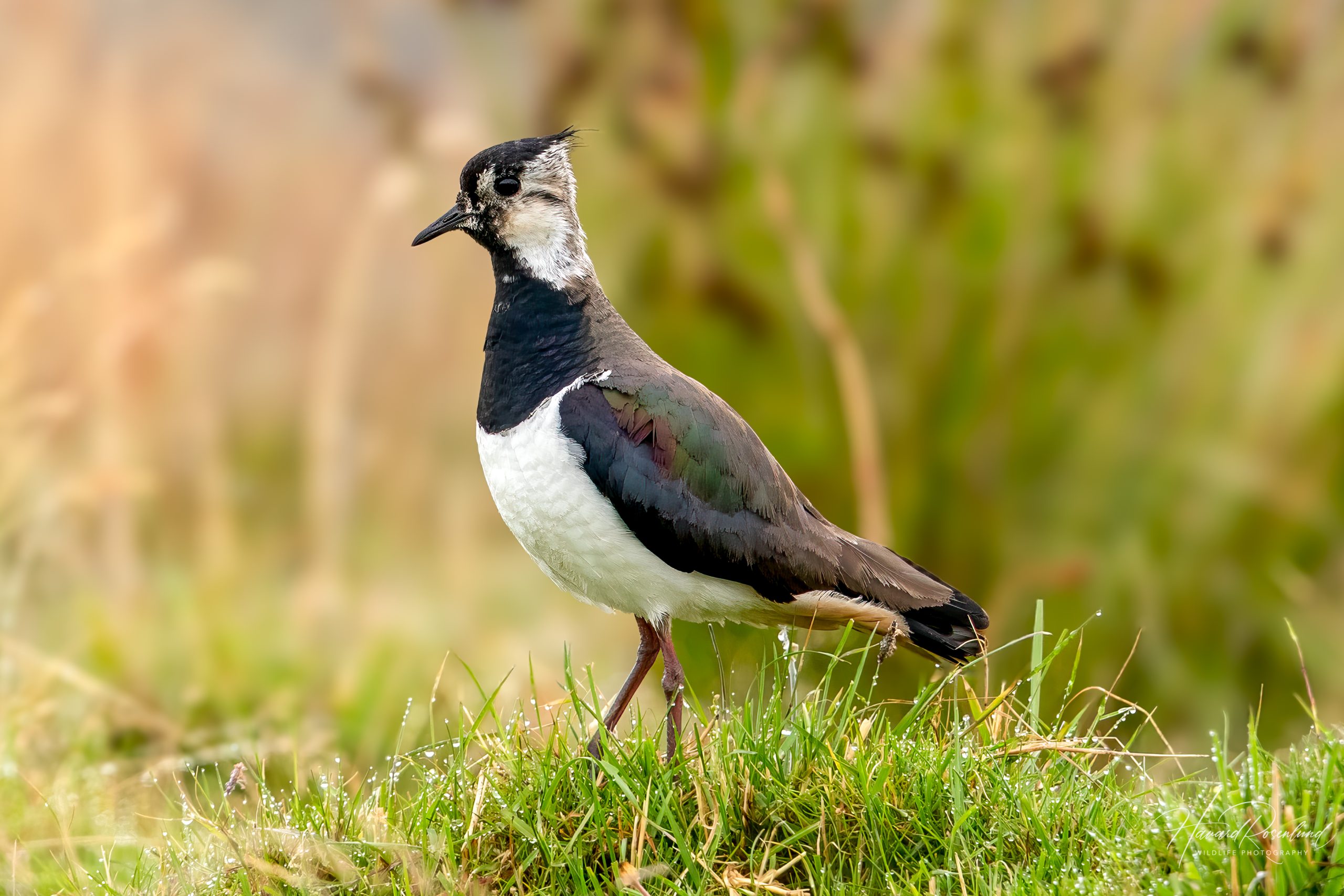
Northern Lapwing
Vanellus vanellus
At a glance
Habitat
- Open farmland, wet grassland, pastures, marshes and other short-vegetation landscapes with damp feeding ground
Diet
- Earthworms, insects and other invertebrates; some seeds and plant material outside breeding
Activity
- Diurnal and crepuscular; can also feed at night
Size
- Length: 28–31 cm Weight: about 250 g average
Range
- Breeds across temperate Eurasia; northern populations winter farther south in western Europe, the Mediterranean, North Africa and southern Asia
Description
The northern lapwing (Vanellus vanellus) is a distinctive plover of open European and Asian landscapes. Adults are about 28–31 cm long, with broad rounded wings, a long thin crest and dark upperparts that shine green, bronze and purple in good light. The face, throat and breast are patterned black and white, while the belly is white and the undertail chestnut. Males generally have longer crests and cleaner black breeding plumage than females.
In flight, the broad wings and slow, floppy wingbeats make the species unmistakable. The familiar pee-wit calls accompany spectacular tumbling display flights over breeding territories, giving the bird many traditional names across Europe.
Habitat
Northern lapwings need open landscapes with short vegetation and access to moist, soft soil for feeding. Historically they bred extensively on wet meadows, marsh margins and other natural grasslands, but in much of western Europe they now depend heavily on farmland, including grazed pasture, spring-sown fields and recently cultivated ground.
Breeding habitat is a compromise. Adults require open visibility and short vegetation around the nest, while chicks need nearby patches rich in invertebrates and enough cover to avoid predators. Fields can therefore look suitable when birds settle in spring but become unusable if crops grow too rapidly or farming operations repeatedly disturb nests and broods.
Diet
Earthworms and insects form much of the diet, together with beetles, fly larvae, spiders and other soil- and surface-dwelling invertebrates. Seeds and other plant material are taken more often outside the breeding season. Chicks feed themselves soon after hatching and depend on dense supplies of small invertebrates close to the nesting area.
Behaviour
Lapwings usually walk or run across short vegetation and pick prey from the surface or probe into soft soil. They also use foot-trembling, vibrating one foot against the ground to disturb hidden prey and make it easier to detect. Feeding can continue after dark, especially on mild nights when earthworms are active near the surface.
Social behaviour
Outside the breeding season, territoriality largely disappears and northern lapwings become highly social. Flocks can number hundreds or thousands of birds and move between farmland, wet grassland and estuaries according to weather, tides and food availability. Communal night roosts are also used, allowing many birds to rest together between feeding periods.
Migration
The northern lapwing is a partial migrant. Birds breeding in milder western areas may remain relatively close to their breeding grounds, while populations from Scandinavia, eastern Europe and northern Asia move south and west when frost makes soil prey inaccessible.
Winter distribution can change rapidly with weather. Large numbers use Britain, Ireland, France, Iberia and the Mediterranean region, while Asian populations winter farther south and east. Cold spells can trigger sudden movements as flocks search for unfrozen feeding ground rather than following a rigid long-distance schedule.
Breeding
Breeding birds are highly territorial around nests but often settle in loose neighbourhoods where several pairs collectively mob predators. Foxes, corvids, raptors and other intruders may be pursued with repeated diving attacks and alarm calls. The male's conspicuous display flight combines steep climbs, rolls and plunging turns with the characteristic calls.
Although northern lapwings are often socially monogamous, polygyny is common in some populations. A five-year Norwegian study published in 1997 near Bergen found that 23–41% of territorial males were polygynous and had two, occasionally three, females. A study published in 2014 documented resident females attacking females that attempted to settle as an additional mate on the same male's territory, while the male often intervened on behalf of the new female.
The nest is a shallow scrape on open ground, often sparsely lined with grass or other vegetation. Four olive-brown eggs with dark blotches are typical. Both adults incubate, although the female usually contributes more, and hatching takes place after roughly four weeks.
The chicks are precocial, leaving the nest shortly after drying and finding their own food while the parents protect them. They typically become capable of sustained flight after about 35–40 days. A study published in 2023, based on 65 breeding attempts at 28 farmland sites in southeastern Norway during 2019, found that 51% hatched successfully. Documented losses were mainly due to predation and farming activity, and hatching success was highest on spring-sown fields.
Status
The northern lapwing is classified as near threatened on the IUCN Red List. It remains widely distributed across Eurasia but has undergone long-term declines across large parts of Europe.
Threats
Agricultural intensification is one of the most important pressures across western and northern Europe. Drainage removes wet feeding areas, while rapid crop growth, repeated field operations, mowing and other machinery can destroy nests or leave chicks in vegetation that is too dense to forage effectively. Loss and simplification of wet grassland further reduce the mixture of open nesting ground and invertebrate-rich feeding habitat needed through the breeding season.
Predation of eggs and chicks can add substantial losses, particularly where fragmented farmland concentrates nests or leaves few safe feeding areas. Low breeding success therefore often results from several pressures acting together rather than from one single cause.
Conservation
On farmland, breeding success can improve when nests are marked so machinery can avoid them and nearby wet, open feeding areas and short-vegetation refuges remain available for chicks.
A Dutch study published in 2008 found that volunteer nest protection reduced losses directly caused by farming operations but did not significantly increase overall clutch survival because other losses, including predation and desertion, still occurred. In a field experiment published in 2011, cumulative chick survival from hatching to fledging was about 24% inside areas from which ground predators were excluded but virtually zero outside. Eggs and chicks are therefore exposed to different sources of mortality during the breeding season.
Image gallery
Loading map and observations…
Have you seen this species?
Independent species archive
Did you find this species page useful?
Wildlife Vagabond is independently built and maintained. Voluntary support helps cover hosting, maps, data storage and continued improvements to the species archive.
Support Wildlife VagabondSpecies content will remain freely available.
References
Information about the species’ global distribution and status is based primarily on global Red List data. See the references below for details.
- BirdLife International. (n.d.). Northern Lapwing species factsheet. https://datazone.birdlife.org/species/factsheet/northern-lapwing-vanellus-vanellus
- British Trust for Ornithology. (n.d.). Lapwing BirdFacts. https://www.bto.org/learn/about-birds/birdfacts/lapwing
- Byrkjedal, I., Grønstøl, G. B., Lislevand, T., Pedersen, K. M., Sandvik, H., & Stalheim, S. (1997). Mating systems and territory in Lapwings Vanellus vanellus. Ibis, 139(1), 129-137. https://doi.org/10.1111/j.1474-919X.1997.tb04512.x
- Grønstøl, G., Lislevand, T., & Byrkjedal, I. (2014). Resident female Northern Lapwings Vanellus vanellus fight to exclude settlement by secondary females. Ibis, 156(2), 461-465. https://doi.org/10.1111/ibi.12132
- International Union for Conservation of Nature. (n.d.). Northern Lapwing. The IUCN Red List of Threatened Species. https://www.iucnredlist.org/species/22693949/111044786
- Kragten, S., Nagel, J. C., & de Snoo, G. R. (2008). The effectiveness of volunteer nest protection on the nest success of Northern Lapwings Vanellus vanellus on Dutch arable farms. Ibis, 150(4), 667-673. https://doi.org/10.1111/j.1474-919X.2008.00842.x
- Parish, D. M., & Coulson, J. C. (1998). Parental investment, reproductive success and polygyny in the lapwing,Vanellus vanellus. Animal Behaviour, 56(5), 1161-1167. https://doi.org/10.1006/anbe.1998.0856
- Rickenbach, O., Grüebler, M. U., Schaub, M., Koller, A., Naef-Daenzer, B., & Schifferli, L. (2011). Exclusion of ground predators improves Northern Lapwing Vanellus vanellus chick survival. Ibis, 153(3), 531-542. https://doi.org/10.1111/j.1474-919X.2011.01136.x
- Sakseide, I. M., & Dale, S. (2023). Effect of farmland type and vegetation height on habitat use and breeding success of Northern Lapwings in southeastern Norway. Wader Study, 130(3). https://doi.org/10.18194/ws.00323