
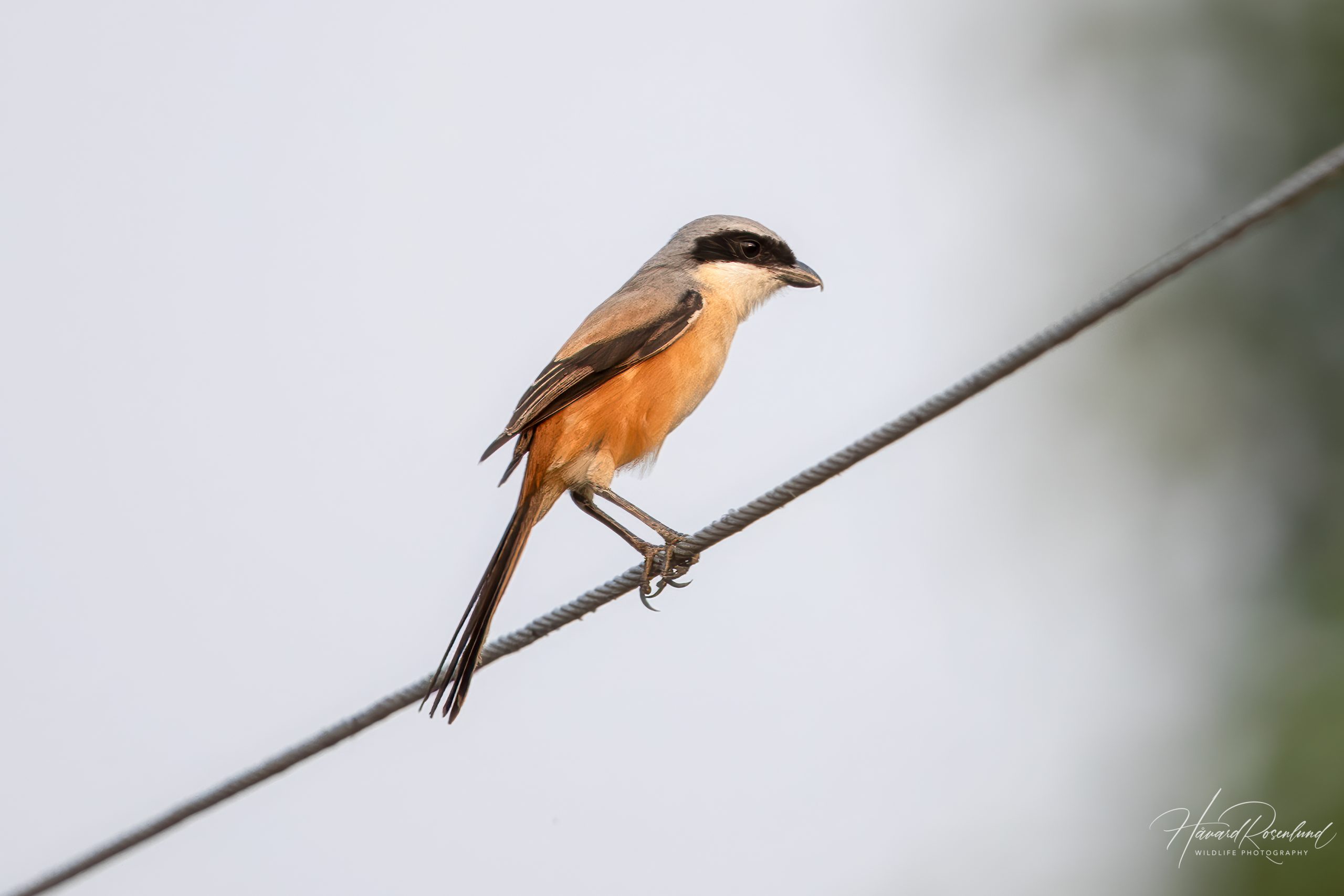
Long-tailed Shrike
Lanius schach
At a glance
Habitat
- Open farmland, scrub, grassland, forest edge and other open habitats with scattered bushes, trees or posts
Diet
- Mainly large insects, but also small reptiles, mammals, birds and other vertebrates
Activity
- Diurnal
Size
- Length: ~25–28 cm Weight: ~30–50 g
Range
- From southern Central Asia and the Himalayas through South, East and Southeast Asia to the Philippines and eastern New Guinea; resident or locally migratory depending on population
Description
The long-tailed shrike (Lanius schach) is a large and distinctive shrike found across a broad part of Asia. Its range extends from southern Central Asia and the Himalayas east through China and south through South and Southeast Asia to the Philippines and eastern New Guinea. Adults are about 25–28 cm long, much of that length made up by the graduated tail, and weigh roughly 30–50 g. Most forms combine a black facial mask, grey head, warm rufous back, pale underparts and a long black tail with white in the outer feathers.
Appearance varies considerably across the range. Some populations are much darker, including almost entirely black birds in parts of Southeast Asia. A breeding study from Guangdong, China, published in 2009 found no meaningful differences between black and brown birds in egg characteristics, nestling development or parental behaviour; adults also accepted eggs and young that researchers exchanged between the two colour forms. This supports treating the black birds as a colour morph within the species rather than a separate species.
Habitat
Long-tailed shrikes are birds of open and semi-open landscapes. They occur in farmland, grassland, scrub, open woodland, forest edges, village outskirts and other habitats where low vegetation is broken by bushes, trees, fences or wires that can be used as lookout posts.
These small landscape features can matter. A large 2023 study of rice-growing landscapes in the central plains of Thailand found higher densities of long-tailed shrikes where field margins were more extensive, while densities declined with increasing urbanisation. The species is adaptable, but it still benefits from open habitat that retains natural edges and scattered hunting perches.
Diet
Large insects make up much of the diet, especially grasshoppers, crickets, beetles and other conspicuous prey. Long-tailed shrikes also take spiders, lizards, frogs, small rodents, young birds and other small vertebrates when the opportunity arises.
Behaviour
Long-tailed shrikes usually hunt from exposed perches, watching the ground and surrounding vegetation before dropping or flying out to seize prey. One of their most characteristic behaviours is impaling prey on thorns, sharp twigs or barbed wire. The impaled prey can be held firmly while pieces are torn off and may also be stored for later. Because shrikes lack the powerful feet of true birds of prey, fixing prey to a sharp object gives them a practical way to handle animals that would otherwise be difficult to tear apart.
They are conspicuous and territorial birds and spend long periods on exposed posts, wires and treetops, where they watch for both prey and rivals. Outside the breeding season they are generally seen alone rather than in flocks.
Migration
Long-tailed shrikes are resident across much of their range, but some populations make seasonal or shorter-distance movements. In India, both resident birds and birds that migrate within the country occur. The species therefore has no single migration pattern.
Breeding
The breeding season varies across the very large range. Pairs defend breeding territories. The nest is a sturdy cup built in a bush or small tree from twigs, grass and other plant fibres and lined with softer material. Clutches usually contain three to six eggs. The female performs most of the incubation, which lasts around 13–16 days, while both parents feed the chicks. The young usually leave the nest after around 20 days but remain dependent on their parents for some time after fledging.
In parts of South Asia, long-tailed shrikes are regular hosts of the Asian koel (Eudynamys scolopaceus), a brood parasite that lays its eggs in the nests of other birds. A study published in 2020, based on nine breeding seasons in central Bangladesh, found that the risk of koel parasitism was higher closer to fruit trees. In long-tailed shrikes, this was also associated with lower nesting success near fruit trees. Brood parasitism therefore adds another risk to breeding success alongside ordinary nest predation.
Status
The long-tailed shrike is classified as least concern globally on the IUCN Red List and remains very widespread. In India, the 2025 update from State of India’s Birds estimates a long-term decline of about 16%, while the trend in recent years has been approximately stable.
The species can tolerate farmland and other modified landscapes, but intensive land use that removes field margins, scrub and scattered vegetation can reduce habitat quality. Open landscapes that retain these features provide both hunting perches and areas rich in prey.
Image gallery
Loading map and observations…
Have you seen this species?
Independent species archive
Did you find this species page useful?
Wildlife Vagabond is independently built and maintained. Voluntary support helps cover hosting, maps, data storage and continued improvements to the species archive.
Support Wildlife VagabondSpecies content will remain freely available.
References
Information about the species’ global distribution and status is based primarily on global Red List data. See the references below for details.
- Angkaew, R., Ngoprasert, D., Powell, L. A., Limparungpatthanakij, W., Round, P. D., & Gale, G. A. (2023). Variation in avian responses to rice intensification in the central plains of Thailand guides conservation opportunities. Biological Conservation, 286, 110307. https://doi.org/10.1016/j.biocon.2023.110307
- BirdLife International. (n.d.). Long-tailed Shrike species factsheet. https://datazone.birdlife.org/species/factsheet/long-tailed-shrike-lanius-schach
- Cornell Lab of Ornithology. (n.d.). Birds of the World – Long-tailed Shrike. https://birdsoftheworld.org/bow/species/lotshr1/cur/introduction
- Huang, J.-W., Zhao, S.-Y., Lin, Y.-Z., Yang, L., Chen, Y.-Z., Tang, S.-X., & Hu, H.-J. (2009). Comparison of Breeding Ecology Between Two Color Morphs of <i>Lanius schach</i>. Zoological Research, 30(3), 288-294. https://doi.org/10.3724/SP.J.1141.2009.03288
- International Union for Conservation of Nature. (n.d.). Long-tailed Shrike. The IUCN Red List of Threatened Species. https://www.iucnredlist.org/species/22705029/93997036
- Nahid, M. I., Fossøy, F., Stokke, B. G., Begum, S., Røskaft, E., & Ranke, P. S. (2020). How does human disturbance affect brood parasitism and nest predation in hosts inhabiting a highly fragmented landscape? Global Ecology and Conservation, 24, e01295. https://doi.org/10.1016/j.gecco.2020.e01295
- State of India's Birds. (n.d.). Long-tailed Shrike. https://stateofindiasbirds.in/species/lotshr1/