
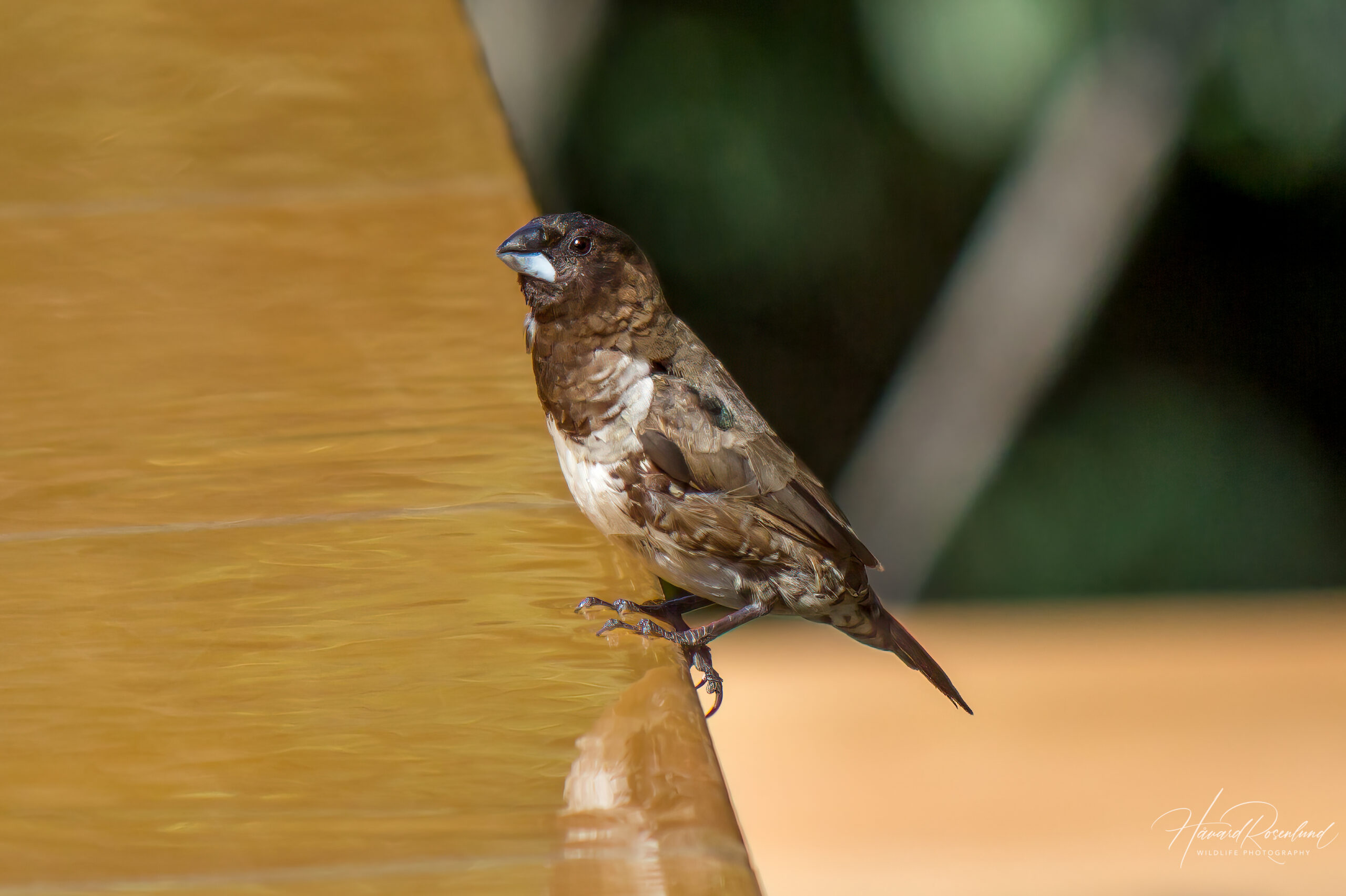
Bronze Mannikin
Spermestes cucullata
At a glance
Habitat
- Grassy savanna, woodland and thicket edges, gardens and cultivated areas near water
Diet
- Mostly grass seeds and grains; occasional insects and other small foods
Activity
- Diurnal
Size
- Length: 9–10 cm Weight: 7.7–11.8 g
Range
- Widespread across sub-Saharan Africa, especially in moister savannas and forest-edge habitats
Description
The bronze mannikin (Spermestes cucullata) is a tiny estrildid finch widespread across sub-Saharan Africa. Adults are about 9–10 cm long and weigh roughly 7.7–11.8 g. The sexes look alike: the head, throat and upper breast are dark brown to blackish, the back and wings are brown, and the underparts are largely white with darker barring along the flanks. A small metallic green-bronze patch on the shoulder can catch the light. Juveniles are much plainer, with buff-brown plumage and little of the adult contrast.
Where it occurs alongside the larger magpie mannikin (Spermestes fringilloides), the bronze mannikin is smaller and shorter-billed and shows a barred rump rather than the magpie mannikin's cleaner black-and-white pattern. Older literature often placed the species in Lonchura as Lonchura cucullata; it is now placed in Spermestes.
Habitat
Bronze mannikins favour grassy habitats with scattered shrubs or trees, including moist savanna, woodland and thicket edges, cultivated land and suburban gardens. They readily occupy disturbed and human-modified landscapes where grass seed, cover and drinking water remain available.
Water is an important part of daily habitat use. Flocks frequently visit drinking sites, especially toward evening before moving into dense vegetation or other sheltered places to roost.
Diet
The diet is dominated by grass seeds and other small seeds and grains. Some insects are also eaten, especially when young are being fed. Gardens, agricultural edges and bird-feeding areas can supplement natural seed sources.
Bronze mannikins take seeds both directly from seed heads and from the ground. The short, stout bill is well suited to handling small hard seeds, and birds move readily between standing seeding grasses and fallen seed on open patches.
Social behaviour
Bronze mannikins are highly social and are usually encountered in small, active flocks, sometimes mixed with other estrildid finches. Flock members forage, drink and roost in close association and maintain contact with frequent high-pitched calls.
A study published in 2009 from Durban, South Africa, found that alarm calls vary with predator size and that familiar flockmates respond more effectively to one another than birds placed into unfamiliar mixed groups. Familiarity among flock members therefore has a clear effect on how effectively the group communicates danger.
In winter, flocks of up to around 30 birds may huddle together in communal roosting nests. A study published in 2002 found that the birds huddled when cold-stressed and that dominant individuals more often occupied central positions. Close body contact reduces heat loss and can be especially valuable for such small birds on cold nights.
Breeding
Breeding timing varies across the large range and is generally linked to rainfall and food availability; in southern Africa breeding can extend from about August into May. The male collects nesting material and the female does most of the actual construction. The resulting nest is an untidy ball of grass and other plant fibres, usually placed in a bush, tree or suitable human structure.
Clutches contain two to eight eggs. Both parents incubate for about 12–16 days and both feed the young. Young leave the nest after roughly 15–21 days and remain dependent on the adults for several more weeks. Family members may continue to associate closely after fledging, fitting the species' strongly social way of life.
Introduced populations
Bronze mannikins have become established outside their native range through introductions and escapes. A long-established population occurs in Puerto Rico, while a more recent population in Cape Town, South Africa, appears to have originated around Rondebosch in about 2015 before spreading through neighbouring southern suburbs. This shows how readily a small social seed-eater can settle where grass seed, water and dense garden vegetation are readily available.
Status
The bronze mannikin is classified as least concern on the IUCN Red List. It has an extensive sub-Saharan range, is common in many regions and readily uses gardens, farmland and other modified habitats.
Its broad diet of small seeds and ability to live close to people make it resilient in many landscapes. Local numbers can nevertheless shift with rainfall, seed availability and access to water, especially in seasonally dry parts of the range.
Image gallery
Loading map and observations…
Have you seen this species?
Independent species archive
Did you find this species page useful?
Wildlife Vagabond is independently built and maintained. Voluntary support helps cover hosting, maps, data storage and continued improvements to the species archive.
Support Wildlife VagabondSpecies content will remain freely available.
References
Information about the species’ global distribution and status is based primarily on global Red List data. See the references below for details.
- Biodiversity and Development Institute. (n.d.). Bronze Mannikin (Spermestes cucullata). https://thebdi.org/2022/03/23/bronze-mannikin-spermestes-cucullata/
- BirdLife International. (n.d.). Bronze Mannikin species factsheet. https://datazone.birdlife.org/species/factsheet/bronze-mannikin-spermestes-cucullata
- BirdLife South Africa. (n.d.). BirdLife South Africa – Checklist of Birds in South Africa 2025. https://www.birdlife.org.za/wp-content/uploads/2025/03/BLSA-Checklist-2025-v4.pdf
- International Union for Conservation of Nature. (n.d.). Bronze Mannikin. The IUCN Red List of Threatened Species. https://www.iucnredlist.org/species/22719782/94643856
- Malan, G., Seoraj-Pillai, N., & du Plessis, M. A. (2009). Alarm calls of Bronze Mannikins communicate predator size to familiar conspecifics. Ostrich, 80(3), 177-184. https://doi.org/10.2989/OSTRICH.2009.80.3.8.971
- Store norske leksikon. (n.d.). Bronsemannikin. https://snl.no/bronsemannikin
- Zootierliste. (n.d.). Bronze Mannikin. https://www.zootierliste.de/en/index.php?art=2222752&familie=250151&klasse=2&ordnung=250