
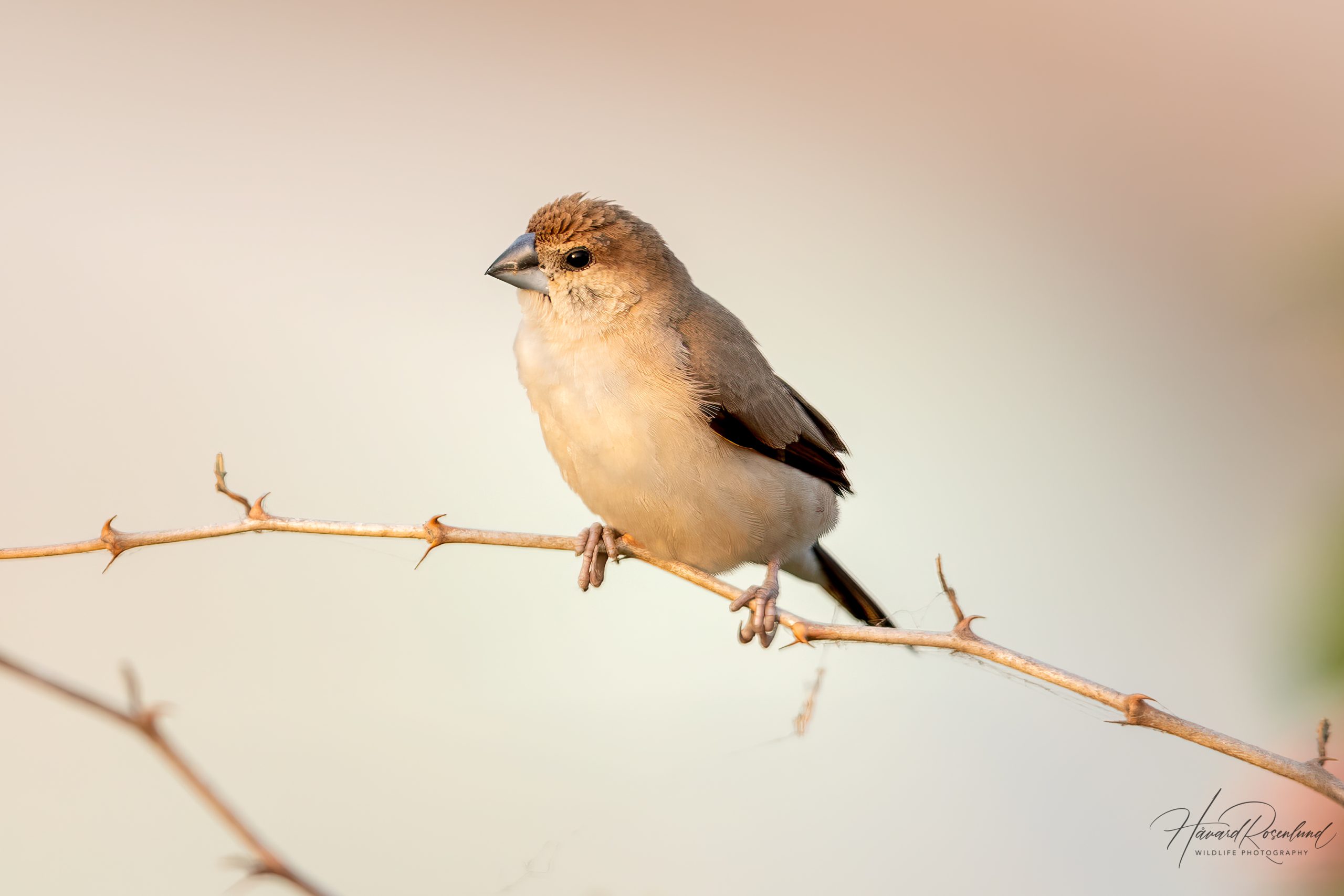
Indian Silverbill
Euodice malabarica
At a glance
Habitat
- Dry open country, scrub, grassland, farmland, villages and gardens
Diet
- Mainly grass and crop seeds; also small insects and occasional nectar
Activity
- Diurnal
Size
- Length: 11–11.5 cm Weight: 10–14 g
Range
- South Asia and parts of the Middle East; introduced populations occur in several other regions
Description
The Indian silverbill (Euodice malabarica), also known as the white-throated munia, is a small estrildid finch about 11–11.5 cm long and roughly 10–14 g in weight. Its stout silver-grey bill contrasts with warm buff-brown upperparts, whitish underparts and rump, dark wings and a pointed black tail.
The sexes look alike. Juveniles are duller and browner below and have a shorter tail. The pale rump and throat, pointed dark tail and heavy pale bill make the species fairly distinctive within most of its range.
Habitat
Indian silverbills favour dry open country, scrub, semidesert, grassland, fallow fields and cultivation. They also enter villages, gardens and other lightly built-up areas where seeding grasses, water and dense shrubs are available.
The species is primarily an open-habitat bird of lowlands rather than dense forest. It readily uses agricultural and semi-urban landscapes where suitable feeding and nesting vegetation remains.
Diet
Grass seeds and grain from cultivated plants form most of the diet. Birds feed on the ground, climb grass stems to reach seed heads and gather around spilled grain or other concentrated food.
Small insects are also taken, particularly when raising young, and nectar is used occasionally. The thick conical bill is well suited to cracking and husking small seeds.
Behaviour
Indian silverbills are highly social and usually occur in pairs or flocks, sometimes numbering several dozen birds. Flock members keep in contact with soft chirping calls while feeding and commonly gather at water.
Most populations are resident, but birds make local and seasonal movements when seed or water becomes scarce. Outside breeding, old nests may be used as communal roosts.
Breeding
Breeding timing varies strongly with region: southern Indian birds often breed in winter, while northern populations breed mainly after summer. Both adults build a loose ball-shaped nest of grass with a side entrance, usually in a thorny shrub, tree or human-made structure. Abandoned woven nests of other birds, especially weavers, can also be used.
A clutch usually contains four to eight white eggs, and both parents incubate for about eleven days before feeding the chicks after hatching. A study published in 1983 documented intraspecific nest parasitism, with females laying eggs in nests belonging to other Indian silverbill pairs. The study suggested that competition for suitable abandoned weaver nests may help explain this behaviour.
Introduced populations
Escaped and released cagebirds have established populations beyond the natural range in several parts of the world. The origin of some Middle Eastern populations is difficult to separate cleanly between natural expansion and human-assisted establishment.
A study published in 2025 documented the first confirmed breeding in Italy at Sanremo. A recently fledged juvenile was recorded there in October 2023, and in October 2024 two adults and two recently fledged young were observed at the same site. The ecological effects of introduced populations remain poorly documented and are likely to differ between regions.
Status
The Indian silverbill is classified as least concern on the IUCN Red List. It remains widespread and common across much of its natural range and uses a variety of open and human-modified landscapes.
State of India's Birds classifies the species as Low Priority nationally. Its 2025 update estimates almost no long-term national change (+0.25%) and a small recent decline of about 0.38% per year, but both estimates are too uncertain to establish a clear trend.
Image gallery
Loading map and observations…
Have you seen this species?
Independent species archive
Did you find this species page useful?
Wildlife Vagabond is independently built and maintained. Voluntary support helps cover hosting, maps, data storage and continued improvements to the species archive.
Support Wildlife VagabondSpecies content will remain freely available.
References
Information about the species’ global distribution and status is based primarily on global Red List data. See the references below for details.
- AviList. (n.d.). v2025 – Euodice malabarica. https://www.avilist.org/
- BirdLife International. (n.d.). Indian Silverbill (Euodice malabarica) species factsheet. https://datazone.birdlife.org/species/factsheet/indian-silverbill-euodice-malabarica
- Carta, E., Zucchetti, E. F., Valfiorito, R., & Alberti, N. (2025). The Indian Silverbill <i>Euodice malabarica</i>: a new exotic breeding species for the Italian avifauna? Rivista Italiana di Ornitologia, 95(1). https://doi.org/10.4081/rio.2024.853
- Dhindsa. (1983). Intraspecific nest parasitism in the White-throated Munia. https://www.birdsnz.org.nz/wp-content/uploads/2022/06/Notornis_30_2-1983-pp87-92.pdf
- eBird. (n.d.). Indian Silverbill. Cornell Lab of Ornithology. https://ebird.org/species/indsil
- International Union for Conservation of Nature. (n.d.). Euodice malabarica. The IUCN Red List of Threatened Species. https://www.iucnredlist.org/species/22719770/131997686
- State of India's Birds. (2025). State of India’s Birds (2025 update) – Indian Silverbill. https://stateofindiasbirds.in/species/dd-indsil/