
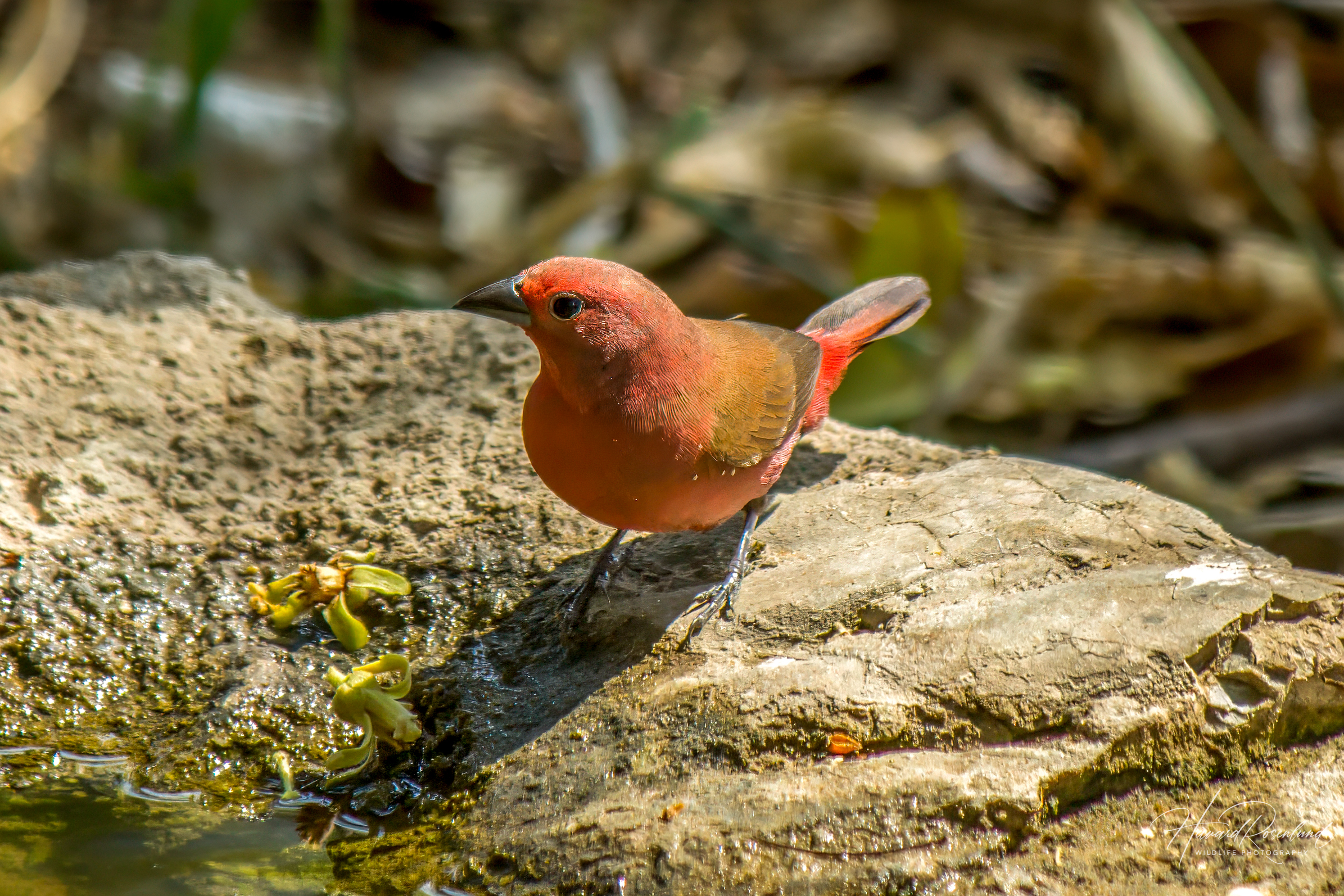
Jameson’s Firefinch
Lagonosticta rhodopareia
At a glance
Habitat
- Woodland edge, scrub, rank grass, riverine vegetation and cultivated land
Diet
- Mainly small grass seeds; also insects and other small invertebrates
Activity
- Diurnal
Size
- Length: 10–11 cm Weight: about 9 g
Range
- Patchily distributed from East Africa through central and southern Africa
Description
Jameson’s firefinch (Lagonosticta rhodopareia) is a small estrildid finch found in scattered populations across eastern, central and southern Africa. It measures about 10–11 cm and weighs around 9 g.
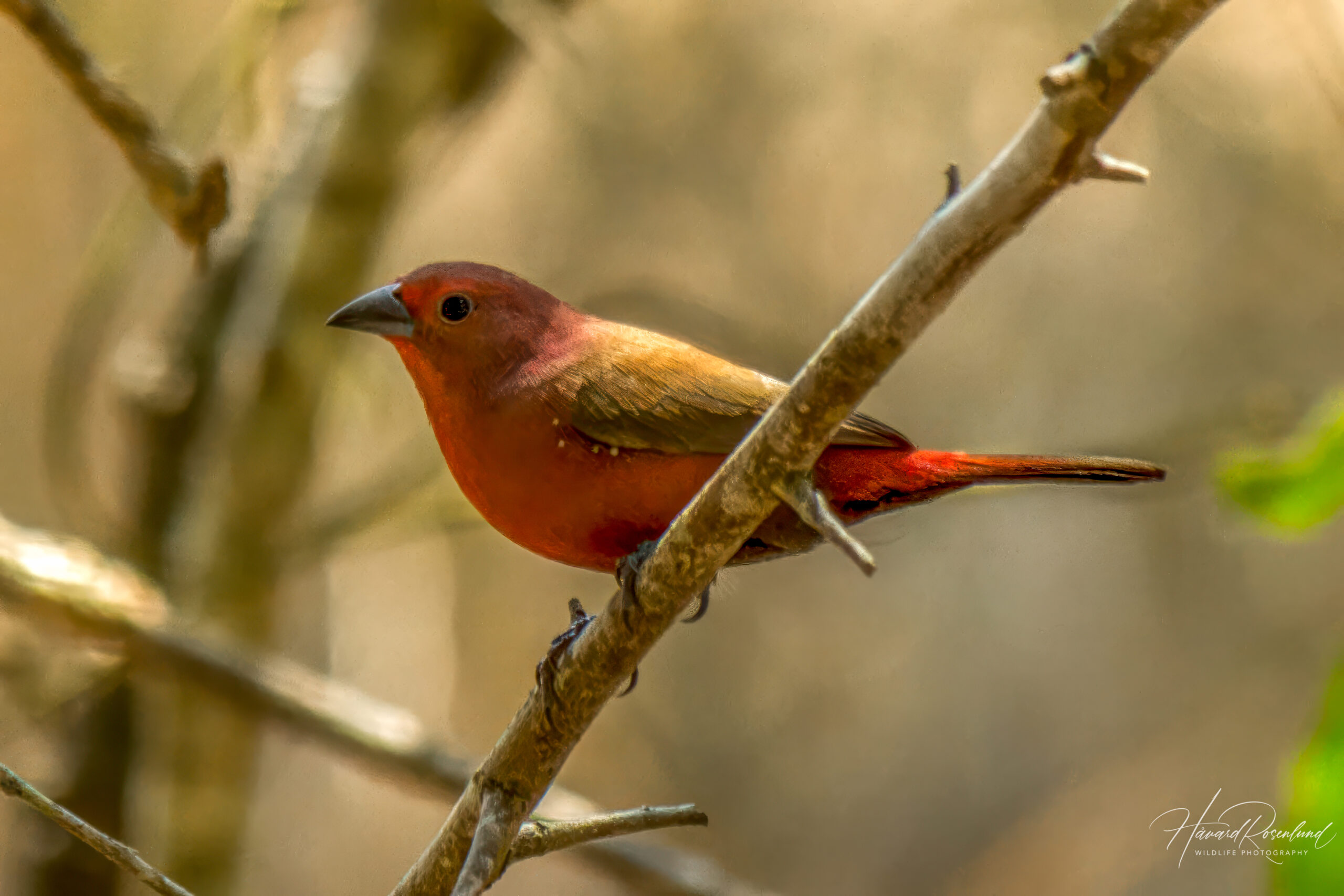
The male is soft pinkish red over much of the head and underparts, with browner upperparts, dark wings and a black tail and undertail. The female is duller, with a browner head and back and paler pink or orange-red underparts. Juveniles resemble females but are still less colourful.
The species can be extremely similar to African firefinch (Lagonosticta rubricata). Jameson’s is usually paler and pinker, with black under the tail and a blue-grey bill, although identification can be difficult where the ranges meet.
Habitat
Jameson’s firefinches inhabit woodland and scrub with patches of tall grass, riverine forest edge, bushy savanna and cultivated land. In drier landscapes they are often associated with streams, seepages or other reliable water sources.
Diet
Small grass seeds dominate the diet, supplemented by insects and other small invertebrates, particularly during breeding.
Most seeds are collected from the ground or picked directly from grass seed heads. Small invertebrates are taken from low vegetation, and flying insects are occasionally caught in short sallies.
Behaviour
Jameson’s firefinches are usually seen in pairs or small groups and tend to remain close to dense cover. At good feeding sites they may join loose mixed flocks with other small seed-eating finches.
They are mainly active by day and often make short movements between feeding patches, cover and water rather than remaining exposed for long periods.
Breeding
Breeding can occur throughout the year in southern Africa, with egg-laying peaking from December to April. Both adults build an oval nest of dry grass with a side entrance, usually hidden low in dense vegetation. The inner chamber is lined with soft grass inflorescences and feathers.
The clutch contains two to seven eggs. Both parents incubate for roughly 12–15 days and feed the chicks. The young leave the nest after approximately 16–19 days and remain dependent for around another two weeks.
Brood parasitism
Jameson’s firefinch is the specialist host of the purple indigobird (Vidua purpurascens). The parasite lays its eggs in firefinch nests, and its chicks are raised alongside the host’s own young rather than eliminating them.
A study published in 2020 showed how precisely purple indigobird nestlings mimic Jameson’s firefinch chicks. They closely match the host’s colourful mouth markings, begging calls and parts of the begging movements, helping the parasite receive food from the foster parents alongside their own young.
Status
Jameson’s firefinch is classified as least concern on the IUCN Red List, based on the BirdLife assessment published in 2016. The distribution is patchy, especially in the north, but the species is locally common in suitable habitat.
No current global population estimate is available, and no major range-wide threat has been identified.
Image gallery
Loading map and observations…
Have you seen this species?
Independent species archive
Did you find this species page useful?
Wildlife Vagabond is independently built and maintained. Voluntary support helps cover hosting, maps, data storage and continued improvements to the species archive.
Support Wildlife VagabondSpecies content will remain freely available.
References
Information about the species’ global distribution and status is based primarily on global Red List data. See the references below for details.
- Avibase. (n.d.). Lagonosticta rhodopareia: taxonomy, subspecies and distribution. https://avibase.bsc-eoc.org/species.jsp?avibaseid=871F32D9B5572594
- BirdLife International. (n.d.). Jameson’s Firefinch Lagonosticta rhodopareia species factsheet. https://datazone.birdlife.org/species/factsheet/jamesons-firefinch-lagonosticta-rhodopareia
- International Union for Conservation of Nature. (2016). Lagonosticta rhodopareia. The IUCN Red List of Threatened Species. https://www.iucnredlist.org/species/103812687/94629339
- Jamie, G. A., Van Belleghem, S. M., Hogan, B. G., Hamama, S., Moya, C., Troscianko, J., Stoddard, M. C., Kilner, R. M., & Spottiswoode, C. N. (2020). Multimodal mimicry of hosts in a radiation of parasitic finches*. Evolution, 74(11), 2526-2538. https://doi.org/10.1111/evo.14057
- Payne, R. B. (2020). Jameson's Firefinch (Lagonosticta rhodopareia). Birds of the World. https://doi.org/10.2173/bow.jamfir1.01
- Péron, G., Altwegg, R., Jamie, G. A., & Spottiswoode, C. N. (2016). Coupled range dynamics of brood parasites and their hosts responding to climate and vegetation changes. Journal of Animal Ecology, 85(5), 1191-1199. https://doi.org/10.1111/1365-2656.12546