
Snow Bunting
Plectrophenax nivalis
At a glance
Habitat
- Arctic tundra, rocky slopes, scree and exposed high mountains when breeding; open coasts and fields in winter
Diet
- Seeds and other plant material outside breeding; insects and spiders become especially important for chicks
Activity
- Diurnal, with activity extending through the long Arctic daylight
Size
- Length: 15–17 cm; wingspan about 30–32 cm Weight: about 30–40 g
Range
- Circumpolar Arctic when breeding; winters farther south across northern Europe, Asia and North America
Description
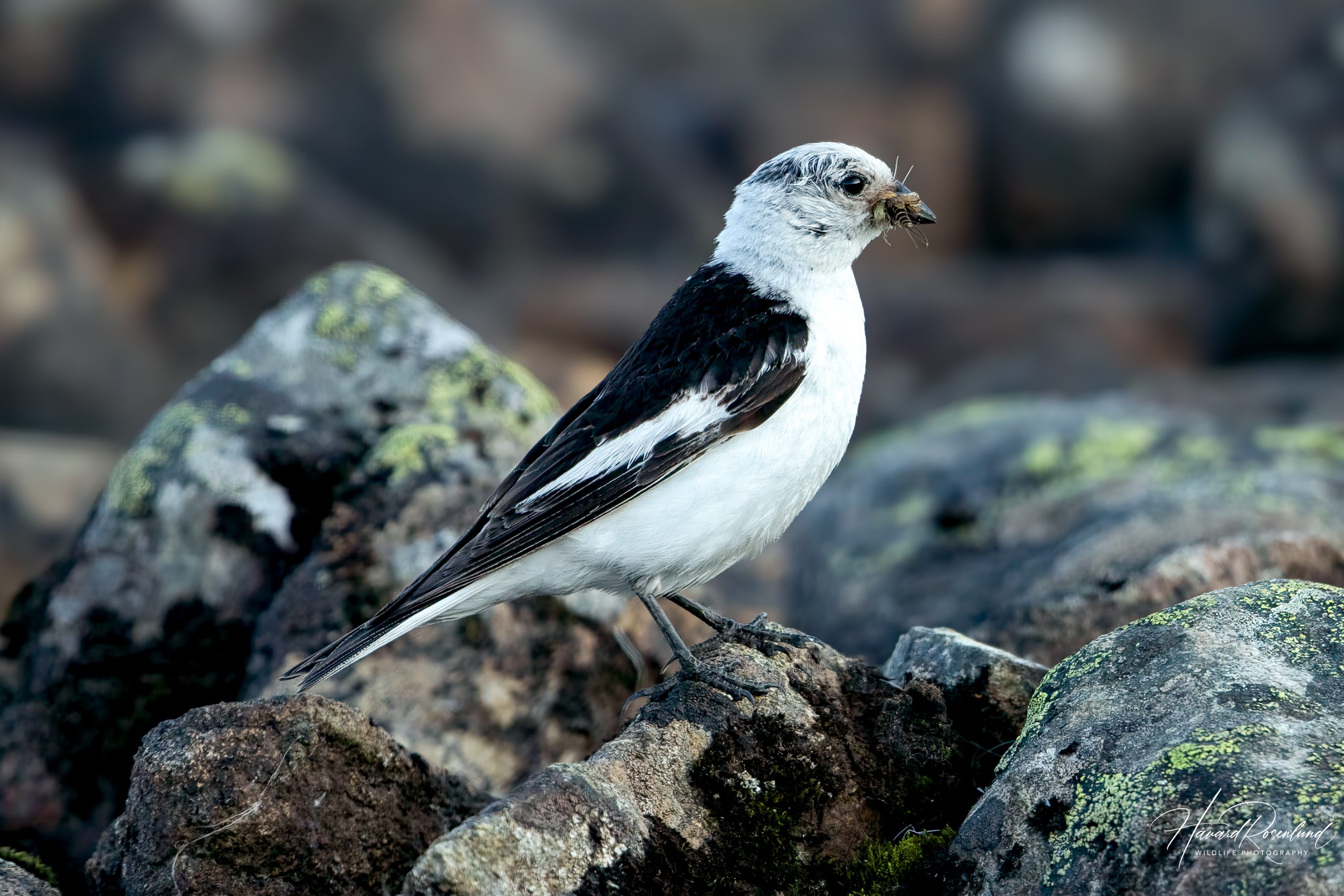
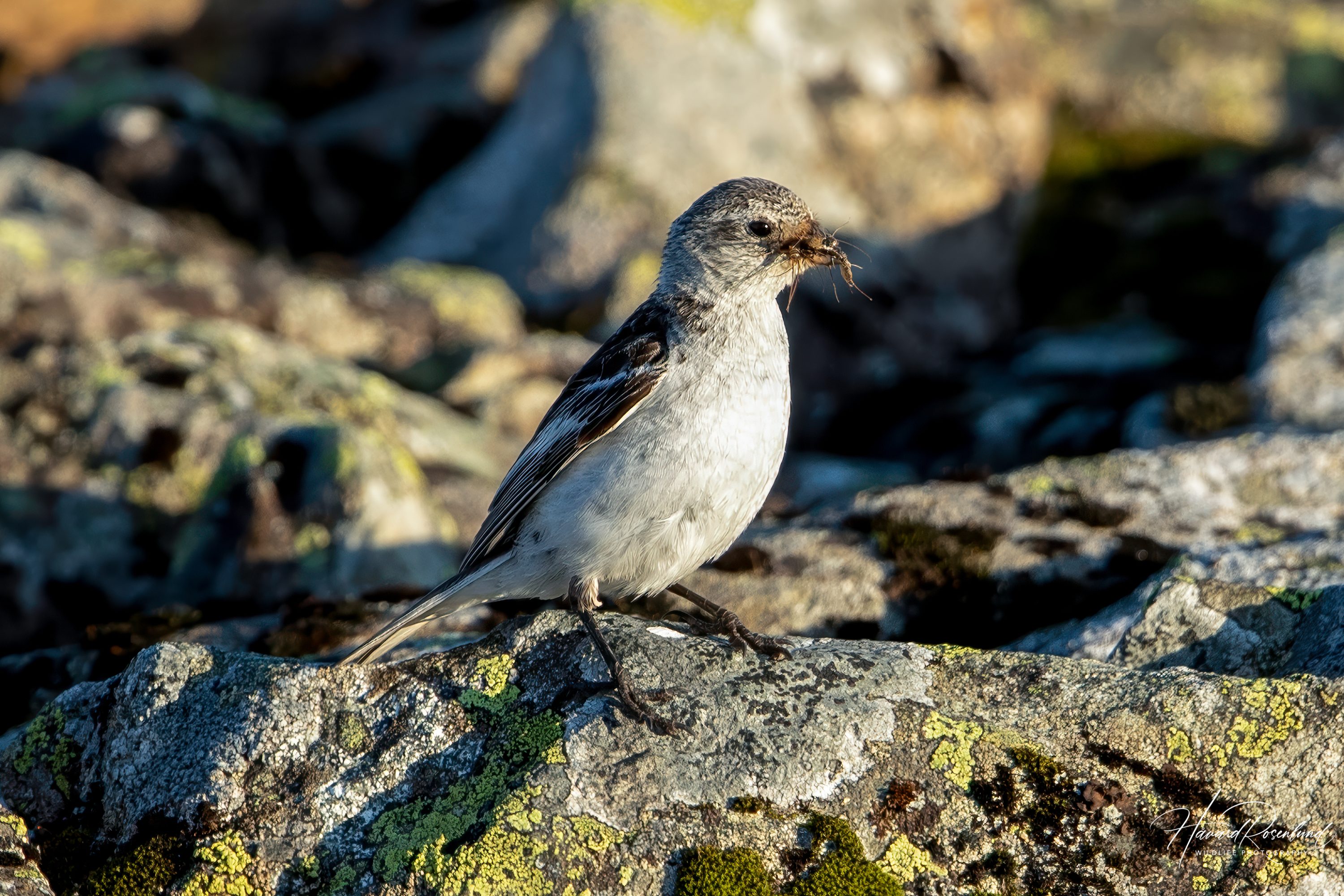
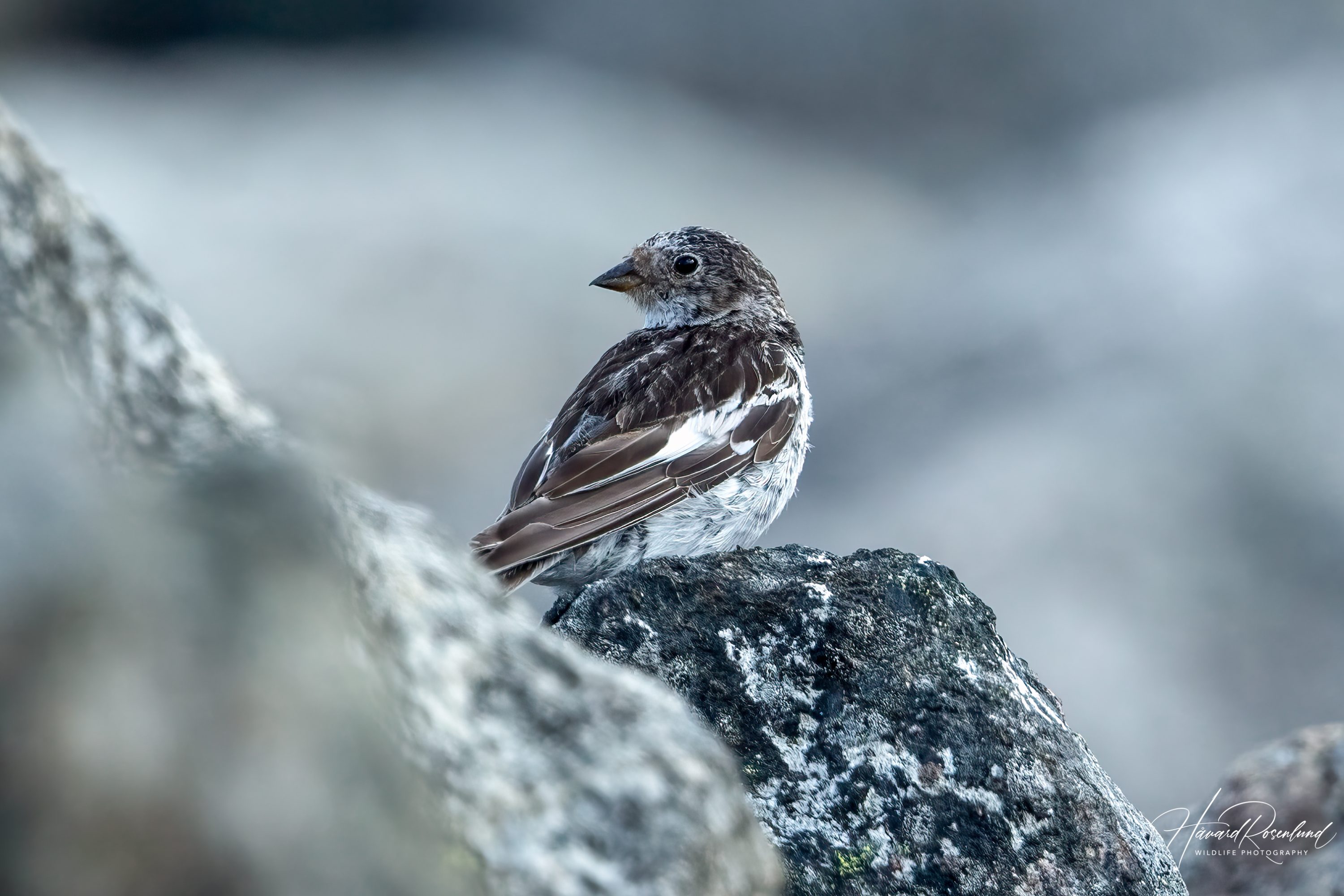
The snow bunting (Plectrophenax nivalis) is a compact Arctic songbird about 15–17 cm long and 30–40 g in weight. In breeding plumage, males are strikingly white with sharply contrasting black on the back, wings and tail, while females retain more brown and grey. Winter plumage is warmer and more buff-coloured in both sexes.
The return to the crisp spring pattern is unusual: much of the brown winter feather edging simply wears away rather than being replaced in a complete spring moult. The short conical bill, long pointed wings and extensive white in flight are useful identification features. The species belongs to Calcariidae, the family that also contains longspurs, rather than to the true buntings in Emberizidae.
Habitat
Snow buntings breed in open, treeless landscapes where cavities are available for nesting: rocky tundra, scree, cliffs, boulder fields, stony mountain slopes and Arctic settlements. They occur farther north than any other regularly breeding passerine and can nest from sea level in the High Arctic to high alpine terrain farther south.
Outside breeding, the species moves into exposed open country such as coastal strandlines, dunes, short grassland, farmland, roadsides and windswept fields. Shallow or broken snow cover exposes seeds and bare ground for feeding.
Diet
Seeds from grasses, sedges and other low plants dominate much of the autumn and winter diet. Birds forage mostly on the ground, running over open surfaces and picking food from vegetation, soil, snow margins and windblown debris.
During breeding, insects and spiders become much more important, especially for rapidly growing chicks. A 2023 DNA study of nestlings on Svalbard detected 31 arthropod taxa and showed that the prey delivered by adults changed through the season in step with local arthropod emergence. Flies were the dominant prey group, with different species becoming important as the Arctic summer progressed.
Behaviour
Snow buntings are exceptionally well adapted to cold, exposed landscapes. They spend much of their time on the ground and usually run rather than hop while feeding. Outside breeding they form mobile flocks that repeatedly lift, wheel and settle as they search open ground for seeds.
Males return to breeding areas about three to four weeks before females, often while snow still dominates the landscape and temperatures remain below freezing. Early arrival gives them access to scarce nest cavities but also exposes them to severe weather. Once back on the breeding grounds, males sing and make conspicuous song flights over their territories, while both sexes become increasingly tied to the nesting area as breeding approaches.
Migration
Snow buntings are strongly migratory across most of their range, but routes differ among populations. Birds move south from Arctic breeding areas in autumn and return very early in spring, often before snowmelt has begun.
A study published in 2018 tracked 12 snow buntings from Svalbard. All wintered on the western Eurasian steppe, and 11 made autumn landfall on Novaya Zemlya after an open-water crossing of at least about 1,100 km. Routes varied between individuals and years, while the timing of the major long-distance movements was relatively consistent.
Svalbard snow buntings therefore spend winter in another cold, exposed environment, using extensive grasslands and croplands in Russia and Kazakhstan where seeds remain available.
Breeding
Breeding begins soon after the early return to Arctic and alpine nesting areas. Snow buntings place nests deep in rock crevices, cavities between boulders, walls and other sheltered holes. Such sites protect the nest from wind and many predators but can remain cold, and the male regularly brings food to the incubating female.
Clutches contain two to seven eggs. The female incubates for about 10–15 days, and both parents feed the nestlings, which remain in the cavity for roughly 9–15 days after hatching.
A 15-year study on Svalbard found strong links between breeding and both local weather and the Arctic Oscillation. Egg laying began earlier in warmer springs, while regional winter and summer conditions were associated with fledging success and nestling body mass. The results show how strongly reproduction in this High Arctic population is tied to seasonal climate.
Status
The snow bunting is classified as least concern on the IUCN Red List. Its circumpolar range is enormous, but population trajectories differ among regions and monitoring remains sparse across much of the Arctic.
Regional declines can nevertheless be substantial. A study published in 2026 using monitoring from Iceland found a significant long-term decline in breeding pairs on Flatey from 1975 to 2023, while long-term capture data also provided the first estimates of adult survival for Icelandic snow buntings.
Image gallery
Loading map and observations…
Have you seen this species?
Independent species archive
Did you find this species page useful?
Wildlife Vagabond is independently built and maintained. Voluntary support helps cover hosting, maps, data storage and continued improvements to the species archive.
Support Wildlife VagabondSpecies content will remain freely available.
References
Information about the species’ global distribution and status is based primarily on global Red List data. See the references below for details.
- AviList. (n.d.). v2025 – Global avian checklist. https://www.avilist.org/
- BirdLife International. (n.d.). Snow Bunting (Plectrophenax nivalis) species factsheet. https://datazone.birdlife.org/species/factsheet/snow-bunting-plectrophenax-nivalis
- Cornell Lab of Ornithology. (n.d.). Snow Bunting life history and identification. https://www.allaboutbirds.org/guide/Snow_Bunting/lifehistory
- Fossøy, F., Stokke, B. G., Kåsi, T. K., Dyrset, K., Espmark, Y., Hoset, K. S., Wedege, M. I., & Moksnes, A. (2015). Reproductive success is strongly related to local and regional climate in the Arctic snow bunting (Plectrophenax nivalis). Polar Biology, 38(3), 393-400. https://doi.org/10.1007/s00300-014-1595-6
- International Union for Conservation of Nature. (n.d.). Plectrophenax nivalis. The IUCN Red List of Threatened Species. https://www.iucnredlist.org/species/22721043/137359271
- Snell, K. R. S., Stokke, B. G., Moksnes, A., Thorup, K., & Fossøy, F. (2018). From Svalbard to Siberia: Passerines breeding in the High Arctic also endure the extreme cold of the Western Steppe. PLOS ONE, 13(9), e0202114. https://doi.org/10.1371/journal.pone.0202114
- Stolz, C., Varpe, Ø., Ims, R. A., Sandercock, B. K., Stokke, B. G., & Fossøy, F. (2023). Predator–prey interactions in the Arctic: DNA metabarcoding reveals that nestling diet of snow buntings reflects arthropod seasonality. Environmental DNA, 5(6), 1234-1251. https://doi.org/10.1002/edn3.439
- Thorstensen, S., Petersen, A., Mallory, M., Robertson, G., Calvert, A., & Gutowsky, S. (2026). Adult snow bunting survival and population change from decades of monitoring effort in Iceland. Arctic Science, 12, 1-7. https://doi.org/10.1139/as-2025-0100